A castle, the sea, and the Isle of Mull in the background. Castle Stalker delivers a backdrop that has few equals. And of course it has a bloody history – what else!
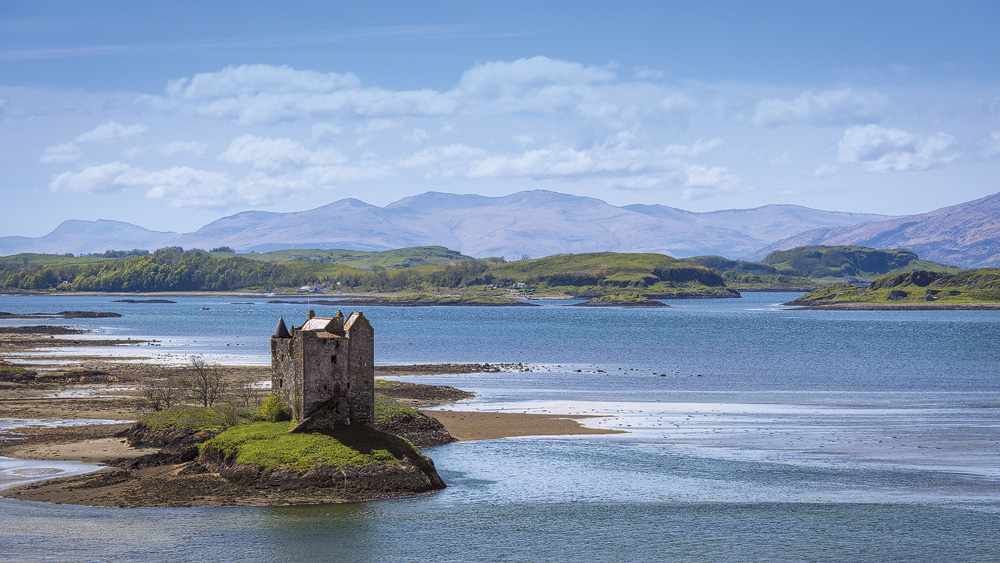
On the eve of battle – Castle Stalker, 1468
There is no forgiving, there is no forgetting. Dugald Stewart paced along the parapet, watching the sun sink behind the mountains of the Isle of Mull. With the last of its rays, it stained the waters of Loch Linnhe blood red.
He had all but forced his enemies into battle. Time and again, Dugald had launched raids on their lands from Castle Stalker. They were not to forget that he was there, that he was growing up, arming himself for this one day of reckoning.
And the day came. He knew the Campbells, the MacFarlanes, and even men of his own uncle would come to settle the matter once and for all. Dugald was ready. On the shore before the castle camped the MacLarens, men of his mother’s clan. They too stood ready to throw themselves into battle for him, just like his own Stewarts.
Here, before Castle Stalker, Dugald would avenge his father tomorrow – or go to his death.
The building of Castle Stalker – 1446
Dugald had good reason to harbour thoughts of revenge. The Campbells and MacFarlanes, together with his own uncle, had been entangled in the murder of his father.
Let’s jump back, then, a good twenty years from the eve of that battle, to the year 1445.
Dugald’s father was John Stewart, second Lord of Lorn. His seat was Dunstaffnage Castle, which he held as steward for the Scottish king. John was a married man, and his wife had already borne him several daughters – but no heir. A son was given to him only through an affair with the daughter of an allied MacLaren clan chief in 1445 – and that son was Dugald.
Dugald was a child born of love, but illegitimate, and therefore, at least initially, a contestable heir. That automatically put him in danger, since too many others had their own hopes pinned on the title of Lord of Lorn. John’s brother Walter Stewart could barely conceal his own greed for it. He would have made short work of an illegitimate son, simply to rule out any potential claim for good. And Colin Campbell, of the clan of the same name, had deliberately married one of John’s daughters in order to press his own claim.
At some point, Dugald and his mother might well need somewhere to retreat to. And so, in 1446, John converted the hunting lodge of Stalcaire into a stately tower house – a true castle. Castle Stalker.
Bride and widow in a single day – 1463
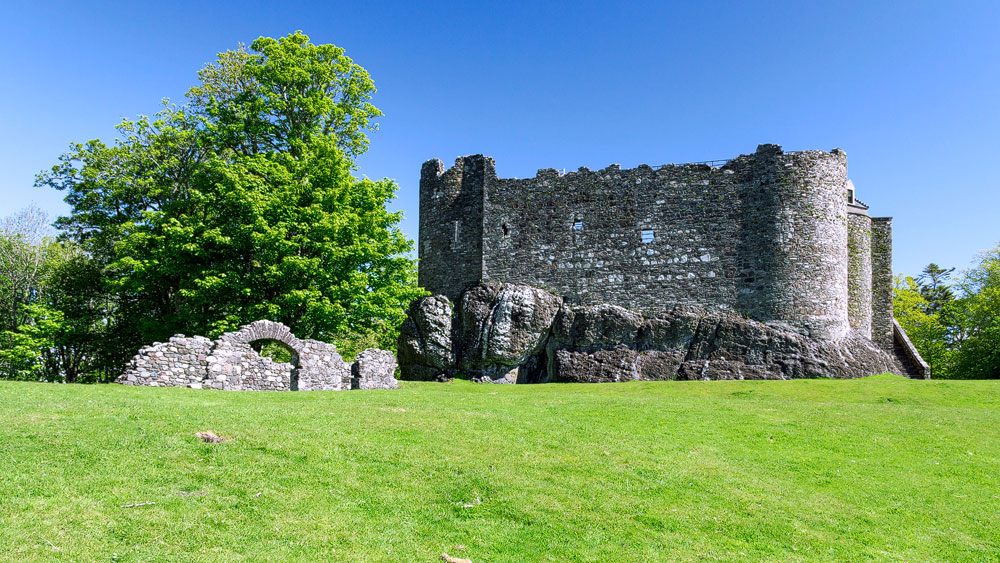
John Stewart had let five years pass since the death of his first wife – a fitting period to signal mourning. Then, at last, he intended to marry Dugald’s mother, ensuring once and for all that there would be no more doubt over his son’s claim to the title and the lands.
The trouble was that his envious rivals wanted precisely to prevent that, and recognised this as their last opportunity. They hired Alan MacCoul – a MacDougall renegade and a reliable hatchet man for the Campbells. A man for the dirty work.
On the short walk between the castle and the chapel at Dunstaffnage, MacCoul ambushed the wedding party and gravely wounded the groom. He nonetheless made it to the chapel and, dying, spoke his vows. And so it was that Dugald’s mother became bride and widow within a matter of minutes, and Dugald the rightful son of the Lord of Lorn. But Dunstaffnage had already been seized by MacCoul, and after a failed siege, the family had to retreat – to Castle Stalker, which they went on to expand further in the years that followed.
And it was there that the drama would meet its end …
Dugald’s revenge at Castle Stalker – 1468
Over the following years, Dugald kept reminding his neighbours of his existence, launching small raids again and again. Eventually, the Campbells and Walter decided to put an end to the troublemaker once and for all, and the two hostile camps clashed on the shores by Castle Stalker.
The fighting was fierce, but in the end Dugald’s men triumphed, all but wiping out Clan MacFarlane. Dugald himself took revenge on his father’s murderer, killing him with his own hands.
Yet he never regained Dunstaffnage or the title. The warring parties agreed that Walter would take on the title instead – who then, within a year, had nothing better to do than hand it over to the Campbells, who rewarded him with fertile land in central Scotland.
Dugald, however, is regarded today as the founding ancestor of the Stewarts of Appin. He died in 1497, fighting against the MacDonalds of Keppoch.
The later history of Castle Stalker
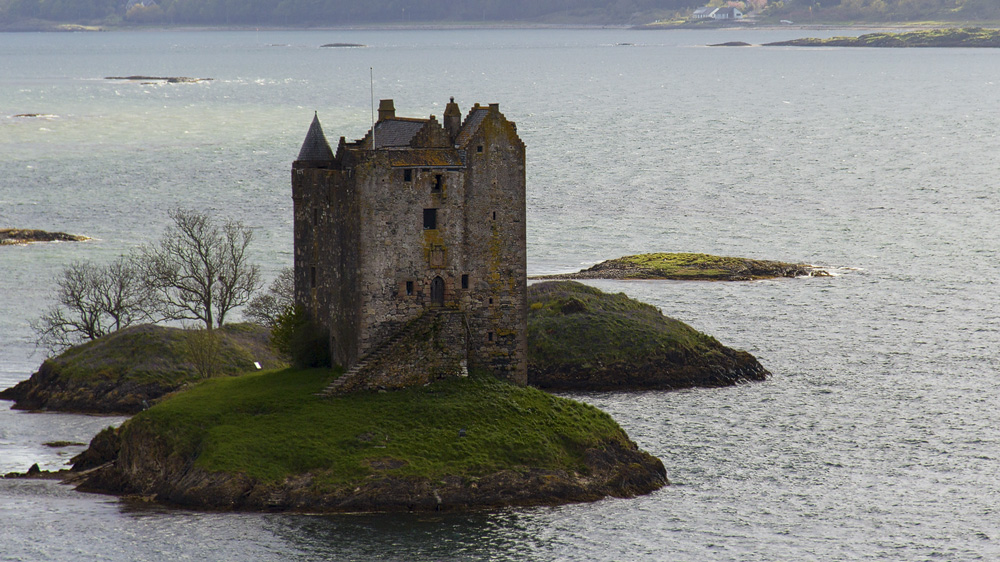
The feud between the Stewarts and the Campbells didn’t end there either in the years that followed. For example, Alexander Stewart of Invernahyle was murdered by Campbells in 1520. His son Donald took revenge 24 years later with a raid on Dunstaffnage, in which he killed nine people.
In 1620, Castle Stalker passed temporarily to Clan Campbell, apparently the result of a bet that its then-owner Duncan Stewart had made while drunk. The castle changed hands between the Stewarts and Campbells twice more before being left to decay around 1800.
In 1908, the Stewarts bought the castle back, and its owners eventually converted it back into a residence at the end of the 20th century.
Today, it can also be visited from the inside by boat, though only on a handful of dates each year.
Know: Pronunciation and meaning of “Stalker”
In everyday English, “stalker” refers to someone who tracks or pursues game. In this case, though, the name Stalker actually comes from the Gaelic “Stalcaire”, meaning “falconer”. That’s also why it isn’t pronounced the English way, but really just as it reads: “Stalker”.
By the way, the castle has also served as a film set before. To the legendary British comedians of Monty Python, it was the “Castle of Aaaaaaaaaa”, where they, in turn, were on the receiving end of the French’s finest insults.
You are currently viewing a placeholder content from Default. To access the actual content, click the button below. Please note that doing so will share data with third-party providers.
Personal note: A visit to the café
Most tourists will enjoy the distant view of Castle Stalker from the café above the castle. It’s said to serve excellent bagels with smoked salmon too. A path past the café leads to a viewpoint, from where you can enjoy a view of the castle and the landscape behind it.
Tip: Good photos further down too
In my experience, nice photos can also be taken a little further down the road, more or less through the roadside fence.
Getting there:
With a sat nav: entering “PA38 4BL” takes you almost right up to the castle.
Without a sat nav:
From Glencoe or Fort William, take the A82 to Onich. There you’ll find a roundabout, where you take the A828 towards Oban. After about a quarter of an hour, the car park for the Castle Stalker View café appears on the right.
From Oban, take the A82 north and continue over the Connel Bridge towards Fort William on the A828. After about twenty minutes, the café’s car park appears on the left, at the top of a rise.