This palace mirrors the soul of the man who built it: arrogant and paranoid – and ultimately ruined. That’s what makes a visit to the Earl’s Palace worthwhile.
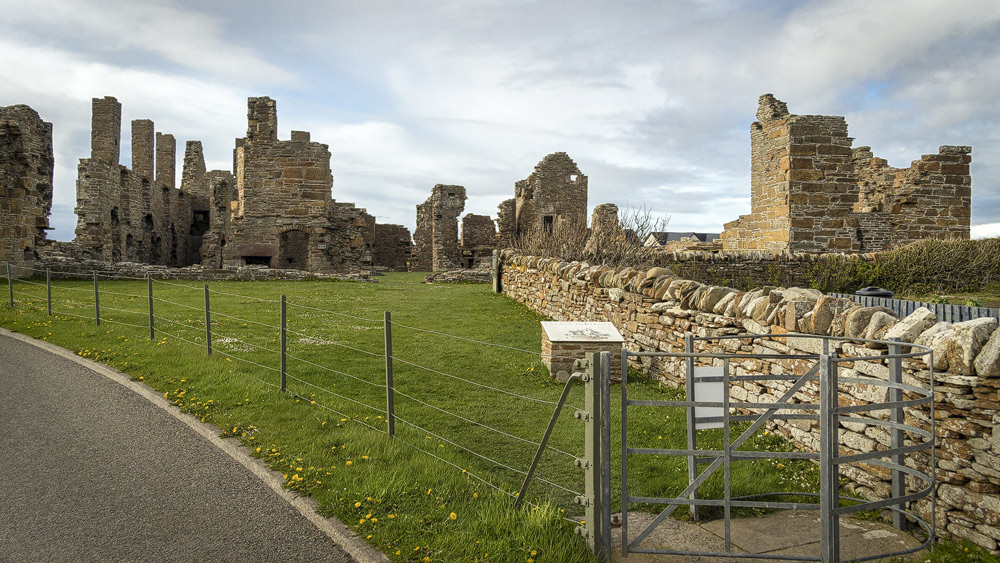
The Stewarts had their run here. Three generations of the royal family left their mark on Orkney – or perhaps one should say, their brand. Because this branch of the royal house was anything but kind to its subjects.
Robert Stewart, Earl of Orkney, was born in 1533 as the illegitimate son of the Scottish King James V. He naturally had no claim to the throne, but was later granted the earldom over Orkney and Shetland as well.
By all accounts, he was an exploiter of the population, and he and his descendants harboured some fairly ambitious plans. One of these took shape from 1569 onwards, in the form of the palace at Birsay.
For its time, it was a magnificent building here on Scotland’s outer edge. Rooms and halls spanning two storeys were arranged around a courtyard on three sides, with towers standing at three corners of the building. One peculiarity: the ground floor had no windows facing outward, instead Robert had gun loops built in. Clearly, he expected conflicts arising from his lifestyle.
The rest of the building was every bit as ostentatious: the Earl’s Palace at Birsay was built in Renaissance style. Inside, the ceilings were decorated with frescoes depicting biblical scenes. There was a great hall with a large fireplace and numerous rooms.
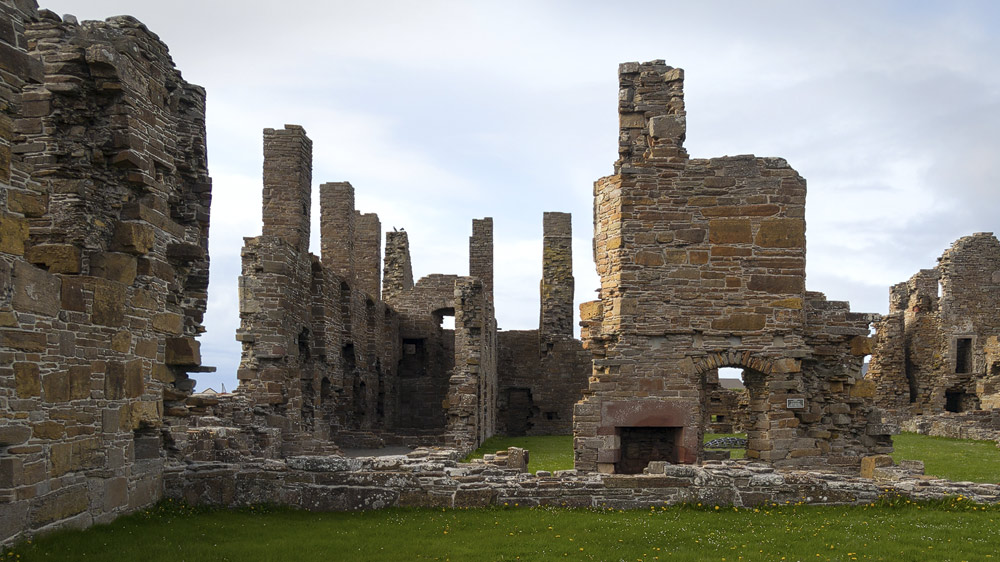
The reason nothing remains of the palace today is that Robert’s son Patrick had his own Earl’s Palace built in Kirkwall. And so, already the second Earl of the Stewart dynasty rarely resided in the palace at Birsay anymore.
By the time of the following generation, the palace at Birsay had fallen entirely out of use, and it had already crumbled into ruin by the early 18th century.
Good to know: The end of the Stewart Earls
Robert Stewart had already treated his subjects with little mercy, but his son and successor Patrick earned himself a reputation that reached all the way to Edinburgh. On top of that, he had no head for money. Together, these two failings eventually landed him in prison in Edinburgh.
Patrick, however, had a son of his own who – like his grandfather – was named Robert. Seeing his chance, he launched a rebellion. With thirty men, he first seized the Earl’s Palace at Birsay, then occupied the Earl’s Palace in Kirkwall. His goal: to rule as governor in his father’s absence.
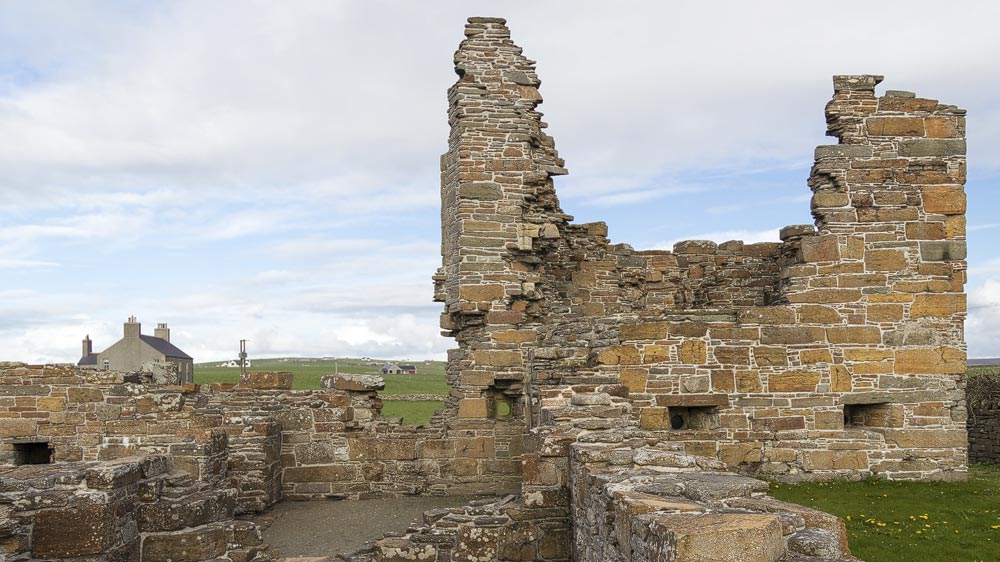
King James VI then sent the Earl of Caithness to bring the rogue Stewart to heel. The siege of the Earl’s Palace in Kirkwall lasted a full five weeks, and the besieger’s cannons could barely scratch the building. In the end, though, the Earl of Caithness prevailed. Robert, like his father before him, was taken to Edinburgh, and both were executed for high treason.
Personal note: Good information boards
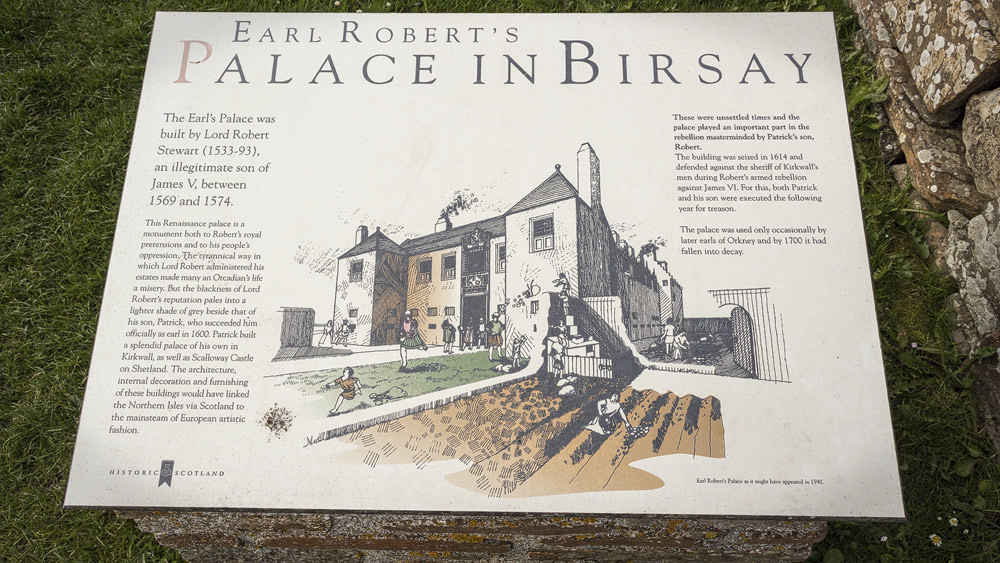
Thanks to the information boards in front of and around the building, the palace’s former rooms and halls come back to life in the imagination. This gives a real sense of the scale of this once-magnificent showpiece.
Tip: St Magnus Church next door
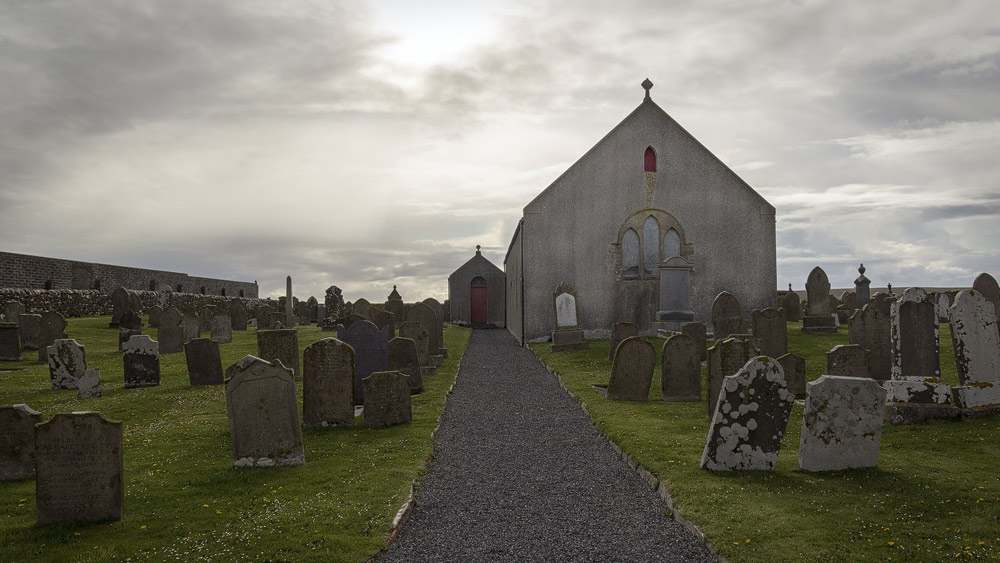
It’s a rather unassuming little church, St Magnus Church, standing right opposite the Earl’s Palace. Still, it’s worth a quick look, as it’s thought to stand on the foundations of the 11th-century Christchurch – the very church built by Thorfinn the Mighty after his journey to Rome. Thorfinn was the ruler who governed a vast realm from Brough of Birsay.
Getting there:
With a sat nav: Enter “KW17 2LX” and it will take you to Birsay.
Without a sat nav: From Kirkwall, first take the A965 towards Stromness, then turn right shortly after Finstown onto the A967 towards Harray, Dounby and Birsay. Continue on until you reach the A966 as described above, then follow the road to the Earl’s Palace.