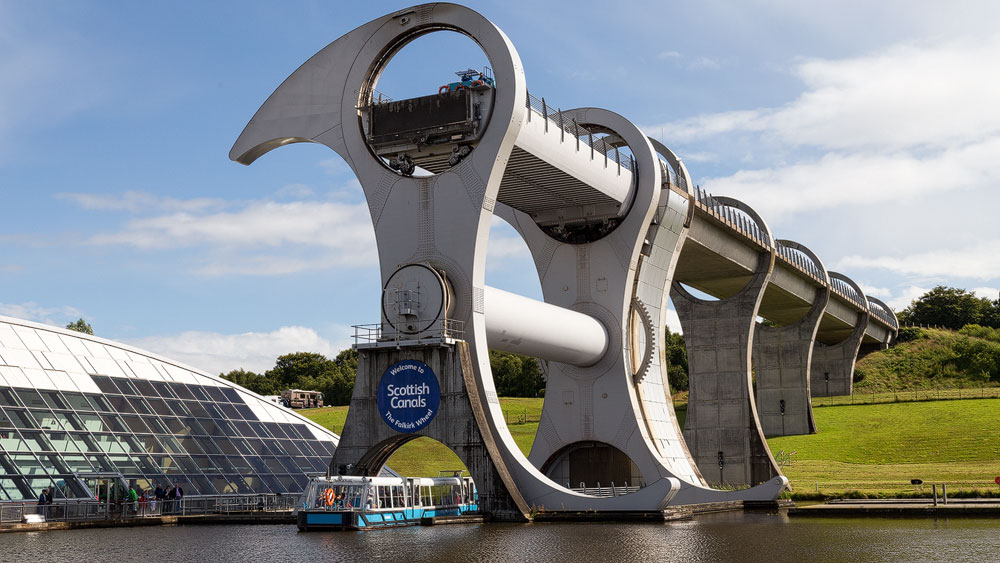
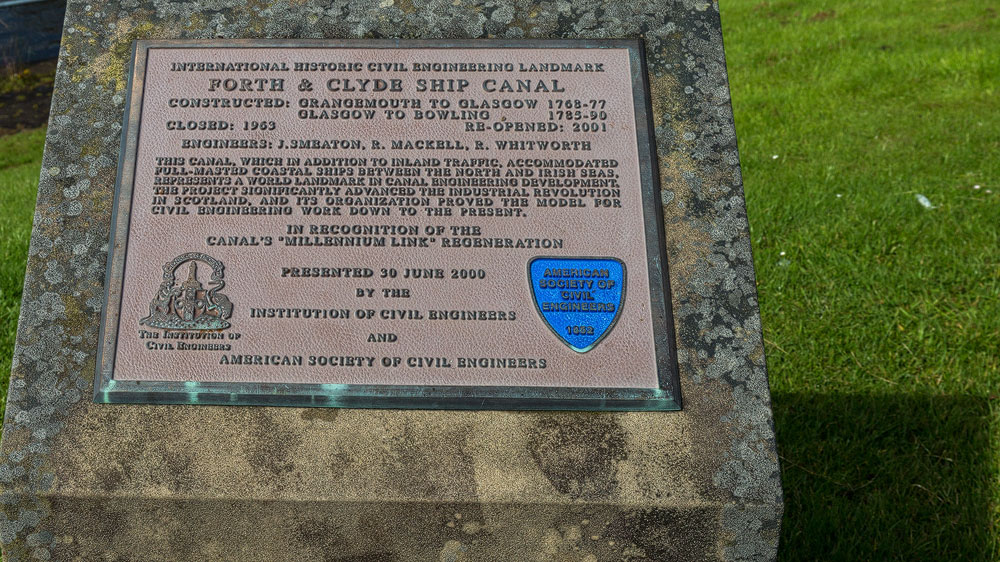
A gigantic steel wheel lifts whole ships into the sky. The Falkirk Wheel is the largest and only rotating boat lift in the world. And it looks good too.
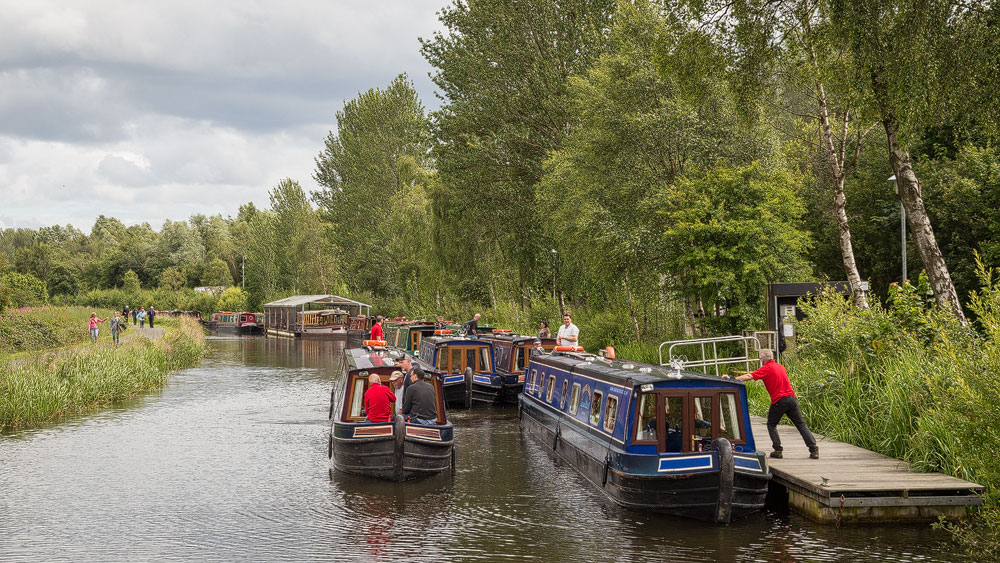
Down at the Forth and Clyde Canal everything seems a little antique: narrow, long wooden boats, elaborately decorated and in eye-catching colours, line an overgrown bank. Romance as if from an earlier century.
But a little further upstream a side arm of the canal branches off, mercilessly pulling you back into the present. This is where the Union Canal begins, which after 50 kilometres finally ends below Edinburgh Castle in the Lochrin Basin. The Forth Clyde Canal, on the other hand, continues on to Grangemouth, where the boats finally pass the Kelpies before heading out into the Firth of Forth.
To reach Edinburgh, the Union Canal first has to climb quite a few metres in height. In the past, boats passed through eleven locks to do this, which often took a whole day. Today a monster of steel manages it in just four minutes: the Falkirk Wheel.
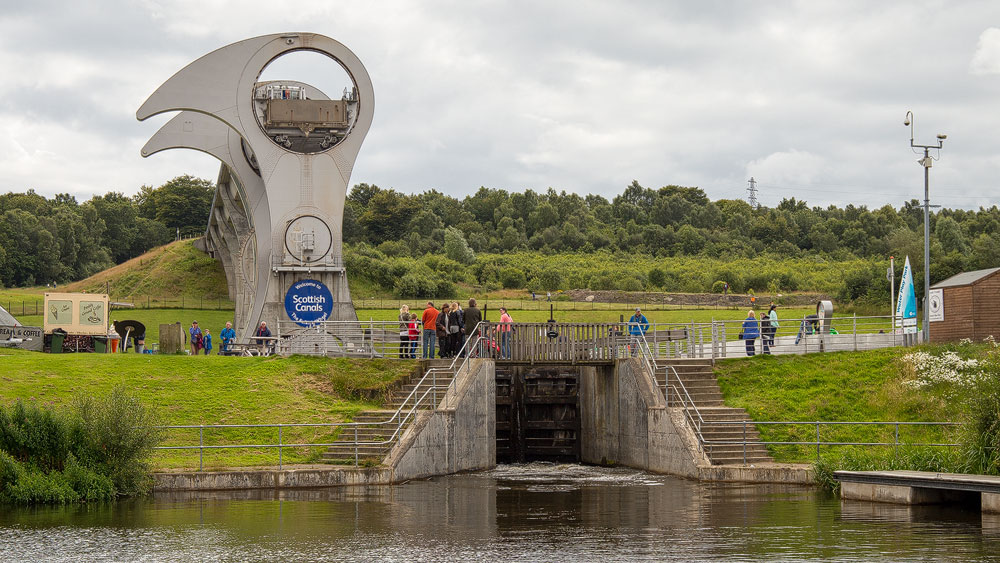
The steel wheel lifts its cargo 24 metres high. But even that’s not enough. Even before this, boats must pass through a lock whose gates, quite unlike the machinery of the Wheel, are opened by muscle power.
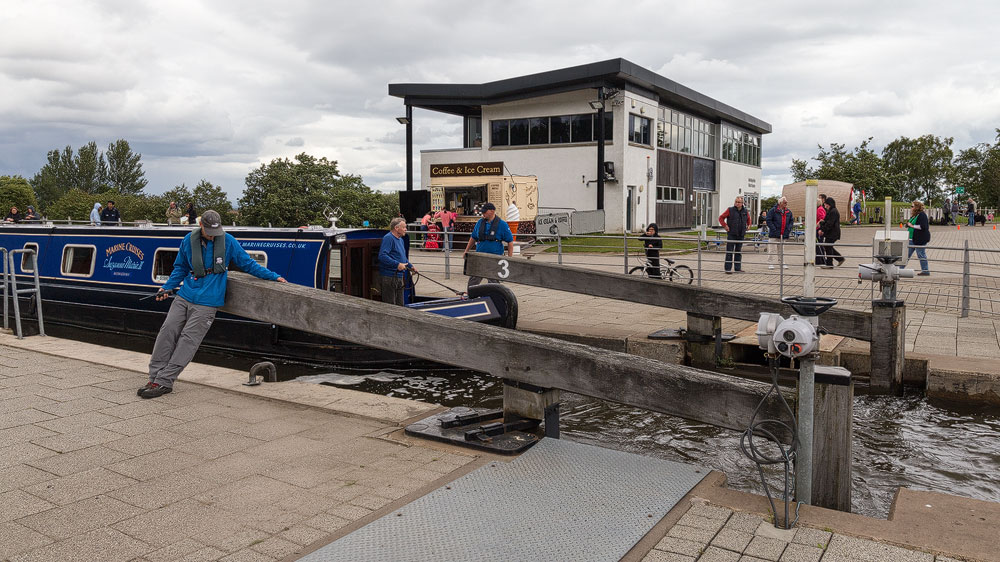
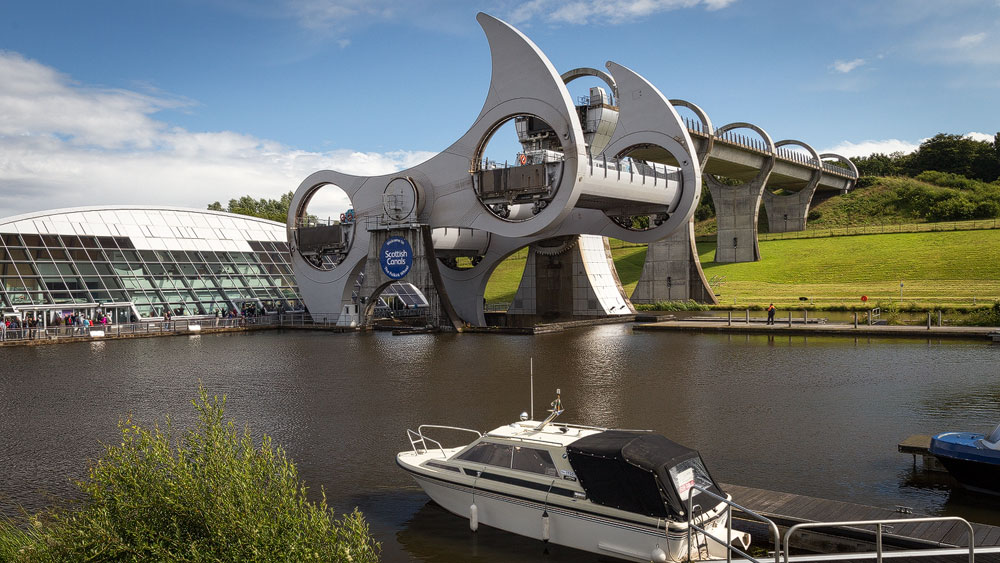
Once the boat has passed through this lock, a large basin opens up in front of it, at the end of which the Falkirk Wheel dips one of its heads into the water.
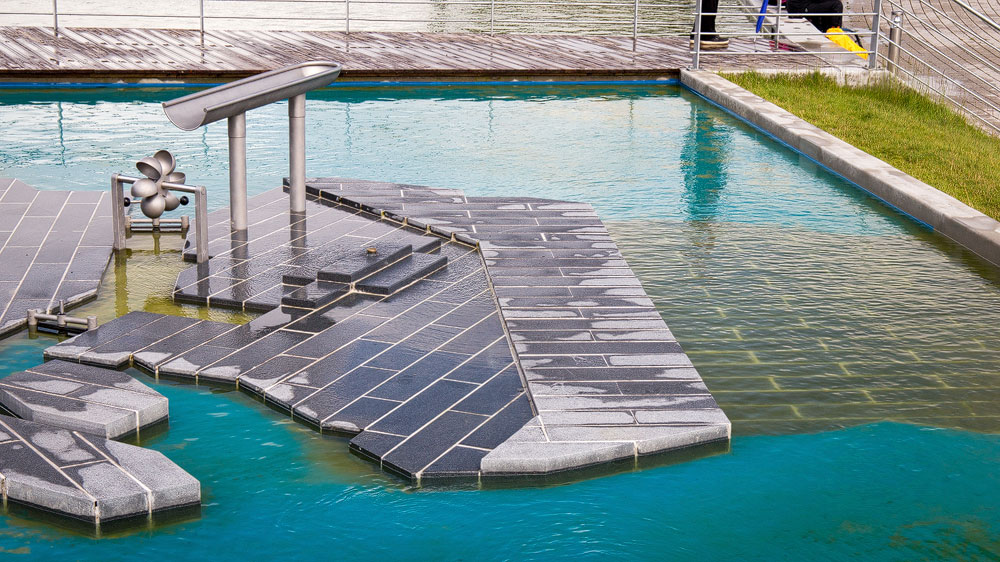
Such a unique structure naturally attracts onlookers. The builders were well aware of this too. So the boat lift stands in the middle of a leisure and recreation area. There are several (!) playgrounds for children here, some of which even playfully demonstrate physics.
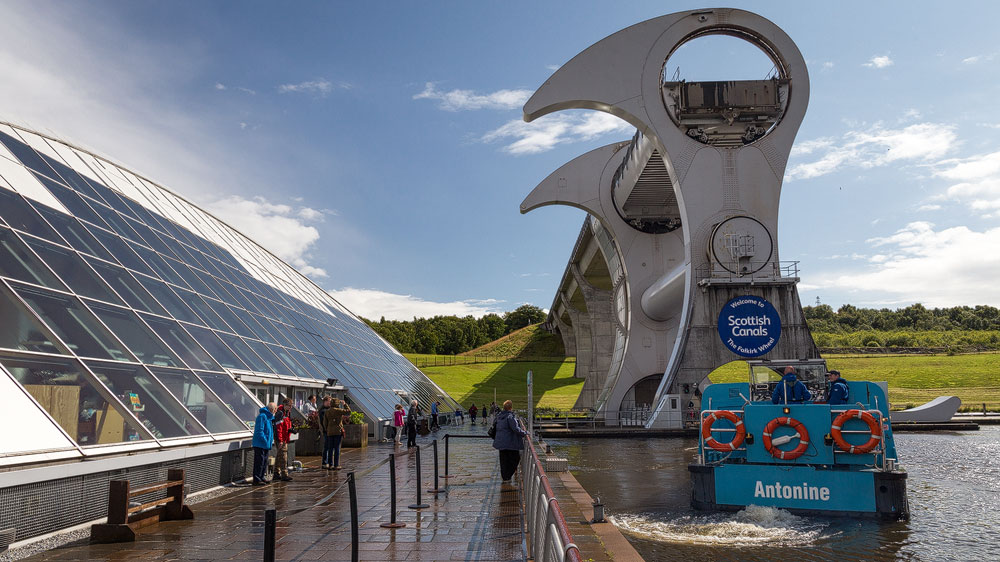
All sorts of stalls offer food and beside the Falkirk Wheel stands a large silver building whose shape resembles an eighth-slice of lemon. Inside it are the Visitor Centre and a café – both with the best view of the wheel.
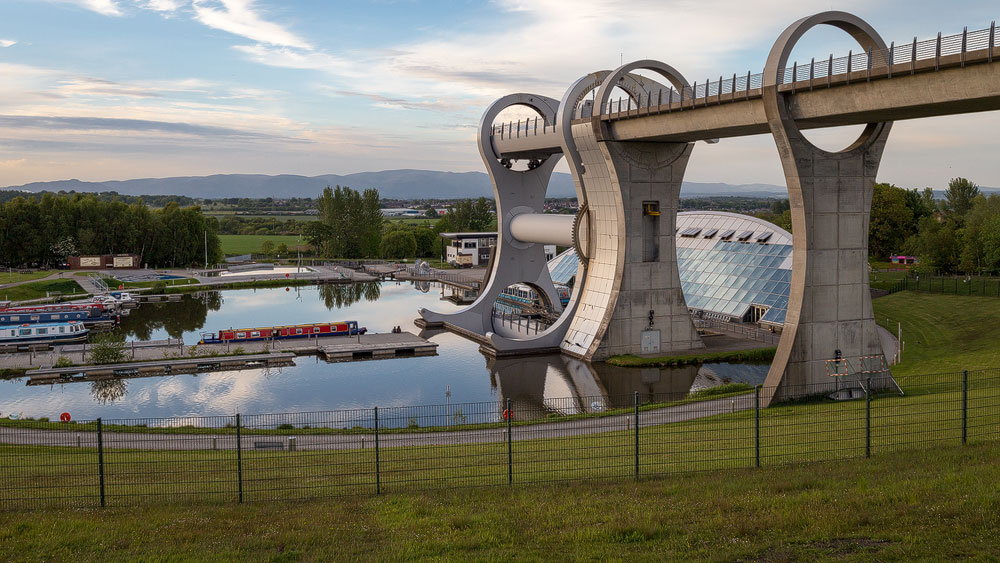
The more modern blue excursion boats also depart from the Visitor Centre towards the Union Canal. Right after casting off, they enter the lower gondola of the wheel. The half-turn then takes four minutes, before the boat is allowed to exit at the top.
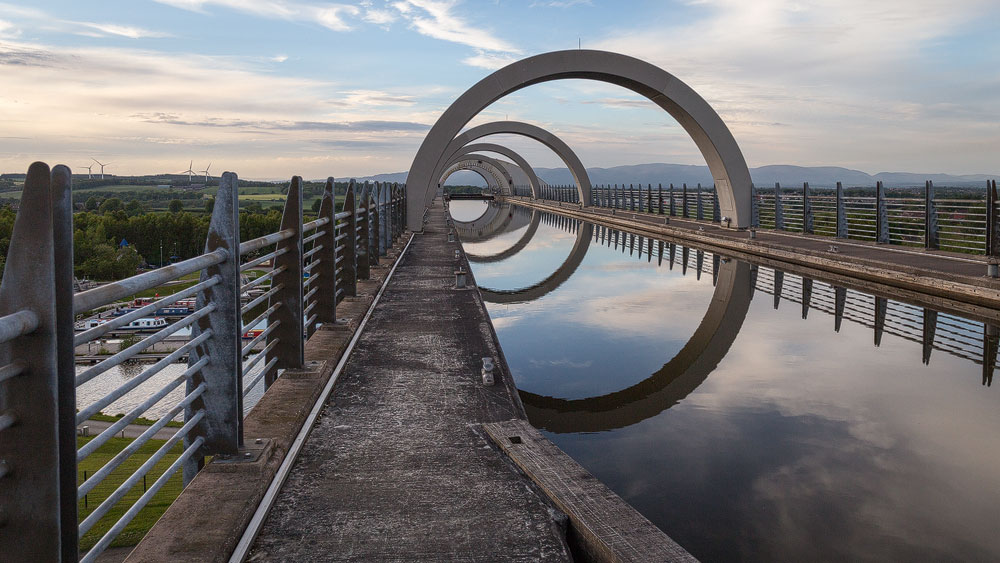
Afterwards, they travel the short stretch along the top of the aqueduct, which offers a phenomenal backdrop.
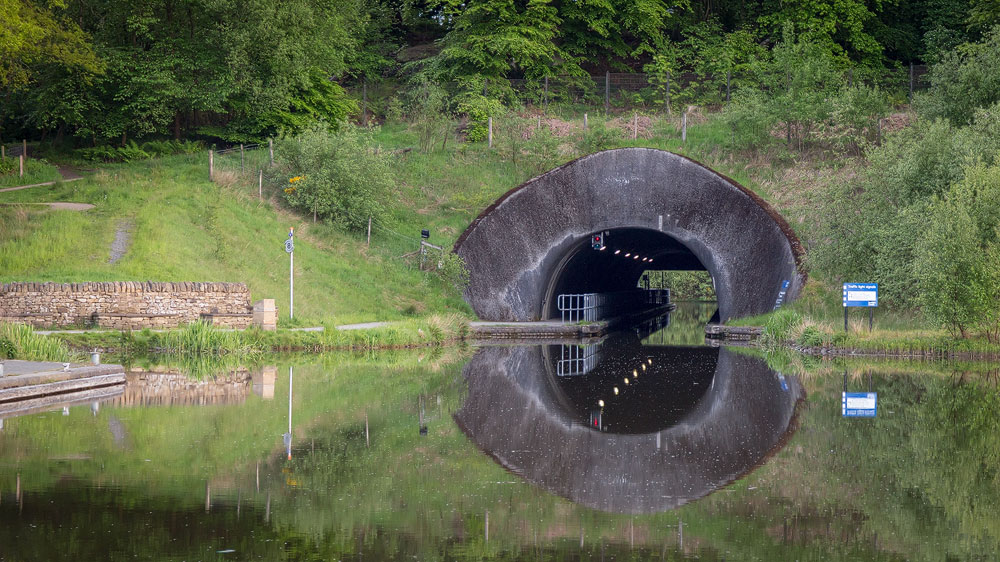
No sooner have they left it behind than they disappear into a tunnel, before the canal bends and heads towards Edinburgh.
But you don’t need a boat trip at all to enjoy the Falkirk Wheel and its surroundings. Several paths lead around the site, inviting you to stretch your legs a little before settling down for coffee and cake at one of the many spots and watching the wheel at its heavy work.
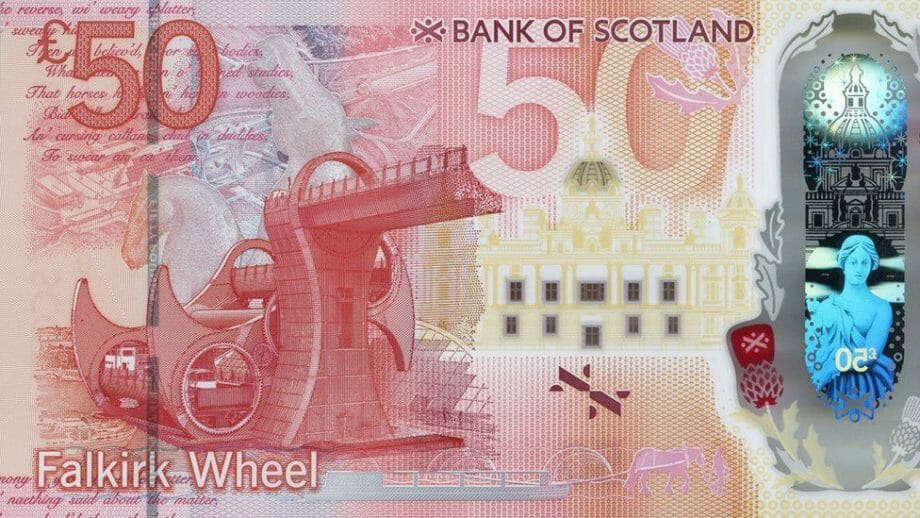
The Falkirk Wheel has by now become a landmark of Scotland. That’s why it once again appears on the new £50 note of the Bank of Scotland (in German for now), valid from 1 July 2021. Behind it, the Kelpies can be seen.
Facts: the technical achievement of the Falkirk Wheel
A few bare figures. The Falkirk Wheel is 35 metres high in total. No one has ever weighed the whole structure, but it’s known that 1,200 tonnes of steel were used. The individual parts were transported north from Derbyshire near Manchester, spread across 35 lorries. Everything is held together by 15,000 rivets.
The idea of a wheel as a boat lift was first considered as far back as 1994. Eight years later, Queen Elizabeth finally inaugurated the completed Falkirk Wheel.
The two gondolas together weigh 600 tonnes and together hold 500,000 litres of water; that’s roughly the equivalent of the contents of an Olympic swimming pool.
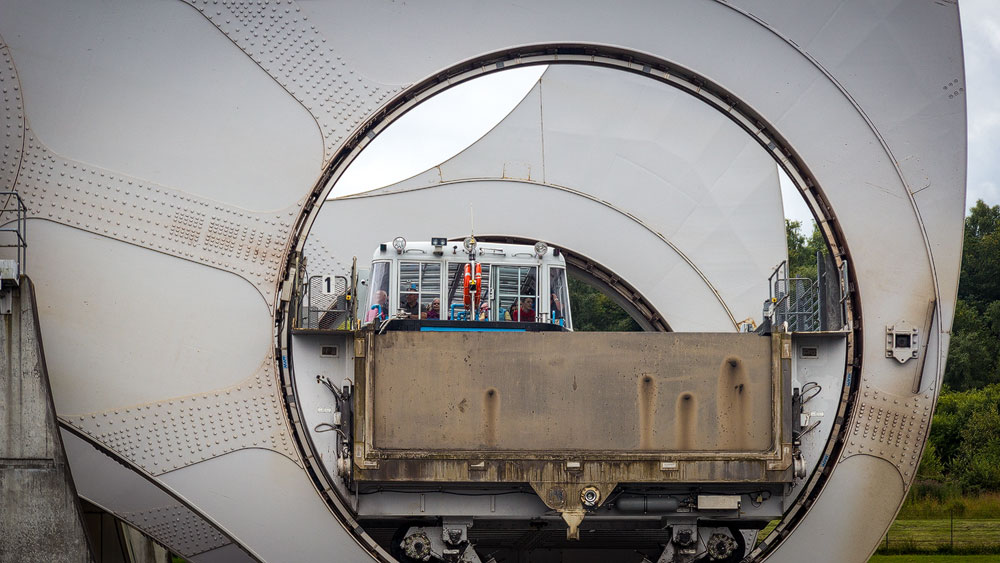
The lift is driven by ten hydraulic motors, which use just 1.5 kilowatt-hours of energy per turn. That’s roughly equivalent to one and a half washing machine cycles – except here far more water is being handled, and hopefully there’s no spin cycle.
But why was such an effort made at all for an old canal? It wasn’t for nothing that the eleven locks were demolished in 1933 and the link was shut down after 111 years. In Scotland, as so often, the answer is: tourism. Nowadays the Union Canal is valued as a recreational destination by Scots and foreigners alike.
More technical details are revealed in this video (in English):
Tips: seeing even more of the canals
If you’re already in the area, you can easily add a short trip to the end of the Forth & Clyde Canal and thus to the Kelpies in Falkirk. The Kelpies can be visited at the end of the day. If it’s already getting dark, all the better: then you can enjoy the horse statues in wonderful lighting.
On the way to the Kelpies, you can still see some old locks in Falkirk itself.
Personal note: child-friendly and well thought out
I’m always amazed at how beautifully the Scots design necessary structures, and how they go on to create a whole experience area around them. The Falkirk Wheel is another example of this.
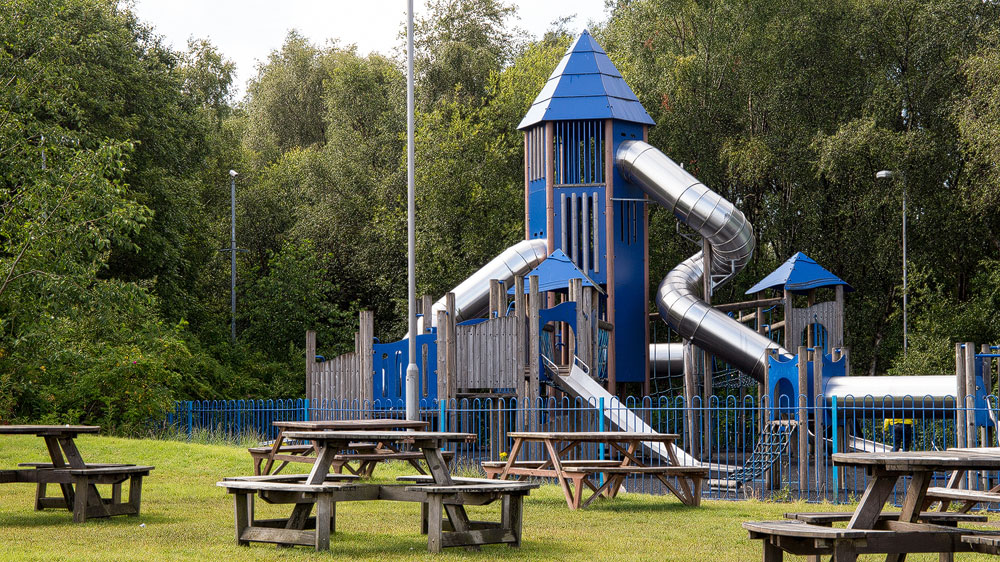
What impressed me was the sheer number of play options. There’s a “normal” playground with a big slide, a small artificial lake with all kinds of water vessels, and a whole “water” park where children can playfully experience physical laws like displacement using various apparatus.
Getting there:
With a sat nav: “FK1 4RS” will take you near the turn-off to the upper car parks of the Falkirk Wheel.
Without a sat nav: coming from Glasgow, take the M80 and leave it at the “Kilsyth, Bonnybridge” exit. Then just follow the signs to Falkirk and onto the A803. Eventually you’ll reach a roundabout where the Falkirk Wheel is already signposted with a brown background and a car park symbol P.
Coming from Edinburgh on the M9, take exit five for Falkirk/Grangemouth. At the roundabout, take the first exit towards Falkirk (essentially straight on). You then keep following this road, the A9. It takes you around Falkirk, while the typical brown signs show you the way. Just once, at one roundabout, it gets confusing, as a yellow sign points to the “Service Entrance Falkirk Wheel”. Ignore that and keep staying on the A9, until the car park sign described above appears.