The Forth Bridge spans the Firth of Forth as a red landmark. Its history, and the best spots to see it from, are covered here.
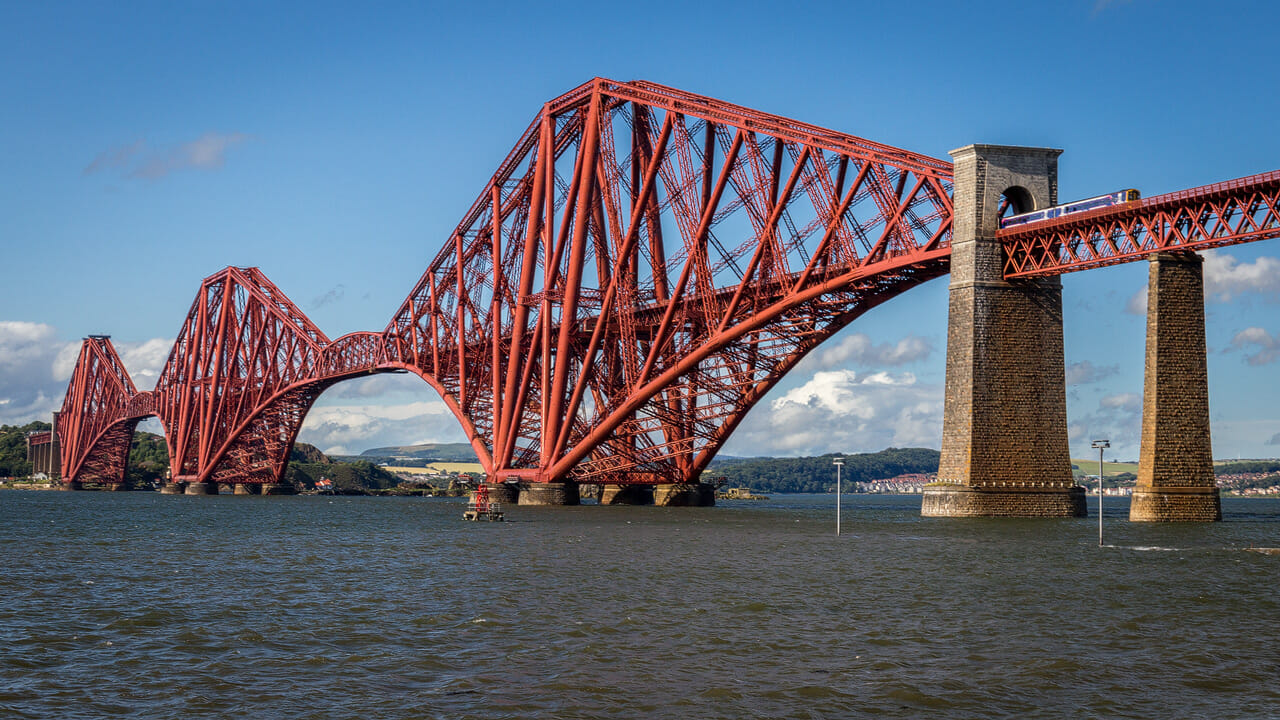
It borders on a miracle that the Scots still trust railway bridges at all. Unlike today, it was by no means guaranteed in 19th-century Britain that passengers would always arrive safely at the far end of a railway bridge. In 1879 – shortly before construction of the Forth Rail Bridge began – the Tay Bridge, barely 50 kilometres to the north, had collapsed under a train. 75 people lost their lives. It was the second such accident within the previous 50 years.
And now an even bigger, even longer bridge was supposed to cross the Firth of Forth? Designed by Thomas Bouch, the very same engineer behind the bridge that had collapsed?
The unfortunate architect Bouch had in fact planned a link between Queensferry North and South using a suspension bridge. But after the accident, confidence in his ideas was gone, and new engineers were brought in – who would go on to achieve something remarkable. Benjamin Baker and John Fowler were awarded the contract for a new idea: a steel bridge built as a cantilever structure.
And that’s exactly what happened: three foundations were driven into the Firth of Forth, one at each shallow edge and one in the middle at the island of Inchgarvie. Unlike the Tay Bridge, it was not built with cast iron – engineers had learned that iron became brittle under heavy use. Instead – and this was revolutionary – a special rolled steel was used, bent into tubes up to four metres in diameter and riveted together.
That the bridge was built at all, despite the bad experience, was simply an economic necessity. The expanding railway wanted to reach northern cities like Dundee or Aberdeen from Edinburgh as quickly as possible. But the Firth of Forth stretches 70 kilometres inland here, and a detour for the railway would have been economically hard to bear.
Until then, ferries had been used to cross at Queensferry. But this could soon no longer cope with the flow of travellers.
So up to 4,500 people set about building the bridge according to the plans. Sinking the foundations was already exhausting work. So-called caissons were used, lowered to the seabed and kept permanently emptied by compressed air. Inside them, workers could clear away debris and lay the foundation – they were effectively diving bells.
Only then were the steel parts brought in and joined together. The rivets needed for this were heated in a furnace to white heat. But how did they then get, still hot, to the worker who had to drive the rivet in? Quite simply: they were thrown! Using long tongs, one worker would hurl each piece of metal to a catcher, who held a kind of leather bucket. There was no such thing as workplace safety back then. Small wonder that 63 workers lost their lives, 13 of them still minors.
Construction took eight years before the Forth Bridge was inaugurated in 1890 – with a golden rivet driven in by the British heir to the throne, Edward. The effort paid off. For over a hundred years the bridge has reliably done its job – around two hundred trains cross it every day. This feat of engineering is now recognised worldwide: since July 2015, the Forth Rail Bridge has been a UNESCO World Heritage Site.
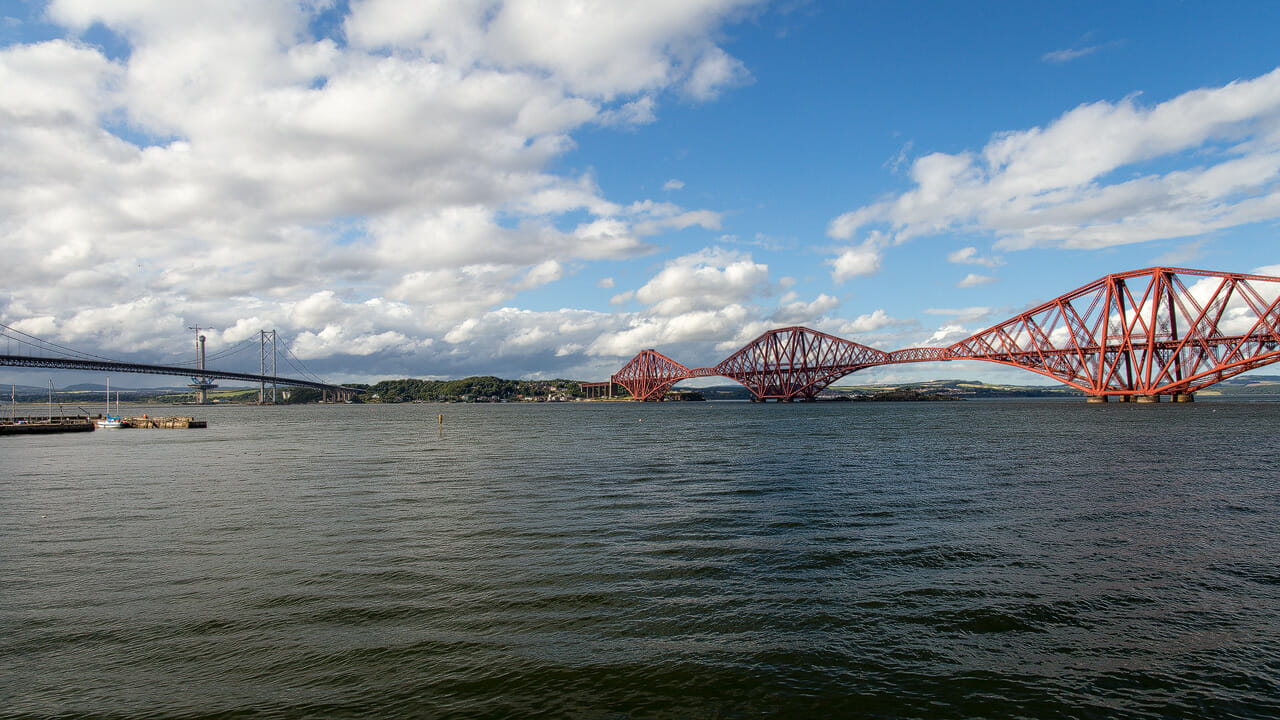
And it has long since stopped being alone. The Forth Road Bridge has stood a little further west since 1964, and a third bridge was under construction at the time of writing (2016).
Facts: the Forth Bridge in numbers
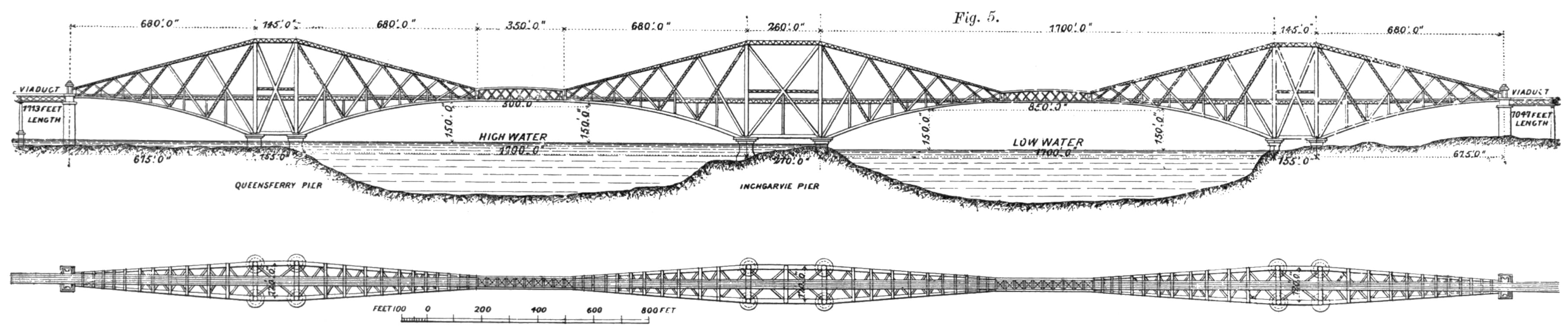
From the foundations rise three sets of four piers, each reaching a height of 110 metres. From these, like wings, the cantilevers extend 207 metres in each direction. Between them hang two identical sections, each 107 metres long (the so-called suspended spans).
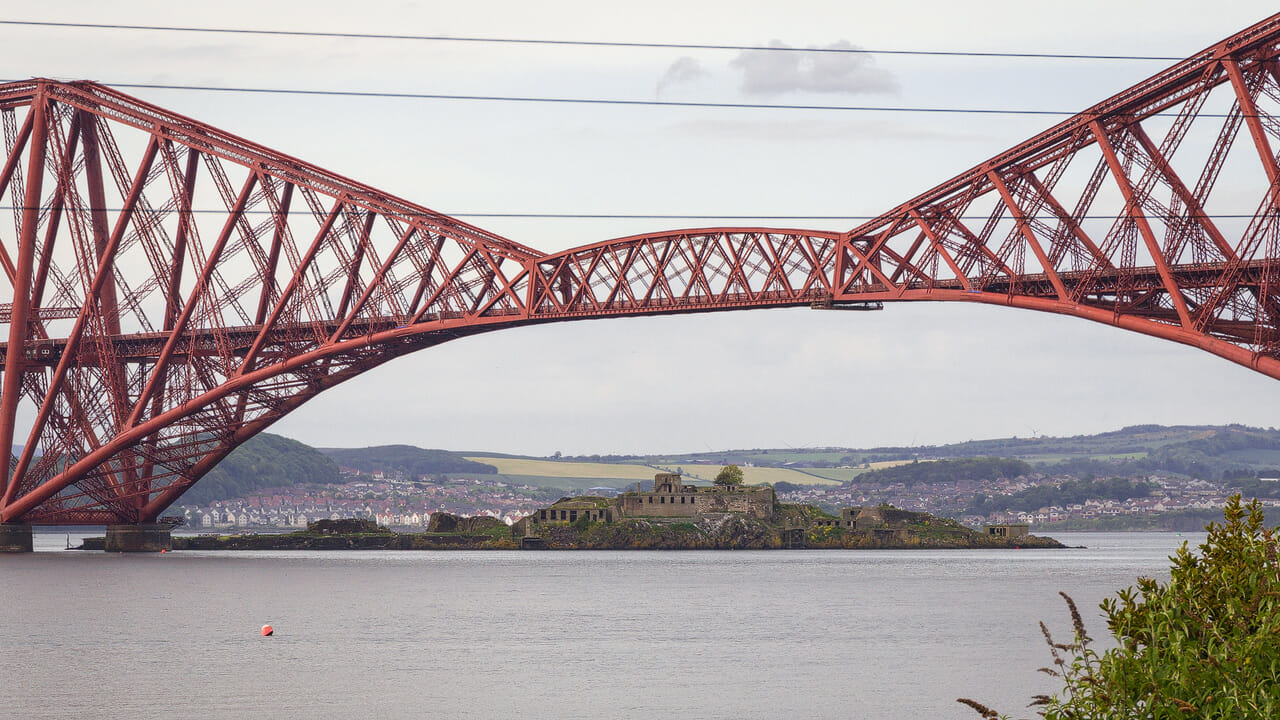
The remaining distance between the bridge and the higher ground on either side is covered by viaducts on piers.
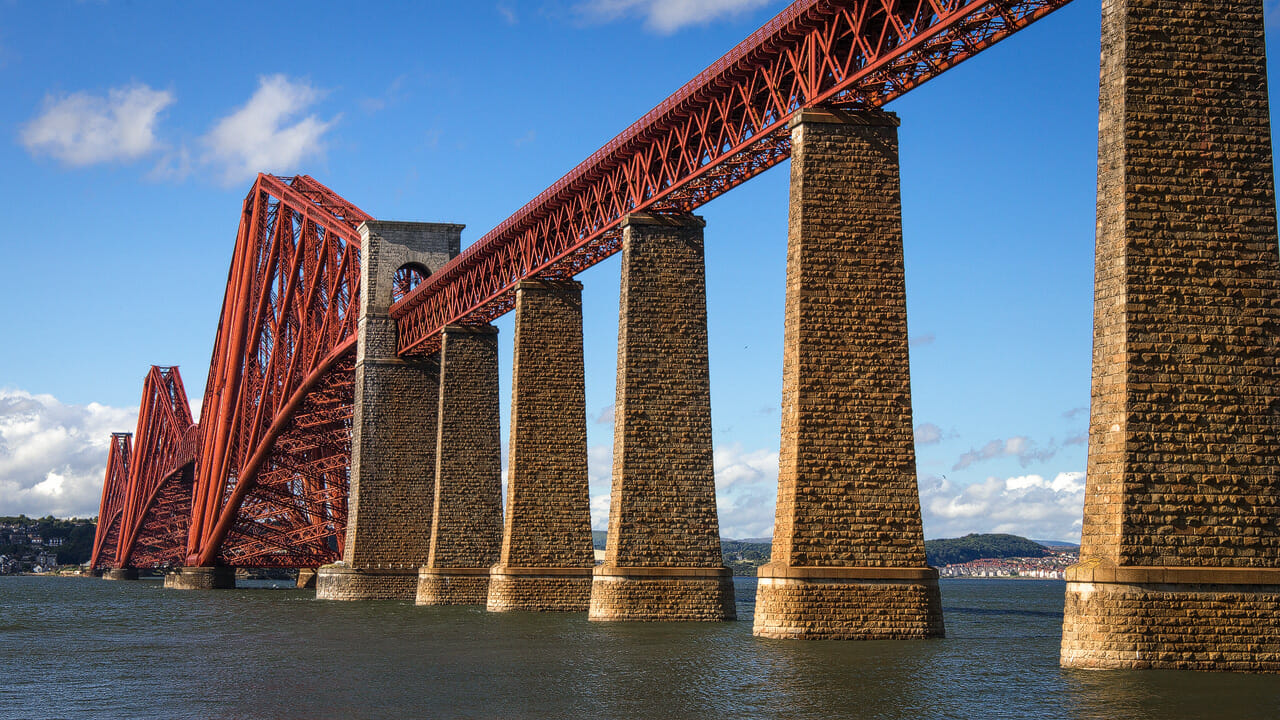
In total the bridge spans almost two and a half kilometres and weighs 53,000 tonnes. For 28 years the Forth Rail Bridge was considered the largest cantilever bridge in the world, before it was pushed into second place in 1918 by the Pont de Québec in Canada.
From 2002, the bridge underwent a ten-year restoration. About 240,000 litres of paint gave the Forth Bridge back its bright red colour.
Tip: Forth Bridge viewpoints
So how can you best admire this wonderful bridge? One option is South Queensferry, from where most of the photos in this article were taken. The little town is a sight in itself, with a row of shops including an antiques dealer (in German for now) full of curios, among others.
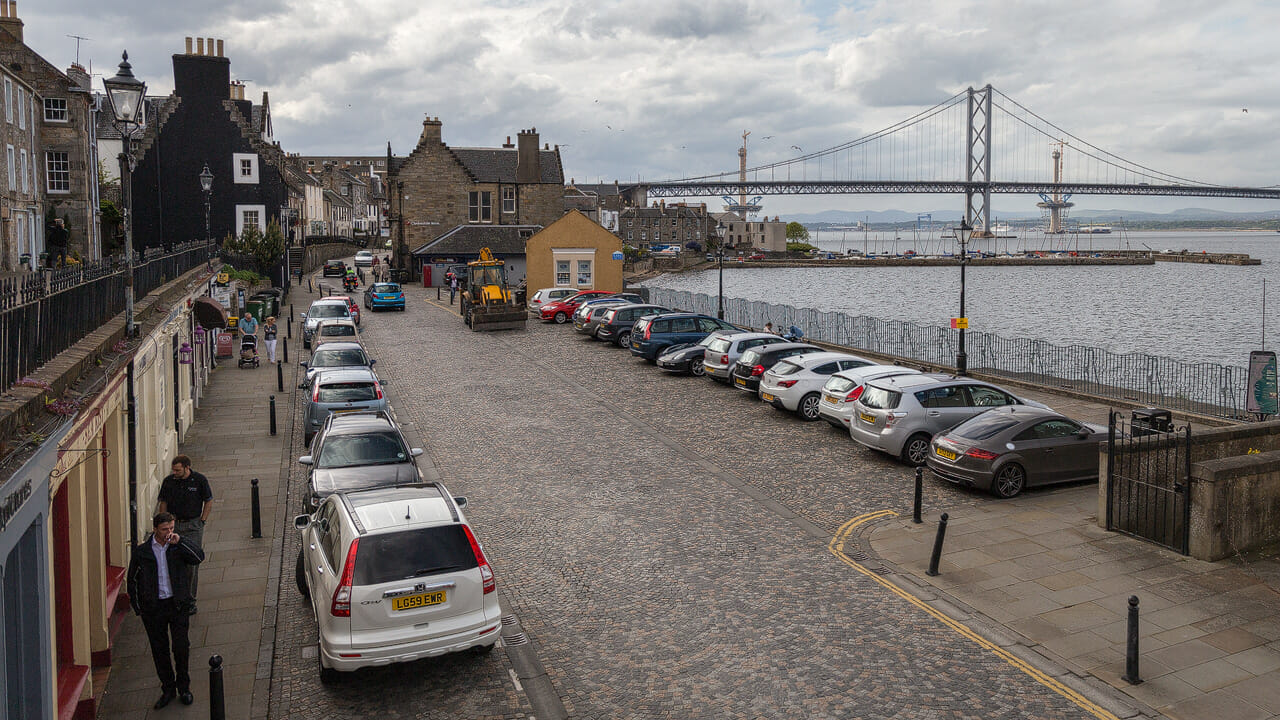
You get a good view from the car park in front of the little row of shops (Mapcode (in German for now) 20.VRB4, coordinates 55.9898288,-3.3945662). From here you can also carry on along the pier, under the bridge, and if you keep following the road you get a view of all three Forth Bridges.

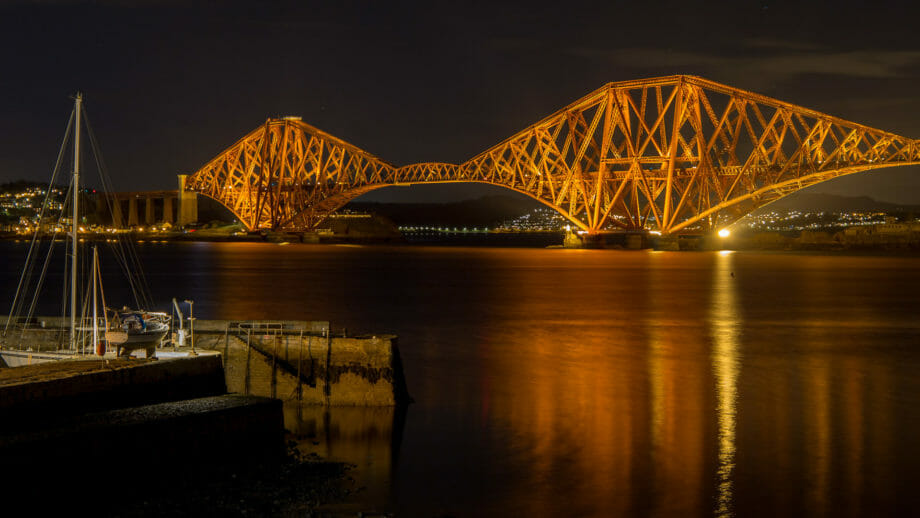
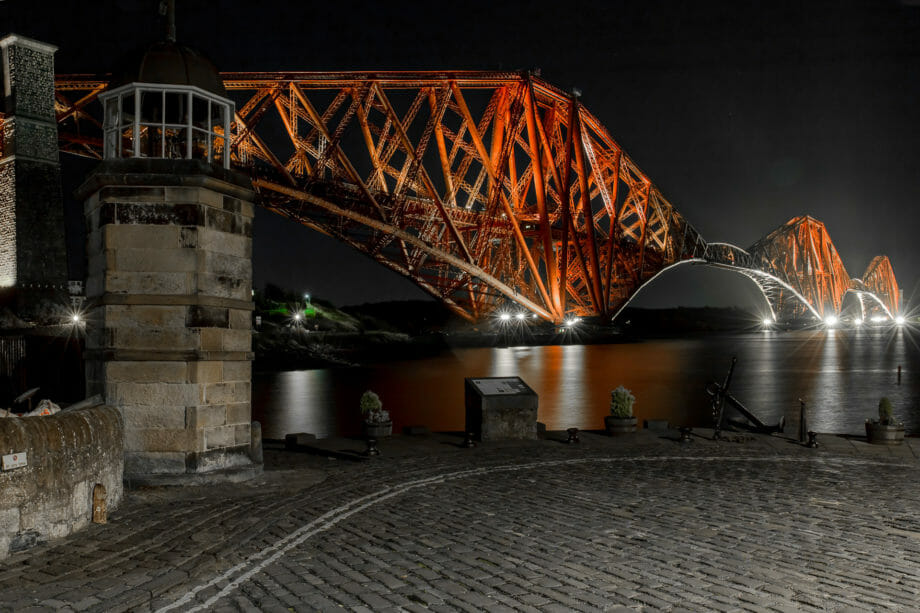
On the north side there is a viewpoint with an information board, a lighthouse and an anchor – which makes a great foreground for photos. It’s in North Queensferry, at Mapcode (in German for now) 20.TK84 or coordinates 56.008219,-3.394947. Especially recommended after dark, when the lights are on.
If you have a bit more time and money, you can take a boat trip from South Queensferry that takes you not only to the bridge but also to the island of Inchcolm with its abbey. Operators include Forth Tours or Maid of Forth.
Personal note: shells and a photo
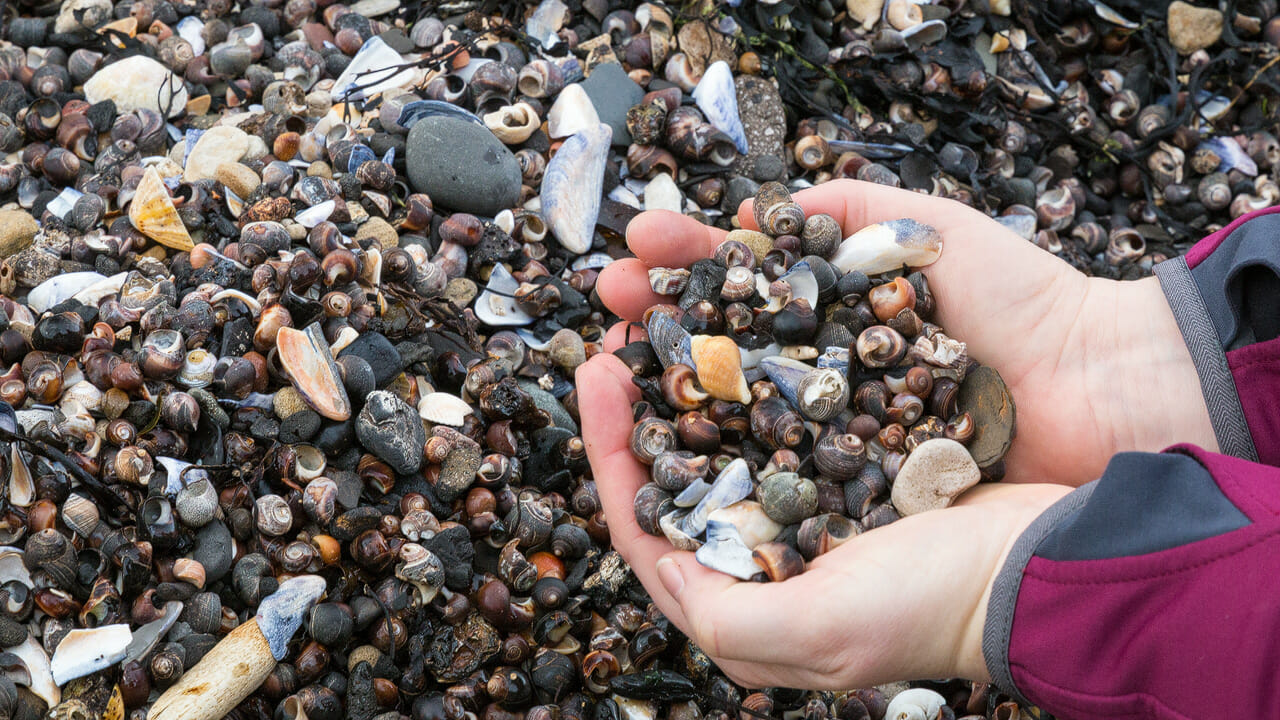
In South Queensferry, alongside an extensive shopping trip, we took a walk along the road. At low tide, a small sandy beach even appears. On that beach: countless shells.
However, we don’t really trust the water quality of the Firth of Forth, so we didn’t handle them for long or take any home.
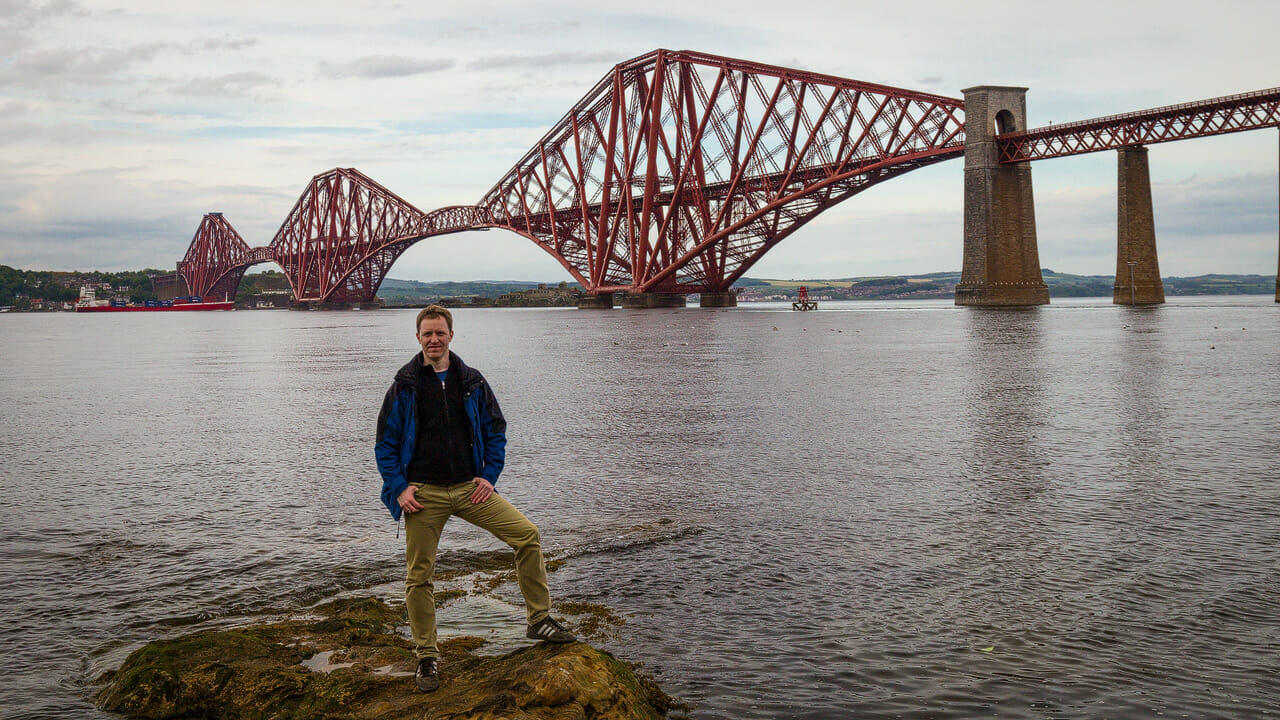
At the same spot there are some rocks where you can pose nicely in front of the bridge:
Getting there (South Queensferry):
From Edinburgh, heading towards Dundee and Perth, take the M8, then the M9, the M90 and the A90. Depending on where you’re coming from… watch for the “Historic Town” sign on the A90. Exit there and, at the roundabout, follow the direction “Queensferry (B 907)”, and again at the next one. After a while the road climbs a hill and you can already see the Forth Railroad Bridge in the distance. Note: at the end of the small slip road, turn right, do not follow the road to the left. Continue through the narrow lanes to the car parks. If nothing is free by the row of shops, carry on and park in the large car park in front of the bridge.
From Glasgow, take the M8 towards Edinburgh, but then switch to the M80 towards Stirling. Later, after “Kincardine Bridge”, switch to the M876 and then to the M9 towards Edinburgh. Take the “Kincardine Br Uphall” exit here, then left towards “Forth Road Bridge” and right again towards “S. Queensferry”. Follow the road until you reach the roundabouts mentioned above.
From the north, heading towards Edinburgh, take the M90 and A90 and, after the Road Bridge, exit towards “Queensferry (B 907)”. Then follow the roundabouts as above.