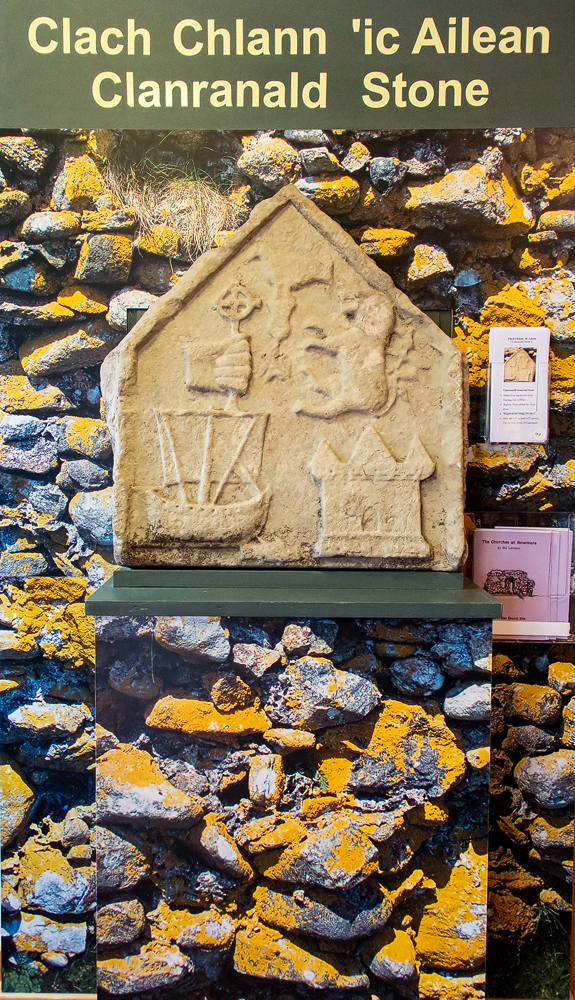
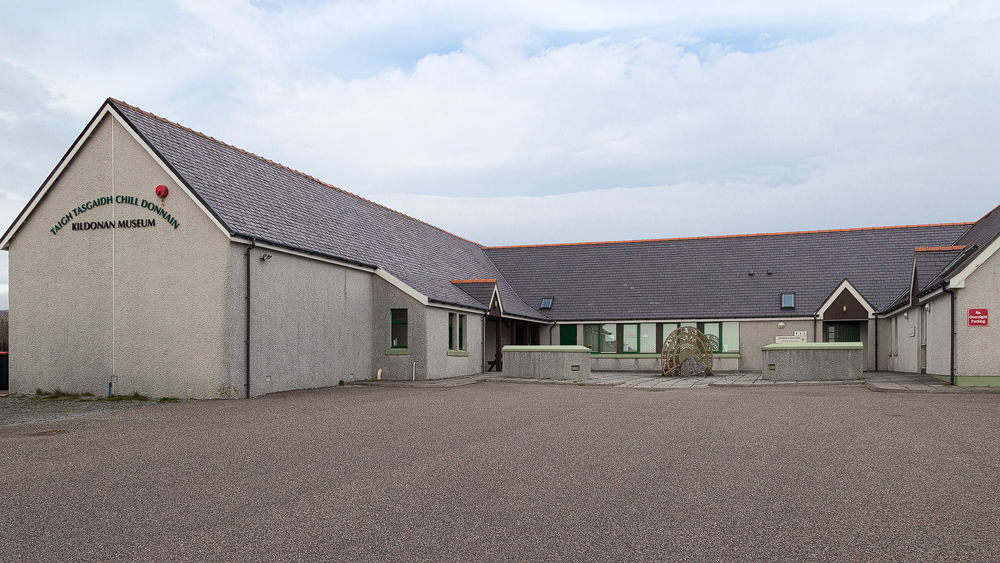
Thieves in the graveyard, a mysterious death in London, and talk of a curse. The Kildonan Museum displays the Clanranald Stone, its eerie history, and many artefacts from earlier life on South Uist.
Spring 1990, South Uist – Something was missing here … The Reverend Angus MacQueen couldn’t quite put his finger on it at first, but something wasn’t where it should be. Suddenly it hit him: the Clanranald armorial stone – it was gone!
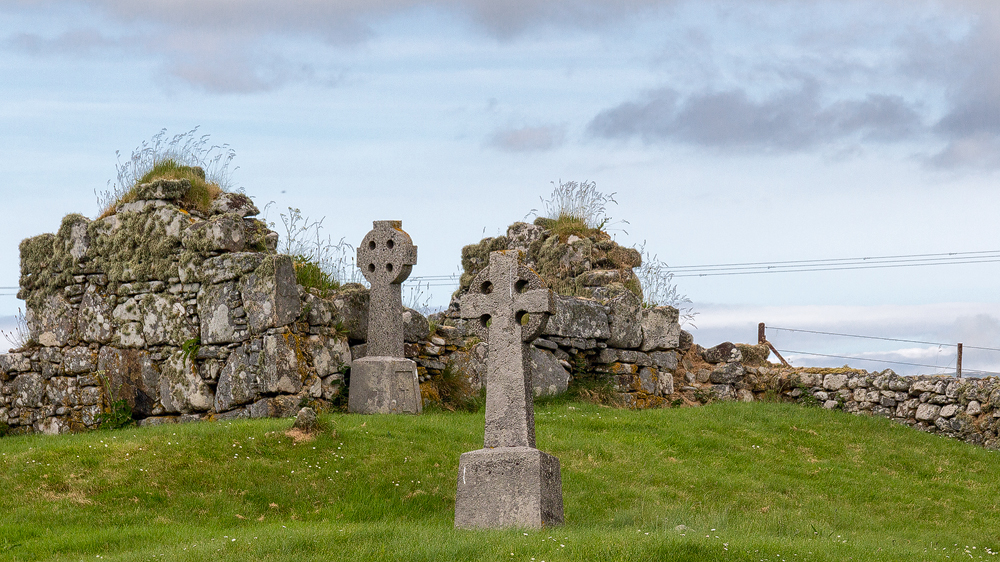
For decades, the Clanranald Armorial Stone had lain in the weathered graveyard beside the remains of the old chapel at Howmore. It bore witness to the pride and glory days of the rulers of South Uist and Benbecula. No one on the island would ever have dreamed of removing it from this sacred spot. Yet now deep drag marks were visible in the peaty ground. Overnight, someone had hauled the 160-kilo monster away. Nobody knew who, or why.
The police? Powerless! Officially, the stone belonged to no one – it had simply been sitting on common grazing land. No owner, no case, no investigation. South Uist had lost a piece of its history.
Only higher powers could help now …
Five years later, London – A Canadian couple had lost their son and had travelled from overseas to clear out the deceased’s flat in London. There they found a large, heavy sandstone slab with strange carvings on it: a hand holding a cross, a lion, a sailing ship, and a castle with three towers. Beside it lay a few photos showing their son removing the stone from a graveyard, together with another person.
The deceased man’s flat lay only a few hundred metres from the British Museum. So they reported the strange find there. Museum staff quickly identified the markings as belonging to the Gaelic world and got in touch with the National Museum of Scotland. It didn’t take long before the stolen Clanranald Stone was recognised for what it was.
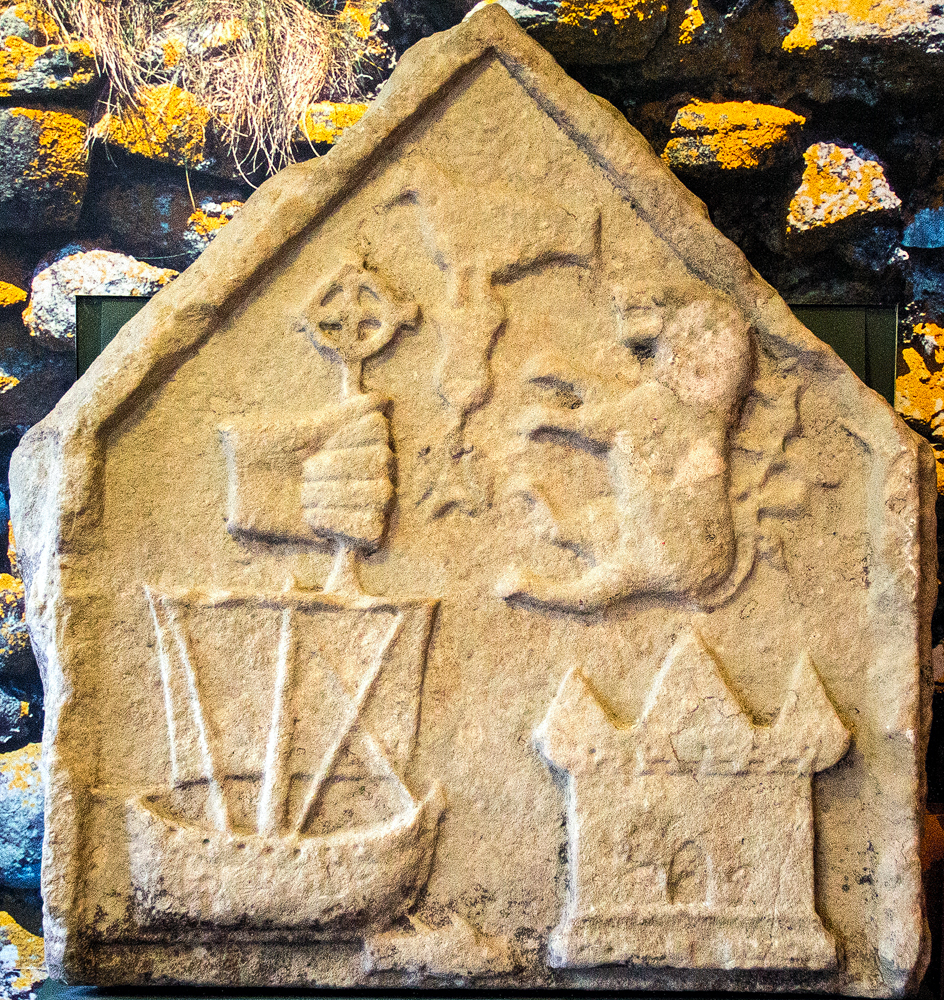
The press took care of the rest: the cause of the thief’s death remained unclear, and before long talk of the “curse of the Clanranald Stone” was rustling through the papers. Suddenly the memorial stone became a gravestone in people’s minds, and some people abruptly recalled seeing kilted ghosts wandering the graveyard – though they’d be from the wrong era, since the stone dates from the 16th century, a time when this particular Scottish garment was still unknown. The newspapers also chased down the accomplice seen in the photo. They tracked him all the way to Germany, where the man was now working. Understandably, he had little desire to return under the circumstances.
The stone was eventually cleaned by Historic Scotland and brought back to South Uist. The week after its arrival turned out to be the finest and warmest weather anyone there could remember at the time. They say the sun shone so brightly over the island that sun cream sold out everywhere.
Strange? And yet, so the story goes …
Today – the Clanranald Armorial Stone never returned to the graveyard at Howmore; a safer spot was found for it instead. So today this magnificent piece greets visitors in the entrance hall of the Kildonan Museum. Guaranteed curse-free at this location.
Good to know: the Kildonan Museum
Of course, the Clanranald Stone isn’t the only piece at the Kildonan Museum. Its rooms lead visitors through South Uist’s more recent history via a wealth of exhibits. You’ll learn how the interior of blackhouses changed over time, and what tools the local fishermen and craftsmen once used. There are also weapons from the world wars, historical photographs, and works by local artists on display.
The building itself is a former school. Its rooms also house an archive, a café, and a small shop selling all kinds of local crafts.
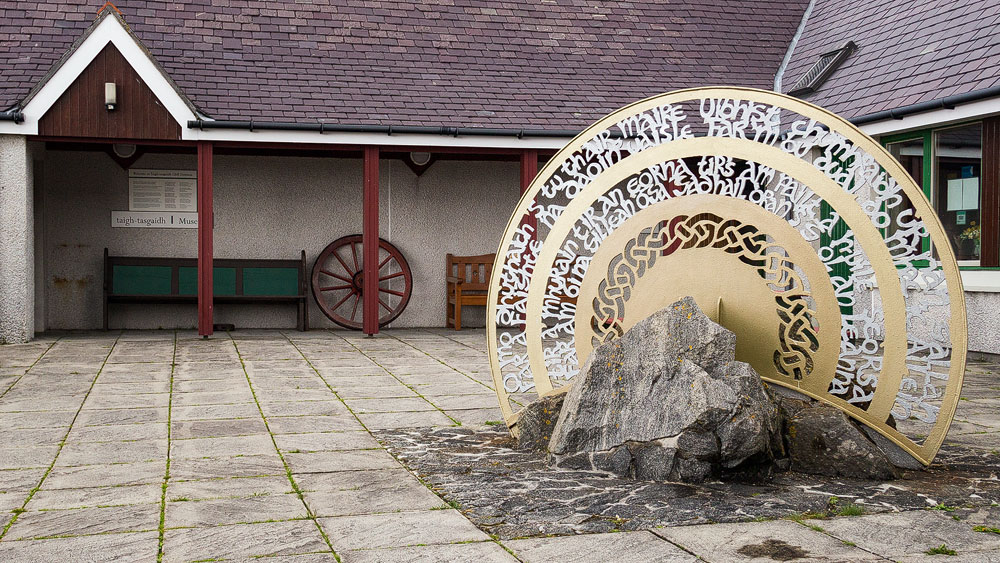
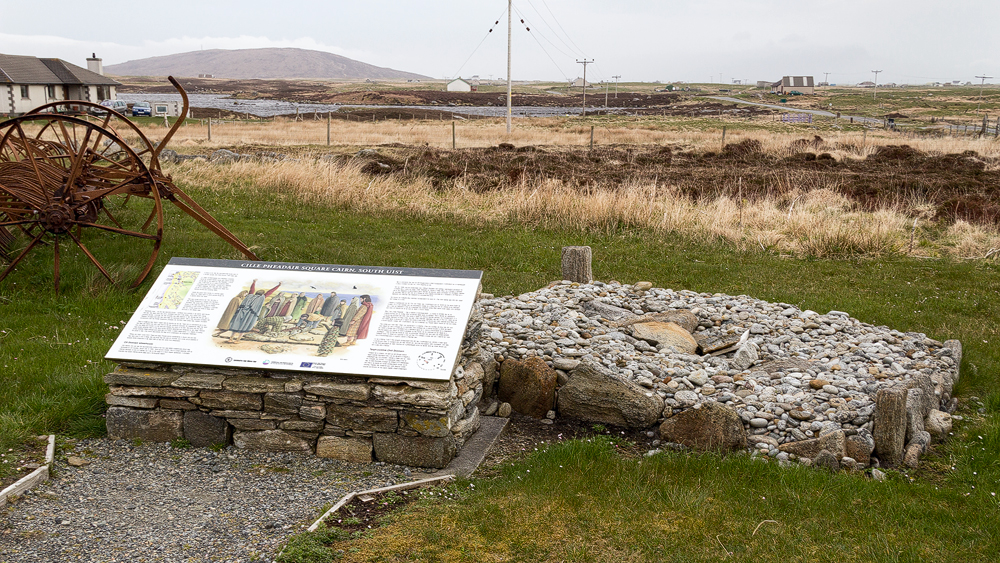
At the museum’s entrance you’ll also find an old Pictish grave that was relocated here. Though, in truth, the information board is more interesting than the grave itself.
Personal note: no room for romanticising – and that’s a good thing
What we really liked during our visit is that the museum doesn’t romanticise the past in the slightest. In one spot, this is even spelled out plainly: life back then was hard, and it’s noticeably better today. I appreciated that honesty.
Incidentally, the details on the history of the Clanranald Stone come from issue 152/1997 of Current Archaeology magazine, whose staff member I’d like to explicitly thank for the fast and uncomplicated help.
Tip: photography prohibited
Photography inside the museum is prohibited. But if you ask politely, you’re usually allowed to photograph the stone itself. At least, that worked for me.
Getting there:
With sat nav: “HS8 5RZ” will bring you close – but don’t leave the main road, and instead look out for the signposting to the museum.
Without sat nav: the museum sits directly on the A865, the main north-south road across South Uist. Coming from the north, a sign for “Cill Donnain” appears along the road, pointing you right. Don’t turn off here, though – continue a little further along the main road, then turn left at the large grey building into the yard and park. That’s the museum. Coming from the south, the museum lies on your right shortly after you pass the sign to Flora MacDonald’s birthplace.