This unassuming mound has been through a lot: death rituals, Viking graffiti and UFO researchers. And once a year, right on the winter solstice, the inside of Maes Howe even sees the sun.
“Nonsense! Elvis was far too unfit to build that!” a woman scolds her husband.
The historian who runs the tours at Maes Howe sometimes hears wild theories from visitors about the purpose of the ancient stone tomb. This man’s idea: Elvis Presley built the tomb to have perfect acoustics for singing in. And the light that falls into the stone chamber every winter solstice? That’s the stage lighting. Though, to be fair, the woman who’d just told off her husband did get straight to the point: Elvis would have had a hard time with stone blocks weighing tonnes and stretching several metres.
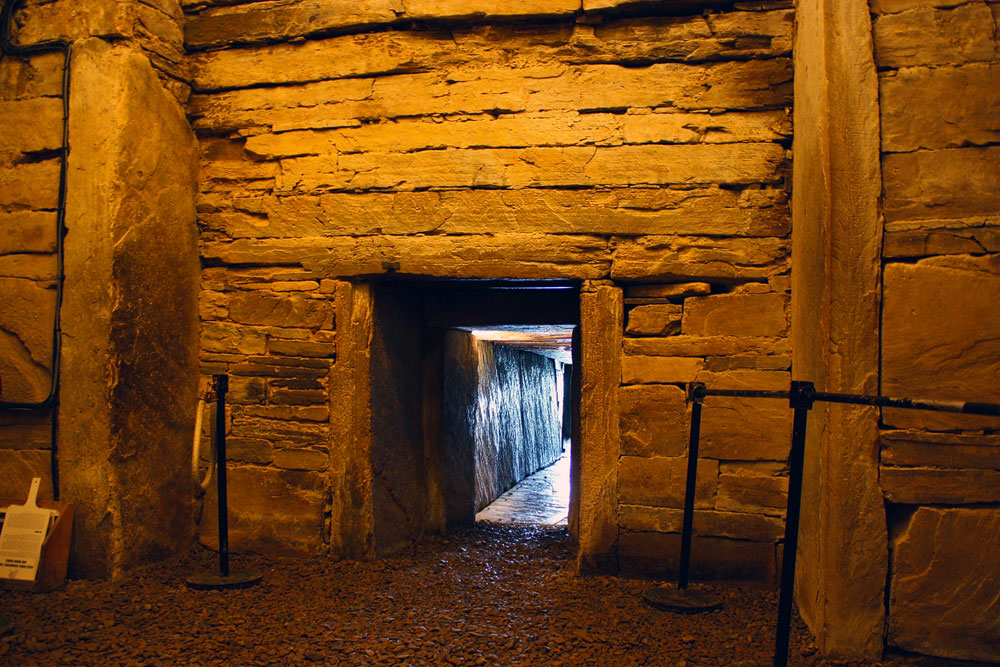
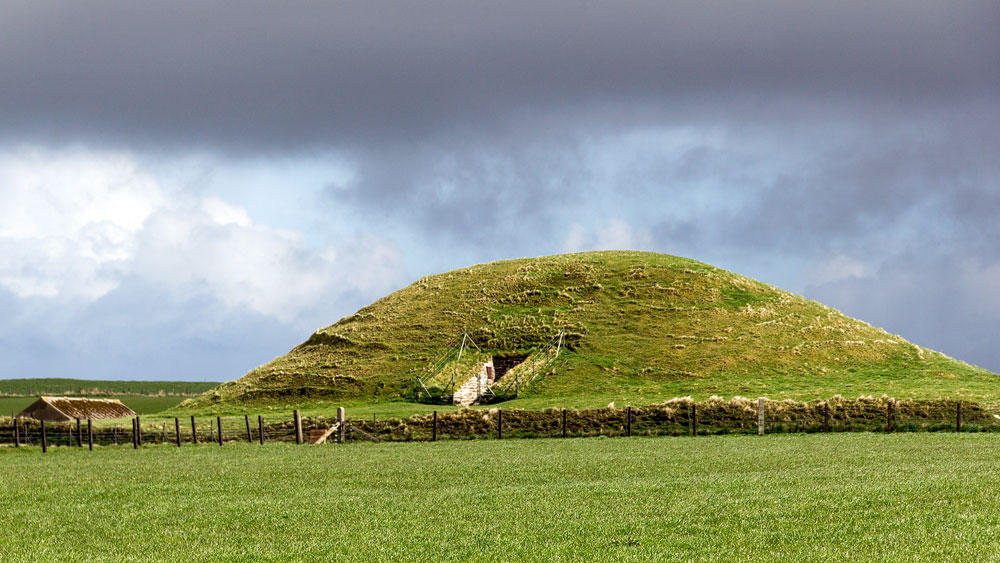
Maes Howe is a chambered cairn – and what a cairn! One of the most impressive in the whole of Europe. Though you wouldn’t necessarily guess it from the outside, since all you see is a large grassy mound. As so often, it’s the inside that counts: beneath the layer of grass and clay lie sandstone slabs stacked on top of one another – some as long as a bus.
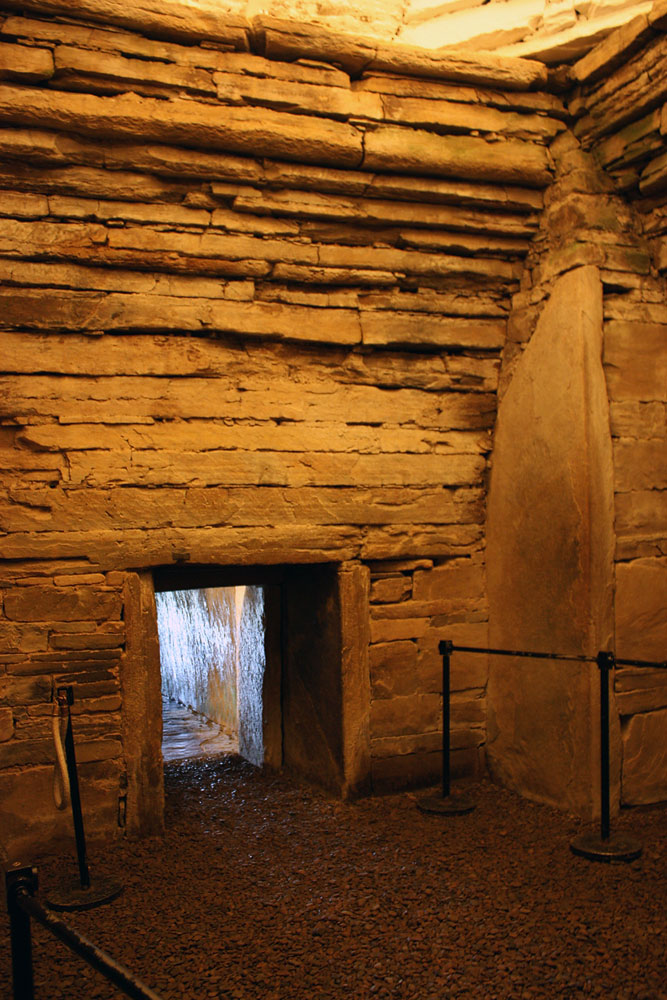
Visitors enter through a narrow portal and a long underground passage that ends in the large chamber. The roof of this chamber is held up by four gigantic stone pillars. It’s genuinely spacious in here – a group of 20 visitors doesn’t need to stoop, nor do they stand on each other’s toes. The ceiling floats four metres overhead.
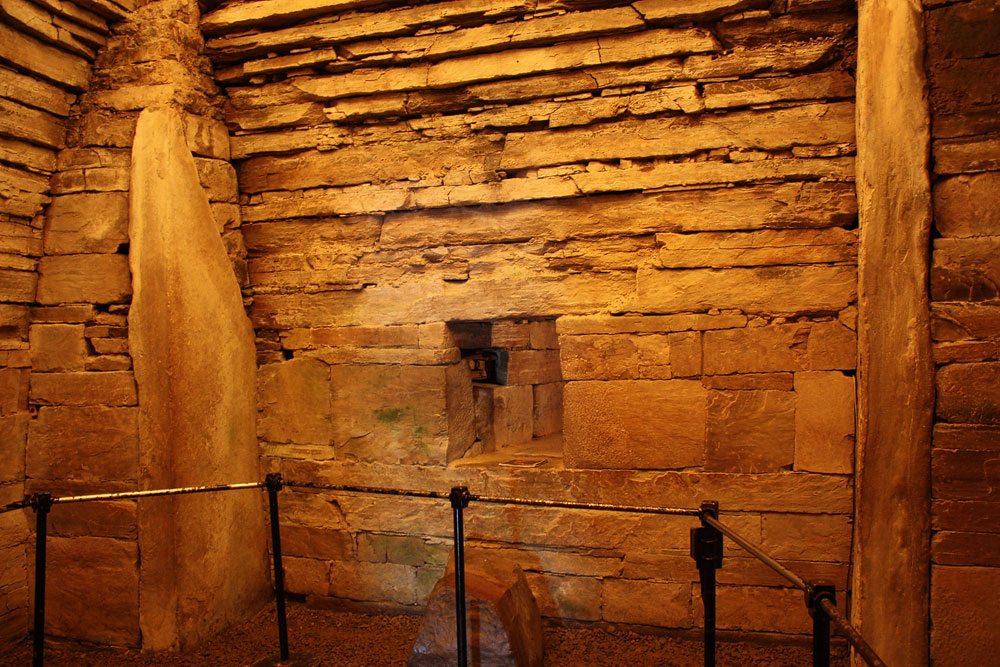
Mortar? Not needed. The architects were masters of dry-stone construction and sealed the tomb so well that even in Scotland’s climate, the inside never got damp.
But if even Elvis couldn’t have built Maes Howe, how did Stone Age people manage it 5,000 years ago? How, for instance, did they bring a ten-metre-long, three-tonne stone here from the sea? How did they hoist this giant up onto the other stones so it forms the entrance tunnel together with them? And all this in an era when the Egyptians weren’t even thinking about pyramids yet.
Could this really have happened without supernatural – or at least extraterrestrial – help?
Science doesn’t know for sure. It has theories – set against dozens of others from ufologists and esoteric believers. But at least the scientists’ theory can be checked for plausibility. Historians believe the stones were laid on beds of silt and seaweed and dragged here on the resulting slide, before finally being hauled uphill onto the other stones. And that’s actually quite easy to follow – it’s even been re-enacted.
Time jump! From today back to the 12th century. Same spot. It’s winter, and inside the tomb a few crusaders from Norway are bored. Caught out by a winter storm, they’d broken into the tomb to shelter from the cold.
But what do you do in a tomb? Well, whatever men tend to do when left alone: crude jokes about women do the rounds, boasts about one’s own skills, dreams of riches. And so that posterity would get something out of these lines too, the Norsemen carved them straight into the stone of Maes Howe.
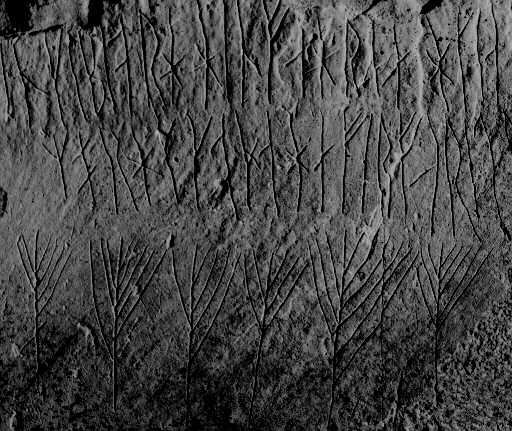
Runic graffiti, basically, as a way to pass the time.
And that’s exactly how it reads. Take the lines about the beautiful widow Ingeborg, who’s said to have given herself rather too readily. Today you’d probably scrawl a phone number underneath. Some of the runes get pretty explicit.
Others, meanwhile, promise a treasure supposedly hidden nearby – nothing has ever been found, at least so far.
And then there’s the message that simply states its writer is the best scribe in the western world. Why does he write? Because he can – and in a secret code, too, which he promptly proves.
But there’s real artistry among the inscriptions too, namely finely worked depictions of animals: a dragon, a wolf, a serpent.
Back to the present. What was a pastime for the Norwegians is a treasure trove for scientists today. Maes Howe now holds the largest collection of runic inscriptions found in a single place, in three different scripts.
Yet another thing that makes this unassuming mound so unique. So you don’t need Elvis, or UFOs, to be amazed here.
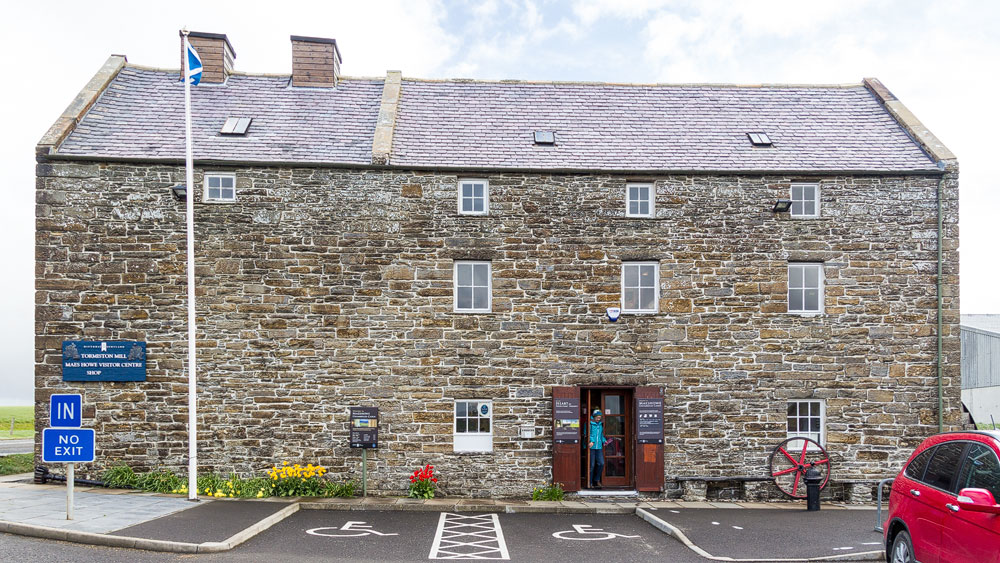
Anyone wanting to see Maes Howe for themselves can do so year-round. Tormiston Mill used to be the visitor centre for Maes Howe, and it may well move back into the mill again at some point.
Right now, though, the tours start from a house a little further down the road. That’s where you buy your tickets and get taken to Maes Howe by bus. You can only get into the tomb as part of this tour.
Good to know: Facts and figures about Maes Howe
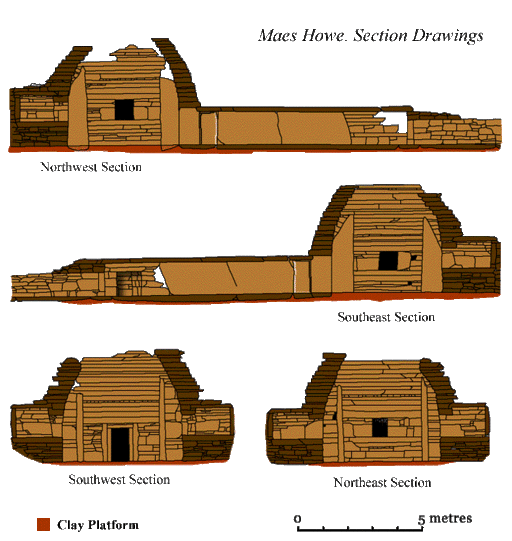
The mound of Maes Howe is seven metres high and 35 metres across. The passage is almost twelve metres long, and the chamber at the end measures 4.7 by 4.7 metres, rising to a height of 3.8 metres. Three further small chambers sit in the side walls, each of which could be sealed with a stone slab.
A ditch runs around the mound, in places up to 14 metres wide. It’s thought this is where the earth used to cover the mound was dug out.
Scientists cautiously date Maes Howe to between 3200 and 2800 BC.
Its actual purpose remains fairly unclear; historians suspect bones were once kept inside, though no traces of this remain today. The tomb was used until around 2000 BC.
The first excavations took place in the 19th century, and a lot was destroyed in the process. The ceiling, for instance, had to be rebuilt afterwards – and unfortunately that was done less well than the original builders had managed, causing some of the large stone blocks to crack.
Tip: Experience the winter solstice
The passage of Maes Howe is precisely aligned with the sunset of the winter solstice. That means: around the 21st of December, the setting sun shines directly into the tomb and lights it up in an eerie glow.
You can experience this spectacle on site – or follow it on the website, here.
The video from Maeshowe.co.uk that I’ve embedded above gives a good impression of it.
Personal note: Elvis and more
When the Historic Scotland guide told the story of Elvis, I nearly fell over with delight. And it stayed that way, because the knowledgeable guide didn’t just share facts, but got everyone excited about the subject with a real touch of humour too. Tours like that, I find, are genuinely worth it.
Only downside: I wasn’t allowed to take photos inside, so I had few photos of my own available for this piece and had to fall back on Wikipedia for some of them. That said, the guides at Maes Howe were kind enough to also provide me with photos of the interior. Many thanks to them!
Getting there:
For your sat nav: Enter “KW16 3HH” and watch for the signs in good time.
Without sat nav: From Stromness, simply take the A965 towards Kirkwall. In the village of Stenness, turn right opposite Sutherlands Garage, and the visitor centre then appears on the left.
From Kirkwall, take the A965 towards Stromness and in Stenness turn right opposite Sutherlands Garage. The visitor centre is then on the left.