Why the Blessed Virgin Mary watches over the island of South Uist as the Lady of the Isles, and how “Father Rocket” got his nickname.
For Mary, the Blessed Mother of God, they have their own name here: Moire, in Scottish Gaelic – a name used for her alone (“Mary” is otherwise “Màiri” in Gaelic). On South Uist, the Mother of God is something like a direct line to God. She’s invoked for almost everything, if only through the startled exclamation “A Mhoire” – “Mary!”. Generations of fishermen from South Uist have relied on her protection when they put out to sea.
Mary, Mother of God, was also meant to spare the islands from an unpleasant affair in the middle of the 20th century. The Second World War had only just ended, and the British government was very keen to build up its military strength. In the 1950s, the Ministry of Defence therefore hit on the grand idea of building a rocket launch base on South Uist, complete with a large garrison stationed there.
At first, the islanders had nothing against it. After all, it would bring money and jobs. But then the locals learned just how far-reaching the military’s plans were: the facilities were set to take up almost the entire west coast. That wouldn’t happen without relocations and expropriations, not to mention the disfigurement of the beautiful beach. Many soldiers would have been stationed there, with little understanding of the culture, language and faith of the Gaelic-speaking islanders. Suddenly, the whole island’s way of life was under threat, and that was something the islanders weren’t willing to accept.
But how do you fight back against something as powerful as the British military? Only an even higher power could avert this disaster – one whose help they could always count on.
The Blessed Virgin Mary.
Father John Morrison set about mobilising divine assistance. He organised prayers and had shrines erected along the roads that would lead to the future rocket range. The newcomers were to be made well aware of exactly who they were up against: the Virgin Mary, and the whole island. But Morrison didn’t stop at religious action. He also organised political resistance, skilfully making use of the power of the media.
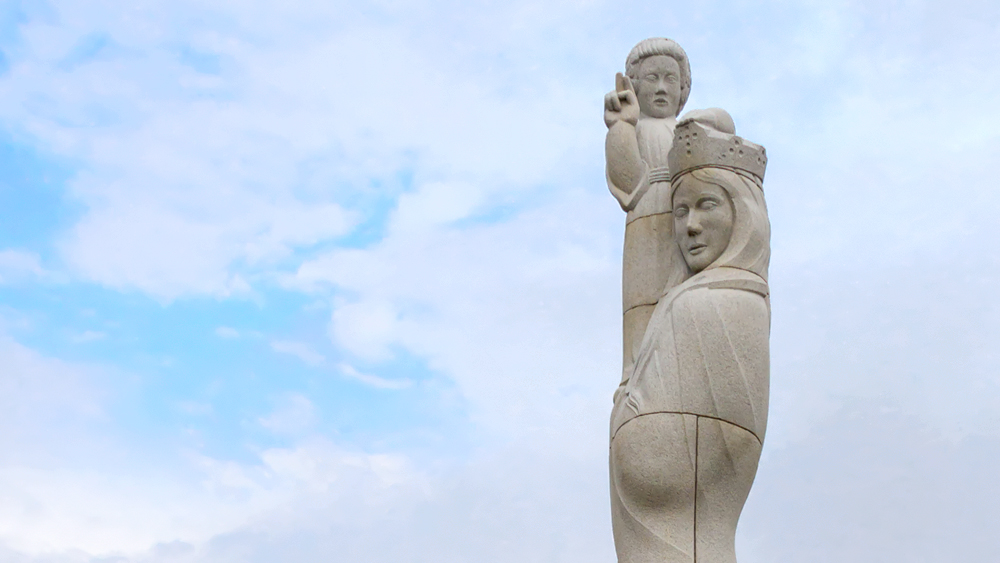
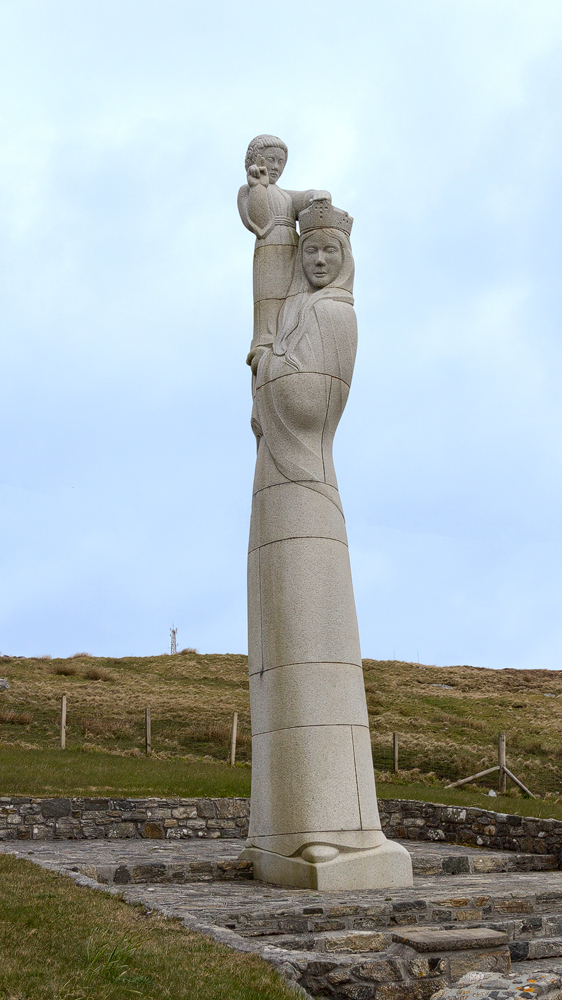
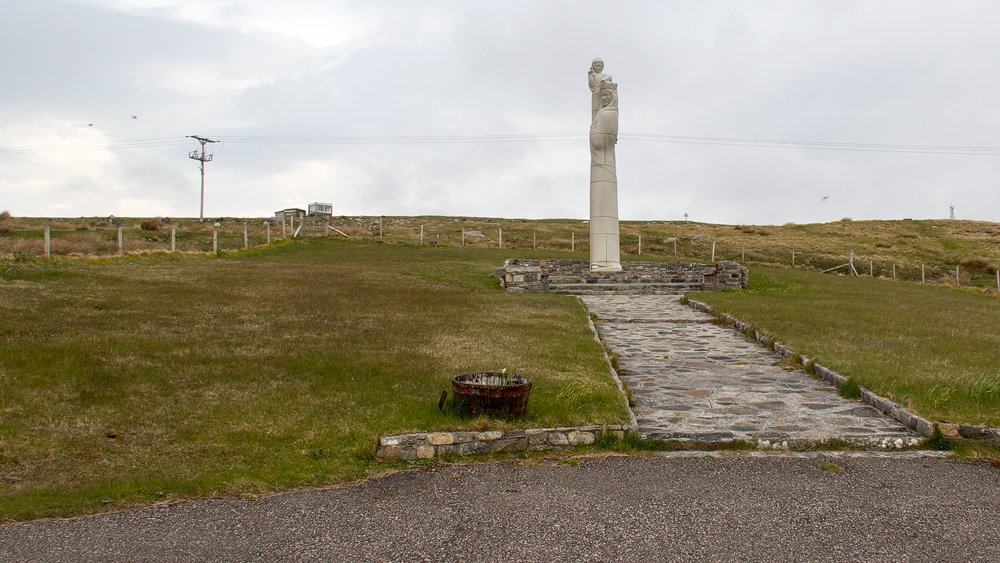
Finally, in 1954, he wanted to put Mary’s power on display once and for all. On the hill of Ruabhal (in English: “Rueval”), he chose a spot 50 metres up and had the renowned sculptor Hew Lorimer erect a nine-metre-tall statue of white granite there, paid for through donations from the local population and the church. It was completed in 1958 and consecrated as “Bana Thighearna nan Eilean” – “Our Lady of the Isles”. With the Christ Child in her arms, the Virgin’s stern gaze was directed precisely towards the planned rocket base.
All these efforts eventually achieved their purpose. In 1959, the Ministry of Defence announced that the planned large-scale facility would be scaled back to a rocket testing range that could operate without a permanent garrison.
The islanders got their way, thanks to the Blessed Mary. The smaller testing range did indeed bring money and jobs to South Uist, but changed neither the island’s culture, language, nor landscape. The statue of Our Lady of the Isles was added to the list of listed Scottish monuments in 2007.
And Father John Morrison? From then on, he was known simply as “Father Rocket”.
Good to know: Catholics and Protestants in the Outer Hebrides
The Western Isles are religiously divided: while the Isle of Lewis, Harris and North Uist are predominantly Protestant, Catholic priests preach the faith on Benbecula, South Uist and Barra. Unlike, say, the sectarian conflicts seen in Northern Ireland, the residents of Scotland’s western isles live peacefully and understandingly side by side.
Tips: the machair and the rockets
A little south of the statue, at the junction towards Loch Sgioport, a path heads off to the west, already marked with the brown “Slighe na Machrach – Machair Way” sign. If you haven’t yet seen the machair, the famous beaches and the sea of South Uist, now is definitely the time to do so. At the northern end of the beach, incidentally, lies today’s rocket testing range.
Getting there:
With sat nav: “HS8 5RR” will get you close to the statue.
Without sat nav: in principle, there’s only one main road running from north to south across the island, the A865. Coming from the north, from Benbecula, you first cross the causeway onto South Uist. Continue for a few kilometres before crossing Loch Bi. The small settlement of Geirnis then appears on the right, and ahead the road winds its way up the side of a hill, with a radar station visible up on the left. This is the Ruabhal of South Uist (careful: there’s a hill of the same name on Benbecula). Drive up there and watch for the brown “Bana Thighearna nan Eilean” sign. The path climbs fairly steeply, with a small car park at the top.
Coming from the south, drive until you reach the junction where a sign points right towards “Loch Sgioport”. From there, you can already see the Ruabhal with its radar station.