Not much is known about this ancient Scottish people. But the Shandwick Stone gives a real sense of Pictish culture – it’s one of their finest surviving relics.
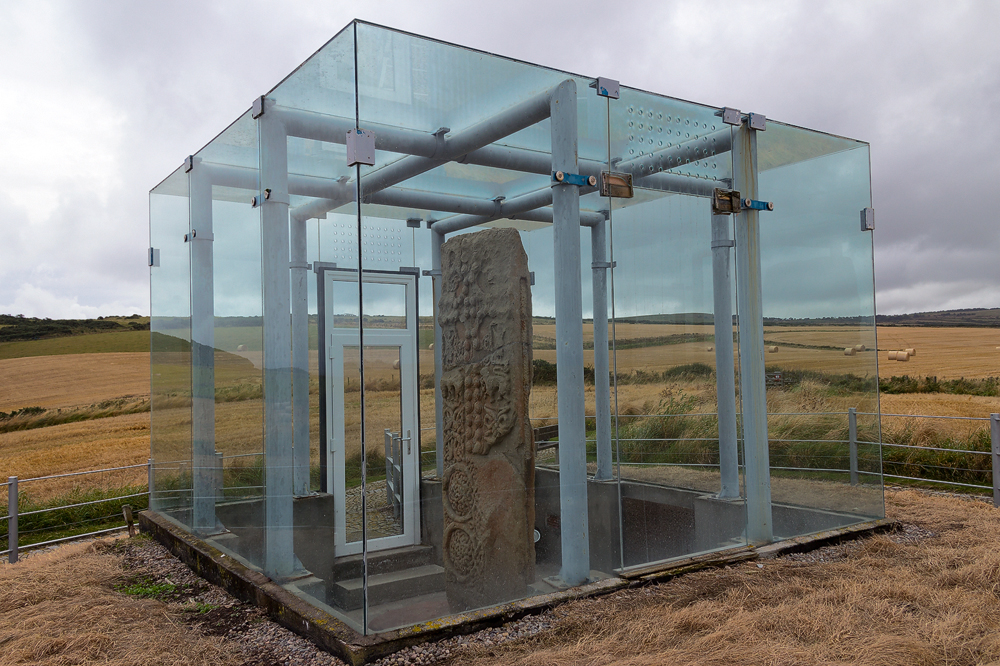
It’s so different from the Celtic crosses in the west of Scotland. The Shandwick Stone radiates a warmth all of its own, thanks to the sandstone’s soft beige colour. At the same time, the engraved symbols feel oddly unfamiliar.
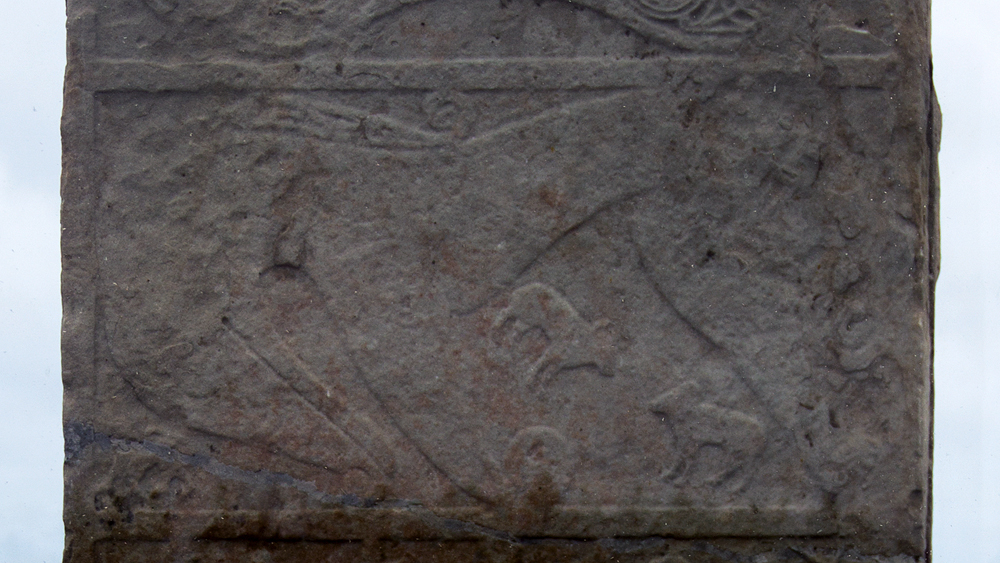
There, for example, is the Pictish Beast, at the top of the side of the stone facing the road – a typical depiction of a creature that, to this day, nobody knows the true meaning of. Below it, viewers find a hunting scene showing a whole herd of animals. Scattered throughout are circular, spiral ornaments and so-called triskeles.
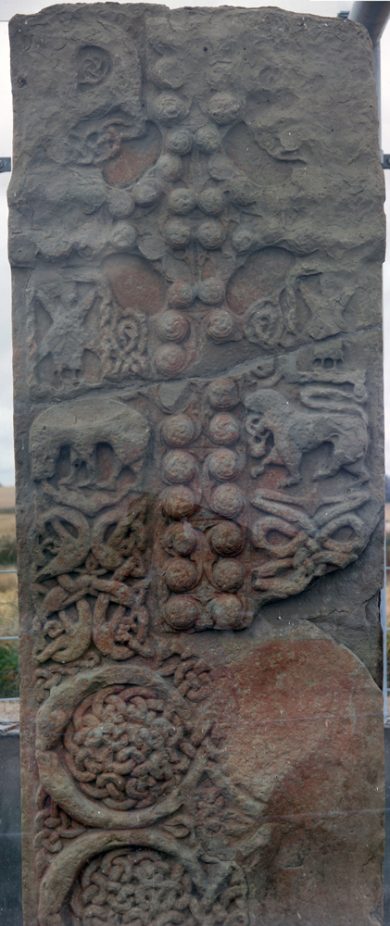
On the side facing the sea, at least the cross feels familiar, even if it looks as though it were made of rivets. The Shandwick Stone is dated to around 780 AD. By then, the conversion of the Picts was already underway. Beneath the cross, though, lies another typically Pictish shape, the so-called double disc.
Despite being Pictish, over the years the stone has of course also picked up a Gaelic name: “Clach a’ Charridh”. “Clach” means “stone”, and “a’ Charridh” likely means “of the burial ground”, since a kind of cemetery stood here until the 19th century. I wasn’t able to find the exact word in a Gaelic dictionary myself, though.
In the middle of the 19th century, the Shandwick Stone broke in two. Today, though, it stands reassembled inside a small glass housing, meant to protect the delicate sandstone from weathering.
Anyone wanting to get a little closer to the mysterious culture of the Picts should absolutely make time to see this stele.
Tip: The stone’s birthplace
The Shandwick Stone stands in an exposed spot overlooking the sea. A few photos with the cliffs in the background are well worth taking, especially since scientists suspect the stone was actually cut from these very cliffs. The surrounding area otherwise offers something rather un-Highland-like: lush fields that glow golden-yellow, especially in autumn.
Good to know: The unknown people and their stones
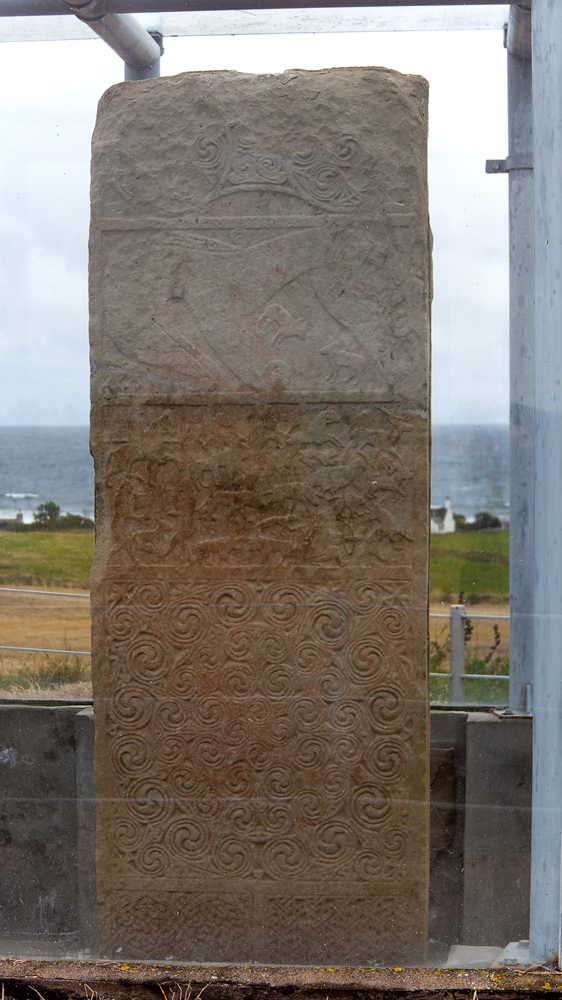
Since the Picts themselves left no writing behind, only little is known about this ancient people of Scotland. The stones and stelae they left behind at least reveal a little. Scientists divide the roughly 350 known objects into three classes. Class I dates from the sixth to the eighth century AD – unshaped stones with patterns and symbols engraved into them. Class II are stelae from the eighth and ninth centuries, precisely shaped this time. Unlike Class I, they already carry Christian symbols and are considerably more elaborate. Shandwick belongs to this second class.
Class III dates from a later period and is already shaped by other influences, or is too generic in nature. It’s generally of less interest for research.
Even so, nobody yet knows for certain why these stones were erected. Theories range from cult sites to boundary markers.
Personal note: Wild wind
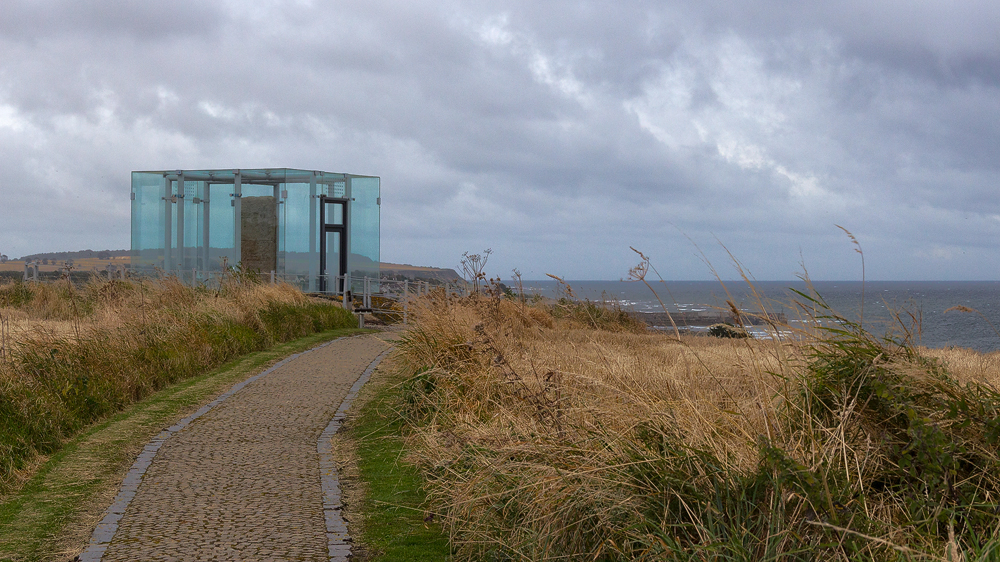
When we were there in autumn, the fields had already been harvested, but straw bales could still be seen everywhere. At the same time, a sharp wind was whipping up the sea, and the sky was overcast. All of it added up to a wonderfully wild atmosphere.
Getting there:
From Inverness it’s about a 50-minute drive north on the A9, crossing both the Beauly Firth via the Kessock Bridge and the Cromarty Firth. After around 50 kilometres you reach the roundabout at Nigg. Take the exit for Nigg here – roughly to the right – and follow the road for a few kilometres, until an arrow on the left side of the road points right towards Shandwick. Watch out, it’s a small turning that’s easy to miss! Then a few hundred more metres, until you see the small wooden gate to the site of the stone on the left. Parking isn’t entirely straightforward, as there’s little space by the roadside – but it’s manageable. If needed, drive a little further down into Shandwick instead.