Near Cladh Hallan lies a Bronze Age village hidden in the dunes. Beneath it, archaeologists made an astonishing find: two mummies, each assembled from the body parts of several people. What’s the story behind them?
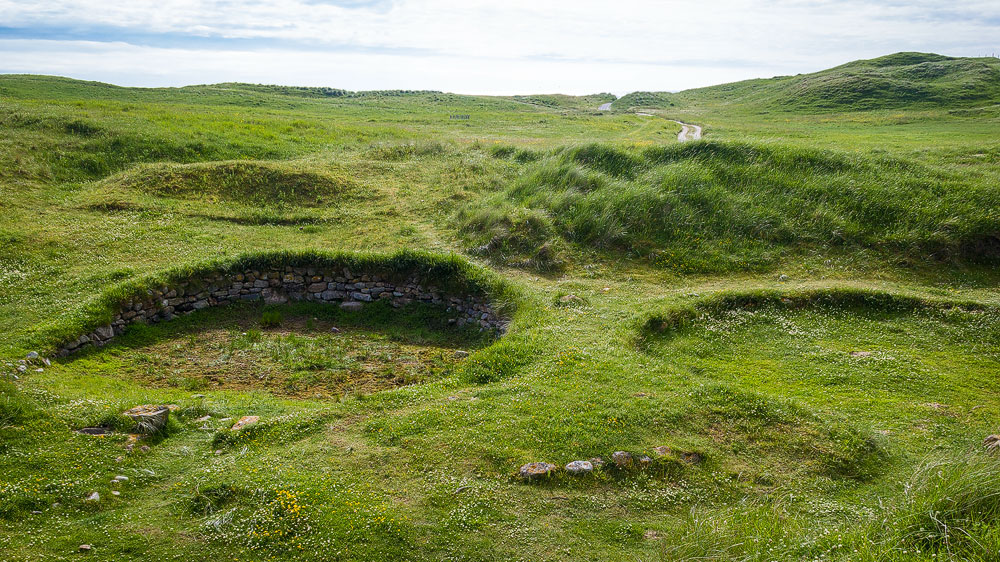
Bronze Age people had built themselves a small, idyllic village right in the middle of the machair of South Uist. With what you might call a beachfront location. Cladh Hallan, researchers believe, once consisted of six or seven roundhouses – the typical buildings of the time. Their walls were set into the ground, the floor lay below the surface, and the thatched timber roof sloped down on the outside to about knee height.
The village was inhabited from around 1100 to 200 BC. Afterwards, sand covered the structures and Cladh Hallan was forgotten, until a storm exposed the remains of three houses. Much to the delight of the archaeologists, who began their investigations there.
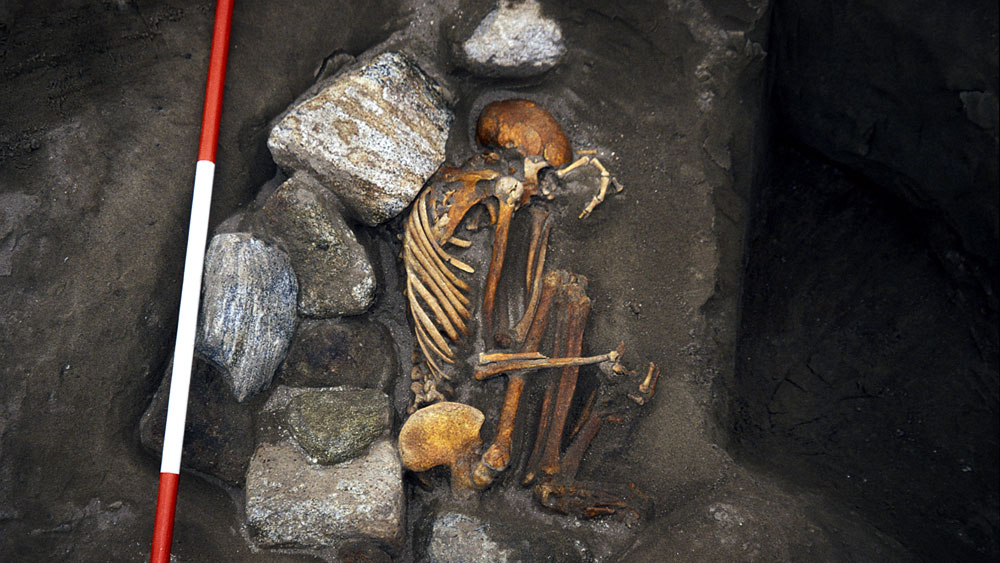
What the team led by Mike Parker-Pearson then uncovered during the excavations at Cladh Hallan was something of a sensation. Nowhere else in the British Isles had evidence of mummies ever been found before. And now there were suddenly two of them, right under their noses, beneath one of the houses at Cladh Hallan – a man and a woman.
Though that’s not quite accurate. The second mummy is predominantly a woman. In fact, the mummy turned out to be assembled from several different bodies: the residents of Cladh Hallan had placed a male head on the female body, and the right arm belonged to yet another person altogether. How do the researchers know this? DNA analysis revealed it in this case.
The second mummy, too, is a composite of several dead individuals. A man’s body was topped with the head of another man, who in turn had the lower jaw of a third person. And the parts didn’t even date from the same period. So it seems a real Dr Frankenstein was at work in Cladh Hallan. But why?
No one can say for certain. But Mike Parker-Pearson at least offers a well-reasoned theory. His idea: in times before people had identity documents, they derived their claim to land and home from their ancestors. To prove that claim, they kept those ancestors visibly with them as mummies. Assembling a mummy from several ancestors might then have symbolised a marriage.
Naturally, the mummies are no longer at Cladh Hallan today. They’re currently being studied by several research teams and will subsequently be handed over to a museum.
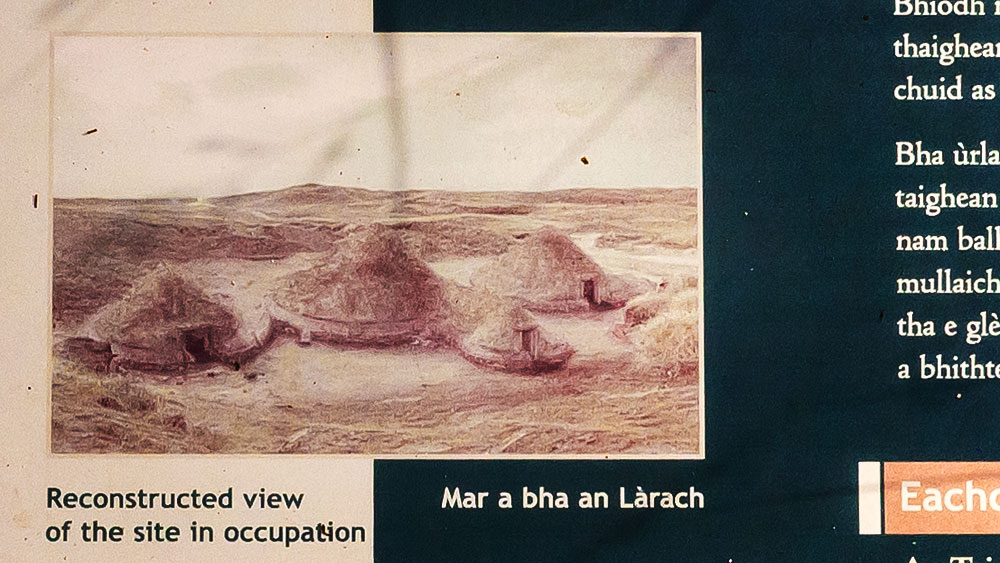
A trip to Cladh Hallan is worthwhile for anyone interested in history even without the mummies, since it’s rare to see Bronze Age remains so freely accessible. Three information boards explain everything worth knowing about the village.
Good to know: details on the village and the mummies
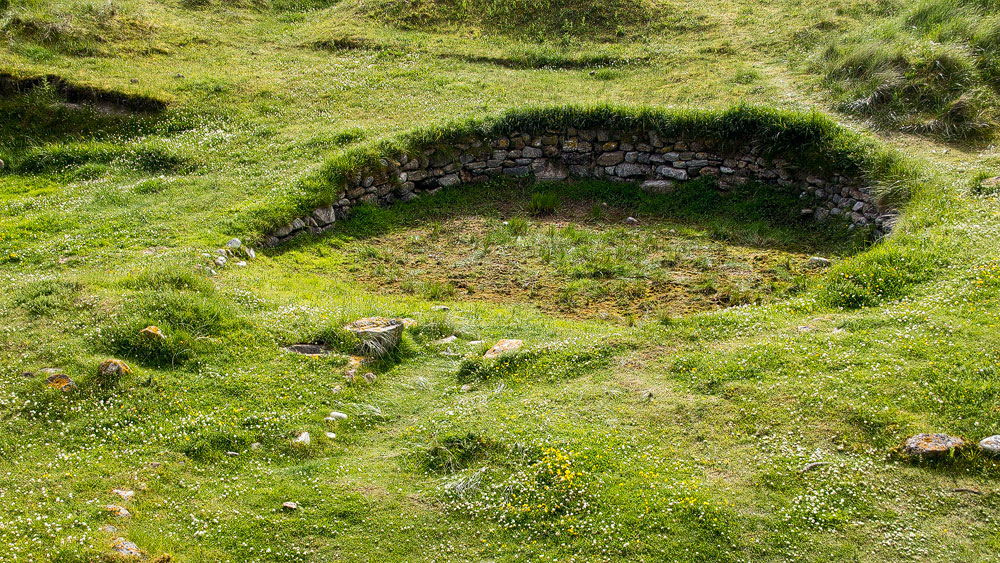
The village at Cladh Hallan was inhabited from around 1100 to 200 BC, spanning the Bronze Age into the early Iron Age. It stretched some 80 metres in length and probably comprised six or seven houses in total. But most of the village still lies buried beneath the southern dune. The large central house you can see today was continuously inhabited for 900 years.
Both mummies were found beneath the north house. It’s thought this may have served as a kind of “house of the dead”.
For the male mummy, the head and jaw of two men date from around 1400 BC, while the torso dates from 1500 BC. The assembled body wasn’t buried until 400 years later. It was therefore kept above ground for centuries. Something remarkable about the man’s head: the skull with upper jaw belongs to an old, toothless man, while the jaw itself belongs to a young man with teeth.
For the female mummy, the body dates from between 1310 and 1130 BC. The male head belonged to an individual who died 70 to 200 years later. The head was missing two teeth, one of which was found in each of the body’s left and right hands. This was presumably meant to establish a connection between them.
Technically speaking, though – as Mike Parker-Pearson pointed out to me in an email – these are “formerly mummified skeletons”, meaning skeletons whose bodies had once been mummified. It’s worth knowing that during the village’s inhabited period, the mummies weren’t buried at all, but kept above ground. Only after several centuries were they laid into the sand. And only then did they decompose down to the bones that were eventually found.
How do researchers know this? Human bones are actually riddled with tiny blood vessels. When a person dies, bacteria enter through these vessels and begin a destructive process there too. But in these skeletons, this process could only be detected in the outer layers. The conclusion: the body initially began to decompose normally, but this process was then abruptly halted. Much later, the mummies were buried in the sand, where the tissue finally broke down.
The mummification process likely involved removing the organs, binding the body together and sinking it into peat. This essentially tanned the tissue, much like leather. The bones point to this too, both through a discolouration typical of peat, and through visible depletion of certain minerals in the bone – a process that also stopped again after a short time.
The Cladh Hallan mummies are the only ones of their kind found in Britain, though it’s assumed the practice may well have been used elsewhere at the time too.
Source: “The Cladh Hallan mummies” by Mike Parker-Pearson, published in 2015 in M. Cardin (ed.) Mummies around the World: an encyclopaedia of mummies in history, religion, and popular culture. Santa Barbara CA: ABC-Clio. 67-70
Tip: a walk into the machair at Cladh Hallan
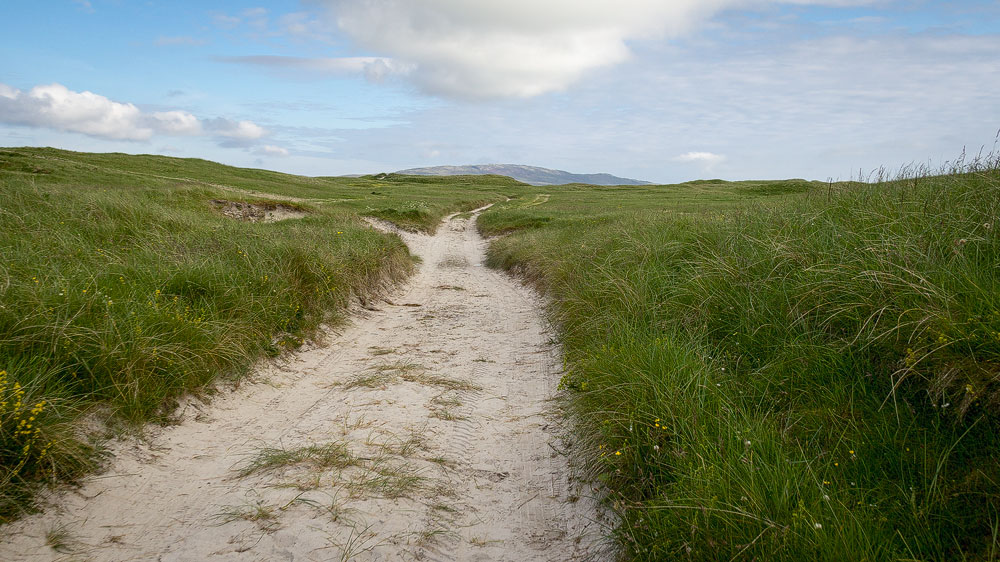
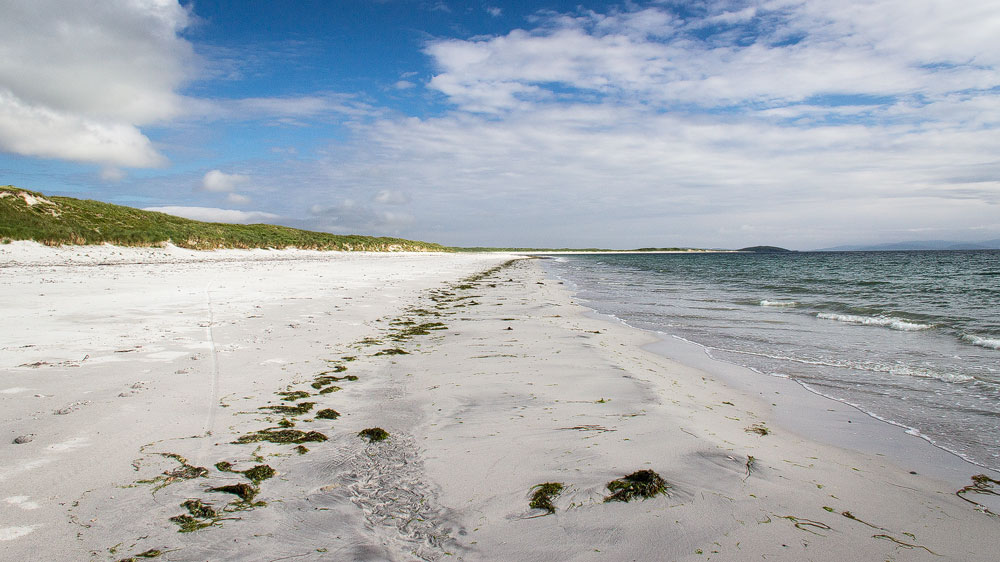
The village remains are pleasant to look at, but there’s no particular reason for the average tourist to make a special stop here. Still, the trip is worthwhile if you think of it as a walk through the machair and dunes down to the beach.
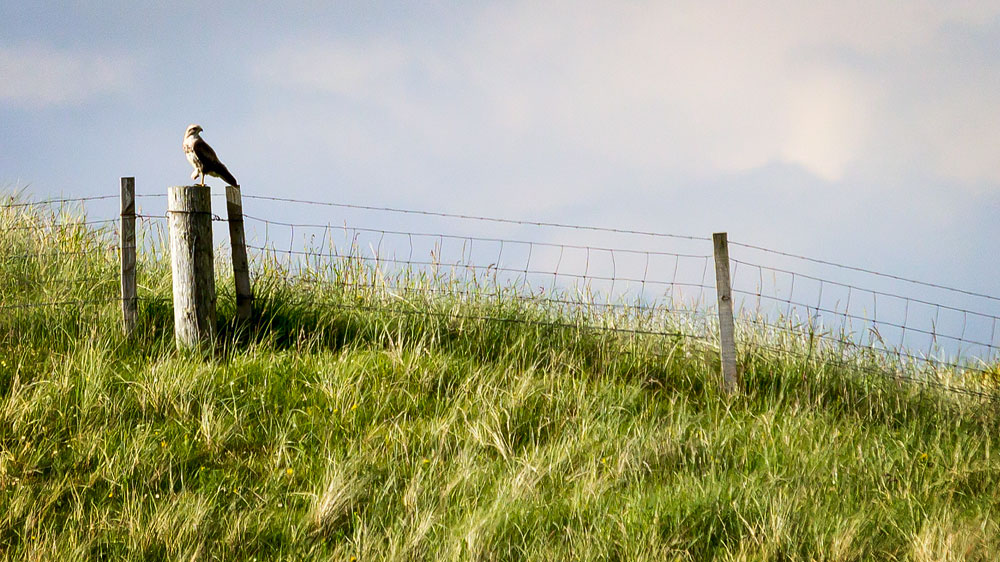
It’s worth keeping an eye on the sky along the way, too, since with a bit of luck you might spot birds of prey or watch wild geese passing overhead during the walk.
Personal note: help from Mike Parker-Pearson
When it comes to Bronze Age archaeology, Mike Parker-Pearson is a renowned scientist at the UCL Institute of Archaeology, whose work I’ve come across many times during my research. Since I really wanted a picture of one of the mummies, I wrote to him personally, though I held out little hope of a reply. I was wrong.
Within six hours, I not only had a good photo I was permitted to use, but additional written material too. My thanks to him again here.
Getting there:
With sat nav: “HS8 5SS” will take you to Daliburgh, then continue as described below.
Without sat nav: Coming from the north on the A865, continue to Daliburgh (Dalabrog). There, a large white sign points towards Pol a Charra and Eriskay. Turn right here onto the B888, then immediately right again towards Cille Pheadair. Follow this road on until you reach the large cemetery of Cladh Hallan. Get out and look for the path through the dunes.