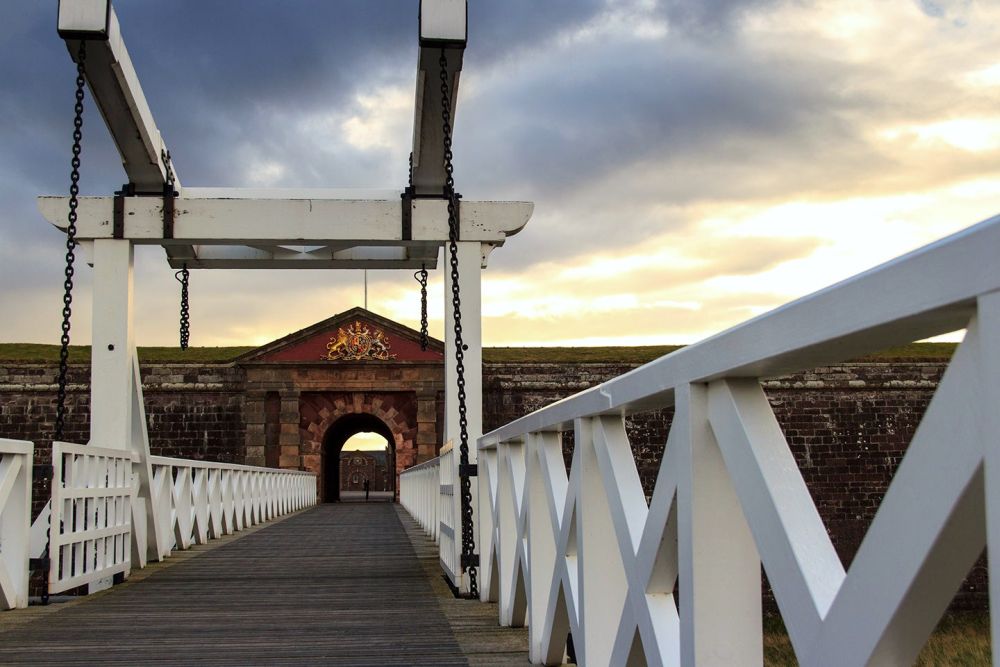
A building conceived as a massive threat to the clans: never again shall you rise up! Even today, Fort George radiates a sense of strength and dominance – and it’s not just military history buffs who fall under the spell of the place.
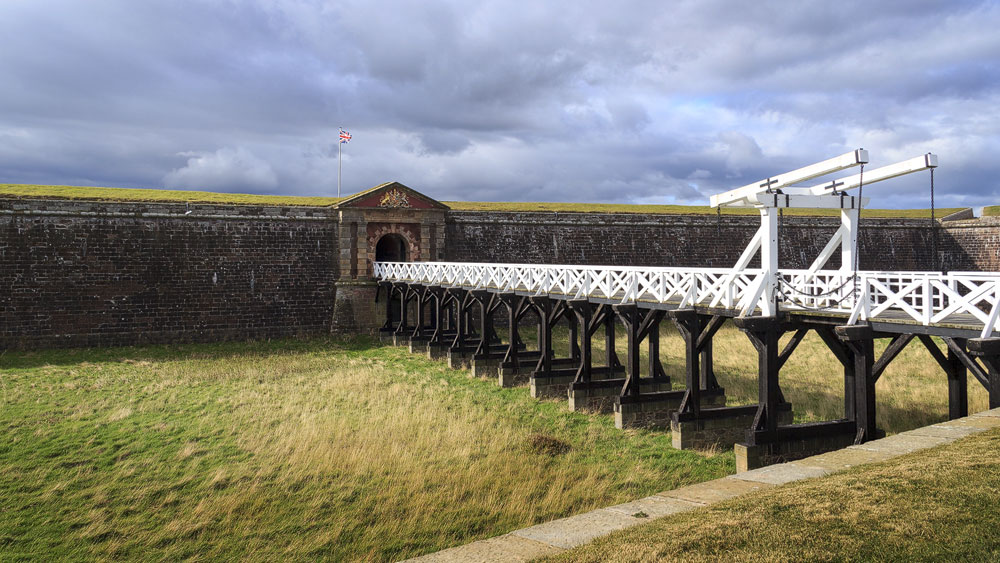
A cold symmetry underlies this barracks: long straight lines, steep ramps, sudden drops – all planned and executed with military precision. Fort George has nothing in common with the usual rambling, higgledy-piggledy Scottish castles. It was designed on the drawing board as barracks for a large body of troops, and built, for strategic reasons, on a headland a little east of Inverness – allowing the garrison to control the bay while also being able to launch expeditions into the interior.
Fort George was the English and pro-government forces’ final answer to the Jacobite Rising of 1746. As a military behemoth, it was meant to enforce the reprisals imposed in the wake of the rebellion against the Crown.
To that end, its builders erected a stone giant 650 metres long and 280 metres wide, costing around £200,000 – roughly a billion pounds in today’s money, for comparison. It took 20 years for the fort to reach its present size, which is why you’ll find different dates on different buildings: 1757 and 1769 are inscribed on two barrack blocks facing each other.
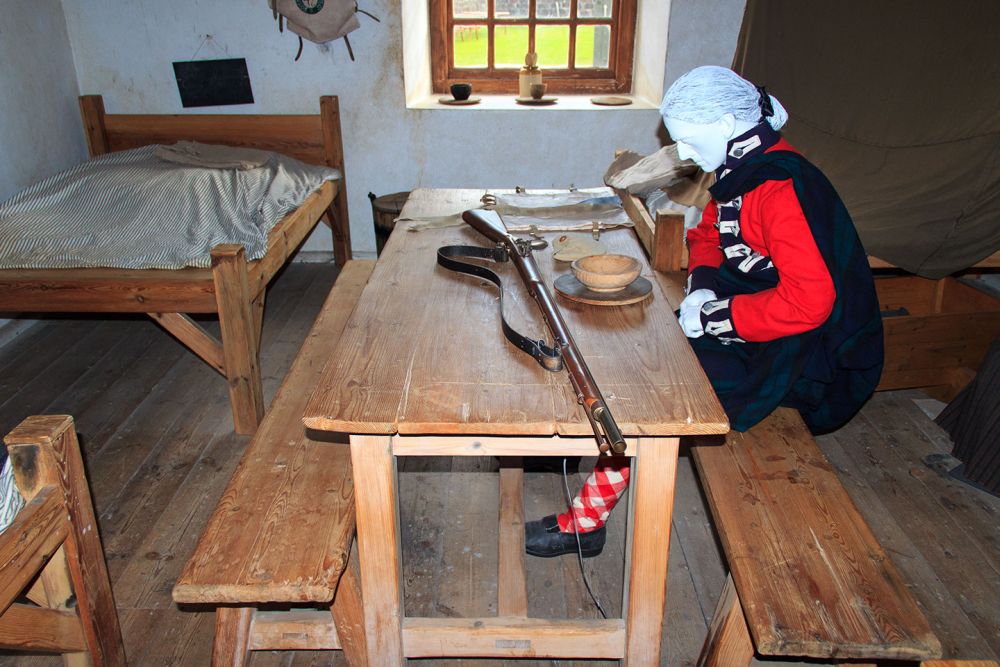
With its chapel, barrack blocks and officers’ messes, its roads and its own harbour, Fort George formed a genuine small town, capable of housing around 1,600 infantrymen. The garrison’s size varied over time – at first, eight soldiers had to share a single room, two to a bed; later, that number was reduced.
Exhibitions in the barrack buildings show what life was like for soldiers back then, and which regiments were stationed at Fort George over the years – and of course, there’s a coffee shop too.
The defensive works around the fortress are impressive: outlying ravelins, towering bastions, and deep ditches that could even be flooded with seawater. Traversing cannons swept the bay and the surrounding land. There was only one real entrance, across a long wooden bridge.
Fort George never actually had to repel an attack, though – none of its many cannons was ever fired in earnest.
Although the barracks are now open to tourists, they’re still in active military use: the famous Black Watch regiment uses the fort as a base. It’s therefore the only site of its kind still in service, while also being maintained by the government body Historic Environment Scotland.
Special features: a tour guide in a little box
One highlight is the digital tour guide handed out with your entry ticket. It’s available in a good number of languages, including German. It brings the history and background of Fort George to life in a lively, engaging way, and visitors can control how much detail they want. Numbered signs are dotted around the fort, and you simply enter the number into the device – which will even tell you where to look. Very cleverly done!
Tip: where dolphins play
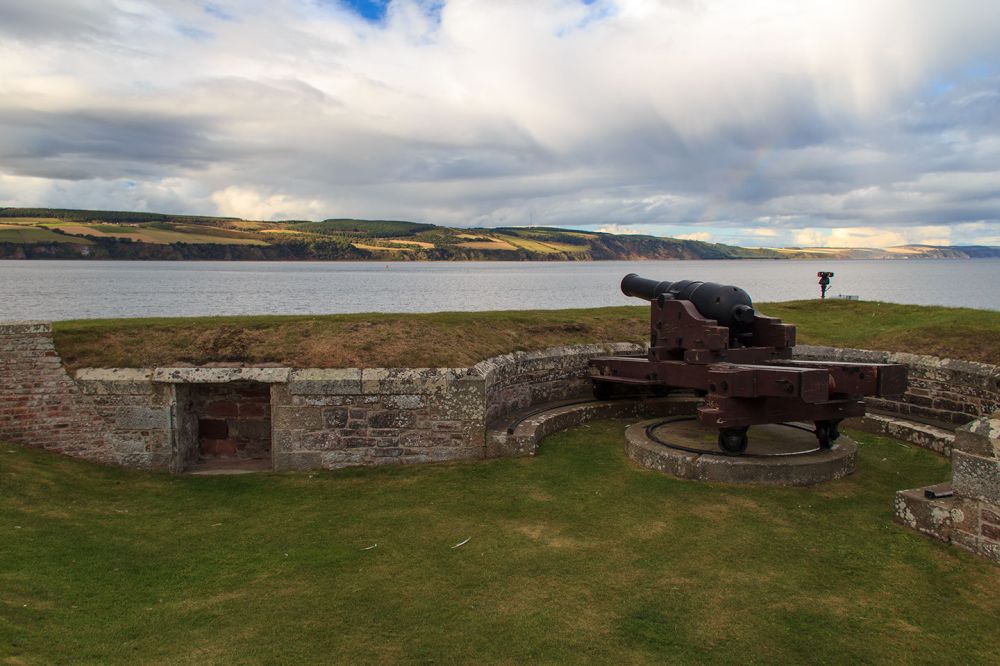
In the Moray Firth, the great bay the fort guards, dolphins gather at certain times of year. With a little luck, you can spot them from the rampart right at the back of the fort.
Did you know: the namesake and architect of Fort George
Fort George is still the largest artillery fortification in Britain. It takes its name from King George II, who commissioned it. There was, however, an earlier Fort George closer to Inverness before 1745, presumably named after the first King George.
The design of Fort George was carried out by a certain Lieutenant-General William Skinner, who also served as its first governor. The works, as he planned them, survive today almost entirely unchanged.
Personal note: a fascination with military architecture
I’d never seen my girlfriend Katrin quite like this before. She was determined to listen to and visit everything the digital tour guide had to offer, no doubt partly because it told the history so engagingly. Meanwhile, I was busy trying to squeeze the site’s stark symmetry into photographs – no easy task with a layout this uniform.
Getting there:
With sat nav: “IV1 7TD” will take you to Fort George.
Without sat nav: From Inverness, take the A96 towards Nairn. After around 16 kilometres, the Military Road (B9006) branches off to the left – a brown tourist sign already points the way here. Follow this road for around 6 kilometres – the surface gets a bit bumpy in places. A large car park then appears on the right, where you can leave your vehicle.