A tower stands in the middle of nowhere, seemingly with no purpose. And yet Scolpaig Tower on North Uist has a fascinating history – its builder had a real goal in mind.
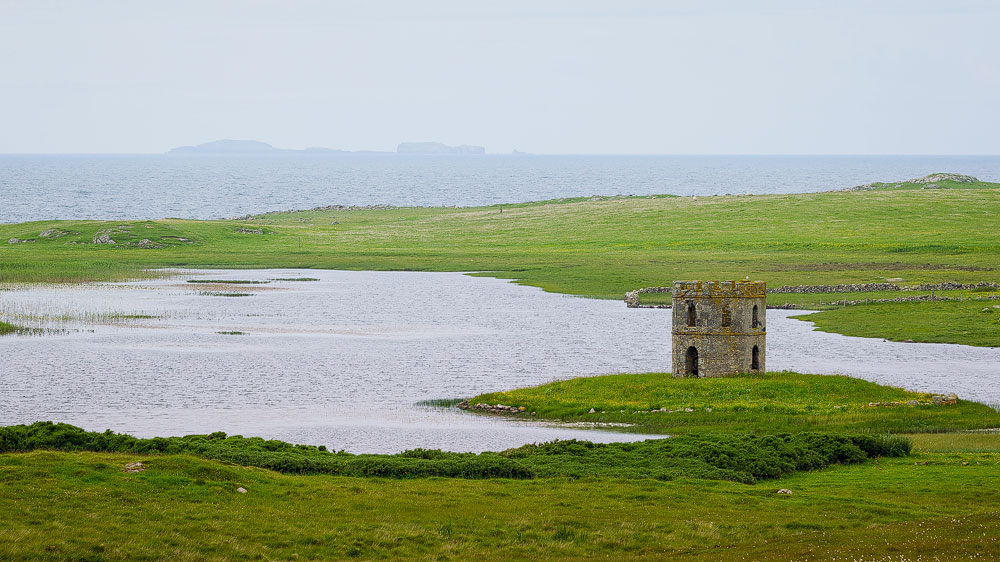
If you came across Scolpaig Tower in the grounds of an English stately home, you’d hardly bat an eyelid. Ornamental follies like this were entirely normal in the Georgian era. But here, on North Uist, there’s no garden to be seen for miles around. Scolpaig Tower sits on a small island in a loch, right in the middle of nowhere.
And yet the tower wasn’t pointless, and its builder was a popular and celebrated man – partly thanks to the tower itself. His name was Alexander MacLeod, and his Gaelic nickname was “an Dotair Bàn” – “the fair-haired doctor” – fitting, given his light-coloured hair.
Doctor MacLeod was born in Cille Phaedair on North Uist – roughly a kilometre southwest of Scolpaig Tower. MacLeod grew up and lived through hard times during the Highland Clearances (roughly 1780 to 1880). Yet he himself ended up on the fortunate side of life, becoming a doctor of medicine and later taking up posts as financial manager of various estates – first on South Uist, then North Uist, and also with the MacDonalds on the Isle of Skye.
During the Highland Clearances, there were essentially only two kinds of people: estate managers exploiting the crofters, or crofters living right at subsistence level – and sometimes below it. An Dotair Bàn, by contrast, managed his estates with restraint and an eye to the future. Today we’d probably call it “sustainable” – he actively supported the crofters. Back then, this approach was rather unusual.
Alexander MacLeod was a man of many talents. On his initiative, for instance, Teampall na Trianaid was partly restored. He also concerned himself with road building, had marram grass planted to make coastal stretches fertile, and cut channels through the land to drain boggy areas. The famous folklorist Carmichael wrote of him: “Instead of draining the estates of their money, like others, Dr MacLeod endeavoured to drain them of their water.” Loch Scolpaig, where the tower now stands, was one such project. MacLeod had parts of the loch drained here to reclaim the land beneath it.
But that still doesn’t explain the tower.
As mentioned, these were hard times for the crofters. In principle, growing potatoes and grain was only part of their work. To pay their rent, they had to take on further jobs too, such as gathering kelp (seaweed) to be processed for soap and glass production. But in 1820 the price of kelp collapsed, and many crofters suddenly lost that secondary income overnight. When several poor harvests followed between 1820 and 1830, hunger spread among the population.
And this is finally where Scolpaig Tower comes into the story. An Dotair Bàn had it built simply to give the crofters paid work – whether the tower itself served any real purpose or not. The lonely tower on North Uist stands as proof that Alexander MacLeod had not just a sharp mind, but a big heart too.
At some point, the doctor accepted an offer to work on the Isle of Skye, also taking on responsibility for the people of Knoydart on the mainland. On 12 April 1854, he set off there on a house call into the interior. Darkness caught him on the way back, he strayed off the path, and fell 20 metres down a slope. And that’s how Alexander MacLeod, “an Dotair Bàn”, died at the age of 66.
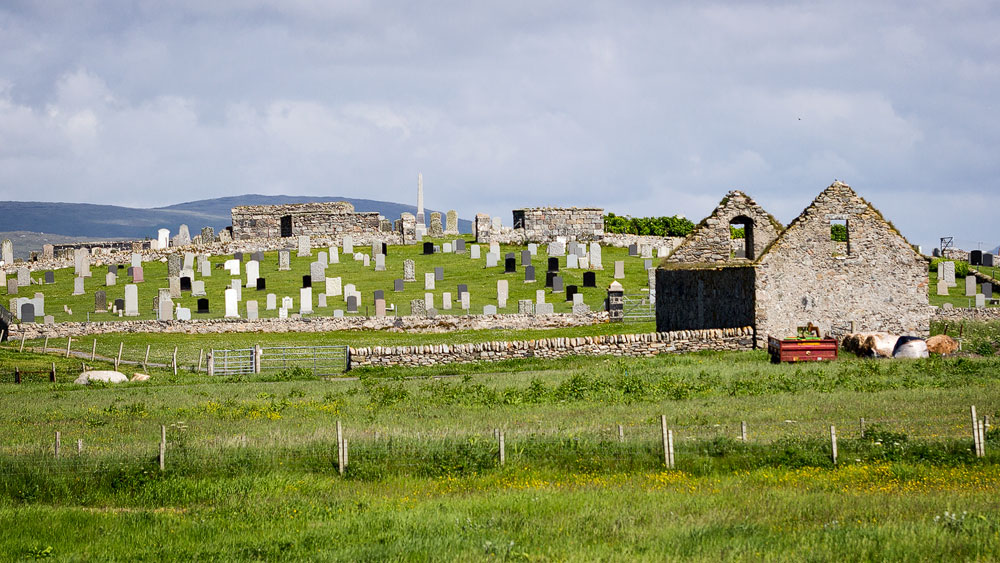
His body was buried close to his birthplace on North Uist, in the graveyard at Kilmuir, right near the Balranald bird reserve.
Today, Scolpaig Tower serves as a reminder that its builder possessed not only a sharp mind, but a big heart as well.
Good to know: Scolpaig Tower and the dun
Scolpaig Tower has another nickname too: MacLeod’s Folly. “Folly” usually means foolishness or nonsense, but in architecture it also refers to an ornamental or purely decorative building.
As mentioned, the tower stands in the middle of nowhere – but it stands there beautifully. On the horizon stretches the rocky island chain of Haskeir. Combined with the loch island, the sea, and the green landscape, it makes for one of the most popular photo spots in the Outer Hebrides.
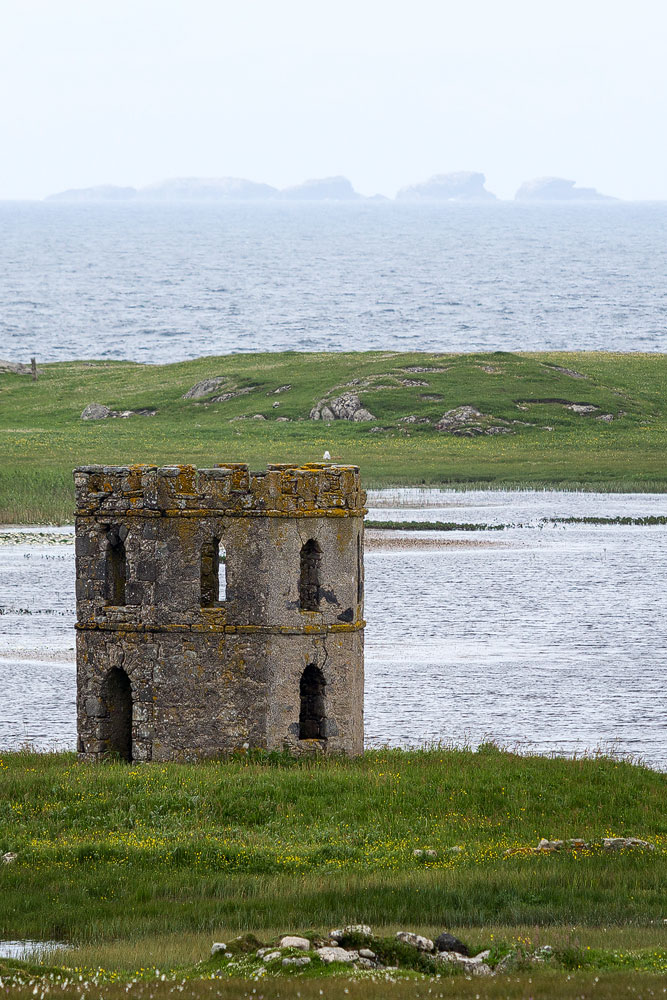
The octagonal masonry was built in the Georgian style – strict symmetry, the typical arches over windows and doors, and surrounded by water. It’s pure folly in the architectural sense too: there’s nothing at all inside the tower.
You can only reach the small island in Loch Scolpaig when low water levels expose the stone causeway leading there. These stones, along with the ring of stone around the tower, likely belonged to an earlier structure – a dun, an Iron Age fort, is said to have stood here once, its materials “recycled” in 1830.
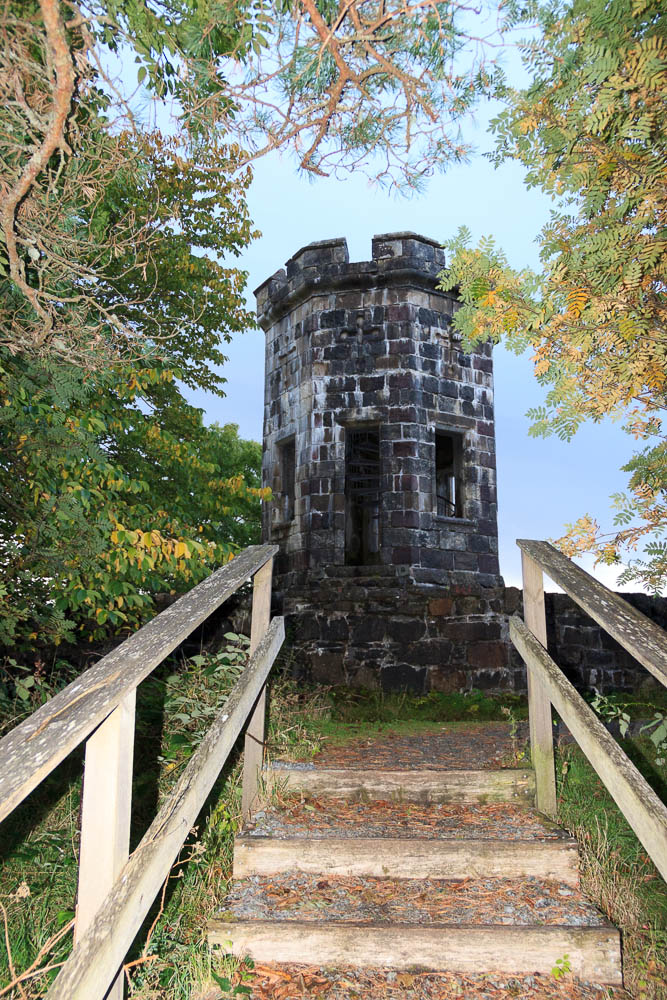
Scolpaig Tower has a big brother, incidentally. During his time on the Isle of Skye, An Dotair Bàn also had a very similar tower built in Portree – the Apothecary Tower, which still stands there today as a viewing tower on the hill known as “the Lump”.
Tip: photographing Scolpaig Tower
Coming from the main road, you can turn onto the side road leading to the tower and park to one side there. From here you get a good view across the land, since the spot sits slightly elevated. If you then walk a little way along the roads, you’ll find the best angles too. Just keep an eye out for the overhead power lines.
Personal note: a quick stop by the roadside
As lovely as the story behind the builder is, we only spent a little time at the tower itself. The closed gate and the fence put us off, the weather didn’t really favour a hike, and we couldn’t have crossed over to the island anyway. The view from the road was enough for us on this occasion.
Getting there:
With sat nav: entering “HS6 5DH” will bring you to Scolpaig. You don’t need to drive all the way down, though – it’s enough to park after turning onto the farm track and take your photos from there.
Without sat nav: essentially, follow the A865 across North Uist until the tower comes into view on the sea side of the island. Then turn onto the farm track and park.