They are a trauma of the Highlands: the so-called Clearances. But what does the term actually mean, and what happened? Here are the key explanations.
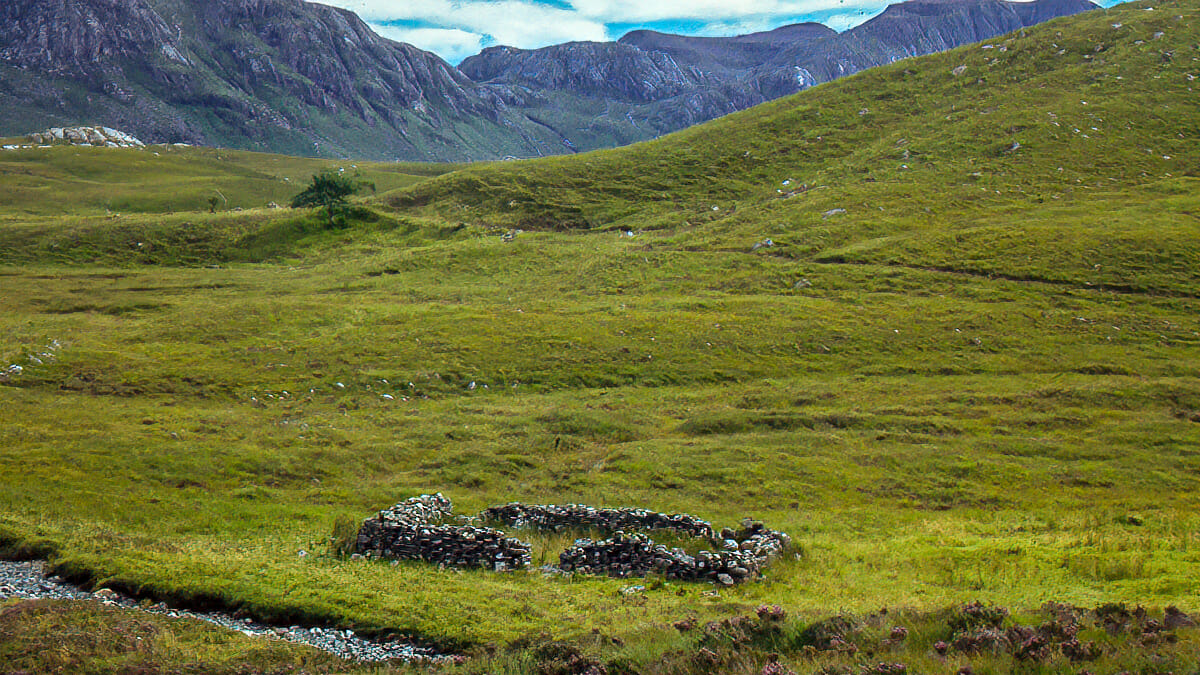
Quite simply, “Clearance” first of all means “removal”. The “Highland Clearances” refer to the depopulation of the land areas in north-west Scotland during the late 18th and the entire 19th century.
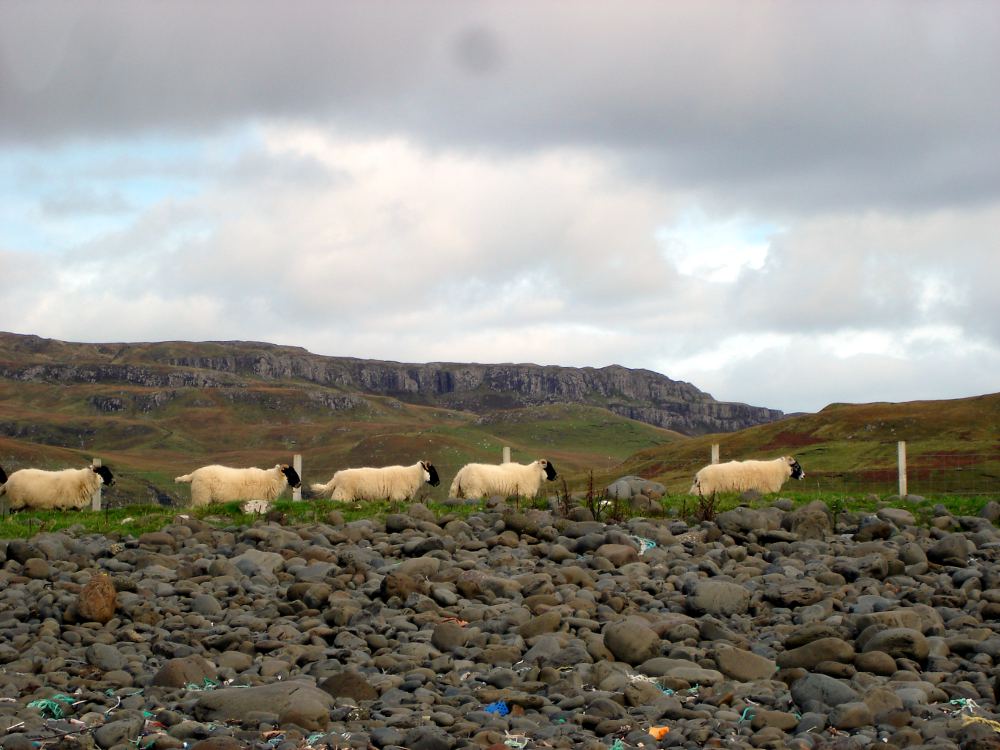
The place of the people was mostly taken by animals we still encounter in vast numbers in Scotland today: sheep.
How did the Highland Clearances come about?
Ask a resident, and they’ll tell you a story of greed: at the time, the wool trade had become more profitable than income from leasing land to farmers. By evicting farmers and establishing sheep farming, landowners could increase their yield.
In fact, there were probably more reasons for the Clearances:
- The economic conditions of the time
- Structural change and industrialisation
Conversely, one might also ask: could the Highland society of that time have survived economically over time? And what would Scotland look like today if this structural change had not taken place?
What was so special about the Highland Clearances?
That sounds like a cynical question at first. But looking at conditions across Europe at the time, the exodus towards the cities and emigration to America was something that took place not only in Scotland.
So why is it so present in the memory of the Scots? One reason is likely that after the Battle of Culloden, Gaelic identity was lost along with the Clearances. This means: the protective clan system disappeared, the language was pushed back, and many lost land and family members. All of this happened within a relatively short span of time.
Understanding the Clearances means understanding the old clan system: the chief, the head of the clan, was generally seen as the guardian of the land, not as its owner. In the clan members’ understanding, the land belonged to everyone. The chief’s noblemen, the tacksmen, distributed farmland so that everyone benefited fairly.
This soon changed after Culloden. While some chiefs still clung to their old role as protectors, in the end all of them came under financial pressure to succeed, brought about by the forced opening of Highland society.
Whereas chiefs used to live solely off the food given to them by clan members, they now needed money. So they began to lease the land to farmers who paid rent. This broke with old tradition and, as Samuel Johnson described on his journey through the Highlands, the chiefs turned from “patriarchal rulers into avaricious landlords”. The chiefs became the lairds.
The lairds had no more use for the former class of tacksmen. A “factor”, a kind of manager, was enough to administer the land going forward.
This breach of trust was hardly comprehensible to many clan members. Those who couldn’t pay were evicted – and that was most of them. The houses and small villages were burned down, fertile and well-tended fields inland were reduced to pure pastureland – first for cattle, which were now bred in huge numbers and sold to the Lowlands, later for sheep and their wool. All of this brought in more money than tenant farming.
What became of those who were evicted?
Of course the great landowners also had a plan for those evicted from the land. They settled them on so-called crofts, mostly located on the coasts. Crofts consisted of a house and a little land. But this land didn’t have the quality of the former inland fields; the crofter first had to make it arable. A laborious process in which stones had to be cleared and so-called lazybeds laid out. The crofter also had to build a dwelling with his family from scratch. The worst part: the more successfully a crofter worked, the more likely he was to be evicted from there again, because the now-arable land was taken back by the laird – he had the right to do so. The crofter could start over somewhere else.
A hard life that was to become even harder. Because the croft was leased from the landlord, meaning it had to be paid for. But the croft itself only produced food for the crofters themselves. The result: crofters were driven into additional work.
On the Hebrides and along the west coast, for example, kelp – large seaweed – was collected and burned. The ash was full of potassium carbonate and soda, a basic ingredient in the glass and soap making of the time. Legally, the seaweed belonged to the landowner, and of course he pocketed most of the money for it.
In short: the lairds had found a system for clearing land and keeping cheap labour. The population was pushed to the coasts and impoverished. The Gaelic culture of the Highlands began to disintegrate.
Emigration to America
The Highland Clearances are one reason why Scots spread across the world, as many could no longer bear the conditions and sought their fortune in the New World. There, the chances of a good life were perhaps even better – even though no one wants to lose their home. It was often the former tacksmen who once again showed their leadership skills here, organising the emigration of entire branches of families.
This wave of emigration (currently only available in German) soon swelled to such an extent that the lairds feared they would soon have no more cheap labourers and crofters. So in 1803 a law was passed without much ado, as a result of which the price of ship passage to North America rose so much that many Highlanders could no longer afford it.
The result: many ended up in the growing cities of Edinburgh and Glasgow, where at least some found work.
What were the consequences of the Highland Clearances?
Almost the entire population of the Highlands had once been free farmers and warriors. Within a few generations they had become impoverished crofters, dependent on additional work. And this was soon to lead to a humanitarian catastrophe.
The crofters had come to rely on a new plant, easy to grow and providing a good food source: the potato. But in 1846 blight swept across the land, a fungal infestation that destroyed the entire harvest within a few weeks. The result: years of hunger and death prevailed in the Highlands.
The end of the Clearances
It was around 1880 when ideas from Ireland took hold, spread also through a newspaper called “The Highlander”. It rekindled the idea of Gaelic identity and fuelled the resistance of the crofters, who had finally had enough of the lairds’ arbitrary rule.
There were uprisings, such as the “Battle of the Braes” on the Isle of Skye. Added to this was a left-wing movement across Great Britain and a press that asked critical questions. In 1886, finally, the “Crofters Act” was passed, a law that protected, for example, against arbitrary eviction from the land.
Highland Clearances: structural change with a lot of suffering
To say the Clearances were carried out by the English in retaliation after the lost Jacobite Rising (currently only available in German) would be too simple. In fact, it was the clan chiefs themselves who committed this injustice – and it is precisely this perceived breach of trust that added itself to the suffering of the eviction.
The Clearances were a structural shift away from a fair and communal agrarian society towards a turbo-capitalism that made a few lairds very rich while leaving most Highlanders very poor. The fact that this upheaval came so suddenly and brutally makes the Highland Clearances something special in Europe. That structural change occurred during the era of the industrial revolution is, from today’s perspective, understandable.
The countermovement to the Clearances placed Gaelic culture back at the centre of Highland identity. That is surely one reason why we see a renaissance of this language and its music in many regions today.
More in the podcast/video
You can find more information about the Highland Clearances in the podcast (currently only available in German) on the subject, also available as a YouTube video:
