Houses are an expression of their builder’s soul. Fittingly, Ormacleit Castle today is a bare ruin, threatened with final collapse. But it wasn’t always this way.
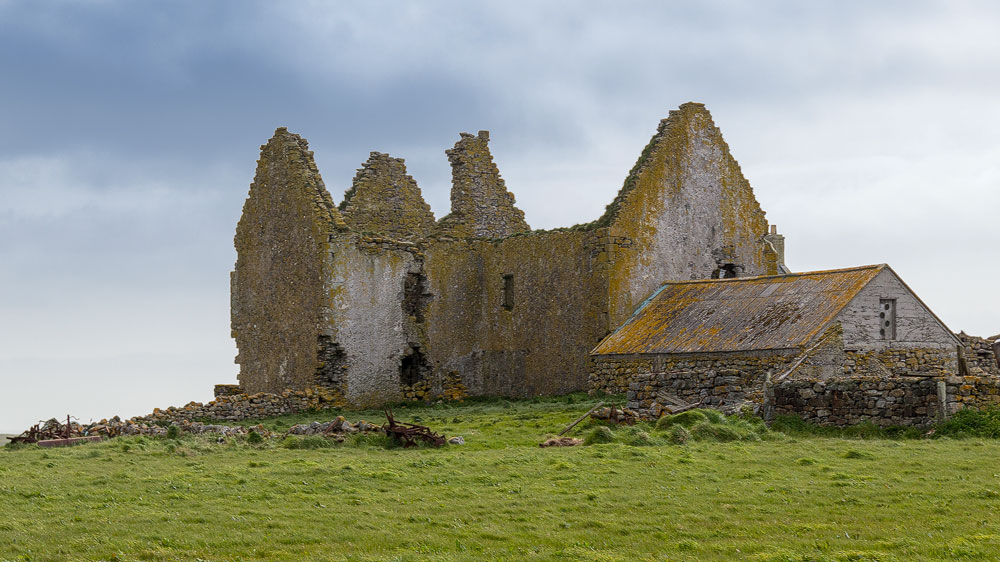
Ormacleit Castle was once home to a colourful figure, worldly and devoted to culture. This person was the head of Clanranald, the powerful branch of the MacDonalds. Allan Dearg MacDonald of Clanranald, “Red Allan”, became the 14th chief of his clan and was quite popular with his “children” – something that mattered a great deal for a clan chief.
Allan, however, had a problem: his main seat, the mighty Castle Tioram on the Scottish mainland, had been occupied by government troops since 1689, following an uprising. He himself was still very young at the time, and first earned his spurs as a soldier in the service of France. There he met Penelope Luis MacKenzie; the two married in 1696 and – since Castle Tioram was still occupied – settled on the island of South Uist.
A chief and his wife need a proper house, and so Allan Dearg commissioned French architects to build a suitable residence. They set to work in 1701. After seven years of construction, the magnificent building was complete. It was spacious, had two storeys, and, according to oral tradition, is said to have had a roof made of marble. Even if the latter seems unlikely, Ormacleit was anything but the unremarkable ruin it appears to be today.
Seven happy years followed for the couple, and the house became renowned for its hospitality. Distinguished guests included, for instance, the Catholic Bishop James Gordon. The house was also known throughout the Highlands and Islands for the Gaelic arts practised there.
But happiness was soon to come to an end, for in 1715 the Jacobites rose again. Although both he and his wife were devoted to the cause with all their hearts, Allan followed the call only reluctantly. He considered it rather more of a rash adventure destined for a poor outcome. He was to be proved right. Nevertheless, he took part, and in September 1715 first freed Castle Tioram from government troops. But he was unable to hold it. He and his clan were needed at battlefields further afield. So he made a decision: he had the castle, the former seat of Clanranald, burned to the ground. An omen for Ormacleit…
None of the Jacobite risings really ended in success, and so it happened as it had to happen: on the battlefield of Sheriffmuir, Allan Dearg lost his life on 13 November 1715.
What happened next has never been fully clarified. Legend has it that while cooking venison, the servants left the kitchen and the peat fire got out of control. Others claim that the servants at Ormacleit Castle were holding a wild celebration, during which a fire broke out that destroyed the entire house.
However, considering how Allan Dearg had dealt with Castle Tioram, it seems more likely that the fire at Ormacleit was no accident. The clan chief had presumably ordered it burned down in the event of defeat and his own death, and the servants followed his orders. That they also drowned their grief in alcohol while doing so seems equally plausible.
All the books, artworks and documents in the house were, of course, lost. Allan’s successor, his brother Ranald MacDonald, took over as chief and moved the family seat from South Uist to Nunton on Benbecula, where, some time later, a certain Flora MacDonald received her education.
Ormacleit was never rebuilt, and has remained in this sorry state ever since.
Good to know: Ormacleit Castle and South Uist’s canal network
Ormacleit – also spelled Ormiclate or Ormaclett – was by this point no longer really a castle, but more of a large manor house. Seen from above, it has a T-shape, with the main section measuring 21 by 7 metres, and the wing measuring roughly 6.5 by 6.5 metres. The house has two storeys and likely had an attic as well. The entrance faces north, and remnants of coats of arms featuring lions, crosses and war galleys can still be found there.
Recent research has looked into how the building material for Ormacleit was transported. The former manor house sits on the west coast, so the materials would have had to be brought all the way around the island – which seems unlikely. Researchers today point instead to another route: a canal system that connected the inland lochs with the large sea loch of Loch Aineort in the east. It was via these waterways that the stones and other goods reached Ormacleit.
Tip: best viewed from a distance
In theory, Ormacleit Castle could genuinely be of interest to visitors, given its unique construction and tragic history. But a visit is really only worthwhile in passing. For one thing, the castle sits on private land behind a large house (which is bigger and more conspicuous than the castle itself); for another, no measures have been taken to secure it. The walls are at serious risk of collapse, and the owner currently seems either unable or unwilling to change the situation.
Personal note: a must for me
Given my fondness for Flora MacDonald and her family, Clanranald, visiting here was a must for me. But even I didn’t dare venture onto the private property, which is why only this one photo, taken with a telephoto lens, is available.
Getting there:
With sat nav: “HS8 5SB” will take you to the settlement of Ormacleit. From there, continue as described below.
Without sat nav: follow the island’s main road, the A865, until the “Ormacleit” place sign appears – on the other side of the road, the turn-off leads towards Loch Ainort. The road quickly narrows into a tight single track, running straight towards the sea. After a short drive, a house appears on the left and one on the right. This is the settlement of Ormacleit. Continue straight ahead until you reach a T-junction with a “Give way” sign. Turn left. You’ll now be driving straight towards the farmhouse, behind which Ormacleit Castle is hidden – it isn’t visible from here. Only once you’ve come round the 90-degree bend in front of the farmhouse does the building appear behind it.