It brought the worst calamity upon the Highlands: the last Jacobite Rising of 1745. It met its cruel end at Culloden – but laid the foundation for many legends and stories that still shape the romance of the northern Scotland today …
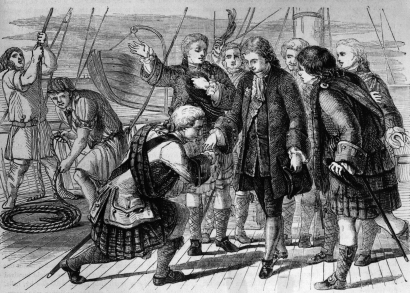
But who were these Jacobites really, and what drove them to take on the “English”?
Background: how the Jacobites came to be
They were supporters of the exiled King James II. “James” derives from the Latin “Jacobus” – hence the name “Jacobites”. James II was the former King of Scotland and England. Both kingdoms were still independent at the time, but had for some time already been ruled in personal union – that is, by a single monarch.
At the time, there were two ever-simmering conflicts in England: on one hand, the one between Protestants and Catholics. Protestants almost always lived in the (not entirely unfounded) fear that the Pope and allied forces wanted to make Britain Catholic again. James II was a Catholic, and he also brought Catholics back into high office. The elite of the time, however, consisted of Protestants and felt threatened by this.
On the other hand, there was the conflict between Parliament and the monarch – for example over who was allowed to levy which taxes or which civil rights were in force.
In short: it was about faith and power. The classic reasons for almost all wars.
Glorious Revolution: the expulsion of King James
By 1688, the conflict between the parties had progressed so far that the English Parliament wanted to drive out the king. It called on Mary, the Protestant daughter of James II, and her husband, Prince William of Orange-Nassau, for help. They duly arrived and drove out James II. He fled to France.
British history books like to remember this, calling it the “Glorious Revolution”. But they had driven out not only the English king, but also the Scottish one – of course without asking the Scots much about it.
The government in London also passed a law determining that the English king must always be Protestant – the “Act of Settlement”. This excluded other descendants of James II. The succession passed to the distant relative Sophia of the Palatinate, whose son George eventually ascended the throne as the first Hanoverian.
Meanwhile, something dramatic happened in 1707: the “Act of Union” merged Scotland and England into a single kingdom. The Scottish Parliament had also voted for this, and was subsequently dissolved. Bribery and self-interest among the members of parliament paved the way for the vote. However, many (not all) Scots were against this union – they found allies among the Jacobites.
Meanwhile, the Stuarts, the descendants of James II, lived in Rome. They were not willing to give up their claim to the throne. After all, there was a lot to be gained for them too: Britain was just beginning to become a world power. Whoever wore the crown also ruled over parts of North America, Africa and Asia.
Jacobites: were they “the good guys”?
However, one should be careful not to take the side of the “poor” Jacobites too readily. For one thing, they themselves were not gentle with political opponents. And it was precisely James’s ancestors who had treated Scottish Protestants very badly. Nevertheless, there were also some Protestants among the Jacobites.
On the other hand, the Act of Union benefited many wealthy Scots. They now had access to the colonies and English markets. Cattle – an important Highland export – could be sold to England more easily. In addition, many of those who had supported the Glorious Revolution stood for a more modern conception of the state, in which crown and church were separated and aristocracy mattered less.
All of this, in their view, was put at risk by the Jacobite risings. So overall it was about far more than loyalty to one royal house or another.
Foreign powers also had a hand in it. The English were, for instance, constantly at odds with the French over the colonies, for example in Canada. That’s why the French king repeatedly supported the Jacobite cause too. The Spanish also had their own interests in the Jacobites – and, confusingly, alliances kept shifting as well.
(For these considerations I draw on “History Scotland”, Sep/Oct 2018 issue, article “Who were the Jacobites”, p. 36ff)
The ’15: the first major Jacobite rising
There were a number of Jacobite risings at the end of the 17th and the beginning of the 18th century (and several conspiracies).
In 1689 John Graham of Claverhouse – nicknamed “Bonnie Dundee” – raised the flag of James VII on Dundee Law hill. He won the subsequent Battle of Killiecrankie against the British government troops. But he himself was killed in the process. Without his leadership, the Jacobites lost against a minority of opponents at Dunkeld. That was the end of the first rising.
In 1715 the Earl of Mar attempted, with 12,000 Highlanders, to restore the Stuart king. At the Battle of Sherrifmuir, he could only manage a draw. Overall the rising lacked momentum: most towns and regions simply didn’t join in. Not even when the Stuart heir James Francis Edward Stuart landed at Peterhead to support the cause.
A footnote is the battle at Glen Shiel (currently only available in German) in 1719. It ended in disaster for the Jacobites, their Spanish supporters, and also for Eilean Donan Castle.
The ’45: the last great Jacobite rising
The third major rising, however, that of 1745, put the Hanoverian government of the time under severe pressure. And it was the rising that made the grandson of James II famous. His name was Charles Edward Stuart, but the Scots still call him “Bonnie Prince Charlie” to this day – an extremely popular and reportedly rather good-looking prince.
In 1745 he first landed on the island of Eriskay (currently only available in German), before moving on to the Highlands at Glenfinnan, where he gathered around 3,000 Highlanders around his standard – most of his later army was likewise recruited from the Highlands, which would later prove fatal for them.
Without much effort, Edinburgh fell into his hands, then he moved on as far as Derby, not far from the British capital. But instead of now taking London – which would probably have been possible – the Jacobites retreated to Inverness.
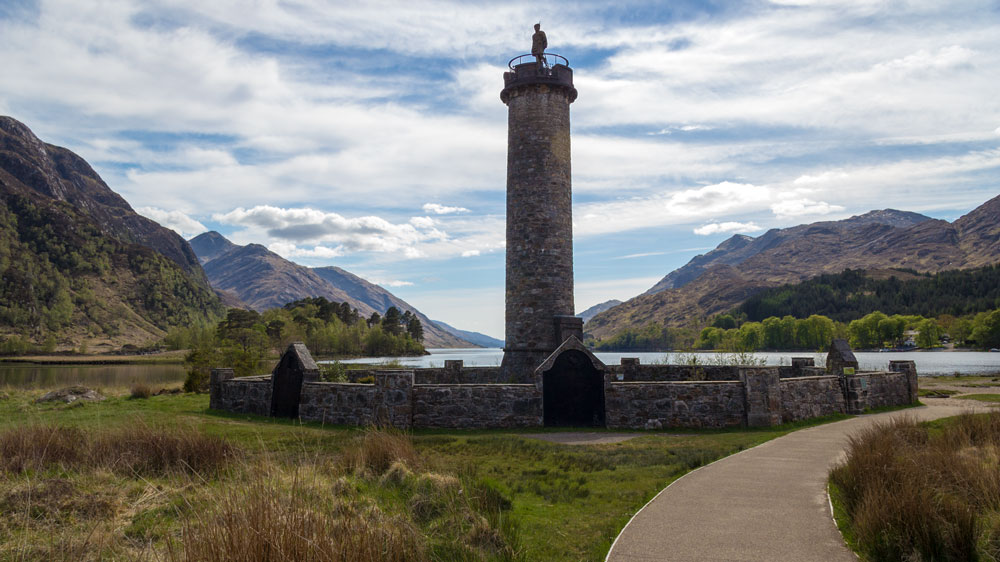
It would be wrong to believe that all Scots were on the side of the handsome prince – some towns in the Lowlands rather sided with the Hanoverians. Nor should one believe that all Jacobites were Catholics. Many were simply convinced of the cause, or hoped for Scottish independence. There were even English supporters of the old royal house – though far fewer than the rebels had hoped. In short: the Jacobites were not “the Scots”. And the government troops were not “the English” either.
At Culloden near Inverness, a disciplined, well-rested Hanoverian army now arrived and confronted the Jacobites. The Battle of Culloden finally brought the decisive defeat in 1746. Bonnie Prince Charlie had to flee and, after a dramatic escape, returned to the continent.
That was the end of the Stuarts’ claims to the throne. The prince grew bitter and turned to drink, falling out with his father and the still-existing Stuart supporters on the continent. Since he only fathered an illegitimate daughter, his line ended there. Charles’s brother Henry Benedict would have been the rightful Stuart claimant to the throne. But he recognised that the Jacobite cause was lost after Culloden. Benedict is regarded as the last of the House of Stuart.
Suppression: the terrible consequences of the 1745 rising
After Culloden, the reigning King George II and his government imposed an iron regime. He wanted to end the Jacobite threat once and for all. Since the Highlands had repeatedly stood out negatively in this regard, his wrath was also directed against them. Laws banned the wearing of certain Highland garments, and in many regions the population was disarmed.
It belongs in the realm of myth, however, that the Gaelic language or the bagpipes were banned. Nevertheless, the Highland way of life was – as so often – regarded as barbaric. Over the following decades, the Highlanders lived through a difficult time, and the Highland Clearances additionally sealed the end of their way of life.
After a few decades, however, the young prince, the rising, and Bonnie Prince Charlie’s adventurous escape were heroised and transfigured into a romantic myth. So one finds references to the Jacobites and their leader in many places across the Highlands. Monuments were erected in his memory, or even trains were named after the Jacobites.
Neo-Jacobites: far from over yet
As a military movement, the Jacobites were now finished. But politically they resurfaced a good 150 years later. Fuelled by Walter Scott’s novels such as Waverley and by growing resentment of Queen Victoria’s seemingly endless reign, a movement of Neo-Jacobitism arose that spanned from Scotland to Ireland. The “Order of the White Rose” (a white rose being the Jacobites’ emblem) was founded in 1866. The Jacobites of this era regarded Marie Therese of Austria-Este, the last Queen of Bavaria, as the legitimate claimant to the throne.
Around 1900, Jacobitism also gained political momentum again, with supporters even sitting in Parliament. The First World War, however, caused support for the cause to collapse. And today there are still Jacobites, and also someone they regard as the legitimate claimant to the British throne. His name: Franz von Bayern, head of the House of Wittelsbach. But he has already made clear that he has no wish to assert this claim in any form.
