The memorial stone is clearly visible, but everything else is uncertain. Scholarship and local tradition disagree over the birthplace and origins of the heroine of the Highlands.
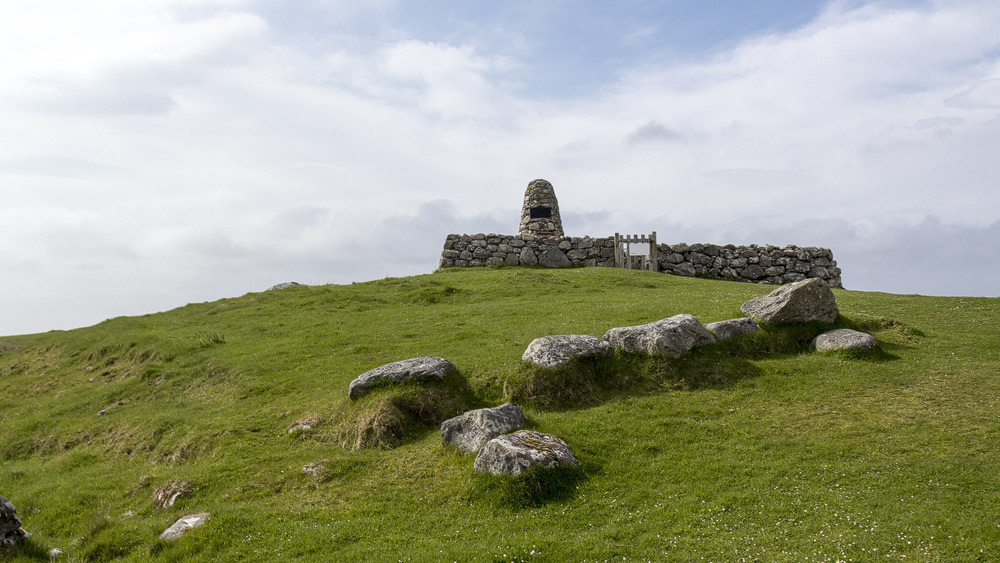
Can it really be here? My car rattles over a cattle grid as I follow the signpost and turn off the main road into a driveway. This is a farm, not a tourist attraction – clearly private property. After a few uncertain, dusty metres across the land, there’s a second rattle, and on the horizon a small stone cairn finally appears – my destination: the Flora MacDonald Monument on South Uist.
This, apparently, is where the heroine of the Highlands came from, the woman whose encounters with the rebel prince Charles Edward Stuart wrote her name forever into Scottish history. Flora is still regarded today as the very image of the cultivated, courageous woman.
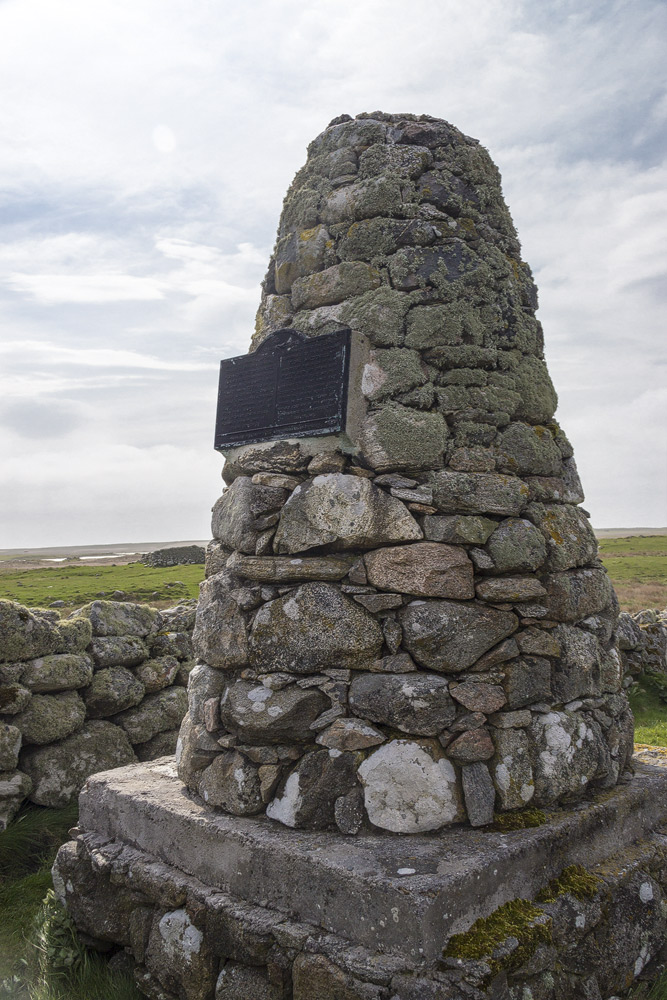
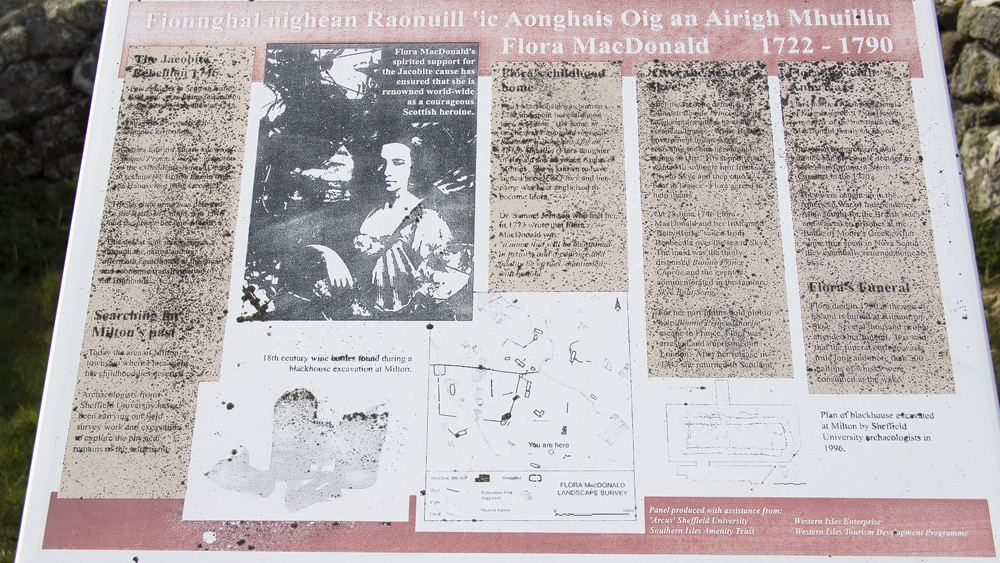
Her memorial, by contrast, strikes me as somewhat less cultivated. It stands amid the remains of an old stone house, its walls rising roughly hip-height – just enough to keep sheep out. A small wooden door, a stone cairn, weathered information boards, and an inscription: “Clan Donald erected this cairn in memory of their kinswoman Flora MacDonald, daughter of Ranald, son of Angus, of Milton, South Uist. She was born nearby in 1722 and spent her early life in the house that stood on these foundations. When the prince’s pursuers closed in on him on the Long Island, her heroism and perseverance helped him find refuge on the Isle of Skye.”
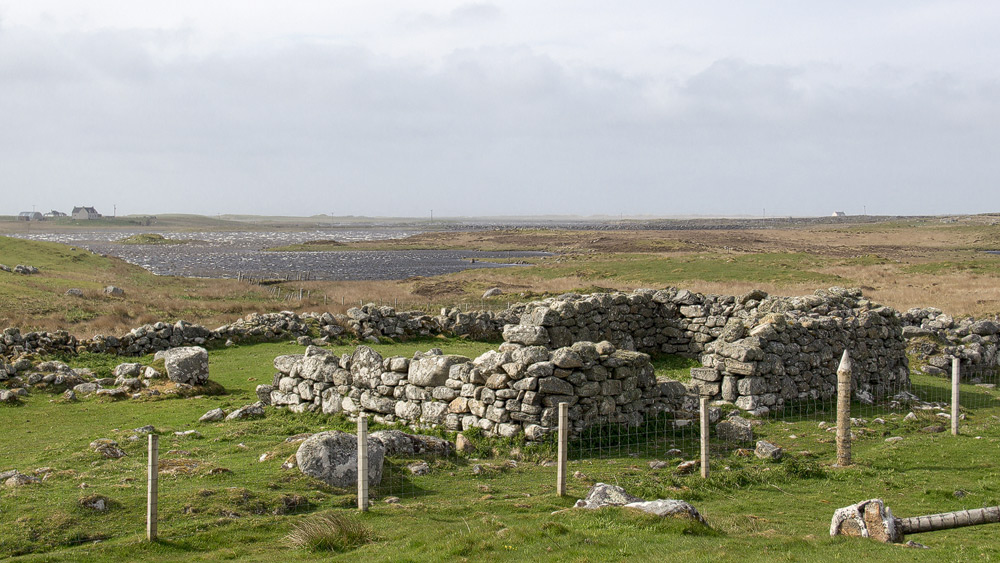
From the plaque, I let my gaze wander past the monument across the vast peat meadows beyond. Far to the west I can just make out the sandy beach and the Atlantic. A little further north, the remains of old stables and houses catch the eye – an abandoned farmstead, or perhaps a small village, likely swept away by the Highland Clearances.
Did Flora MacDonald really spend her childhood here at Milton? Local tradition places her birthplace at Frobost, a small hamlet nearby – which would make the inscription correct.
There are, however, serious doubts about Milton, where the monument stands. One person who keeps repeating these doubts like a mantra is Angus MacMillan, book author and family historian on Benbecula and South Uist. He never tires of pointing out that Milton was merely pastureland during Flora’s childhood years, and that the family actually lived at Balivanich on Benbecula. (I conducted an interview with him on the subject, which you can read here.)
Excavations support his findings. The house and the surrounding foundations at Milton date to no earlier than 1790 – a time by which Flora had already been laid to rest after a long life on Skye. No older buildings were found here.
Even older sources have their doubts
So how is it that almost everywhere you look, Milton is stated as the birthplace with such confidence? Yet even the genealogical research of Angus MacDonald of Killearnan, who recorded the history of the MacDonalds in the mid-19th century, raises considerable doubt:
“In these circumstances, the natural inference would be to regard Balivanich as the natal soil of the heroine in the absence of documentary proof to the contrary. On the other hand the traditions of South Uist are so positive that we do not feel called upon to disturb the current belief that her birthplace was her father’s residence at Airidh Mhuilinn, or Milton, in the year 1722.”
In short: because the local stories were so deeply entrenched, he didn’t dare claim anything different at the time. Even so, it remains just as possible – and indeed likely – that Flora spent at least a large part of her childhood on Benbecula, with her mother and stepfather.
So although the historical record is full of contradictions regarding Flora’s upbringing, almost every website and guidebook tells the same Milton story. That’s probably because they all copy from the same original source (Wikipedia, perhaps?) and have little patience for doubt. And so this one version becomes ever more cemented in place, even though honesty would demand we say: nothing here is certain.
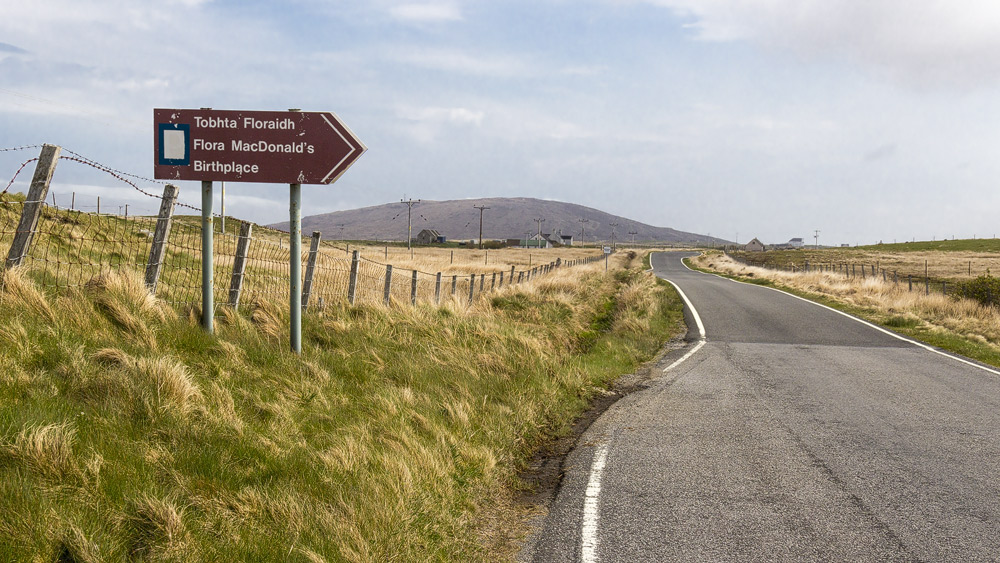
As I drive back onto the main road, I notice that the road sign, at least, is absolutely certain of its claim: “Flora MacDonald’s Birthplace”, it reads in bold letters.
I no longer really believe it myself, but simply for the remaining chance that this might, after all, be the right spot – meaning I’d have stood both at Flora’s birthplace and at her grave on the Isle of Skye – makes a visit to the monument feel worthwhile all the same.
Getting there:
With a sat nav: “HS8 5RY” takes you roughly to the area. Watch for the signs from there.
Without a sat nav: the island’s main road is the A865. Coming from the north, you’ll first pass the Kildonan Museum, and a few metres further on, the brown sign for “Flora MacDonald’s Birthplace” appears. Turn right here and drive first across the farmland. The monument then comes into view. Coming from the south, you’ll first pass “Gearraidh Bhailteas (Milton)” before the brown sign appears on the right.