There are many magnificent stone circles in the Highlands, but Callanish on the Isle of Lewis is different—much more complex and wild.

Unlike other stone circles, the Stones of Callanish—or “Calanais” in Gaelic—on the Isle of Lewis are not uniformly hewn, which gives each stone its own unique character. Furthermore, Callanish consists not just of a simple circle, but of several interwoven geometric shapes, at the center of which stands a large monolith four and a half meters high. A true stone giant. The surrounding menhirs are shorter, so it almost looks as if they rise toward the center.
In fact, everything converges on this single center: long lines meet at the center from three sides, and from the north, there’s even a sort of stone-lined avenue leading toward the circle. If you were to fly over it like a bird, you’d see how the monoliths form the shape of a gigantic Celtic cross.
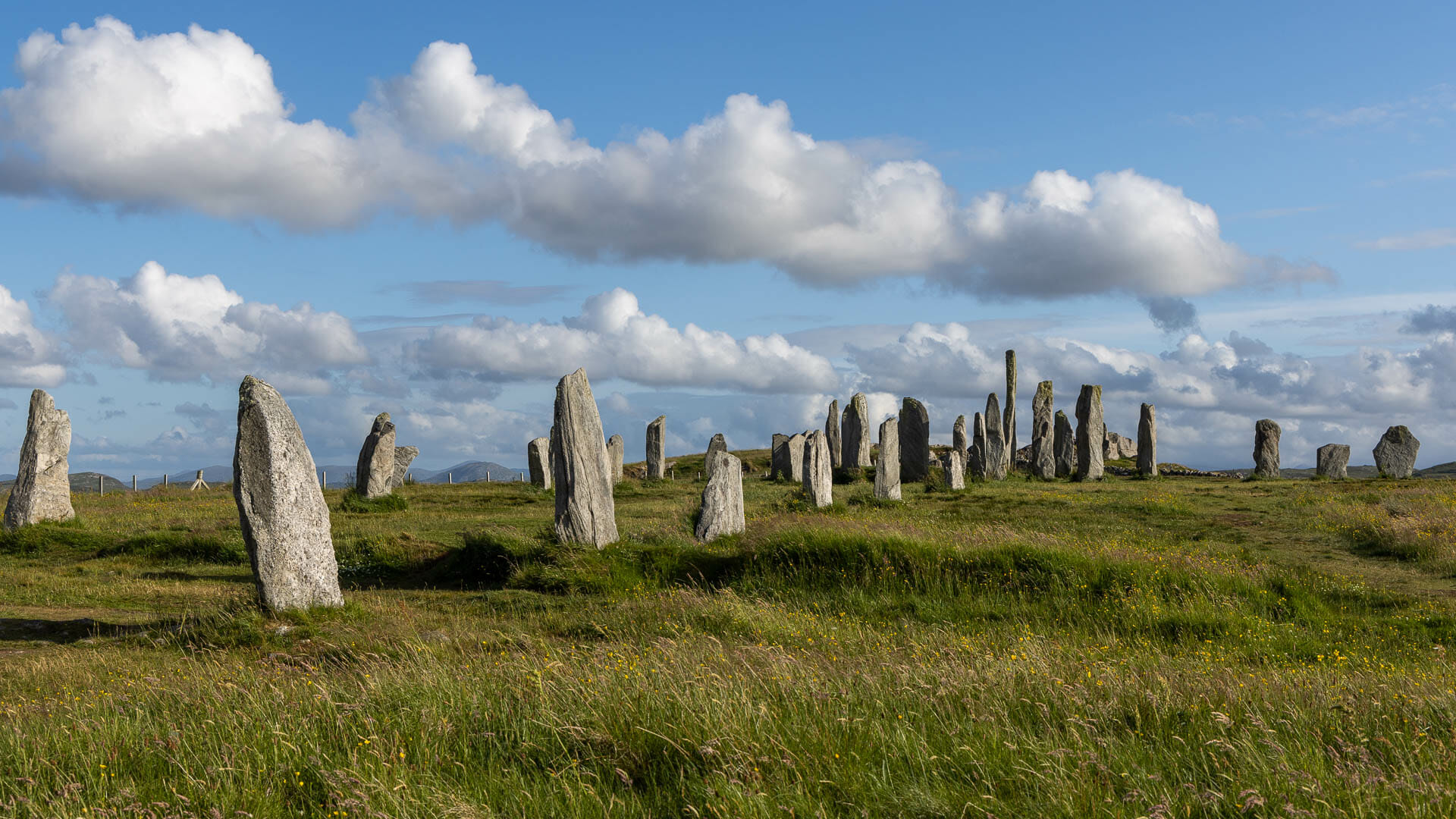
Yet the Celts—or even the Gaels—had very little to do with this structure. For this gigantic monument, consisting of about 50 stones, was erected some 5,000 years ago—during the late Stone Age—when there was still no sign of the Celts anywhere in Europe.
In any case, very little—if anything—is known about the people who built Callanish. But we do know something about the land they inhabited back then. It was significantly more fertile than it is today, and the climate was generally much milder. The sea level was lower, and the land was teeming with wildlife and plants.
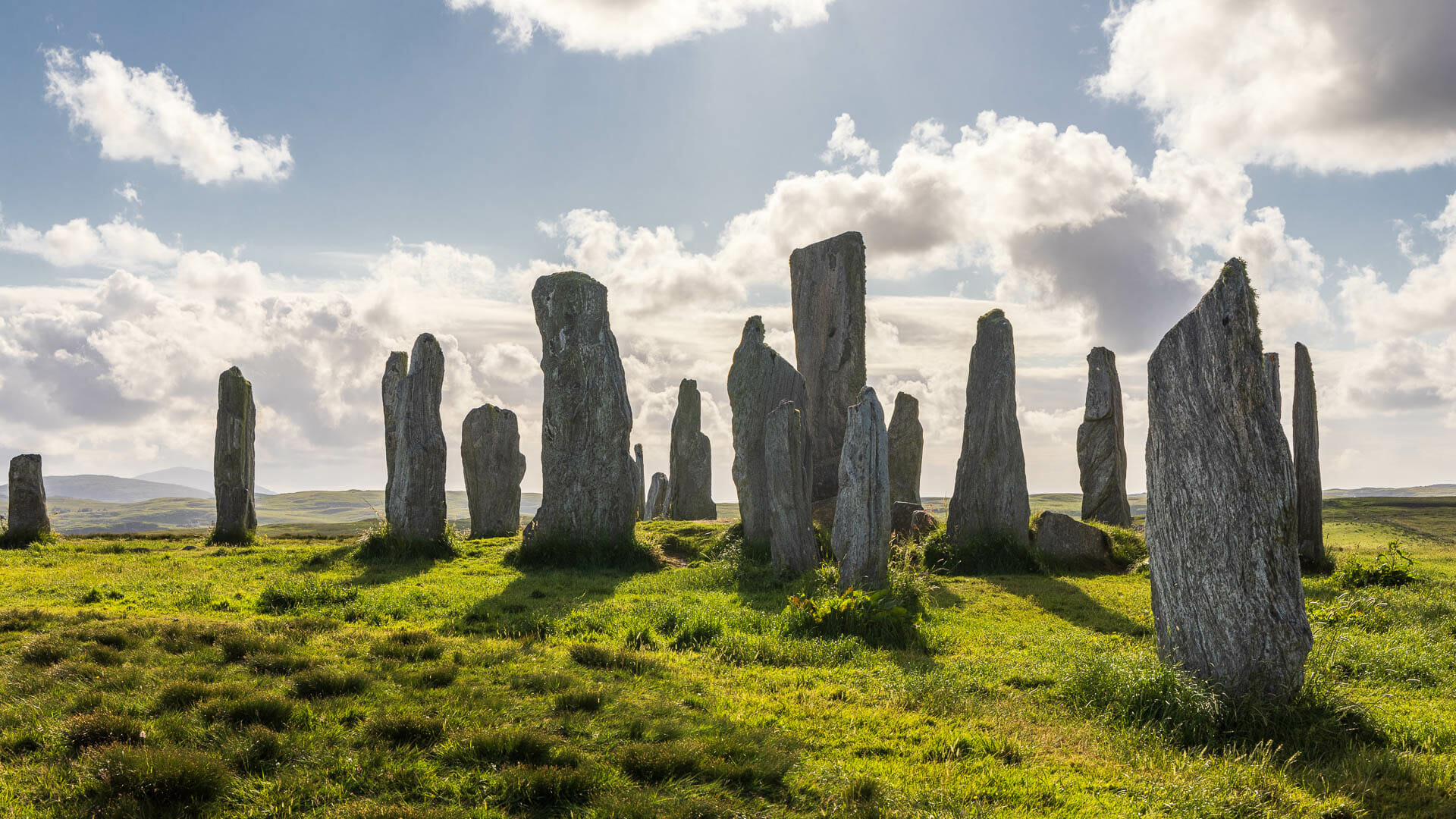
So Lewis was a good place to live back then.
Why was the circle built? Here, too, scientists can only speculate. In times of sky cults, the idea that Callanish was used to track the phases of the moon seems most obvious to some.

Stephen Whitehead, for example, demonstrated that the eastern arm of the cross points to the full moon at the autumn equinox, making it an important marker between harvest time and winter.
Another theory suggests that the stones help predict the moment when the moon appears to dance on the nearby hills to the south. This occurs every 18.6 years. The idea is that people back then believed the moon would visit Earth at that time. Callanish’s precise north-south orientation lends some credence to this theory.
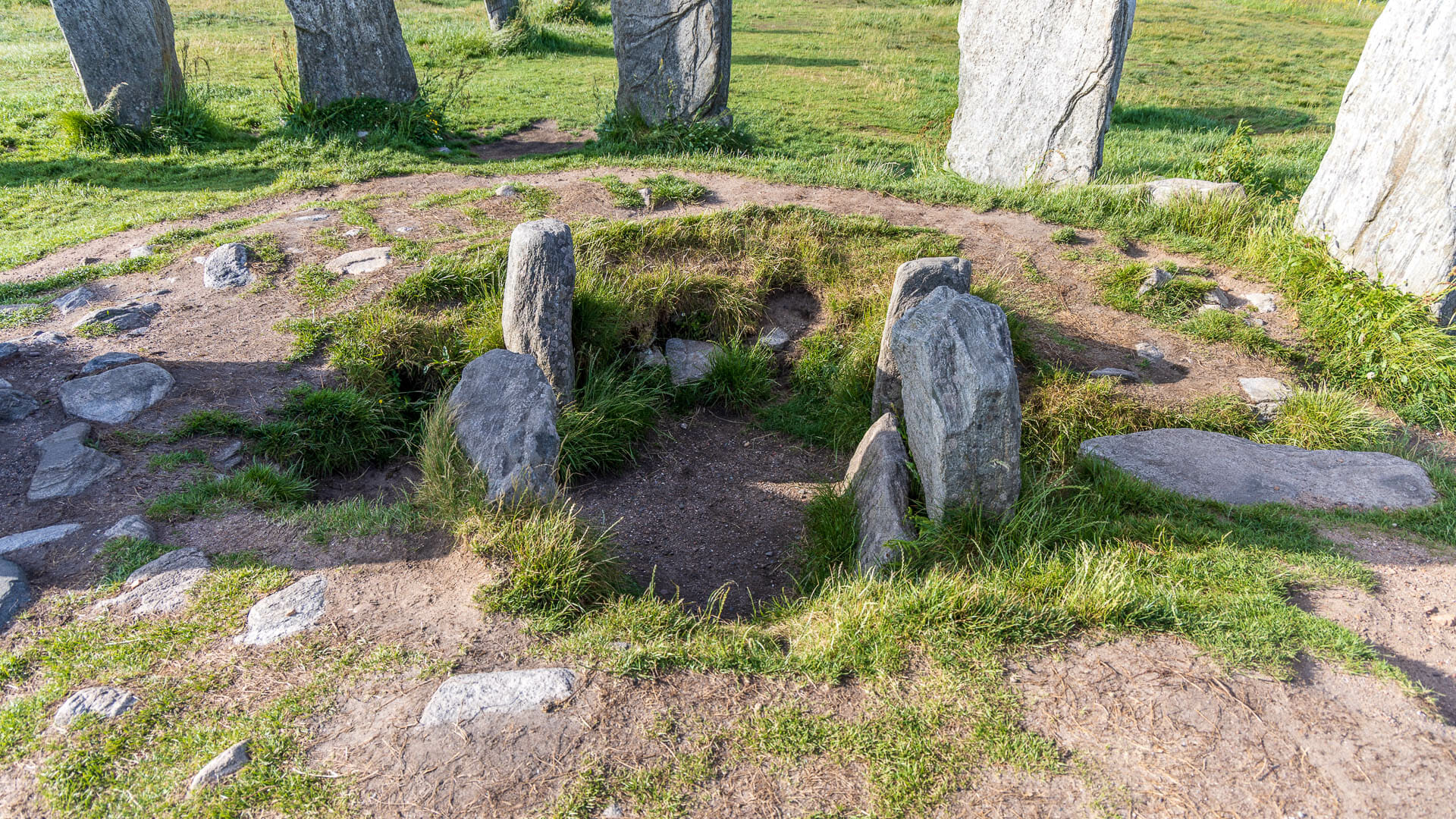
Yet one peculiar feature seems to defy this theory entirely, for at the center of the circle lies a burial chamber—something completely unusual for these stone circles. However, this chamber was not incorporated into the site until several generations after the construction of the great monument. Scientists are still searching for an explanation for this as well.
Personal note: Wonderful landscape
This stone circle is fantastic—probably the most beautiful I’ve seen in Scotland, alongside the Ring of Brodgar. The much wilder backdrop also contributes to this, as Callanish is a peninsula jutting into the sea inlet known as Roag or Loch Ròg an Ear. The hills of Lewis provide the perfect backdrop to this view.
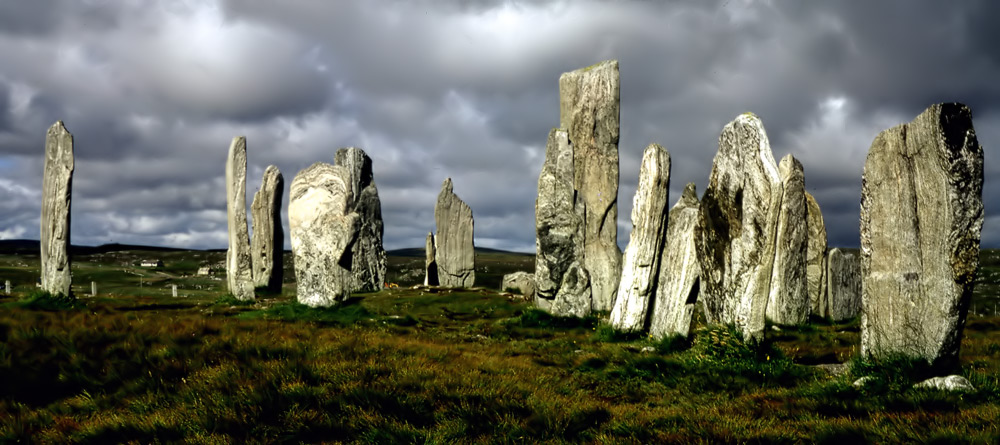
I had the chance to visit here for the first time back in 1994. Back then, I was still taking slides. Here’s a photo from that time.
Facts: Age and Name of Callanish
Callanish (in Gaelic, “Calanais”) simply means “the peninsula of Kalas.” The stone circle dates back to around 4000 B.C. and is the best-preserved of its kind. All 13 stones of the main circle are still standing, unlike its counterparts in Orkney. The site is also so well-preserved because it was completely enclosed by peat.

It wasn’t until 1981 that it was completely cleared of peat, and now it attracts approximately 40,000 visitors annually.
Since 1995, there has been a visitor center at Callanish (I’d actually been there before that) complete with a free parking lot. Inside, you’ll find a gift shop and—of course—a coffee shop.
Tips: Other stone circles in the area
Actually, Callanish (Calanais) isn’t just a single stone circle—it’s an entire complex. The main circle is therefore called Calanais I and is, of course, the best known. But some of the more than ten others are also worth a visit.
Calanais II and III are quite easy to reach from the road. Coming from Geàrraidh na h-Aibhne (Garrynahine), you’ll see a sign on the left that reads “Cnoc Fhillibhir Bhig, Calanais III.” There’s a small parking bay right in front of it. From here, you walk through a small gate; the stone circle is already visible. This is Calanais III.
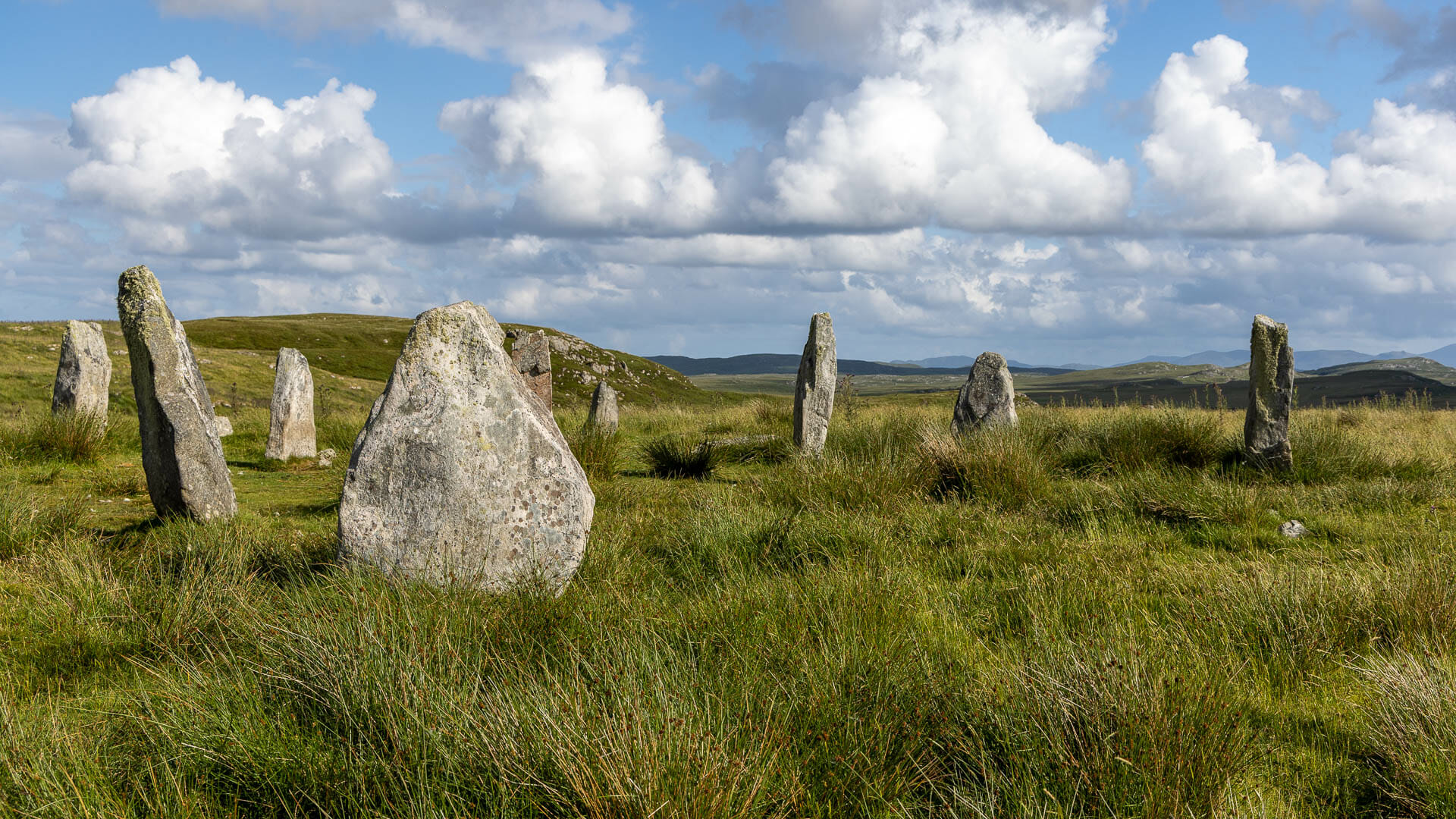
From there, it’s about 300 meters along a footpath—partly paved with planks—to the Calanais II stone circle. The stone circle is already visible from the hilltop of Calanais III.
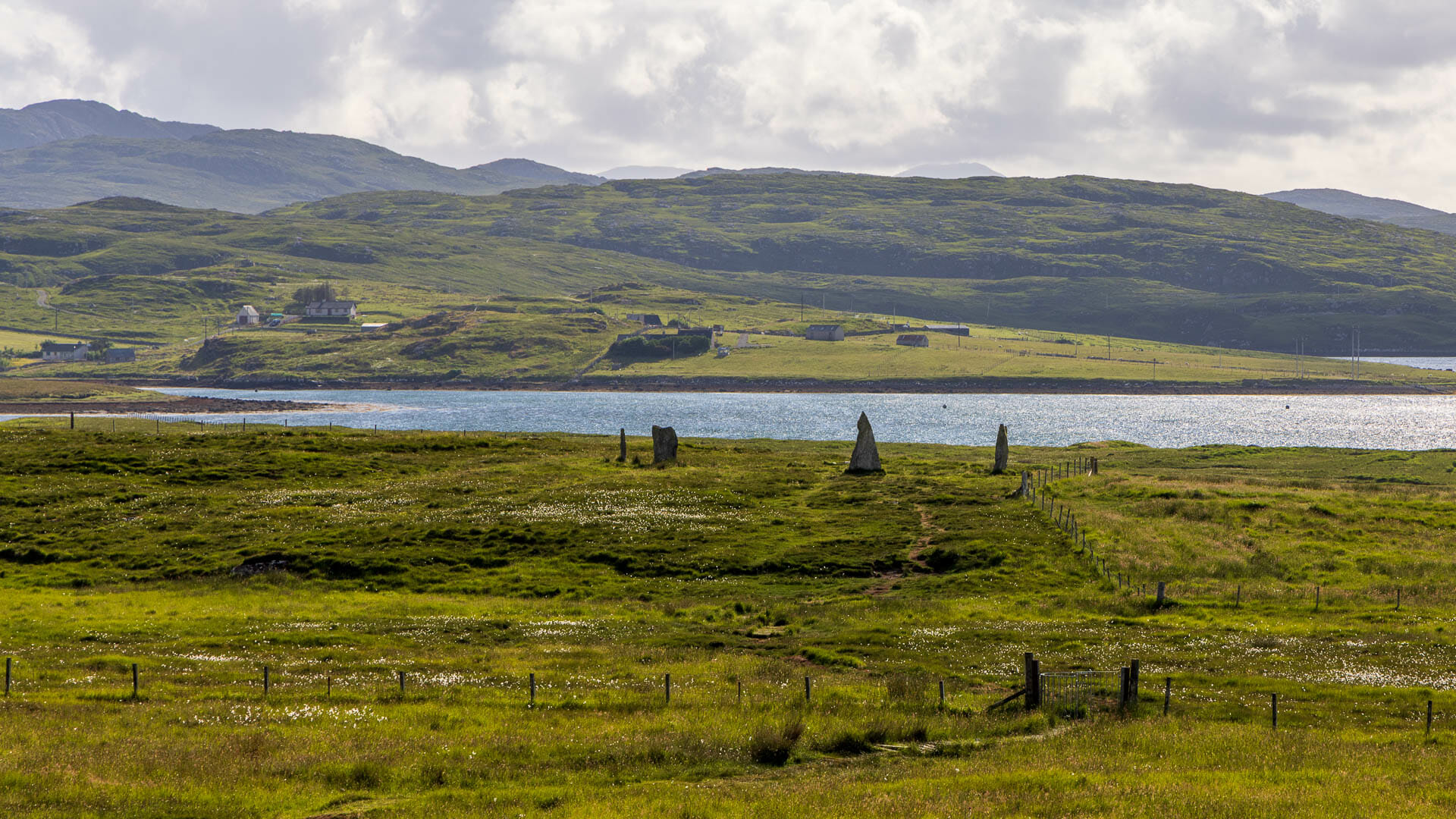
Of particular interest is the stone that appears to resemble a fang (on the left in the photo).
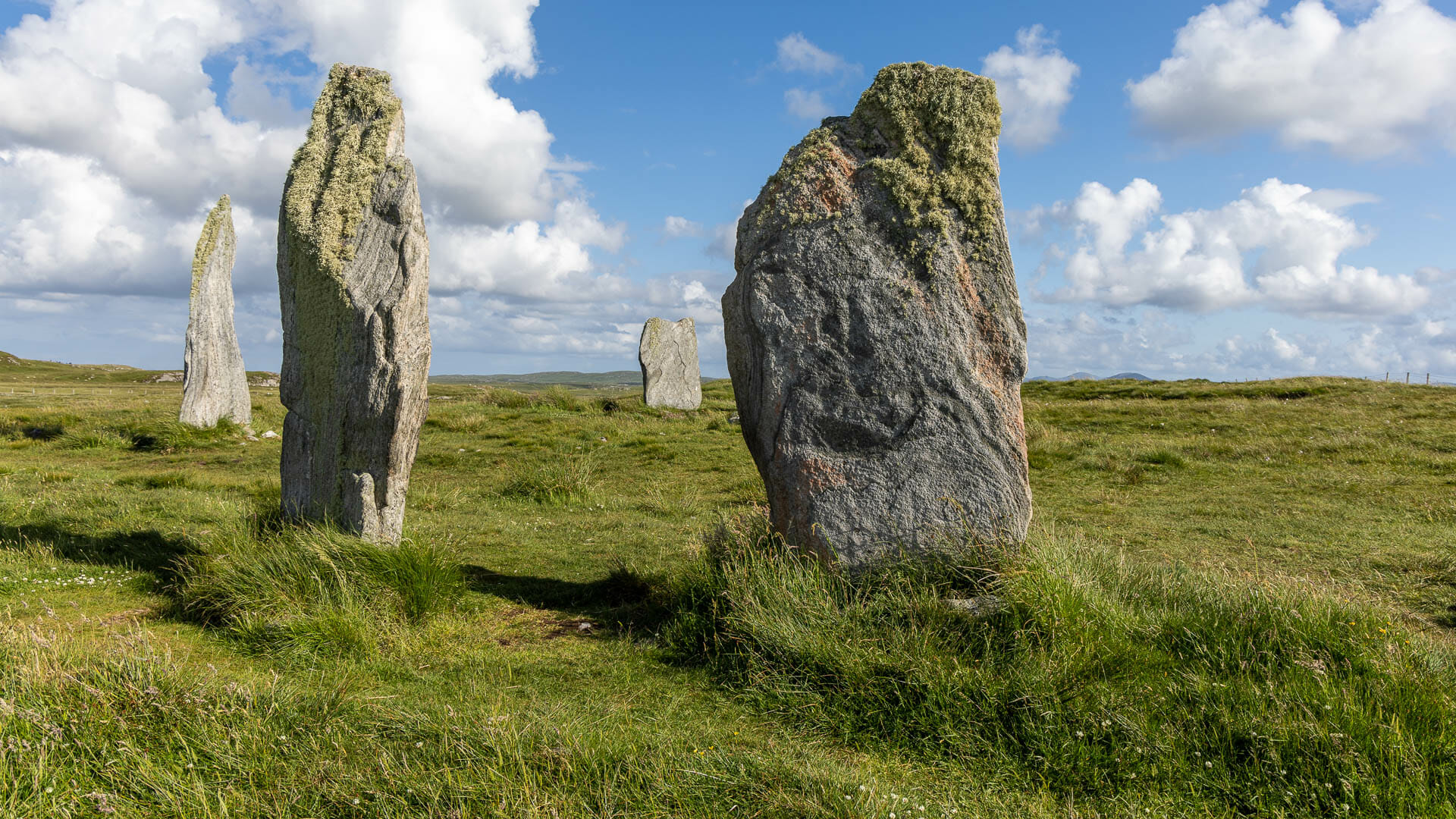
The return route takes you back via Calanais III to the parking area.
If you’d also like to see Calanais IV, head toward Geàrraidh na h-Abihne and then turn toward “Bearnaraigh agus Uig.” After about a mile or 1.5 kilometers, there’s a small parking lot on the left that looks more like a driveway. Turn right and head up the hill to the stone circle.
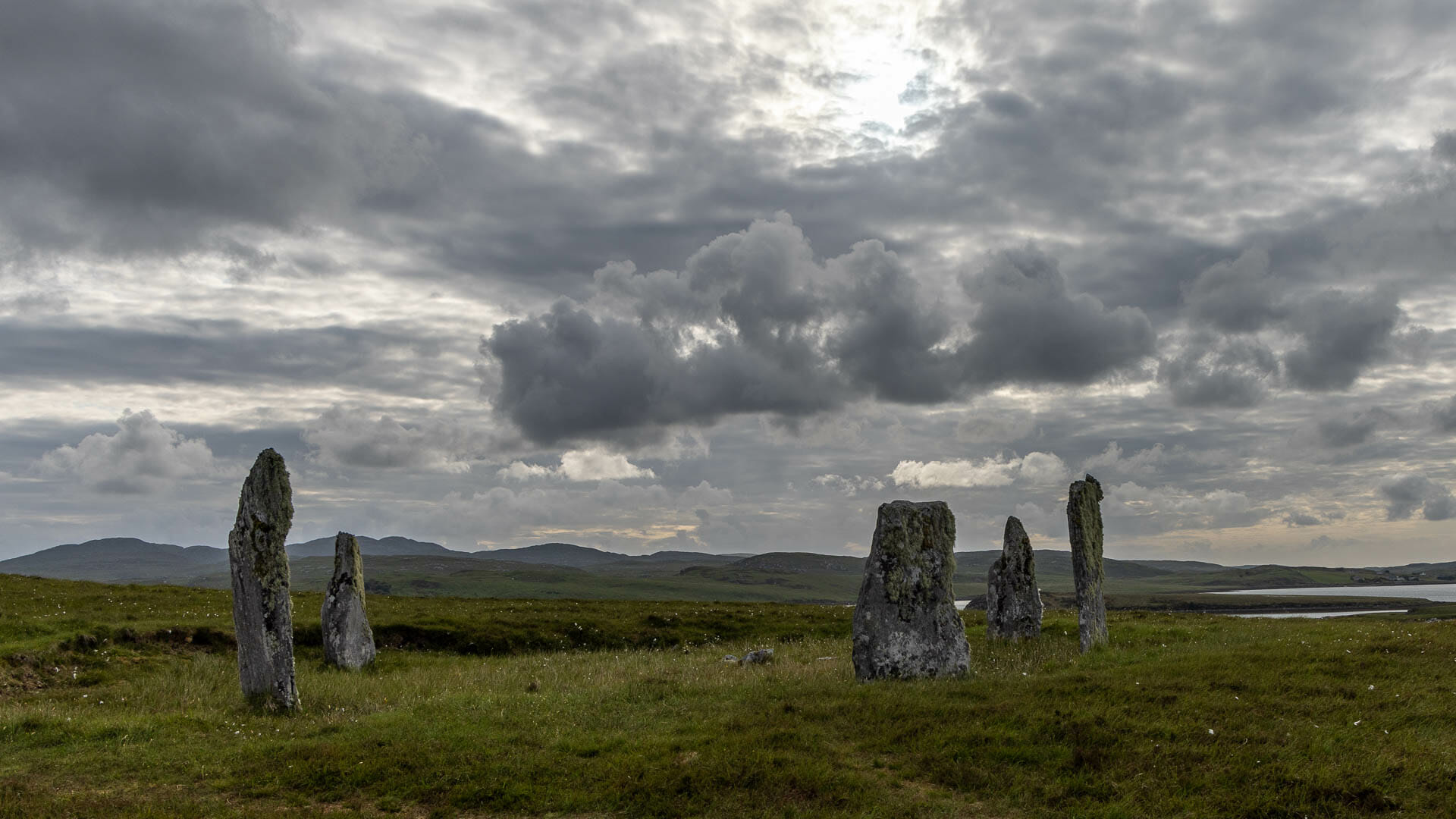
A list of all the Calanais stone circles can be found relatively far down on this page.
Directions:
With a GPS: Enter “HS2 9DY.” This will take you to Callanish. From there, follow the signs to the visitor center and park for free in the parking lot.
Without a GPS: From the capital, Stornoway, head toward Tarbert at the roundabout. As soon as you see the brown sign for “Ionad Tursachan Chalanais,” turn left and follow the remaining signs (it’s well signposted). Just be careful at the very end not to drive to the Callanish pier, but to find the parking lot instead. The total distance is about 25 kilometers.
