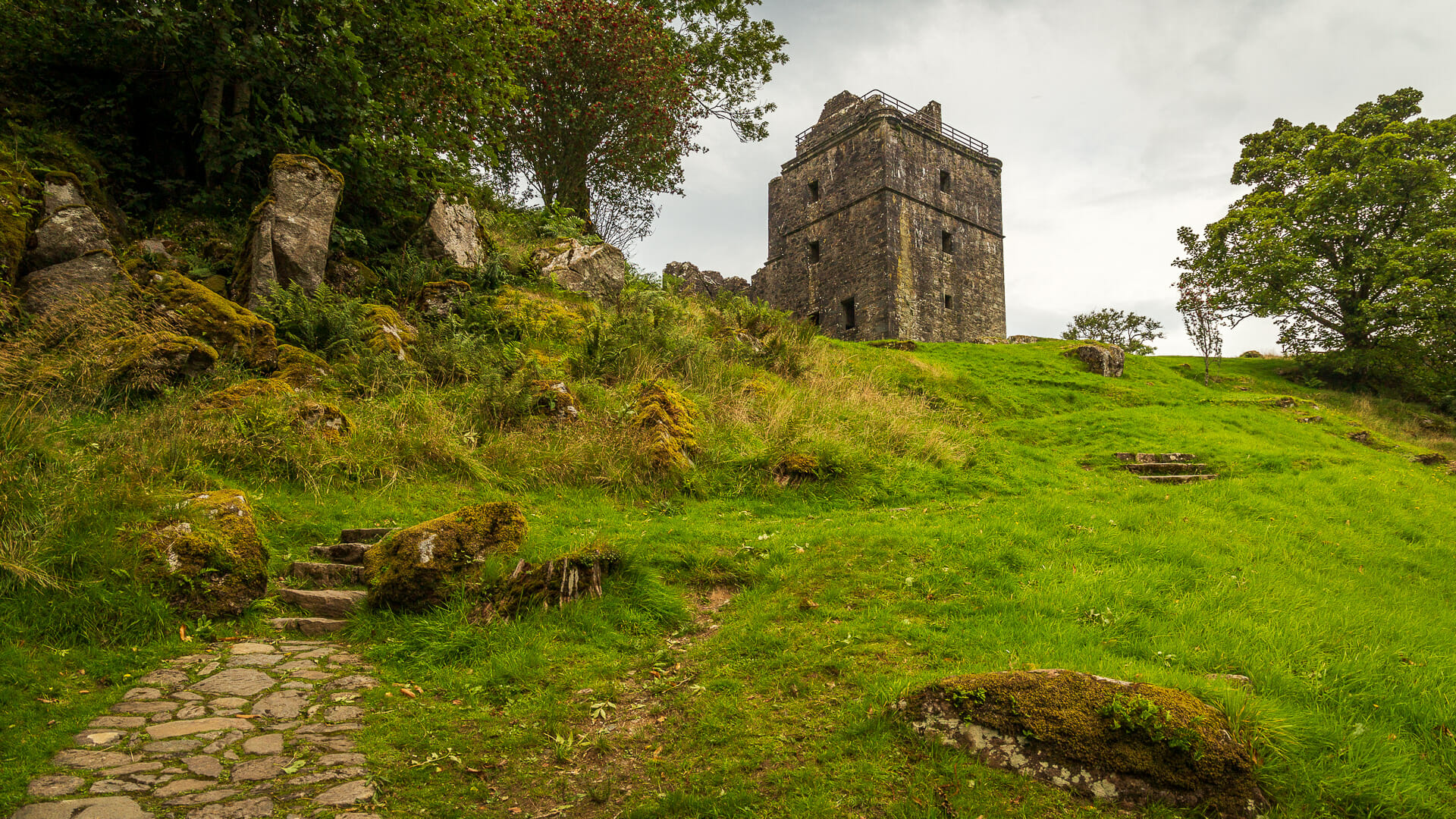
Carnasserie Castle sits enthroned on a hilltop like a black ghost castle. Yet once it was colourful and full of life.
Large windows in large rooms, wood-panelled walls and platforms offering views over the wonderful landscape of Kilmartin Glen. Carnasserie Castle is a typical Renaissance building from 1560, and with all its opulence it was meant to express the importance of its lord: the 5th Duke of Argyll, Archibald Campbell.
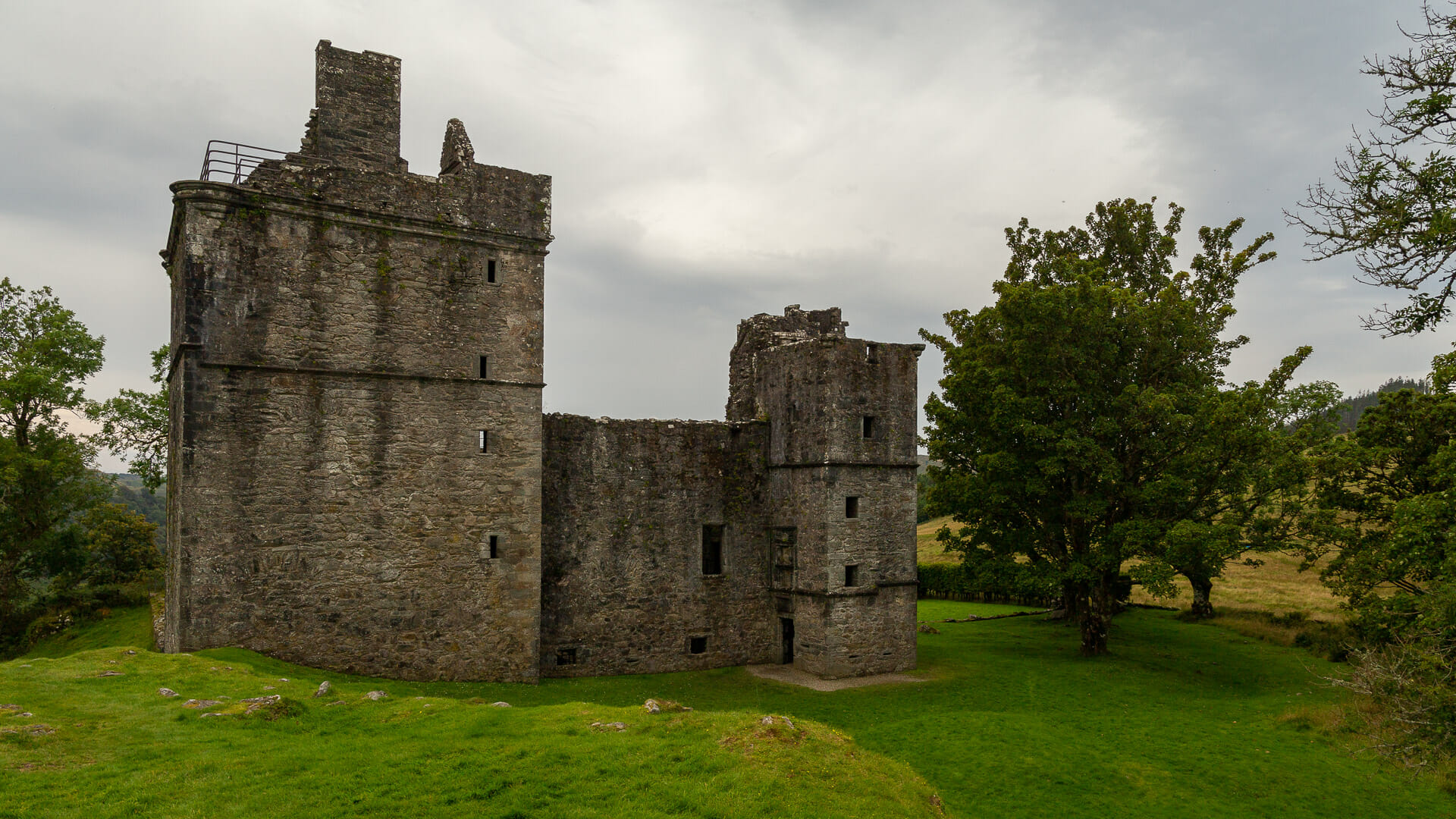
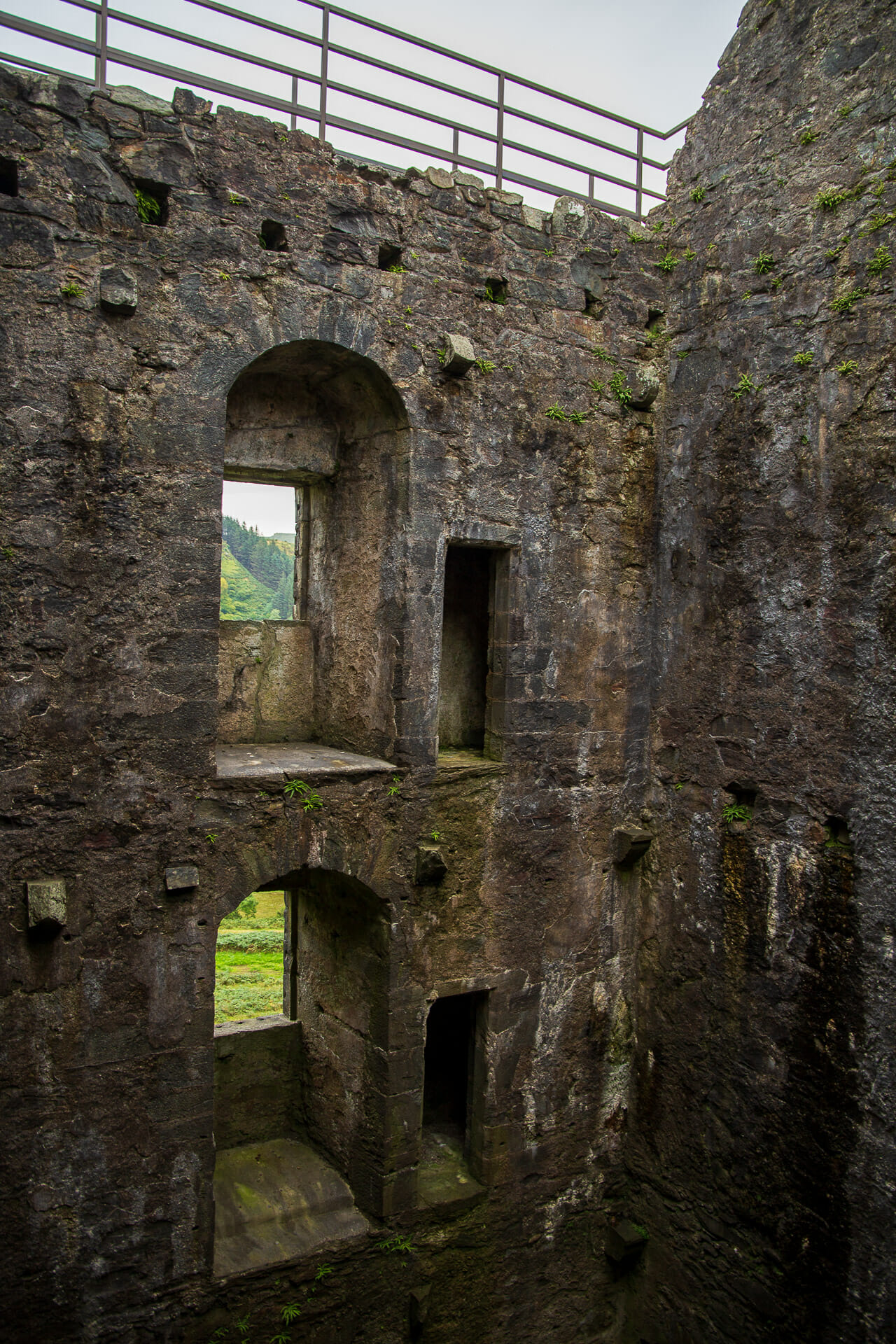
But anyone approaching Carnasserie Castle today sees nothing left of the castle’s former splendour. Instead, visitors feel as though they are climbing the narrow stairs to a haunted ruin. A black shell with empty window sockets and crumbling walls. What happened?
Although the Duke of Argyll owned the castle, its builder was Bishop John Carswell. Both Campbell and Carswell had more in mind than just the beautiful view when they had the castle built. It also held an excellent strategic position, controlling the route through the glen to the sea.
For both men it also served as an important base from which to spread the Reformation across the land. For the Campbells were Protestants. And that is where the problem lay. James VII of Scotland and II of England was Catholic. Conflict was inevitable.
When the Duke of Argyll launched a rebellion against the king in 1685, the castle’s owners at the time, the Campbells of Auchinbreck, joined the uprising. In response, men loyal to the king from Clan MacLean plundered the castle and then set it on fire. The owner was financially ruined and had no money left. Carnasserie was therefore never repaired.
What remained was the black ruin.
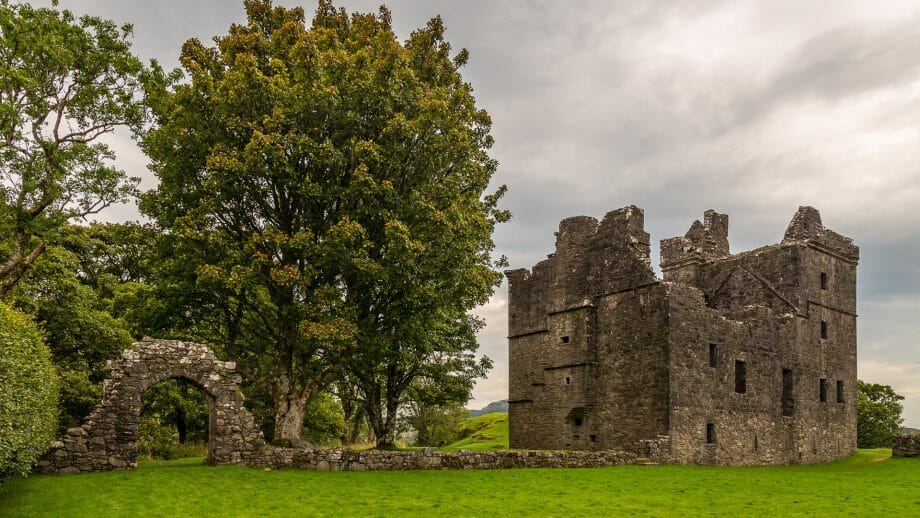
Visitors today can still sense its former beauty. Behind the gate and the crumbling wall, for example, there was once a well-tended garden. The initials of the former owners are engraved in the gate.
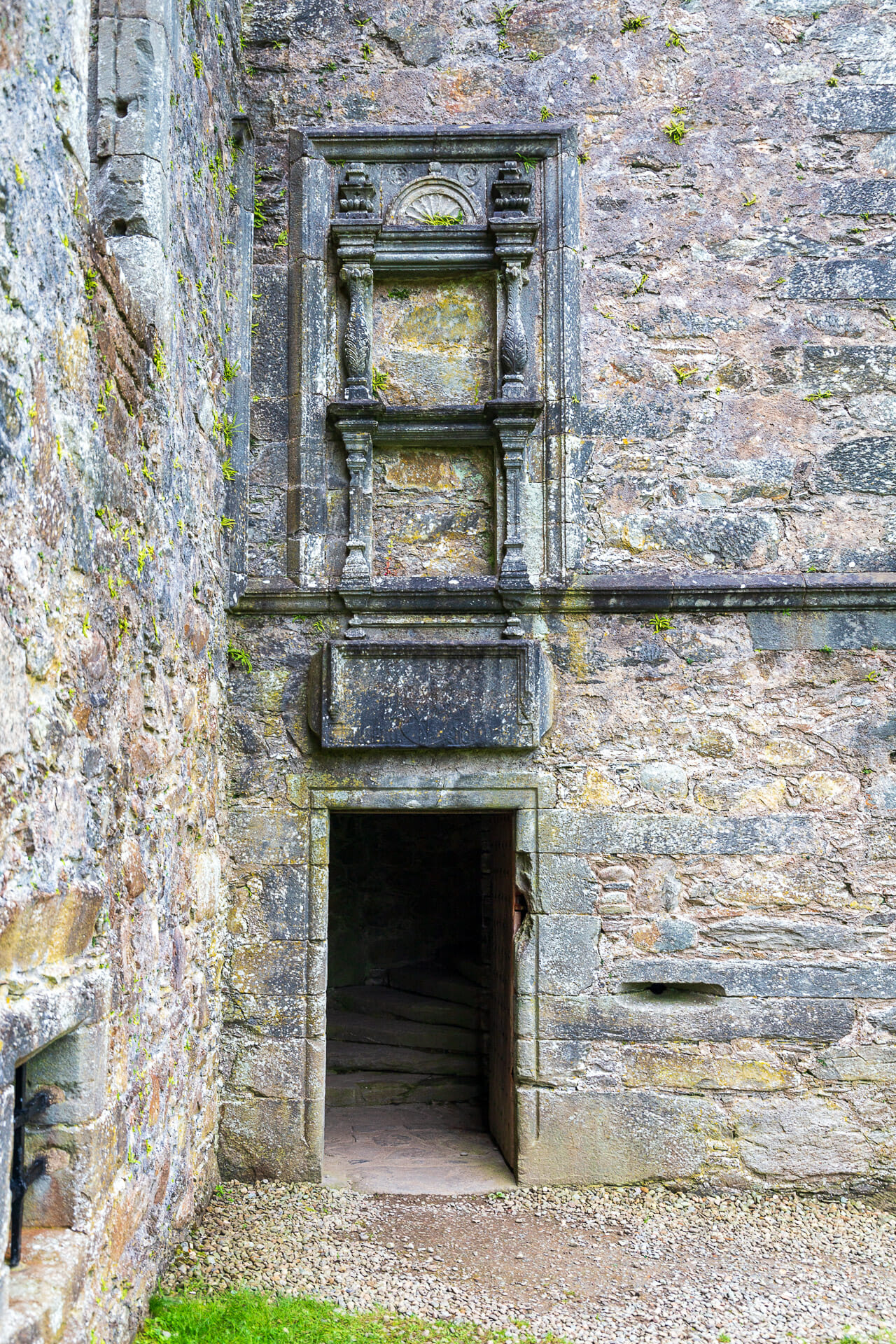
Even the relatively small entrance door shows hints of the former splendour. Above it, shapes bulge out of the wall that resemble two chimneys stacked one on top of the other. In fact, they were frames for the coats of arms of the castle’s lords.
Through it, visitors enter the now bare world of the castle, which can only be brought back to life through interesting, illustrated information panels. Whether kitchen or dining room, chambers or bedrooms – only cold stone greets you everywhere.
But one highlight still awaits at the top of the spiral staircase: the view over Kilmartin Glen!
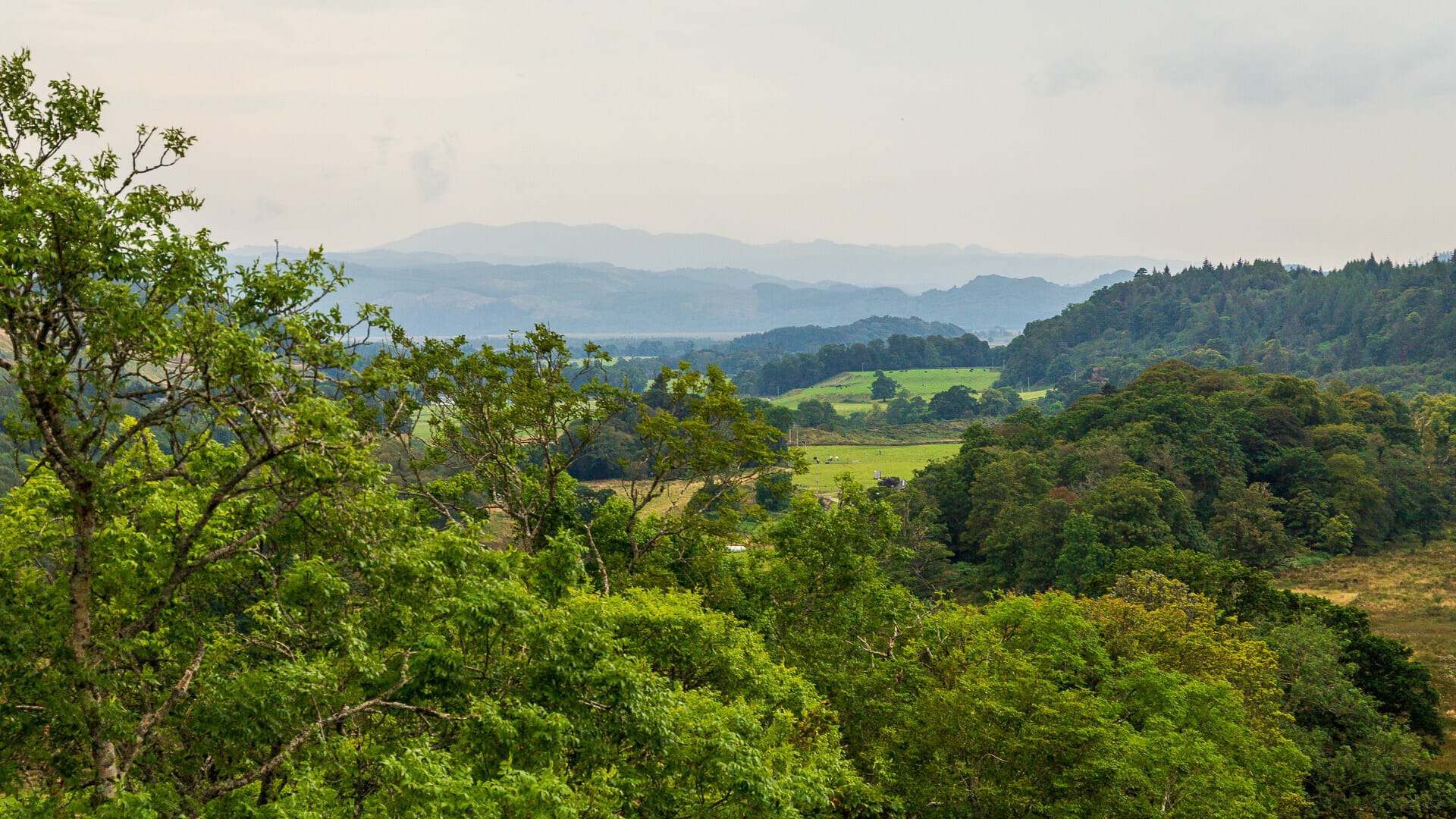
A visit to Carnasserie Castle is worthwhile for this alone – but not only for this.
Good to know: Carnasserie and the Bible
Although the Campbells were, by and large, oriented towards the Lowlands, they and Carnasserie Castle played a major role for the Gaelic-speaking population. For it was at Càrn Àsaraidh (the Gaelic form of the castle’s name) that Bishop Carswell wrote the first book ever printed in Gaelic.
As already mentioned: Carswell wanted to spread the Reformation, including among the Gaelic-speaking population. So he translated the “Book of Common Order”, written by John Knox in Edinburgh – essentially a guide to worship. Carswell rendered the work in Gaelic and dedicated it to Campbell. It was printed in Edinburgh in 1567.
Getting to the castle: A short walk
From the car park it is about 500 metres up a good gravel track and up a hill. First you pass through the V-shaped gap in the wall onto the path, then uphill. You reach the path running parallel to the road through Kilmartin Glen.

Continue slightly to the right and gently uphill; the castle then soon appears on the left, reached by the narrow stairway leading up to it.
Getting there:
With a sat nav: enter “PA31 8RQ” to get you to the area.
Without a sat nav: The car park lies on the A816, which runs through Kilmartin Glen. You’ll pass it, for example, if travelling from Oban to Kennacraig for the Islay ferry, or on to Lochgilphead.
