One rears up wildly, the other gazes resolutely ahead. The Kelpies near Falkirk are two steel horse giants that tell a story.
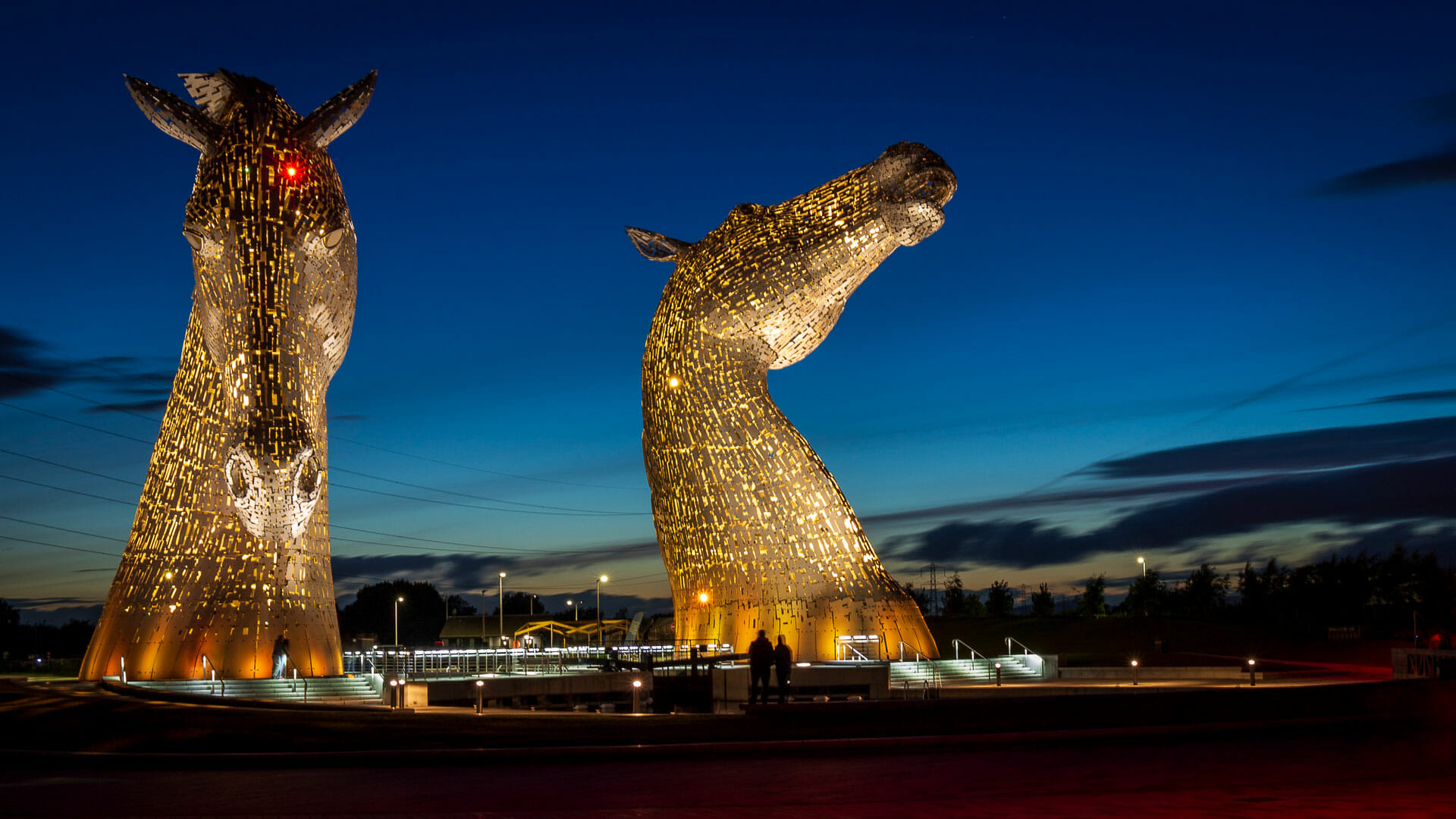
The idea that Scotland isn’t just about crumbling castles or wild landscapes is one story the Kelpies are meant to tell. And they do so impressively. They fuse organic art with angular steel industry, cold sheen with soft contours, delicacy with gigantism. After all, these are statues that rise 30 metres into the air – and withstand storms! That required not just artistic vision but a huge amount of engineering know-how.
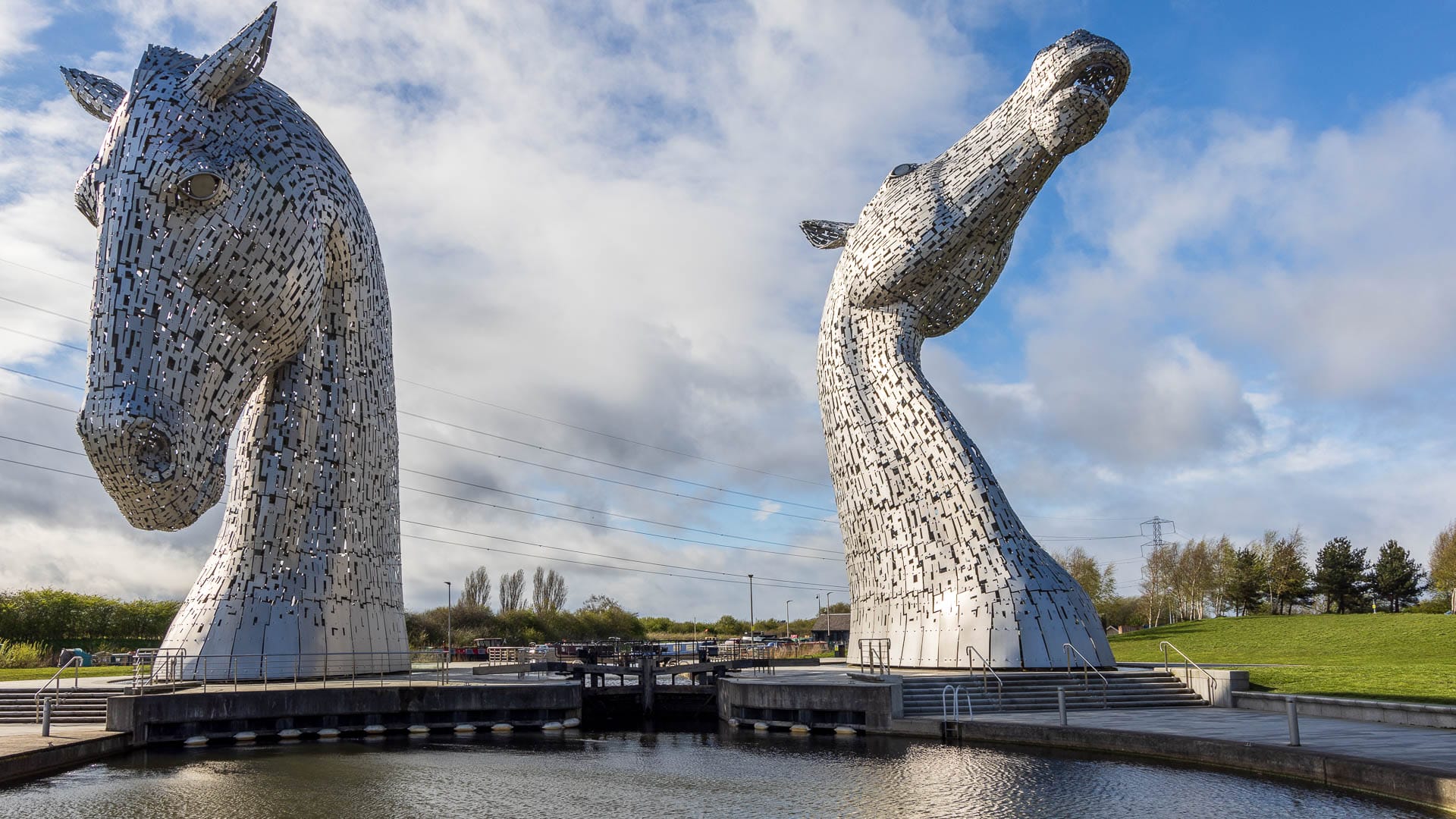
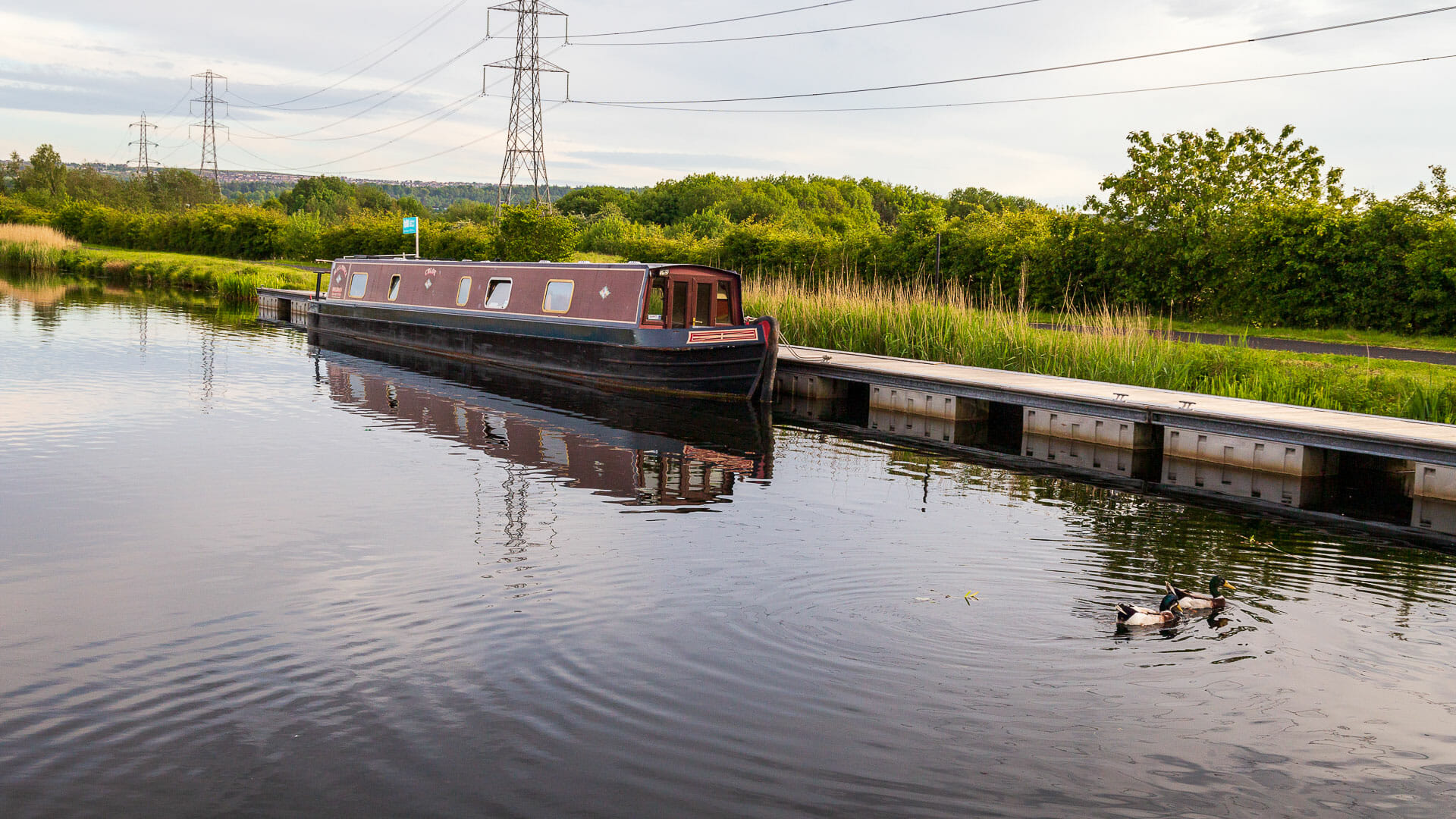
Kelpies are actually water spirits (in German for now) – and not necessarily friendly ones. Logically, there should be water somewhere near here. And indeed: the two horse heads are separated by a narrow canal – this waterway is the very reason they stand here at all. It’s a branch of the Forth and Clyde Canal, which runs right across Scotland, linking the Atlantic in the west with the North Sea in the east.
Here, shortly before it reaches the Firth of Forth, the canal used to have a problem: the final stretch along the River Carron was difficult to navigate. Bridges and shallows made it unattractive for boaters. To fix this, a new branch was built by 2012, bypassing a total of four bridges and the shallows. This stretch begins right here at the Kelpies, making them essentially the gateway to the east. Thanks to a lock, usually closed, visitors can still cross the canal here.
And that’s precisely the other story the Kelpies are meant to tell. That of the strong working horses that once pulled barges along the canal and kept the whole region alive. These animals were, so to speak, the horsepower of the Industrial Revolution. So the Kelpies aren’t really mythical water spirits at all, but are modelled on the heads of tireless working animals.
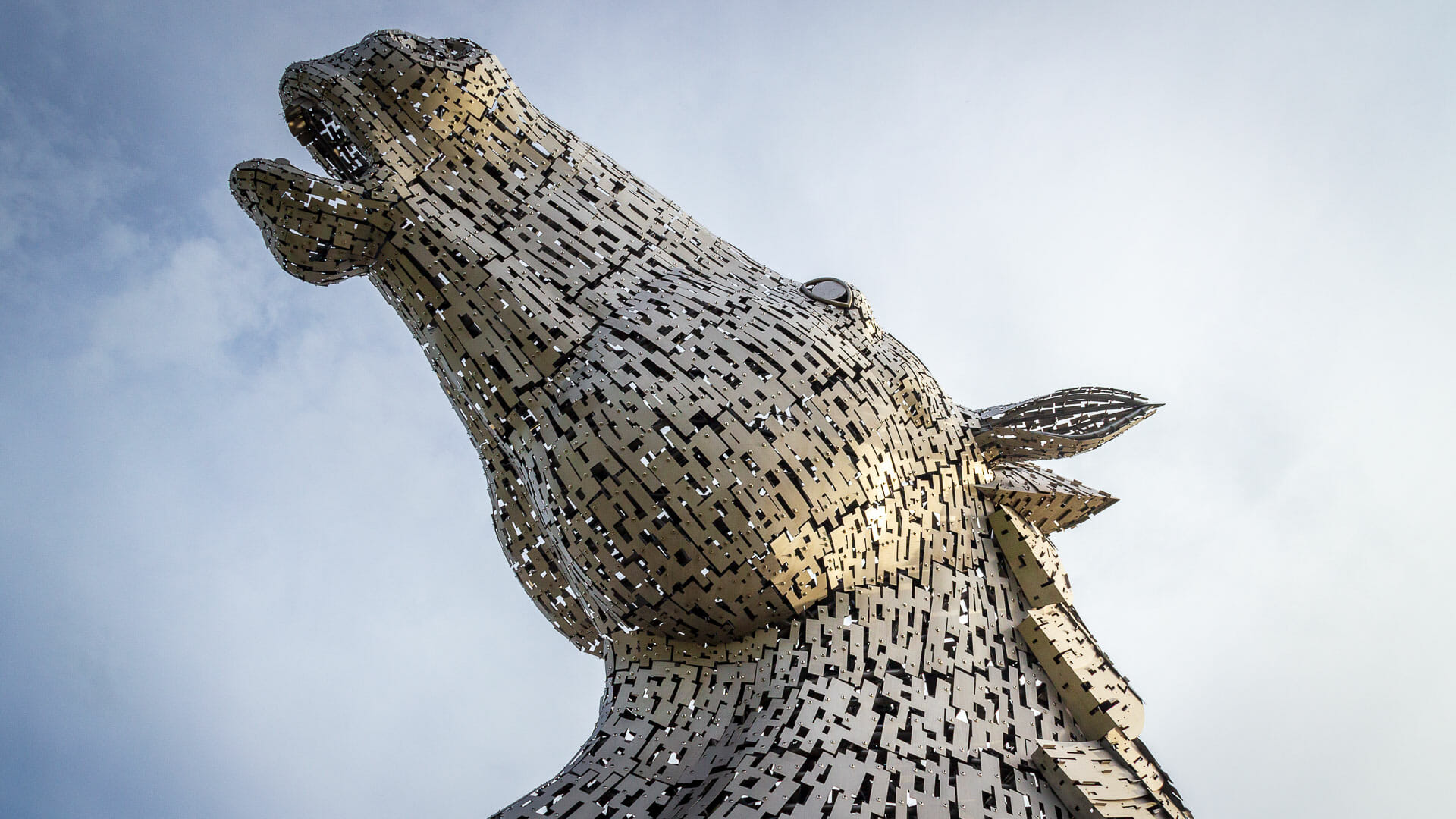
They even have names: Duke, the one with his head lowered, and Baron, rearing up with his mouth open. The names were taken from the two horses that once modelled for the artist. Both companions were once stabled at Pollock Country Park near Glasgow, but sadly are no longer alive.
Even so, water plays an important role here. Ring-shaped pools surround the Kelpies, and directly in front of them is a larger basin. All these water surfaces reflect the horses’ heads, and at night, when the multicoloured lighting is switched on, they amplify and reflect the light.
The Scots are so enamoured with the two statues that, together with the Falkirk Wheel (in German for now), they now adorn the new £50 notes of the Bank of Scotland (in German for now).
The Kelpies near Falkirk are two magnificent statues of enormous size, well worth a visit, especially on a fine day.
Did you know: numbers and facts about the Kelpies
The artist who designed the two horse heads is Andy Scott, from Glasgow. His steel sculptures aren’t found only here in Falkirk, but are scattered across the whole of Scotland. Yet the Kelpies are probably his largest and, by now, most famous work.
A few figures to marvel at: each of the two horses weighs 300 tonnes, built from a total of 990 steel plates. To keep the Kelpies firmly in place, 1,200 tonnes (!) of reinforced concrete were laid as foundations beneath each one. The Kelpies were built in just 90 days, and there’s even a beautiful video of this construction phase:
The Kelpies are the centrepiece of an entire site laid out as a local recreation area between Falkirk and Grangemouth. The grounds here have been named “The Helix”; they offer space for events, and a total of 27 kilometres of cycling and walking paths wind through the landscape.
You can also book tours that not only share knowledge but also let you go inside the statues to admire the construction from within. These are apparently very popular, so it’s worth booking on the website ahead of time.
Right by the Kelpies, a large café serves food and drink, and there’s also a gift shop inside. Out front stand the Kelpies once again, in a smaller version.

As mentioned, Kelpies are actually unfriendly water spirits. And these two do have one negative effect: since their opening, the accident risk on the M9 motorway has increased. Many drivers have suddenly slowed down there, or even stopped at the side, to look at the statues. Both are extremely dangerous! For that reason, a noise and sight barrier has now been erected along the road, which not only blocks the view from the road but also makes visiting the Kelpies a little quieter.
Tip: watch out for the pylons in your photos
Honestly: as beautiful as the two Kelpies are, the surroundings they stand in are just as unromantic. On one side the big road, on the other a power line whose pylons are constantly visible. In front of them, the visitor centre. And when it comes to photography, there’s always something in the way.
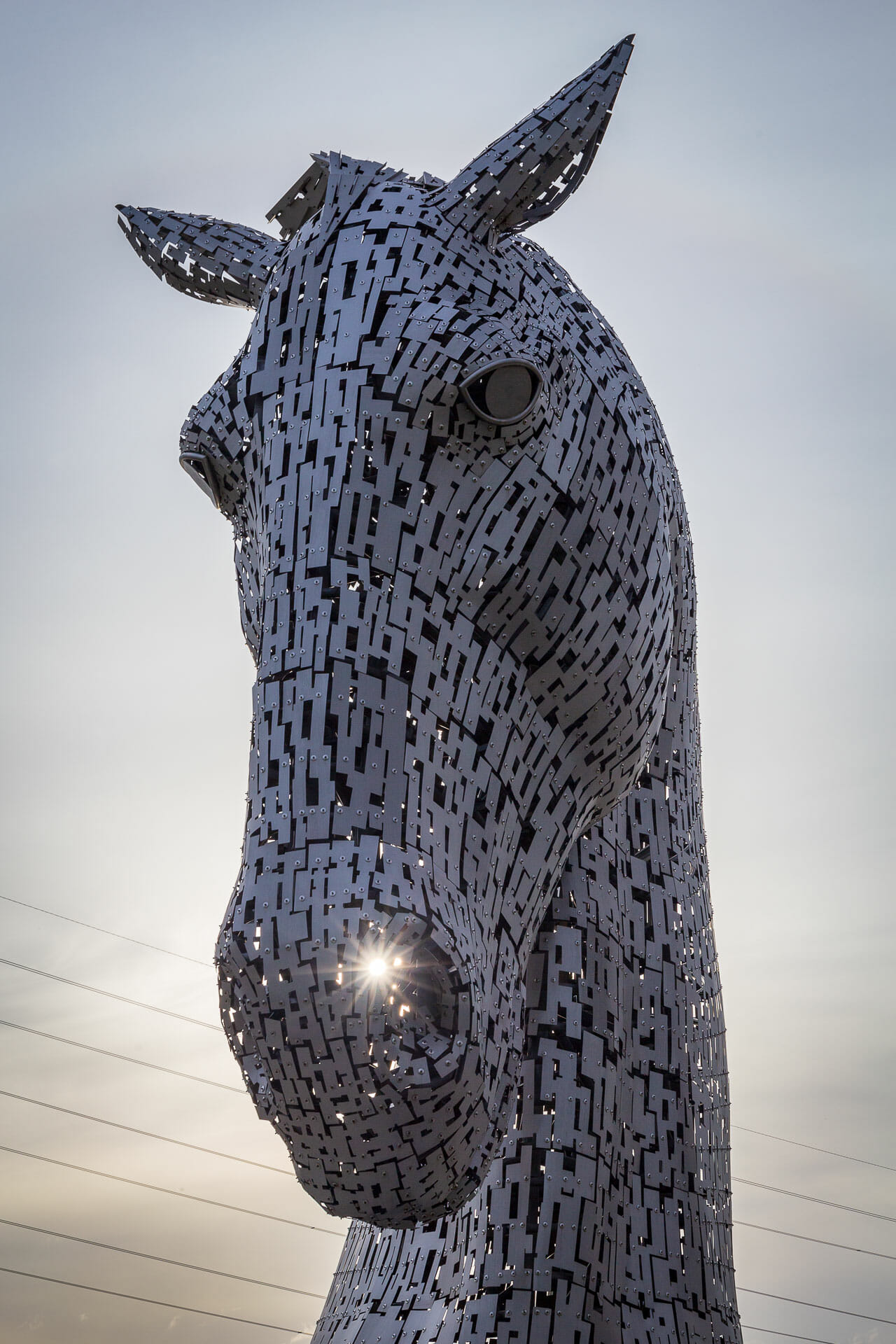
There is, at least, one angle where almost all the pylons disappear behind the heads, leaving only the wires still slightly visible.
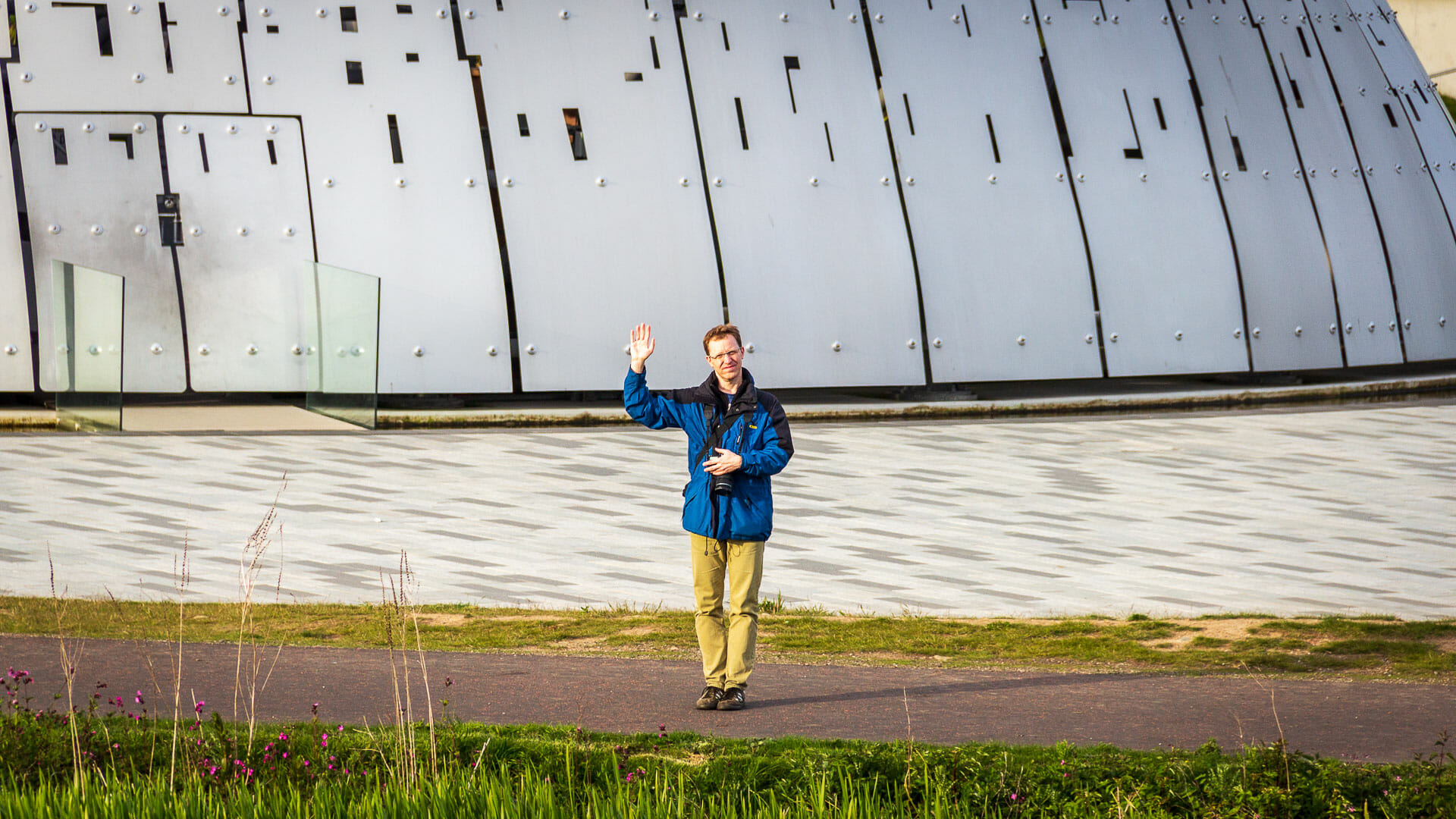
By the way, many people have fun “feeding” the Kelpies. I posed for the photo too:

Personal note: the Kelpies at night
I waited for months to finally get to visit the Kelpies, having admired photos of them online for so long. Now it finally worked out, and at sunset the horses look wonderful too. At night, though, they’re lit up in a completely different way.
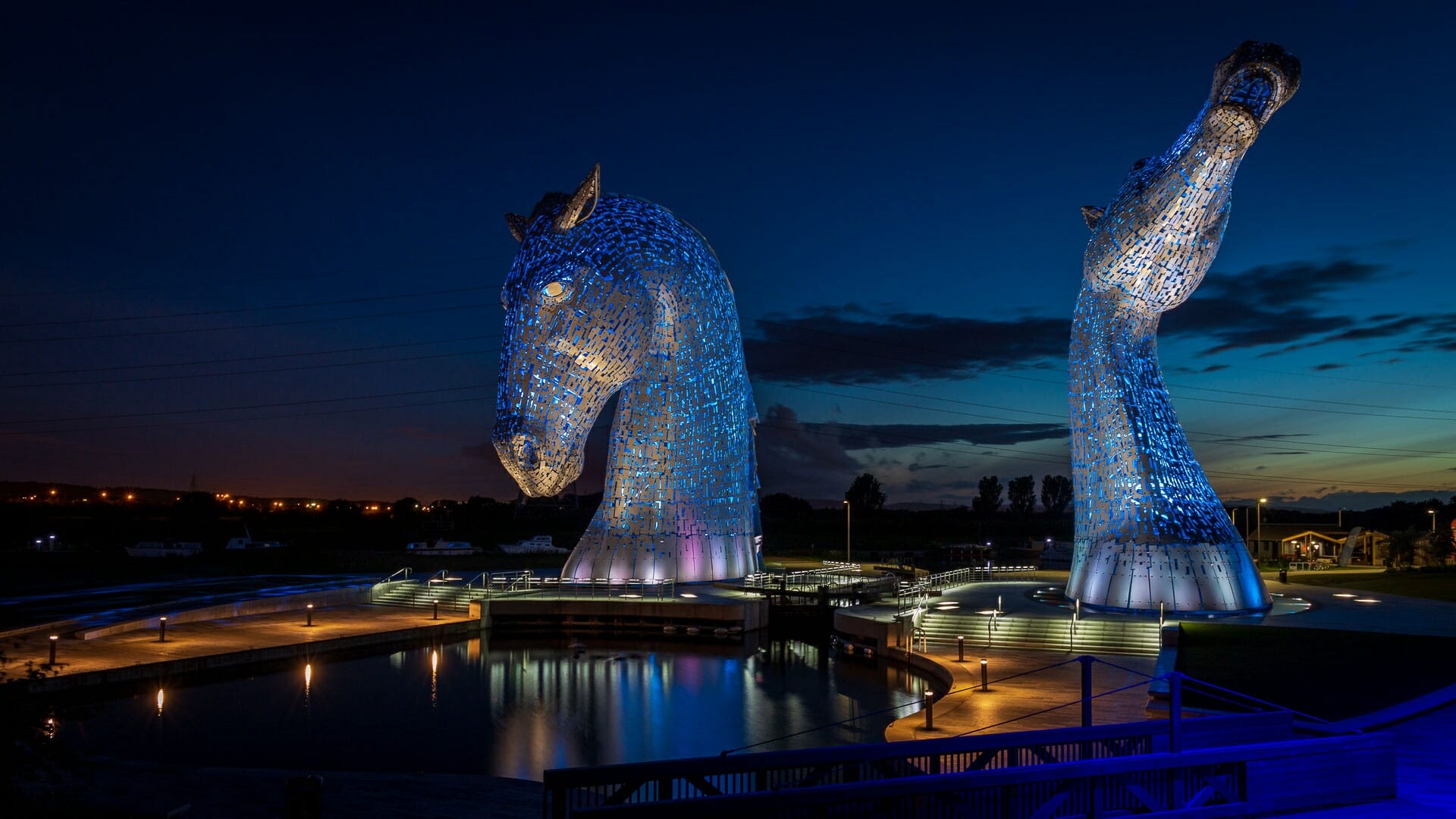
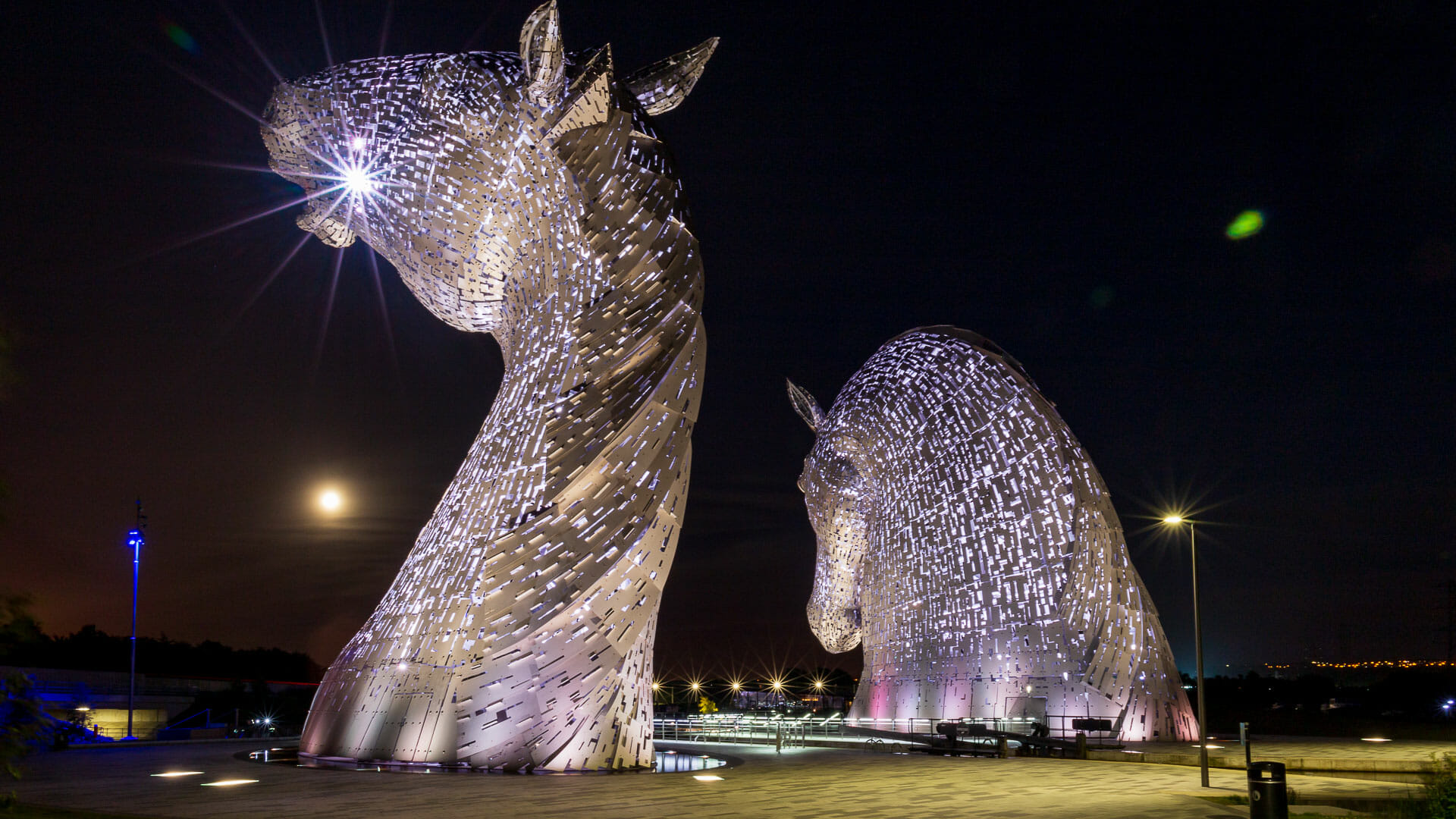
When I travelled to Scotland again in 2015, I made a point of waiting until the sun had set. Of course, good photos then also require a tripod, since the shots only really work with a long exposure. The result, I think, was some truly wonderful photos of the Kelpies – the spectacle of the changing colours came out beautifully.
Getting there:
With a sat nav: enter “FK2 9EE” and then follow the directions below.
Without a sat nav: from Edinburgh, take the M9 towards Stirling and leave at junction five for Falkirk/Grangemouth. At the roundabout, take the first exit towards Falkirk (essentially straight ahead). Three more roundabouts follow, which you also take essentially straight on, before the fifth one (Etna Road Roundabout) finally shows a sign for the Helix Car Park.
From Glasgow, take the M80 towards Stirling, and at junction eight come down onto the M876 and finally onto the M9. There, leave the road at junction six, Falkirk/Grangemouth, and at the roundabout turn right towards the A8. Right again at the next roundabout, and the following one is already at the Helix – follow the signs from there.
Coming from the north, always head for the M9 and then follow the directions above.
Parking: don’t just take the first car park. There’s one right at the back, from which it’s only a few minutes’ walk along the canal to the Kelpies.