Eerie. Grey stone tombs in a bleak, boggy landscape in the middle of nowhere. The Camster Cairns have patiently kept their secret here for thousands of years.
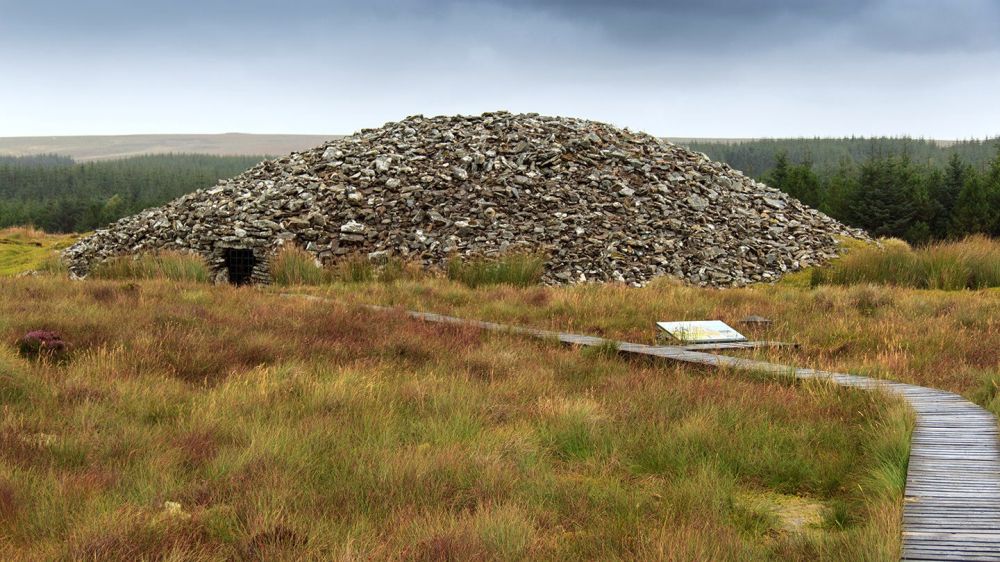
A Stone Age death cult is thought to have taken place in these two burial monuments around 5,000 years ago – though exactly what was celebrated in the chambers, nobody knows today. What is certain is that burnt human bone fragments and partial skeletons were found inside the cairns.
The two well-preserved stone structures stand on boggy grassland, conveniently reached via wooden walkways. First there’s the so-called Round Cairn – a circular pile of stones 18 metres in diameter and four metres high, with a chamber at its centre. A little further on lies the far more imposing Long Cairn, stretching 60 metres in length and 20 metres wide. The Long Cairn nestles gently into the undulating landscape.
Inside the Long Cairn are two chambers, which visitors can explore for themselves. Every chamber in the cairns is accessible – or perhaps more accurately, crawlable, since visitors can only make their way through the metres-long passages on all fours. Not everyone dares to go in…
Special features: the best of their kind
The Camster Grey Cairns are considered the best-preserved stone tombs anywhere in Britain.
The Long Cairn, incidentally, was only created a little later, formed by joining two neighbouring round cairns together. https://youtu.be/FzegUxuR9ik
Tip: the right clothing for the Camster Cairns
Exploring the chambers means crawling, so suitable clothing is a good idea. A pair of tear-resistant waterproof trousers, for instance, will keep your knees dry. There’s enough light inside, but if you have a torch to hand, you’ll certainly see more.
Did you know: about cairns, and the land 5,000 years ago
“Cairn” simply means a pile of stones – and, in essence, that’s really all the Camster Cairns are. There are, incidentally, plenty of such structures across Scotland. They date from the Neolithic period, the same era that produced stone circles such as the Ring of Brodgar on Orkney.
The cairns have been partially restored. Some of the chambers were fitted with concrete domes with skylights, which improves safety but does take away a little of the atmosphere.
Some assumptions were also made during the restoration, and scholars still happily disagree over how accurate they are. It’s not clear, for instance, whether the forecourts – the areas at either end of the Long Cairn – truly reflect the original layout.
5,000 years ago, the site of the cairns wasn’t boggy at all, but scrubland. The people of the time farmed the land here and were already partly settled. Scotland’s climate has since changed, however, and peat has grown here at a rate of about a millimetre a year.
Personal note: playing at Indiana Jones
Crawling through the tunnels and chambers of the stone tombs, we felt like amateur archaeologists on the trail of a lost civilisation. The grey weather and the solitude (there wasn’t another visitor in sight) created a slightly eerie atmosphere. The wind whistled outside, while inside it was hauntingly still.
In short: we had a great time visiting!
Getting there:
Take the A99 towards Wick through Lybster, then after around 600 metres turn left towards Camster – the cairns are already signposted here. Follow this road for 8 kilometres to reach the site. There’s parking for around five cars right by the road.
