At the start of the first millennium, the Romans had pushed their way into Britain as far as Scotland. There, they encountered the Caledonians at Mons Graupius.
“To plunder, to slaughter, to steal, these they misname empire, and where they make a wilderness, they call it peace.”
Around 80 AD, the Caledonians had had more than enough of the Romans. So they awaited the legions for a decisive battle at the mountain “Mons Graupius”.
What follows is the first decisive battle on the soil of what is now Scotland that we know of.
Table of contents
The background
Many politicians and generals of that time wanted to serve Rome by expanding the empire.
Emperor Claudius, for example, did just that, beginning the conquest of Britain in 43 AD.
In several waves, the Romans pushed further and further north and west across the island.
They did not rely *only* on force, however, but also formed clever alliances with some Celtic princes. Among some of the conquered, it was even fashionable to adopt Roman customs.
Bit by bit, the island of Britain thus fell under Roman rule.
Of course, there was also resistance. Around 60 AD, for example, the Celtic queen Boudicca rose up against Rome. But what began successfully soon ended with her death.
Among the Roman soldiers who marched against this Boudicca, a young military tribune also earned his spurs.
His name: Gnaeus Iulius Agricola. He was only 18 years old during this campaign.
From then on, Agricola’s steep rise through the Roman army was always linked to Britain.
Just a few years later, he commanded his own legion to put down the revolt of the Brigantes.
Finally – in 80 AD – he was even appointed Roman governor of Britain.
But that wasn’t enough for him.
He began extending his reach further north, deep into what is now Scotland. All the way to Mons Graupius.
There, as a general, he met his opponent under the leader Calgacus.
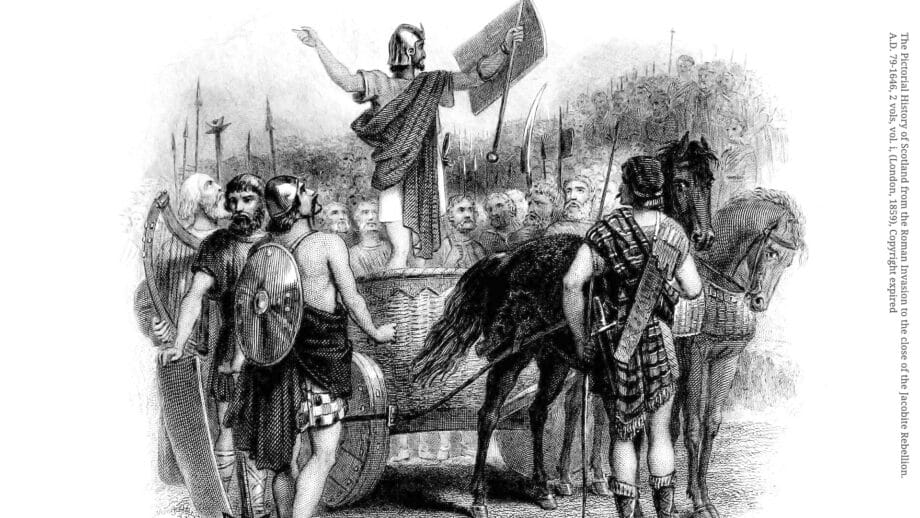
And as much as we know about Agricola, we know just as little about Calgacus. To this day, he remains an almost completely unknown Caledonian to us.
Interesting war technology: the chariot
“They fight not only on horseback and on foot, but also in chariots and carts, and are armed in the manner of the Gauls. They call these chariots covines, which are fitted with scythes around the axles.”
Chariots were a distinctive feature of Celtic warfare. These single-axle horse-drawn vehicles usually carried a driver and a warrior as crew. Under the Celtic conventions of war, incidentally, the drivers were off-limits as targets.
Chariots could quickly bring warriors to a location and pick them up again. The Celts also used them to cover retreats or to provoke opponents by driving up, hurling spears and quickly withdrawing.
The Belgae, the Celts of what is now Belgium, also used this technique:
The manner in which they fight from their chariots is as follows: first they drive about in all directions and hurl their weapons, and generally break the enemy’s ranks by the terror caused by their horses and the noise of the wheels;
and when they have worked their way in between the troops of cavalry, they leap from their chariots and fight on foot.
Meanwhile the charioteers withdraw a little from the battle and place themselves in such a position with the chariots that, if their masters are overpowered by the number of the enemy, they may have a ready retreat to their own troops.
Thus they display in battle the mobility of cavalry and the steadiness of infantry.
Calgacus also used these chariots at Mons Graupius.
The problem here, though: Agricola already knew these war machines well from his long career in Britain. And his Germanic auxiliary troops were no longer impressed by them either.
The situation before the battle
Most people underestimate how far the Romans actually pushed into Scotland. They think of Hadrian’s Wall, near today’s border between England and Scotland.
Others know of the Antonine Wall, or are even aware of the legionary fortress of Inchtuthil near Perth, on the edge of the Highlands.
But the Romans got much, much further into what is now Scotland. We know today, for example, of marching camps found a short distance east of Inverness.
This shows that Agricola was a complete professional. He advanced step by step, building this chain of camps along the way to secure his supply lines.
The Romans avoided the Grampian Mountains in the centre and worked their way forward through the flat, fertile ground in the east.
This also allowed them to be supported by a fleet sailing along the east coast.
So Agricola proceeded in an entirely methodical way.
Resistance among the Celts in what is now Scotland, on the other hand, initially formed only at a local level – and was broken each time.
After a while, however, it dawned on the tribes that they could only hold off the Romans united.
So they gathered and chose a leader: Calgacus. He now led his troops into battle against the Romans.
He waited for Agricola and his legion at the mountain Mons Graupius.
30,000 Caledonians had positioned themselves on its slopes – a superior force, with the advantage of high ground at their backs.
Agricola, however, was hardly impressed. He had known the British Celts for decades. He knew how they fought. And he would use that knowledge even against superior numbers, for he had only one legion along with auxiliary troops.
Calgacus, on the other hand, probably had little or no such knowledge of the Romans.
How the battle unfolded
On the slopes of Mons Graupius, the Caledonians stood in long ranks, their chariots and horsemen positioned in front of them.
Agricola had placed his auxiliary troops at the foot of the mountain, in the centre, at the front. These were Germanic fighters from what is now the Netherlands: the Batavians. Only behind them stood the actual legion.
Mounted Roman units waited on the flanks.
The Caledonians began the fight, trying to provoke the Romans with disorganised chariot attacks.
This left the Romans unmoved, as these tactics had never helped the other Britons either.
The legion and auxiliary troops were trained for this kind of warfare and equipped accordingly.
The Roman auxiliary troops then pushed up the mountain slope.
Their equipment helped them here: while the Caledonians had only small shields and slashing weapons, the Romans pressed forward with large shields and short stabbing swords.
The Caledonians could barely land a hit with their slashing weapons against the shield wall.
It was only on the steeper part of the slope that the advance of the Roman auxiliary troops stalled.
The Caledonians now tried to encircle the Romans with further warriors coming down from the slopes. But the Roman cavalry prevented this attempt.
The Roman cavalry was then able to strike into the enemy’s flanks itself.
This was, in essence, already the decisive moment: the Caledonian ranks broke, and the warriors retreated into the nearby woods.
They wanted to regroup there once more, but they were outmatched in discipline, equipment, leadership … in short: in everything.
And so the Caledonians fled in all directions. The battle was over.
The result speaks for itself:
- 10,000 Caledonians fallen
- only 360 Roman auxiliary troops fallen
- the actual legion didn’t even need to intervene
But I need to add an important piece of background information here: we know about this battle exclusively from Roman chroniclers.
In fact, there was really only one: Tacitus. And he had exactly one source, namely his father-in-law.
And that was Gnaeus Iulius Agricola himself.
What the battle changed
But why didn’t Caledonia become Roman from then on? Why did the Romans soon end up behind Hadrian’s Wall?
Agricola had indeed won, and Scotland lay open to his troops. But the administration in Rome had other plans.
Emperor Domitian had troops redeployed, because the border in Pannonia – in what is now western Hungary – needed defending. That region was far more worthwhile for the empire than wet, cold Scotland.
So the Romans withdrew and demolished their forts. Inchtuthil near Perth is the best known. It was dismantled in 86, just three years after the battle had been won.
Despite their defeat, the Caledonians therefore remained free. The Romans had been victorious in the battle, but had gained nothing.
So where exactly is the battlefield?
You may have noticed that I never actually said exactly where Mons Graupius is located. That’s because it’s a battle historians are still fighting today.
For one thing, Tacitus’s descriptions are hard to interpret. And it didn’t help that historians relied on a poor translation for a long time.
For another, no remains of a battle from this period and of this scale have ever been found.
There have already been many candidates for Mons Graupius. But currently, Bennachie is considered the strongest contender. It lies around 30 kilometres northwest of Aberdeen and fits the description well.
So what remains of the battle: an unknown leader named Calgacus, an unknown battlefield, a source who was related to the other leader, and an outcome that didn’t last long anyway.