Stornoway is the capital of the Outer Hebrides. Its founding began with a contested expedition in 1598. What happened back then – and what the town has to offer today.

The promised land was cold. Ludovic looked out at high cliffs with sparse vegetation as his ship sailed into the bay of Stornoway. This certainly didn’t look like a granary of an island. Had the king been mistaken?

Ludovic Stewart, second Duke of Lennox and cousin of the regent James VI, was in the process of leading his own small army onto the Isle of Lewis. He and eleven other men wanted to settle here. The king had handed them the land after the ruling clan MacLeod could not produce a title deed for its ownership. And now he and his companions had set out on an expedition as the “Fife Gentlemen”. Their goal: to build a small town, to “civilise” the Highlanders living here, and to farm and exploit the land. King James had promised them a rich island. All that interested him was that the barbaric, Gaelic-speaking inhabitants of the island be subdued – by force if necessary.
But the sight of the all-too-bare cliffs of the bay filled Ludovic with dark forebodings…
Even today, passengers on arriving ships first look out at the rocky landscape before entering the safe harbour of Stornoway. The car ferry from Ullapool steams into the funnel-shaped sea loch every day, to moor at its berth before disgorging a column of cars from its belly.
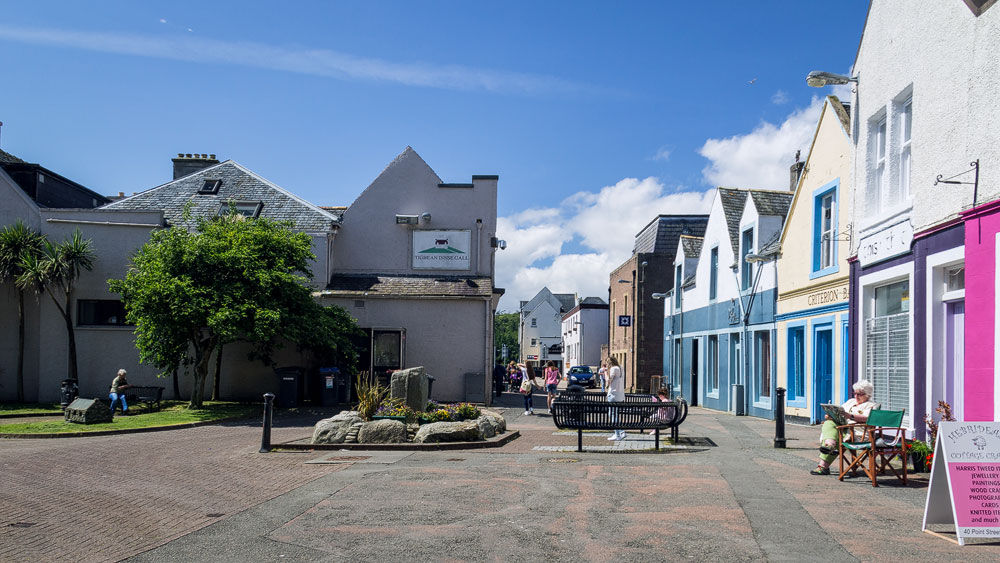
Unlike Ludovic, most arrivals today are well aware of what awaits them: a modern town with interesting sights and pleasant shopping. Tweed traders have set up shop in the lanes between the brightly painted houses, working the island’s own fabric in modern ways – into handbags, for example.

Along the waterfront promenade “Mol a Deas” – the “South Beach Street” – you can today stroll past pubs, hotels and the old Town Hall. Behind it, the pointed spire of Martin’s Memorial Church rises above the rooftops. Stornoway is a small but lively hub of Scotland’s western isles.
The Fife Adventurers, by contrast, found: nothing. The landing itself was easy enough. With his private army of around 600 men, Ludovic took the bay of Stornoway and the nearby castle, driving out the two MacLeod brothers, Murdo and Neil, who had ruled over Lewis until then.
But the newcomers had not reckoned with the harshness of the winter: it was considerably harsher than on the mainland. Fife – the expedition’s homeland – lies on the east side of Scotland, offering fertile soil and less rain. Here on Lewis, Atlantic storms and constant rain ruled. The soil was acidic and infertile. On top of that came the constant raids and skirmishes with the MacLeods, who stole livestock and supplies.

Cold was soon joined by hunger. Out of necessity, the settlers had to send a ship to the mainland to fetch supplies. But Murdo MacLeod intercepted it, killed most of the crew and demanded a ransom for the rest. A second ship was sent – with a stronger crew. But these men were now missing from the settlement’s defence, which Neil MacLeod and his men made ample use of.
In the end, what had to happen, happened: the expedition failed, the settlers withdrew and sold the rights to the land to the MacKenzies of Kintail. They were more successful. For the conflict had also decisively weakened the MacLeod chiefs. And so it came about that the MacKenzies ruled over Lewis for the following centuries – tolerated by the population.
Tips: sights in Stornoway

Lews Castle: this large mansion was built for Sir James Matheson, who had it erected in 1847 on the site where MacKenzie’s Lord Seaforth had previously kept a country house. It was later renovated by Lord Leverhulme, who gave it to the island’s residents in 1923. It housed a school until 1988, but it became clear that the building was at risk of collapse. It was renovated from 2012 onwards. Today it houses a hotel for its guests.
Around Lews Castle lies a park with a golf course laid out on it. The entrance to the park from the main road is formed by the Lews Castle Porter’s Lodge, a mixture of gatehouse and residence.
Museum nan Eilean: the “Museum of the Isles” presents exhibitions on art, history and more. It is located in the extension to Lews Castle. You can find out more here. Admission is by donation. April to September: Tue-Sat 10am-5pm. October to March: Tue-Sat 1pm-4pm. Closed Sunday and Monday.
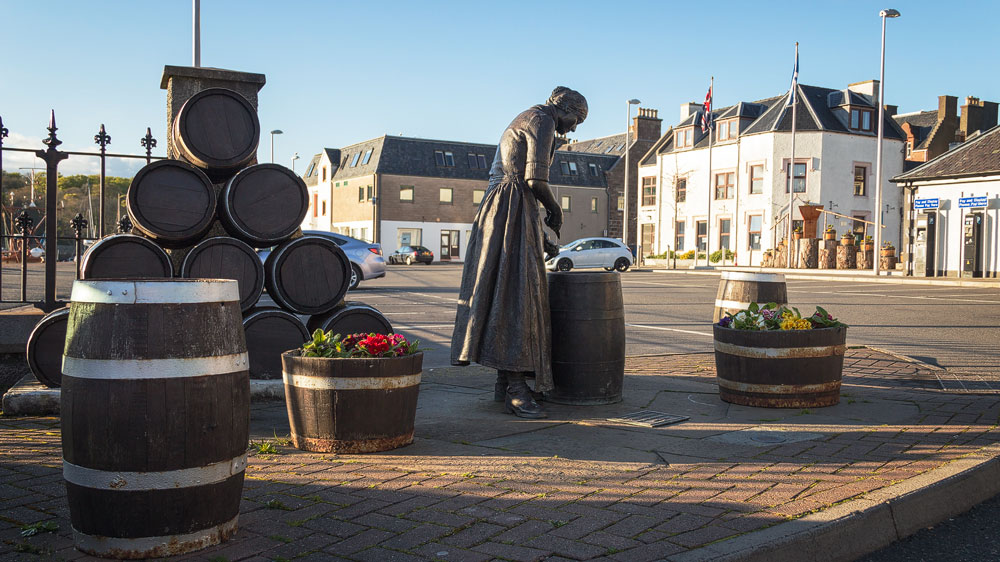
Harbour: a small spit of land divides the bay of Stornoway into an outer and an inner harbour. At the inner harbour there is a large car park from where you can start your walk around town. At the harbour itself stands one of the “Herring Girls” statues, commemorating the women who did hard labour during the herring fishing heyday. Around 1900, these women gutted the herring at the harbour and packed it into barrels. However, industrial herring fishing on Lewis ended with the Second World War.
The Visitor Centre, which has further ideas on offer, is also located at the harbour, by the way.
Lewis War Memorial: a tower roughly 26 metres high commemorates the 1,526 who fell in the First and Second World Wars. The impressive building was erected as early as 1924 and stands a little outside the town centre. (TomTom: B7L0.1QG)
Facts: the name and location of Stornoway
Stornoway lies in the middle of the Isle of Lewis, on the side facing the mainland. A deep bay cuts into the land here. Even today it offers a calm harbour and, thanks to its central location, fast connections to all parts of the island. That’s why Stornoway is also the perfect landing point for the car ferry from Ullapool.

This ideal location was already known to the Vikings (in German for now), who ruled over the Outer Hebrides for a long time. That’s why they gave the place the name “Stjórnavágr”. All the websites agree unanimously that this means “Steering Bay” in English – but how should one sensibly translate that? “Bay of steering”? It’s most likely a reference to a good anchorage, and it’s assumed the Norsemen already had a settlement there too. There is even some evidence that the area was settled as far back as the Iron Age, meaning the centuries before and after the birth of Christ.
According to the 2011 census, the authorities counted 5,714 residents in Stornoway, making it the largest town in the Outer Hebrides and the third-largest in the Highlands. If you take the whole Stornoway administrative area including the suburbs, you arrive at 13,009 people – almost half the population of the Outer Hebrides.
Getting there:
You reach Stornoway by ferry, coming from Ullapool. The ferry operator is Caledonian MacBrayne. You can find the current timetable here.
With a sat nav: the postcode for the town centre is “HS1 2XQ”.
Without a sat nav: the major roads A857, A858 and A859 all end in Stornoway. The best place to park is at the inner harbour – though there is a parking fee.