For five centuries, a British kingdom on the River Clyde weathered defeats, sieges, and powerful neighbors—and yet, to this day, it remains largely unknown. Its name: Strathclyde.
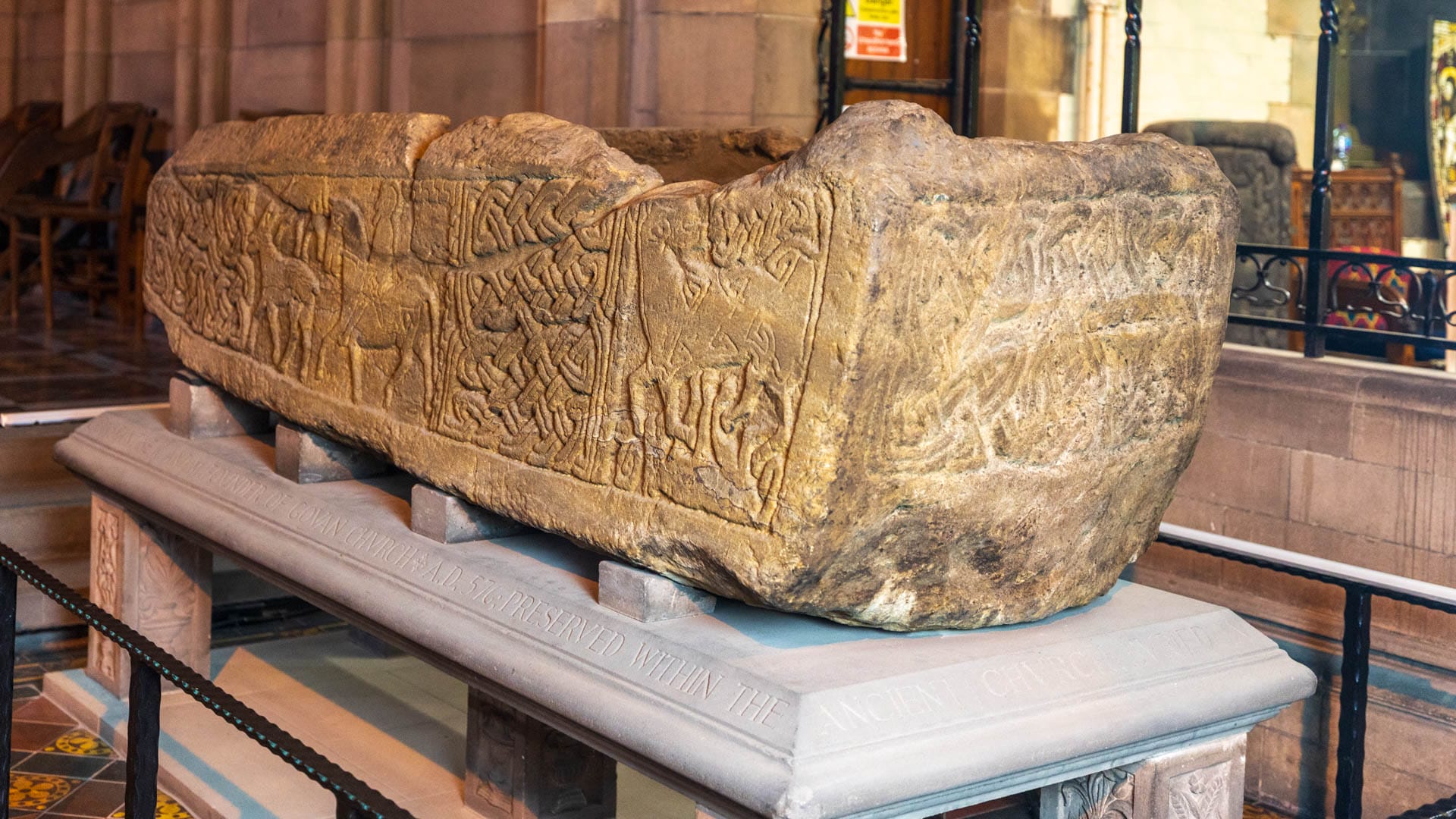
In the Govan Old Parish Church near Glasgow, 31 intricately decorated stone crosses and gravestones still stand today, some over a thousand years old. Among them is even a sarcophagus for a king. Such a collection in a single location is unique—and scholars like Tim Clarkson see it as evidence of a former center of power. In fact, there was a kingdom here that is largely overlooked in the romanticized image of Scotland: Strathclyde. It lost many battles—and yet endured for 500 years. It witnessed other kingdoms fall and the rise of the new Scotland.
The Damnonii and the Romans
North of Glasgow once ran the Antonine Wall: a border consisting of earthen ramparts and palisades that Emperor Antoninus Pius had built in the mid-2nd century A.D. It began in the west at the Firth of Clyde and ended in the east at the Firth of Forth—a distance of about 60 kilometers between the sites of present-day Glasgow and Edinburgh. With it, Rome expanded its empire 160 kilometers to the north, beyond Hadrian’s Wall.
Between these two frontier walls, around the River Clyde, lived the Damnonii: British Celts who coexisted peacefully with the Romans, while the Caledonians, who settled further north, were considered difficult to deal with. The ancient geographer Ptolemy reported that the Damnonii had a capital called Alauna—translated as “the rocky place.”
After only 40 years, the Romans withdrew back behind Hadrian’s Wall, but the Damnonii remained loyal to their former occupiers. In the 4th century, Roman soldiers finally left Britain entirely. This opened the door for a new ethnic group.
The Saxons and Angles Arrive
Immigrants now arrived from what is now Friesland, northern Germany, and Denmark—some of whom had originally been hired as auxiliary troops. The Angles and Jutes came from what is now Denmark, while the Frisians and Saxons came from northern Germany. Their names can still be found today: Wessex, the West Saxons; Essex, the East Saxons; Sussex, the South Saxons. England itself means “Land of the Angles.” The Britons—including the Damnonii—had to come to terms with these new neighbors.
The Cumbri and Their Language
Meanwhile, a new people had emerged around the Clyde, particularly at its mouth, who called themselves “Cumbri”—“countrymen.” Today’s Welsh still call themselves “Kumm-rie,” spelled Cymry. The language of the Cumbri was Cumbric, a Celtic language closely related to Old Welsh; together with Welsh, Cornish, and Breton, it formed a language family. These were the British Celts who had remained. Strathclyde was thus a British kingdom—right in the heart of present-day Scotland.
Other kingdoms formed around the Cumbri: to the northwest, the Gaelic-speaking Scots of Dalriada; to the east and south, various Saxon kingdoms; and as neighbors, the Picts, whose language also originated from British Celtic.
Old Clut—the Rock on the Clyde
Depending on the era, the kingdom of the Cumbri bore different names. In the early period, scholars refer to it as Alt Clut: “Alt” means “rock,” and “Clut” refers to the Clyde. Today, this rock is called Dumbarton Rock and is located about 20 kilometers west of Glasgow, in the Clyde River delta. It is even possible that Alauna, the “rocky place” of the Damnonii, describes the same location—though this is not certain.
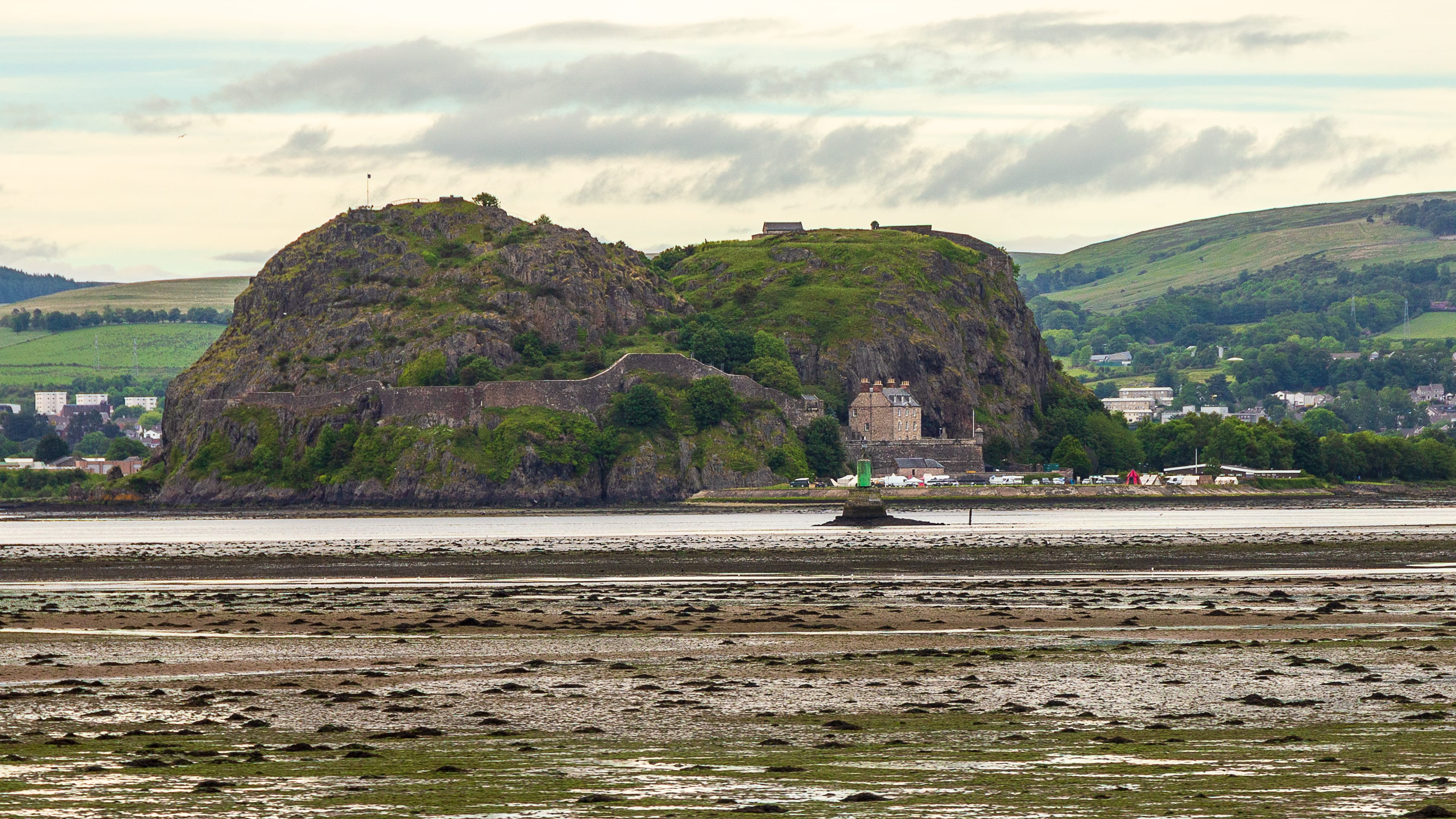
What is certain, however, is that the Cumbrian kings resided at Alt Clut. One of the first kings for whom there is solid historical evidence is Rhydderch Hael. He lived at the end of the sixth century, was a contemporary of Saint Columba of Iona, and is mentioned in various chronicles and poems. It is known that he fought against the Angles. His sword, Dyrnwyn—“with the white hilt”—is one of the thirteen legendary treasures of Britain: it is said to have blazed when its bearer was worthy.
Rhydderch also played a role in an event that was decisive for the region: he enabled a certain Kentigern to resume preaching on the Molendinar River after his predecessor had driven him away. Kentigern later became known as St. Mungo, and his small congregation is today’s Glasgow—though at that time it was still insignificant. When Rhydderch traveled, he presumably stayed at a farmstead near what is now Partick, where the River Kelvin flows into the Clyde and a ford allowed for crossing.
Alt Clut was a force to be reckoned with. It formed coalitions and won and lost battles. In the chronicles of one of these conflicts, a name appears for the first time that would later become central: Ovania—today’s Govan.
The Vikings Conquer Alt Clut
Over the centuries, the island’s ethnic groups had just begun to stabilize again when foreign conquerors arrived once more: the Vikings. In the year 870, two Nordic rulers from Dublin laid siege to the fortress of Old Clut. The Cumbri held out for four months, then the garrison was forced to surrender—they had run out of water. The Norsemen enslaved the population. All that is known about the king at that time is that he died two years later, presumably as a prisoner. Alt Clut was finished.
Yet the Cumbri kingdom endured. Survivors of the dynasty moved the capital deeper inland, to the Clyde Valley—in their language, “Strat Clud”: Strathclyde. The seat in Partick remained, while Govan emerged as the new center. “Go ban” means “little hill” and refers to the artificially mounded Doomster Hill, where the king held council and ceremonies took place—a spiritual center of the kingdom, connected to the nearby church by a short processional road. Doomster Hill remained visible well into the 19th century before it disappeared with the construction of new docks and houses.
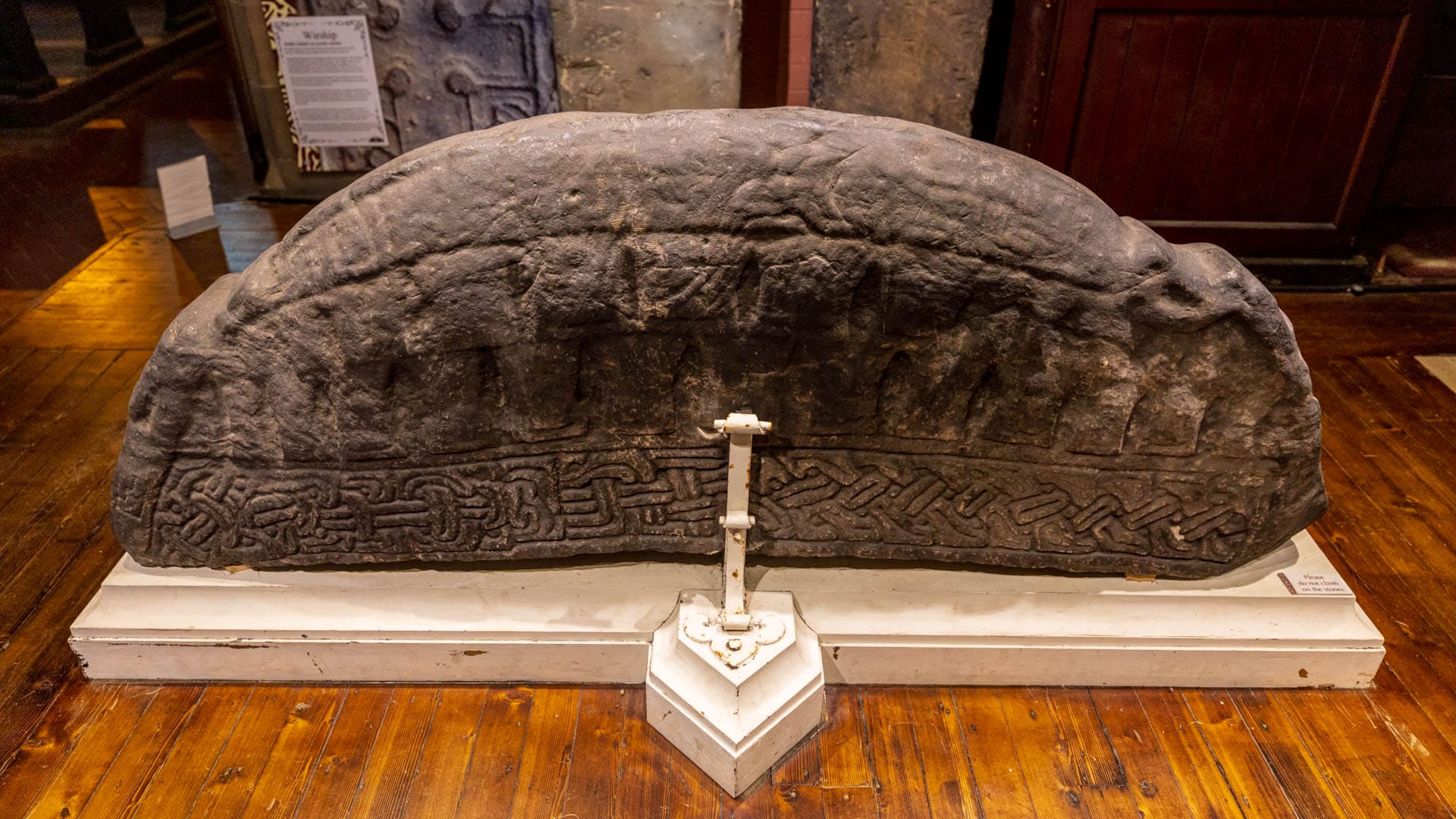
The so-called Hogback Stones of Govan still demonstrate today that the Nordic neighbors certainly influenced the art of the Cumbrian people.
The Extent of the Kingdom
Much is said about the Clyde, but Strathclyde’s territory was significantly larger. Around the year 900, the kingdom extended south as far as the River Eamont in what is now northern England—Dumfries and Galloway were thus also part of Strathclyde. To put this in context: Around 900, Strathclyde still existed, while Dalriada and the Picts had already united to form the kingdom of Alba, where the Gaelic language prevailed. The Saxons, for their part, were under pressure from the Danes and the Norsemen from Dublin. In the end, however, it was not the Vikings who brought about the downfall of Strathclyde.
Brunanburh and Other Battles
In the year 934, King Athelstan, ruler of Wessex and Mercia and one of the first kings to unite large parts of England, marched north. Both Constantine of Alba and Owain of Strathclyde were forced to acknowledge his suzerainty—they remained kings but were subordinate to him. Just three years later, both rebelled and allied themselves with the Norse ruler Anlaf of Dublin. Together they marched against Athelstan.
In the year 937, the Battle of Brunanburh took place—its exact location remains a matter of debate to this day. Athelstan emerged victorious, and the armies of Strathclyde, Alba, and Dublin suffered a severe defeat. Brunanburh is now considered one of the most significant battles in British history, as Athelstan’s victory stabilized Anglo-Saxon rule over England. For Strathclyde, it marked another setback—but not the end.
Eight years later, in 945, Athelstan’s successor, Edmund, attacked Cumbria and ravaged the region. He subsequently ceded it to Máel Coluim, the king of Alba, but remained the supreme ruler himself. In 973, one of the most famous gatherings of medieval kings took place: The English King Edgar gathered several rulers in Chester. Later chroniclers turned this into an embellished tale, according to which Edgar took the helm of a boat while eight subordinate kings rowed—among them, possibly, the ruler of Strathclyde. To what extent this scene was later embellished in literature remains open to question; however, it illustrates how English chroniclers understood the balance of power at the time.
In the year 1000, the English King Æthelred attacked Strathclyde and plundered the kingdom—the exact reason is unknown; perhaps it had allied itself with Norse rulers, or perhaps it had supported Alba. The attack likely significantly weakened Strathclyde’s military power. And once again, that could have meant the end—yet even afterward, Strathclyde remained independent.
The End Comes with a Comet
Around the year 1018, Owain the Bald reappeared: Together with Máel Coluim, the King of Alba, he fought against Northumbria. The armies clashed at Carham, and Strathclyde and Alba emerged victorious—a significant triumph that strengthened the influence of both kingdoms in the border region. The battle is sometimes dated to the year 1016, but much evidence points to 1018: a comet is said to have appeared in the sky shortly before, and one is indeed documented for the year 1018.
After Carham, the chronicles fall silent regarding Strathclyde—growing ever quieter. This does not mean that the kingdom disappeared immediately, but the political landscape did change. In the southwest, the Gall Gaidheal—the “Foreign Gaels”—spread: a people whose culture blended Norse and Gaelic traditions, arising from contact between the Vikings and the Gaels. They spoke Gaelic and increasingly occupied land deep into the former heartland of Strathclyde—the region of Galloway bears their name to this day, and later a separate realm emerged there.
At the same time, pressure mounted from the east: In 1038, the Northumbrian Earl Eadwulf invaded Scotland. Although Strathclyde is not explicitly mentioned in this context, the kingdom lay precisely between the warring parties and likely felt the pressure acutely. The Gaidheal to the west, Alba to the north, and Northumbria and England to the east and south—Strathclyde was hemmed in on all sides.
Macbeth and the End of Strathclyde
Yes, exactly—Shakespeare’s king. The historical MacBethad, however, had only limited connection to the character on stage. In 1054, Earl Siward of Northumbria attacked Alba on behalf of Edward the Confessor, defeated MacBethad, and installed a man named Máel Coluim. One source describes him as the son of a king of the Cumbrian people—a suggestion that Strathclyde’s ruling family may still have existed at that time, or that Northumbria already controlled the kingdom. We cannot know for certain.
Siward died as early as 1055; MacBethad apparently regained control of Alba but was killed in battle in 1058. His successor was another Máel Coluim, son of Duncan—the name was apparently very popular at the time. During his reign, the Normans seized power in England beginning in 1066; this initially had no major direct impact on the north, but it did weaken the neighboring kingdoms.
A footnote from Malcolm’s reign catches one’s attention: A chronicle reports on a raid Malcolm led into Northumbria, for which he passed through Cumbria—and almost in passing, we learn that Malcolm had forcibly subjugated the kingdom of Strathclyde. Thus ends, unspectacularly, the history of a centuries-old kingdom: no grand downfall, no single decisive battle, just a passing remark. Strathclyde had been absorbed into Scotland.
The Legacy of the Cumbri
The territory south of the Solway Firth fell to the Earls of Northumbria; there—though not until the late 12th century—the name Cumberland became established. The ancient kingdom was divided: the northern part became Scottish, the southern part English. Galloway initially continued to develop independently; the once-cohesive Brittonic kingdom gave rise to several regions.
Yet the idea of a Cumbrian kingdom had not yet disappeared entirely. Around the year 1120, King Alexander I appointed his brother David as “Prince of the Cumbrian People” or ruler of the Cumbrian kingdom—a territory that encompassed a large part of the old Strathclyde, though excluding Galloway and the regions south of the Solway Firth. David also reestablished the Diocese of Glasgow and later became King of Scotland himself. However, this was not a true revival of Strathclyde, but rather a new dominion within the Kingdom of Scotland.
The Cumbric language, too, had already largely disappeared by this time; it was replaced by Gaelic and, later, increasingly by English or Scots. Some names still remind us today of the kingdom of the Cumbri: Cumberland, the county in northwestern England, where the southern part of Strathclyde once lay. And the Cumbraes archipelago in the Firth of Clyde—which translates to “the Cumbrian Islands.”
Anyone visiting Glasgow today should take a detour to Govan to see the ancient stones—or drive to Dumbarton to admire the castle perched on the rock. For hidden between the stones of Govan and the walls of Dumbarton lies the history of a Briton kingdom in the heart of modern-day Scotland: a kingdom that often lost battles but survived for a surprisingly long time.
Source:
T. J. Clarkson: “Strathclyde and the Anglo-Saxons in the Viking Age,” Birlinn.