Britain has its share of nasty little bloodsuckers too – and in Scotland, tick numbers are actually rising sharply. How bad is it really, and how do you protect yourself? Here’s what you need to know.
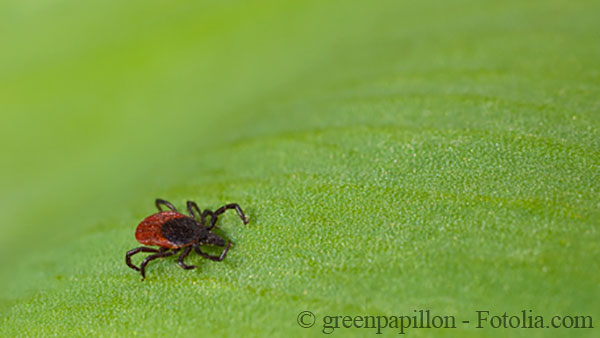
The king of the Highlands is to blame for the rising number of ticks in Scotland – the deer. As red deer numbers grow larger year after year, ticks multiply there too, since red deer are one of their favourite hosts. Dry, mild winters, like those of 2013/2014, further favour tick breeding. So it seems that in Scotland, ticks are starting to become something of a nuisance on a par with the notorious Highland midge.
It’s true: just walking a short distance into the heather in the Highlands – even just to take a photo or use the toilet – can be enough for these little bloodsuckers to latch on. (My wife can certainly tell a tale or two about that.)
Even so, there’s no need to panic, since you can protect yourself.
What diseases do British ticks carry?
The good news first: tick-borne encephalitis (TBE) – a potentially life-threatening inflammation of the brain and its membranes, widespread in Germany – doesn’t (yet) exist in Britain.
That leaves the second concern: Lyme disease. These bacteria carried by ticks are indeed found across the whole island – including, and especially, in the Highlands & Islands, in the Scottish west.
The estimated number of Lyme disease infections in Britain is thought to be between two and three thousand cases a year – estimated, since a significant number of unreported cases is assumed. For comparison: in Germany, figures of between 60,000 and 100,000 infections are commonly cited.
So the takeaway for Scotland, and Britain as a whole, is this: it isn’t nearly as bad as on mainland Europe.
Where and when are ticks most common in Britain & Scotland?
Research has shown that ticks favour the following conditions:
- habitats in and around woodland
- warm areas
- proximity to red deer
For Scotland, that means, for example: the low-lying, wooded areas along the west coast are the riskiest. Ticks are also common in heather moorland. By contrast, you can feel relatively safe from these creatures from about 500 metres above sea level upwards – the higher you go, the fewer there are.
In Britain, tick season peaks in summer, with numbers particularly high in May, dropping off sharply again by August.
How do I protect myself?
Prevention: the best approach is to avoid tall vegetation, meaning stick to paths and roads. Admittedly, that takes a lot of the fun out of a holiday, since it’s precisely the wilder parts of Britain that are the most beautiful.
If you do venture into areas with tall vegetation, try to cover as much skin as possible. For example, by wearing long trousers and tucking them into your shoes. (A tip from Armin: hiking gaiters work quite well for this.) It also helps to wear light-coloured clothing, since ticks are easier to spot on it and can then be brushed off.
Using insect repellent helps too – not just on the skin. There are also products you can spray onto clothing. I’ve included a selection as Amazon links in the article.
Advertisement:
Advertisement:
Advertisement:
Advertisement:
In the evening, check yourself, your children and your pets thoroughly – paying particular attention to skin folds when looking for the little creatures.
Removal: if a tick has already latched on, time matters. The sooner you remove it after the bite, the lower the risk of infection with Lyme disease. A tick removal tool is helpful here – ideally along with an alcohol wipe to clean the bite site afterwards.
Using the tool, grip the tick as close to the skin as possible; the rear of the tick’s body shouldn’t be squeezed, as this increases the risk of infection again. Then simply pull the tick straight out, slowly and steadily.
You should avoid using butter, oil and similar old home remedies to try to suffocate the tick. This stresses the creature and once again increases the likelihood of infection.
Aftercare: keep a close eye on the area around the tick bite for the next couple of days. If a circular rash forms there, it could be a sign of Lyme disease – as could a general feeling of being unwell, or flu-like symptoms. In that case, see a doctor as soon as possible and mention the tick bite. Incidentally, the German word for tick, “Zecke”, is “tick” in English, so a tick bite is simply a “tick bite”.
Lyme disease can usually be treated effectively with antibiotics.
Bottom line: yes to caution, no to panic
Ticks are a real and annoying hazard on the British Isles. But compared with the risk posed by ticks in Germany, it’s relatively low. So there’s no need to panic – just prepare properly for your trip, and bring along a tick removal tool at the very least.
Sources:
https://travelhealthpro.org.uk/media_lib/mlib-uploads/full/the-green-book-tick-borne-encephalitis-august-2026.pdf
http://www.nhs.uk/Conditions/Tick-borne-encephalitis/Pages/Introduction.aspx
https://www.rki.de/DE/Aktuelles/Publikationen/RKI-Ratgeber/Ratgeber/Ratgeber_LymeBorreliose.html
