It’s the best-preserved chambered cairn in the Outer Hebrides. It survived 5,000 years – but now time has begun to take its toll.
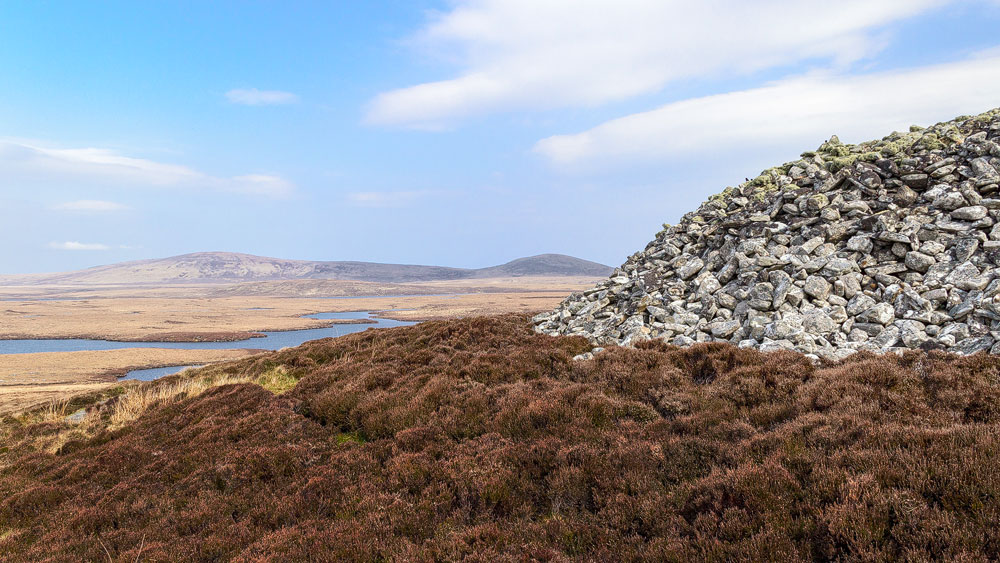
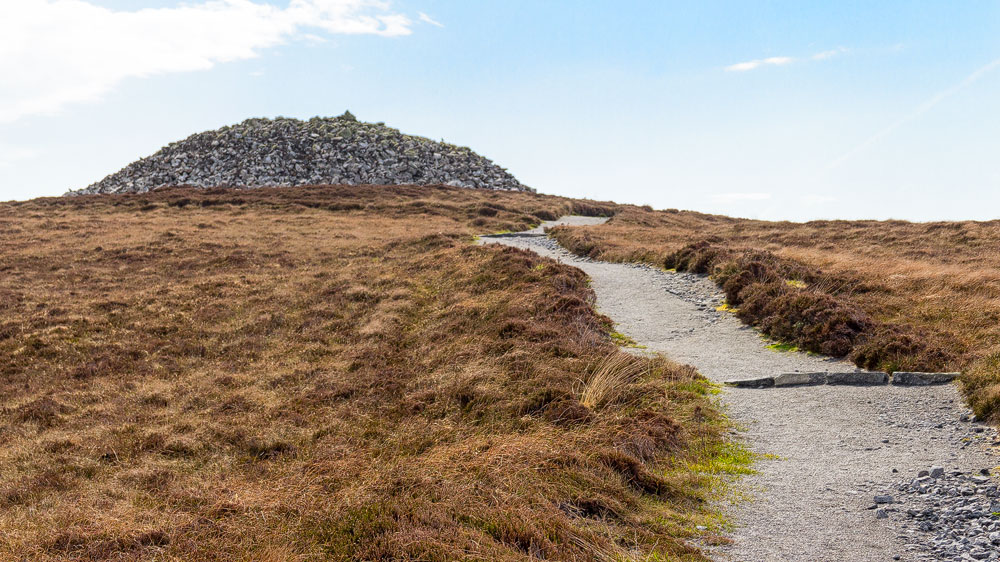
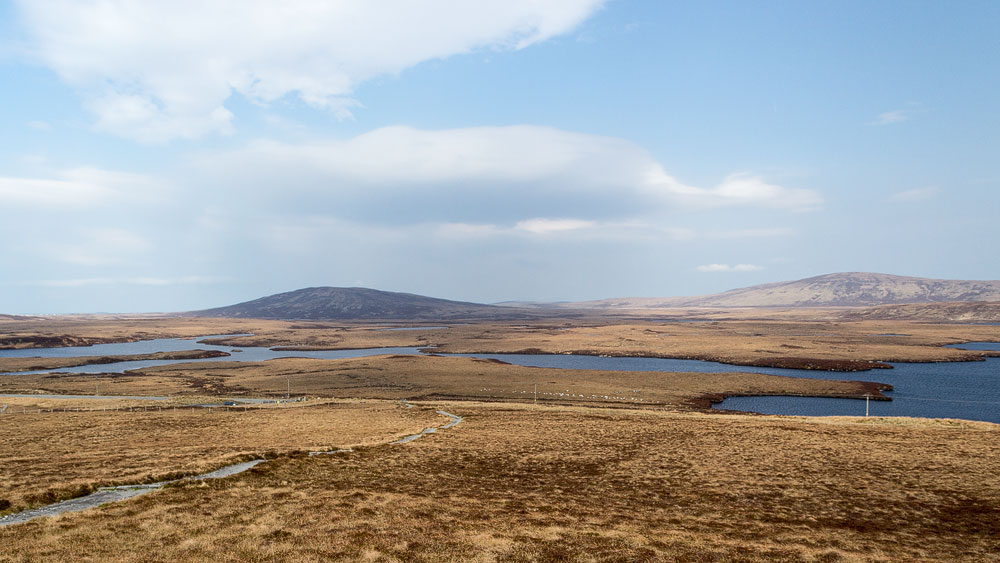
We’re standing on the mound of Barpa Langais, looking out over the moor. Heather and grass cover the peat and shape the plain, while a mountain range crouches behind a loch in the background. The landscape presents itself as wild and barren.
But that isn’t the view the builders of this cairn had. Around 3000 BC, they would have looked out over a plain covered in dense forest, or a fertile meadow, partly under cultivated grain. Five thousand years ago, when Barpa Langais was built, North Uist was a paradise for Stone Age people. The climate was considerably milder, and the early inhabitants could farm the land here and raise livestock.
Finds of pottery within the burial mound show that these early people had developed real craft skills. Human bone remains that had been cremated were also discovered there.
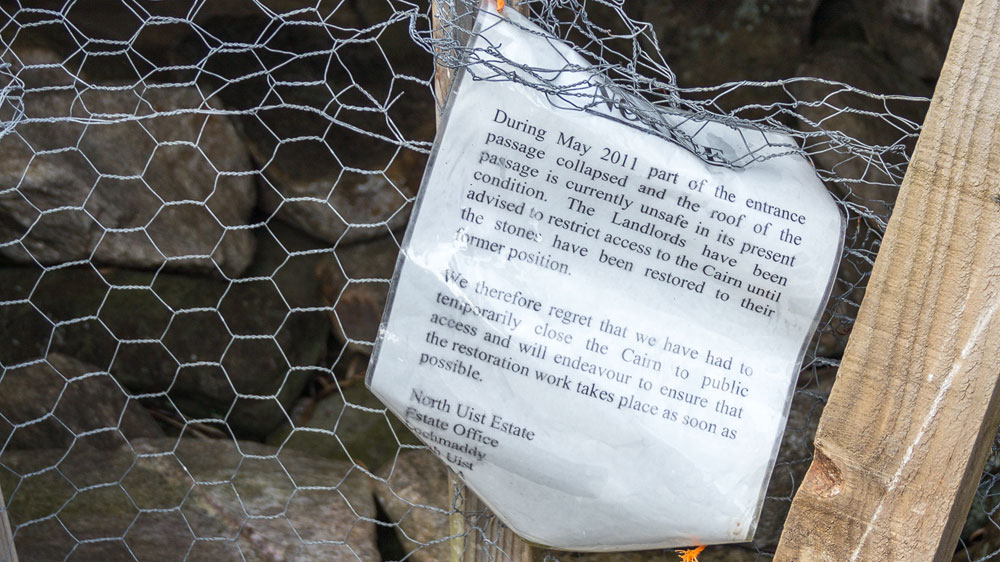
Barpa Langais is the best-preserved chambered cairn in the Outer Hebrides. Unfortunately, though, parts of the mound gave way in 2011, burying the chamber. Up until then, visitors could still crawl through the tunnel into the interior. The entrance has now been closed off for safety reasons.
Good to know: name and classification
Barpa Langais means “Langais burial mound”, referring to nearby Loch Langais and the hill of the same name on which it was built. It’s a typical chambered cairn – essentially a pile of stones with an inner chamber – standing in the same tradition as the famous Maes Howe on Orkney, or Camster Cairns in Caithness.
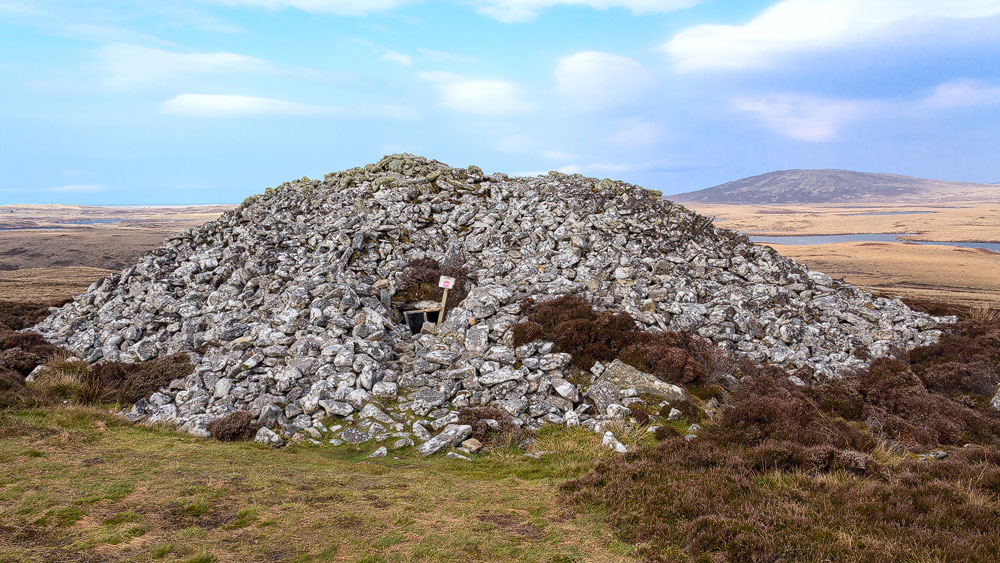
The stone mound has a diameter of 25 metres and rises four metres high, though it should be assumed that the ground around the cairn was once lower, meaning it would originally have stood even taller. The chamber was oval, around four metres long and 1.8 metres wide.
The road to Lochmaddy runs at the foot of the hill on which the cairn stands. When this road was due to be widened, archaeologists first set about investigating the area. They found the remains of a hunter-gatherer population that had made camp here around 6000 BC. The scientists found holes where posts for dwellings had once stood. Remains of primitive tools and a kind of anvil were also unearthed.
Incidentally, there are various spellings of Barpa Langais, with “Barpa Langass” being a very common one.
Tip: walking to the stones
Nearby is the stone circle Pobull Fhinn (“Finn’s People”), the most beautiful stone circle on North Uist. You can extend your visit to the cairn into a short walk, described on Walkhighlands. It leads over the hill of Beinn Langais to the stone circle, down to the hotel, and back to the road. From the top of the hill, there’s a magnificent panoramic view.
Personal note: the mood at the car park
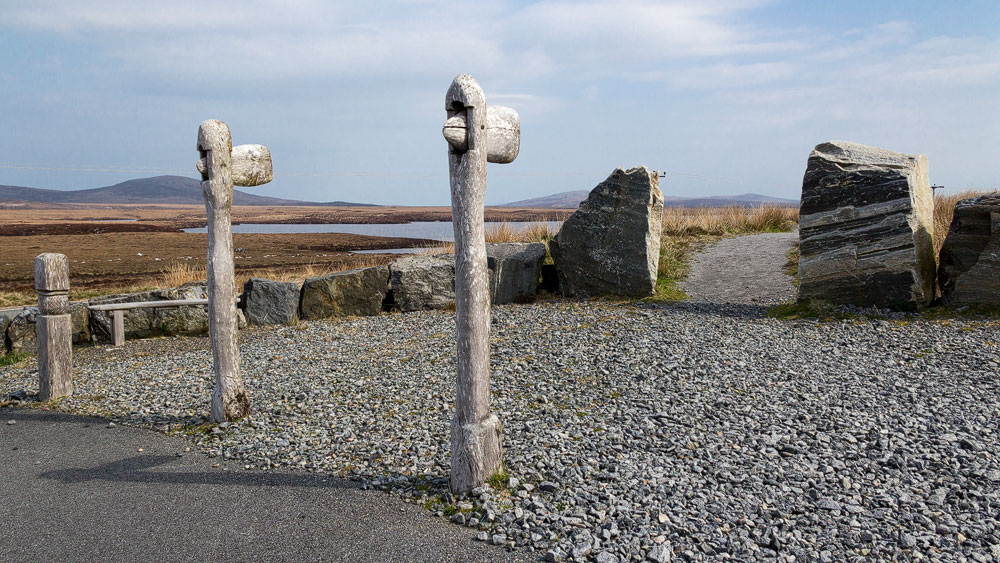
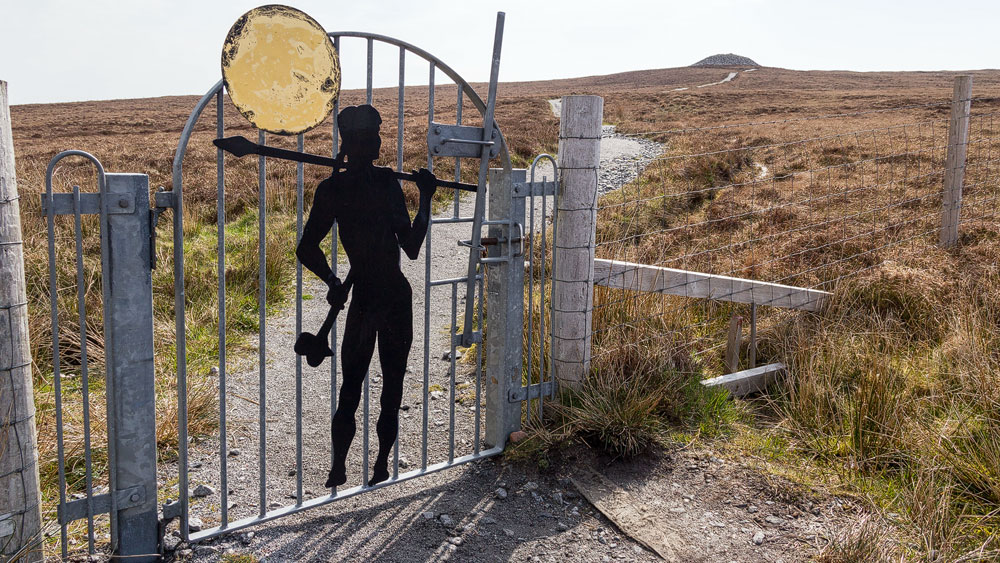
There are wooden sculptures of stone axes at the car park, and you enter the path up to Barpa Langais through a wrought-iron gate depicting a hunter carrying just such an axe. Although my first thought was of Native Americans, these little pieces of modern art are genuinely lovely to look at.
Getting there:
With sat nav: “HS6 5HA” will get you almost all the way there.
Without sat nav: heading along the A867 from Lochmaddy towards Clachan, the car park appears on the left after around 15 minutes and 13 kilometres. Coming from Clachan, you’ll naturally find the car park on the right, appearing after around 3 kilometres and just as many minutes.