When’s the best time to visit Scotland? Our climate tables show when it rains least. Plus: when there are fewer midges and fewer tourists around.
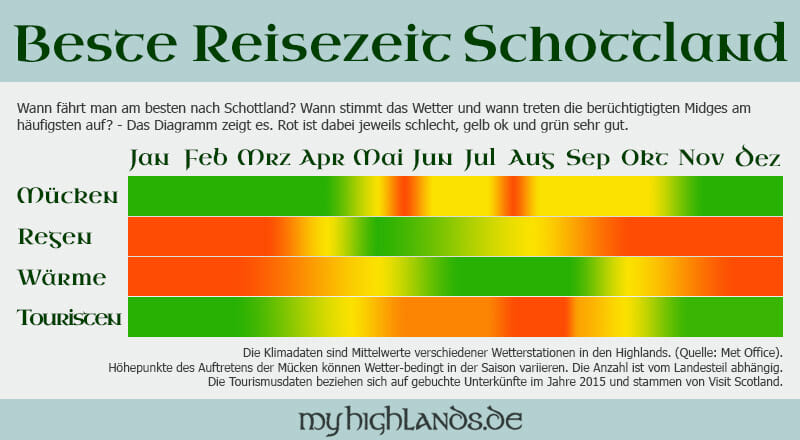
Several factors matter when it comes to the best time to travel to Scotland:

I’ve gathered the key information on all of this on this page.
Best time to visit Scotland at a glance
- April and early May: for a road trip with fewer midges. Allow for cooler weather and some seasonal closures.
- May and June: for long days, scenery and walking. Start packing midge protection from May.
- July and August: for summer trips; book popular accommodation early and prepare for midges.
- September and October: for autumn scenery. Days shorten; keep preparing for midges, especially in September.
- November to March: for city breaks and quiet stays. Check rural opening times and winter conditions.
Here’s more detail on each of these.
Climate: what the weather is like in Scotland
The Scots have a saying: “If you don’t like the weather, wait five minutes!” This joking phrase has a serious background, because the weather in Scotland often changes quickly. Your best bet is to pack clothing you can layer and change quickly.
Scotland is a large country, and weather and climate vary hugely between regions. One example makes this clear: Glasgow sits on the west coast, Edinburgh on the east coast, and the straight-line distance between the two cities is just 70 kilometres. Aberdeen lies 200 kilometres further north, also on the east coast, while Inverness sits in the Highlands on the east coast.
The climate tables below show historical averages for 1981–2010. They help compare regions, but are not a weather forecast. The Met Office now also publishes averages for 1991–2020; the tables below have not yet been updated to that newer reference period.
| City | Rainfall mm | Hours of sunshine |
| Glasgow | 1124 | 1203 |
| Edinburgh | 704 | 1426 |
| Aberdeen | 814 | 1435 |
| Dundee | 722 | 1426 |
| Inverness | 732 | 1220 |
As you can see, those 70 kilometres between the two largest cities make a big difference in climate: Edinburgh gets only two-thirds of the rainfall that falls on Glasgow. In exchange, Edinburgh gets 200 more hours of sunshine. This lower rainfall extends all the way up the east coast.
So it really depends on where in Scotland you’re heading – west or east.
The west gets more rain, the east more sun. The catch is that Scotland’s west coast is the wilder and more beautiful part – which is in turn thanks to that sometimes extreme weather.
Here’s the climate data for the major cities at a glance (on a smartphone you can swipe the table cells left to see the values):
Glasgow (West)
| Month | Jan | Feb | Mar | Apr | May | Jun | Jul | Aug | Sep | Oct | Nov | Dec |
|---|---|---|---|---|---|---|---|---|---|---|---|---|
| Max. temperature | 6 | 7 | 9 | 12 | 15 | 17 | 19 | 19 | 16 | 12 | 9 | 6 |
| Min. temperature | 1 | 1 | 3 | 4 | 6 | 9 | 11 | 11 | 9 | 6 | 4 | 1 |
| Hours of sun/month | 45 | 72 | 104 | 140 | 190 | 162 | 170 | 159 | 118 | 89 | 57 | 44 |
| Rainy days | 18 | 13 | 17 | 13 | 11 | 12 | 13 | 12 | 14 | 17 | 18 | 16 |
Edinburgh (East)
| Month | Jan | Feb | Mar | Apr | May | Jun | Jul | Aug | Sep | Oct | Nov | Dec |
|---|---|---|---|---|---|---|---|---|---|---|---|---|
| Max. temperature | 7 | 8 | 10 | 12 | 15 | 17 | 19 | 19 | 17 | 13 | 10 | 7 |
| Min. temperature | 1 | 2 | 3 | 4 | 7 | 10 | 12 | 11 | 9 | 7 | 4 | 1 |
| Hours of sun/month | 54 | 79 | 115 | 145 | 188 | 166 | 172 | 162 | 129 | 101 | 71 | 46 |
| Rainy days | 13 | 9 | 10 | 9 | 10 | 10 | 10 | 10 | 10 | 12 | 11 | 11 |
Inverness (East/Highlands)
| Month | Jan | Feb | Mar | Apr | May | Jun | Jul | Aug | Sep | Oct | Nov | Dec |
|---|---|---|---|---|---|---|---|---|---|---|---|---|
| Max. temperature | 7 | 7 | 9 | 12 | 15 | 17 | 19 | 19 | 16 | 13 | 9 | 7 |
| Min. temperature | 1 | 1 | 2 | 4 | 6 | 9 | 11 | 11 | 9 | 6 | 4 | 1 |
| Hours of sun/month | 39 | 73 | 105 | 136 | 177 | 143 | 140 | 134 | 113 | 84 | 50 | 28 |
| Rainy days | 14 | 11 | 14 | 9 | 11 | 11 | 10 | 12 | 12 | 14 | 13 | 13 |
Midges: midges also affect the best time to visit Scotland
But the best travel time also depends on other factors. A very important one, if you’re visiting the west, is the presence of midges – Scotland’s infamous biting flies. They’re especially fond of damp, less sunny areas. In short: the Highlands.
Midge season typically runs from May to October, peaking in midsummer. Weather and location determine how many you encounter. Late September is not automatically midge-free. For day-to-day planning, see the forecast and practical advice in the midge guide: season, locations and protection.
Hay fever: best time to travel for pollen allergy sufferers
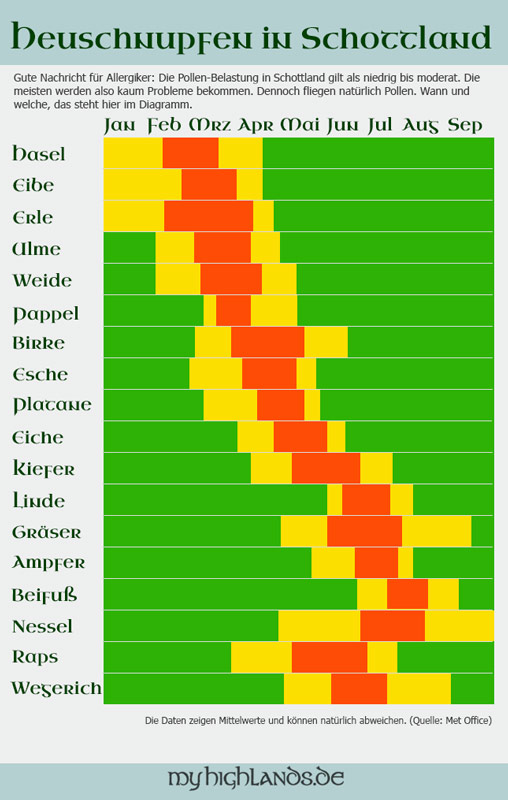
Unlike southern Britain, allergy sufferers generally feel quite comfortable in Scotland. Pollen levels in the Highlands and Islands are considered very moderate. Only the belt stretching between Glasgow and Edinburgh sees any notable pollen load, and perhaps parts of the east coast.
These are typically the core allergy seasons:
- Tree pollen from mid-February to mid-July
- Grasses from early June to late July
- Weeds (nettle, mugwort, etc.) May to mid-August
Incidentally, I suffer badly from hay fever myself (with mild asthma these days), and I haven’t had any problems with my allergy on any of my trips so far. If any of you have had a different experience, please leave a short comment below.
Tourism: when it’s busiest in Scotland
When tourists are treading on each other’s toes at the castle by Loch Ness, it’s no fun any more. So when is the best time to avoid the crowds?
Your destination matters as much as the month: festivals, public holidays and school holidays can make individual places busy. Check accommodation for your actual route early. See VisitScotland’s accommodation performance reports for official research. Occupancy is not a price comparison or a direct measure of crowds at an attraction.
For popular destinations such as Skye or Edinburgh, compare several travel dates. A single annual report cannot establish that June is a particularly cheap month.
It’s always worth keeping an eye on UK bank holidays (in German for now), since on those days and long weekends, more tourists from England and Wales tend to be travelling around Scotland too.
Conclusion: the best time to visit Scotland is May
May remains my favourite for a first road trip, with long days and spring scenery. But it is not guaranteed to be dry or midge-free. Choose according to what matters most to you: daylight, fewer midges or a particular experience.
June and July are also options for long days. For autumn colours, consider September or October and plan around shorter daylight hours. Match the season to your route and check opening times, accommodation and the weather before you travel.
By the way: if you want the full detail, you can click through to the relevant climate chart on each region page via the “Best time to visit” link.
