Brodick Castle on the Isle of Arran holds wonderful treasures and curiosities within its walls. Yet the most bizarre moment awaits us outside the mansion.
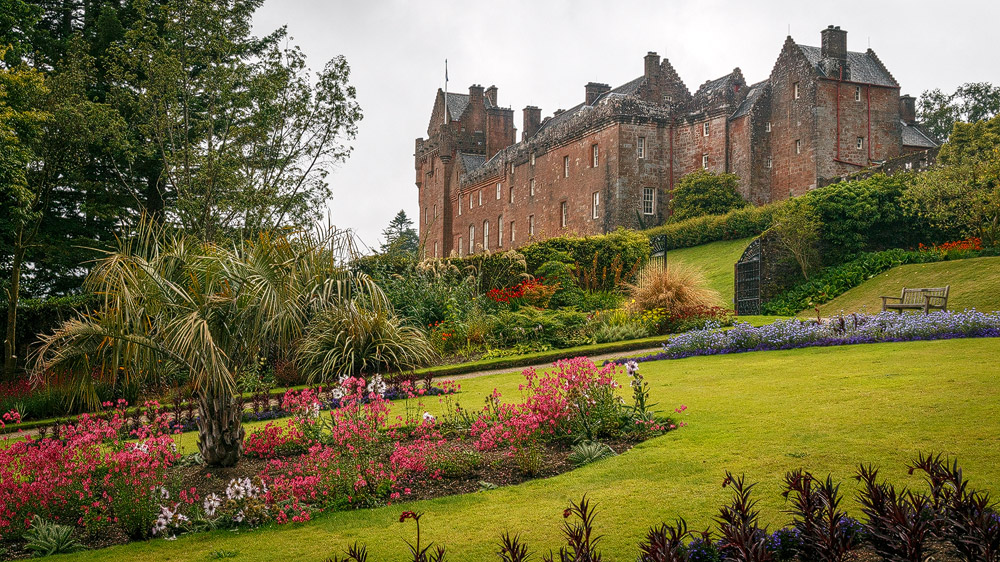
The outline of Brodick Castle seems strangely familiar as I approach the main house. Where have I seen this before? Of course! On the Scottish twenty-pound note. Brodick Castle graces its reverse side, seen exactly from the garden. Incidentally, it’s the only motif not located on the mainland, but on an island.
Brodick Castle isn’t a stern fortress, but a typical castle in the Baronial style. Lots of little turrets, everything slightly irregular. What’s more, unlike many Scottish castles, the walls glow not in cold grey but in a warm dark red – the typical sandstone of the region.
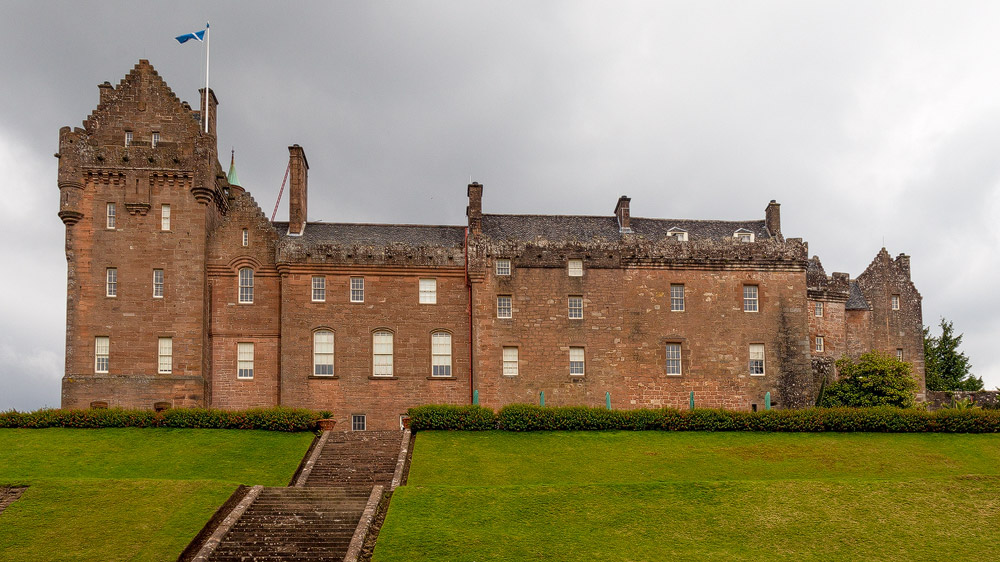
It’s quite a walk from the car park and visitor centre, but the parkland around the path quickly makes us forget the effort. And soon we arrive at the entrance. As is so often the case, Scottish castles are a patchwork of different eras, slowly mutating from a real fortress into a noble residence with no defensive function. Brodick Castle is no exception either – we can make out the building phases: the entrance to the south lies within the extensions built during the Victorian era.

Above, on the left gable, we can see several coats of arms, including the motto of Clan Hamilton, “Through”, and the year 1844, marking the date of the extension.
We go in, show our ticket once more, and then are free to wander the rooms to our heart’s content. As is now often the case at National Trust for Scotland attractions, volunteers usually stand in the rooms, sharing their knowledge of each room with enthusiasm.
The castle’s collection of paintings is also impressive.
Unfortunately, photography isn’t allowed here. So you’ll miss out on the opulent rooms and overflowing tables laden with silver and gold. Still, the interior visit is well worth it. Right at the end, in the oldest part of the building, there’s even a collection of silver and gold.
We finally leave the building through the café, go down the stairs to the garden, and get a view of the long east side of the castle. Here too, you can clearly see the patchwork of extensions adjoining the old tower house on the right.
Now we turn our attention to the park and gardens. There are many circular walks laid out, one meant for children, and there we come across mushrooms made of wool.

Indeed, there are also moles, squirrels, and insects made of wool here. They’re all meant to show children examples of the island’s flora and fauna.
One highlight of the little walk is the reconstructed roundhouse from the Bronze Age.

In theory, from here you could continue west and climb the famous mountain Goatfell, at over 800 metres Arran’s highest peak. We, however, turn back and head towards the Walled Garden. Unlike the rather wild park, it’s symmetrical and contains exotic plants.

Further down in the garden stands a sundial, surrounded by trees and plants.

All of this is very lovely. But things get downright bizarre a little further below the Walled Garden. Because here we come across the “Bavarian Summerhouse”.

This is a pavilion that the Duke of Hamilton had built in 1848 for his wife, Marie of Baden. The house was built by Bavarian workers, so that his wife would feel less homesick on the island.
The Bavarians certainly did a thorough job. Because even from the outside, it celebrates a kind of Black Forest kitsch, but things only really get intense inside. The entire walls are lined with fir and pine cones. Even the ceiling follows the same style.

We’ve never seen anything like it. It’s impressive on the one hand, but also simply overdone. We decide that nothing more can top this, and leave Brodick Castle behind.
Good to know: The history of Brodick Castle
There was likely already a fortification on the site of today’s mansion during the Viking Age, and even before. The location was strategically important, as from here one could control the Firth of Clyde, the sea inlet by Glasgow.
After the Vikings gradually lost influence in Scotland, the land passed to the Stewart family, who built a first stone castle here in the 13th century. However, this was destroyed in the 15th century by the MacDonalds and the Lords of the Isles.
Through marriage, Brodick Castle then came into the possession of the Hamiltons, who from 1510 onward rebuilt Brodick Castle – repeatedly interrupted by further destruction and changes of ownership. Eventually, in the mid-17th century, the castle was occupied by Cromwell’s troops. They continued building, along military lines: the long buildings facing east date from this period, with a gun battery at their northern end.
Brodick Castle only gained its Scottish Baronial appearance with its renovations from 1844 onward. That’s also when the large, dominant corner tower and the garden grounds were created.
The Hamiltons were followed in the early 20th century by the Grahams as owners, who soon handed the estate over to the state. Today the castle is under the care of the National Trust for Scotland, which looks after its preservation.
Also worth mentioning is the rhododendron collection. Amateur gardeners can obtain cuttings from the visitor centre.
Remarkably, though, the park is also regularly cleared of wild and invasive rhododendrons, in order to preserve the native flora there.
Personal note: Bizarre Bavarian Summerhouse
At Brodick Castle you can genuinely spend a relaxed, well-rounded day. A long walk in the park, a tour of the castle interior, coffee and cake in the castle café, and finally another leisurely stroll through the nearby gardens. And at the visitor centre, you can even pick up some souvenirs.

I enjoyed it there – even the bizarre Bavarian Summerhouse … somehow …
Getting there:
With sat nav: Simply enter “KA27 8HY”, which will take you to the village of Brodick. From there, follow the signs.