They brought fear and terror – but also trade and craftsmanship, language and culture. The Vikings ruled over large parts of the Highlands for four centuries. And have left traces that remain to this day …
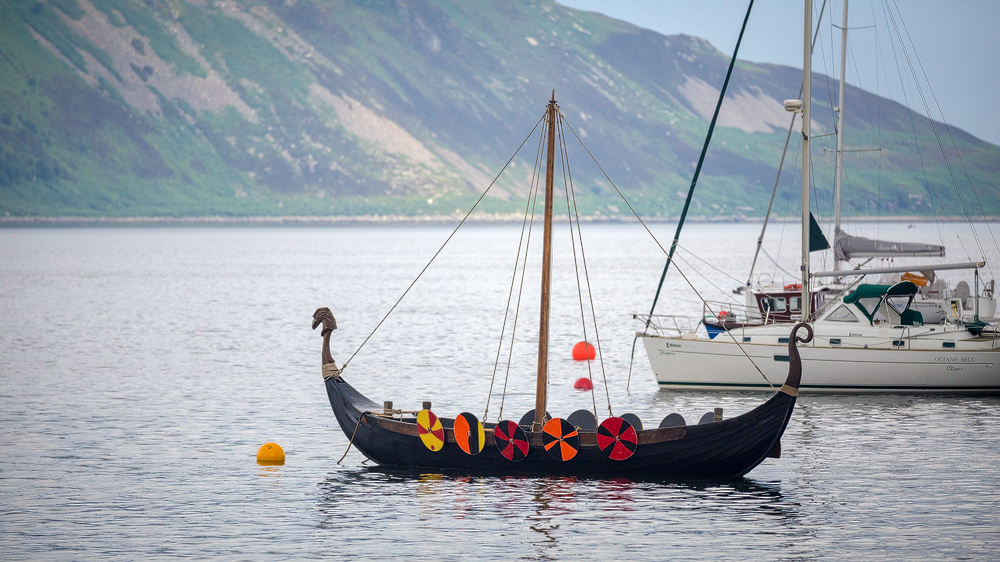
According to the chronicles, relations between the peoples settled in Scotland and the Vikings didn’t start particularly well: on 8 June 793, men who had arrived from the north on longships stormed the monastery of Lindisfarne. They murdered and plundered before finally withdrawing again from the small island off the east coast of northern England.
Scholars now believe the Vikings were no longer strangers by that time. Isolated raids had already occurred before 793, and it is even assumed that trade relations existed first, before some Norsemen began to plunder. One indication of this is recently discovered Viking graves in Ireland. Their remains were, in all likelihood, buried there even before the raids began.
Yet in people’s memory and in the chronicles, Lindisfarne marked the beginning of the Viking era, the beginning of the terror.
From then on, the men from the north made frequent appearances: the monastery on Iona in the west of Scotland, an important spiritual centre of the Gaels of Dalriada, was raided no fewer than three times, in 795, 802 and 806. The churches on Islay were likewise targeted by the attackers. In short: the Vikings were a scourge on the Highlands, the western isles, and also on Ireland and England.
By this time, Shetland and Orkney – the islands to the north – were probably already in Scandinavian hands. The north and parts of the east of the Scottish mainland were to follow; Caithness and Sutherland quickly fell to the Norsemen. Across the Outer Hebrides, Skye, Mull, Islay, the western Highlands … in short: peoples from Norway, Sweden and Denmark now soon ruled over vast stretches of Great Britain.
What began purely as raiding expeditions, mostly carried out by young Vikings to prove their prowess in war and to accumulate wealth, was over the years followed by settlers coming to Scotland too. Scholars disagree, however, on exactly how the land was taken possession of. Some believe that, particularly on the northern islands, a gradual and peaceful takeover took place. Others assume an actual genocide carried out by the Vikings. Excavations on the Outer Hebrides have shown, for example, that pottery and ironware styles changed quickly and markedly there, which doesn’t point to peaceful integration but rather to displacement, enslavement and destruction.
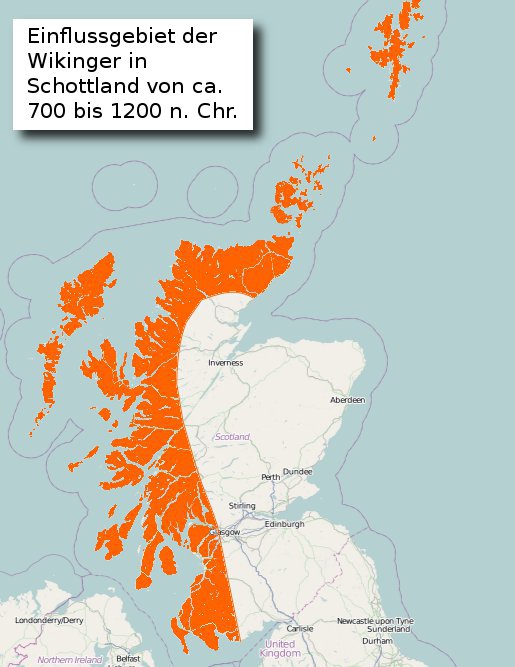
Wherever the Vikings settled, the language changed too. Word endings such as “-ness” or “-vik”, among others, still clearly point to Norse place names today. Broadford on Skye, for instance, carries the “fjord” within it – it comes from “breida-fjord”, meaning “broad sea inlet”. Or the island of Jura near Islay, which comes from the Norse “dyr ey” – “deer island”. The list of such examples could go on for quite a while.
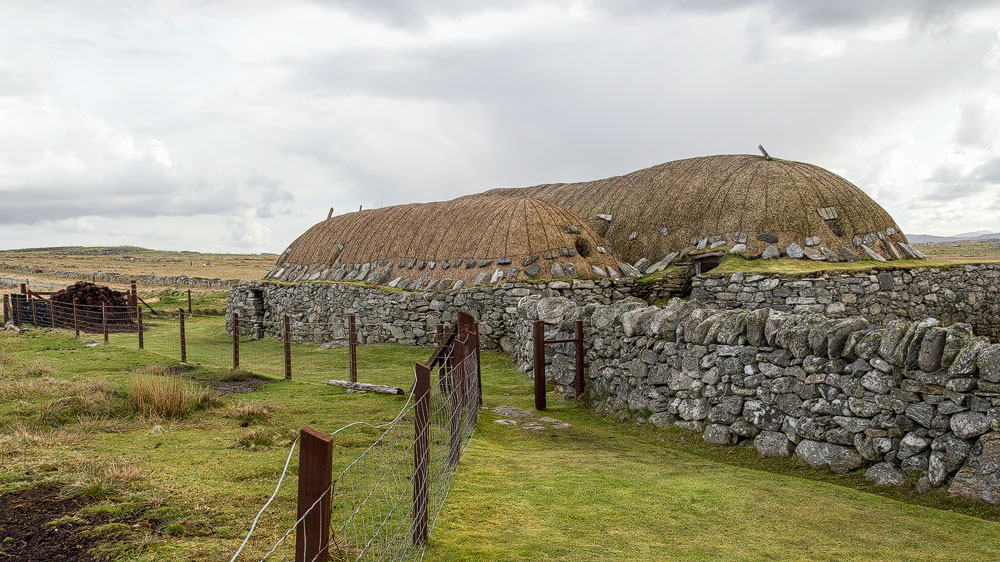
Alongside language, the Viking settlers also brought their craftsmanship with them. This, for example, shaped house-building. The Scottish blackhouses that later became widespread, for instance, bear strong similarities to the longhouses of the Norsemen. And not to forget: the Vikings were skilled seafarers and shipbuilders. They established this art on the islands too. It even formed the basis for the soon-following rule of the Lords of the Isles (currently only available in German) over the Hebrides. Their fast boats, the so-called birlinns, later carried troops and goods right across their territory. These birlinns were nothing other than further developments of the Norse dragon ships.
Yet the territories of Great Britain couldn’t be ruled from afar forever …
First successes against the Vikings
In the 12th century, a Norse mother bore a son to a Gaelic father. They named him Somerled – “summer traveller” – and he would grow into the man who would, at least partially, shake the power of the Norse rulers over Scotland.
In the year 1156, Somerled fought a naval battle for control of the western isles. It ended in a stalemate, and so the two sides agreed to divide the island territory: Somerled received Islay, Jura and Mull, while his opponent Godred II kept the Outer Hebrides, Skye and the Isle of Man. Later, Somerled also took the remaining territories. In doing so, he renounced allegiance to the Norwegian king over these areas and established a third realm alongside those of the Norsemen and the Scots – one that, while nominally subject once again to the Norwegian king later on, had already embarked on its own path of development.
By 1160, Somerled had grown so powerful that even the Scottish king, Malcolm IV, perceived him as a threat. This led to a battle between the two, which neither side could really win. A shaky peace was negotiated, but it held for only four years. In 1164, Somerled marched against Scotland again with an army. But before any significant fighting broke out, he was probably assassinated.
What Somerled left behind were islands freed from foreign rule. His descendants later shaped a new realm out of this legacy – the territory of the Lords of the Isles. Somerled, incidentally, had many descendants; one might say he was a Scottish forefather of sorts. A DNA study suggests he still has around 500,000 living descendants worldwide today – a number surpassed only by Genghis Khan. No wonder, since several clans (currently only available in German), such as the well-known MacDonalds, descend from him and his children. And these clans, too, later scattered across the world through the Highland Clearances.
Since he was himself partly of Norse blood, the Scottish Vikings also live on in these descendants.
The end of Norwegian rule
Norse power had been called into question by Somerled. Yet they still ruled over large parts of Scotland, and legally the western isles remained under their authority. In the 13th century, the Scottish kings Alexander II and III wanted to change that. They wanted to bring the territories under their control – first they tried trade, then they resorted to force. When King Haakon III finally arrived on the Scottish west coast with his army and launched a campaign to preserve his power, he was unable to bring about a decisive resolution. Although he was mostly victorious on the field, as at the Battle of Largs, the approaching winter eventually drove him off.
Haakon III withdrew to Orkney and died there. His successor ceded all territories to the Scottish crown in the Treaty of Perth in 1266, except for Orkney and Shetland. These islands remained in Norwegian hands until 1468, before they too fell to Scotland – peacefully, as a wedding dowry. Viking rule in Scotland thus ended after around 700 years.
The Viking language, however, held on the longest: the so-called Norn was spoken on Orkney and Shetland into the 18th century, and still flows into the dialect there today.
