Azure water, reddish rock, white sand – Scotland’s north seduces with dreamlike coastlines. Where the Atlantic and the North Sea collide lies one of the most beautiful beaches, Ceannabeinne.
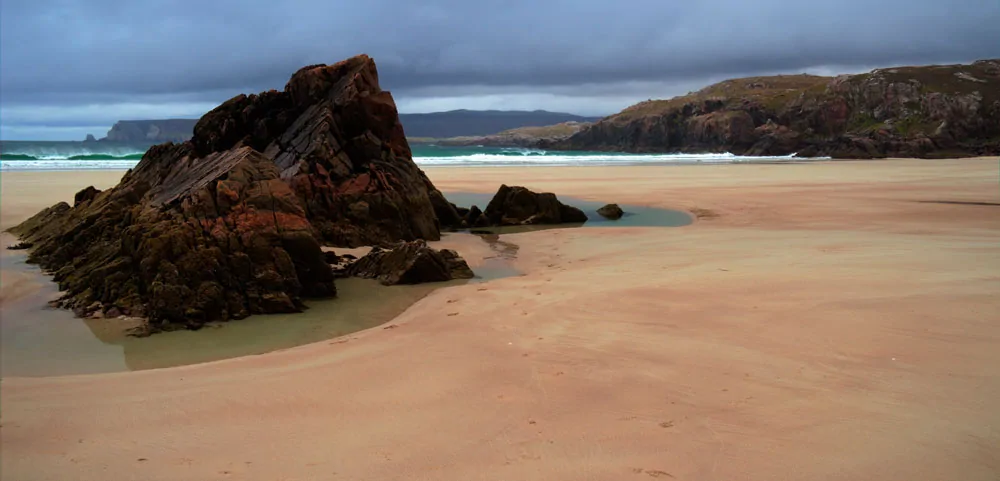
Framed by a curving bay, lined with green grass where rabbits roam, Ceannabeinne lies right on the road to Durness. Visitors can easily make their way down from the car park. Despite its location, the beach isn’t overrun – its neighbours, Smoo Cave and Sango Sands, tend to draw most of the tourists instead, so the odds of an undisturbed walk are good.
Tip: Second beach at low tide
When the tide is right, you can visit the western part of the beach. It’s separated from the rest by a rocky spur. However, don’t let the incoming tide catch you by surprise – it can rise very quickly.
Good to know: The beach’s eerie name
Ceannabeinne is pronounced roughly “Kyauna-benye”. In German that just means “foothill of the mountain”. However, the beach has a second name, which is also recorded on the Ordnance Survey maps, for instance. Traigh Allt Chailgeag (pronounced “Try Owlt Chalkyak”) means “beach of the stream of death”. According to legend, an old woman drowned in the small stream. Her body was carried down by the water to the beach, where she was eventually found.
Ceannabeinne was also the name of a nearby village. It was cleared, however, in the course of the Highland Clearances in 1842. Around 50 people were evicted. The remains of the settlement can be seen along the Township Trail.
Personal note: Subjects in HDR
I love this beach because nowhere else does the mix of rose pink, azure blue and beige come together quite so well. Even in bad weather I managed to take some HDR photos here that are among the finest shots of the whole trip for me (one of them even made it into the Scotland calendar). The bizarre rocks make for excellent foreground subjects.
Getting there:
There’s only one road here: the A838. It runs directly past the beach.
Coming from Durness, you first pass Smoo Cave, then Sangobeg Beach, before Ceannabeinne appears on the left, with the car park on the right.
Coming from Tongue in the east, you drive for a long stretch along the Kyle of Tongue. Once you turn away from it, after a while the beach appears on the left and the car park on the right. You just need to pay a little attention here.