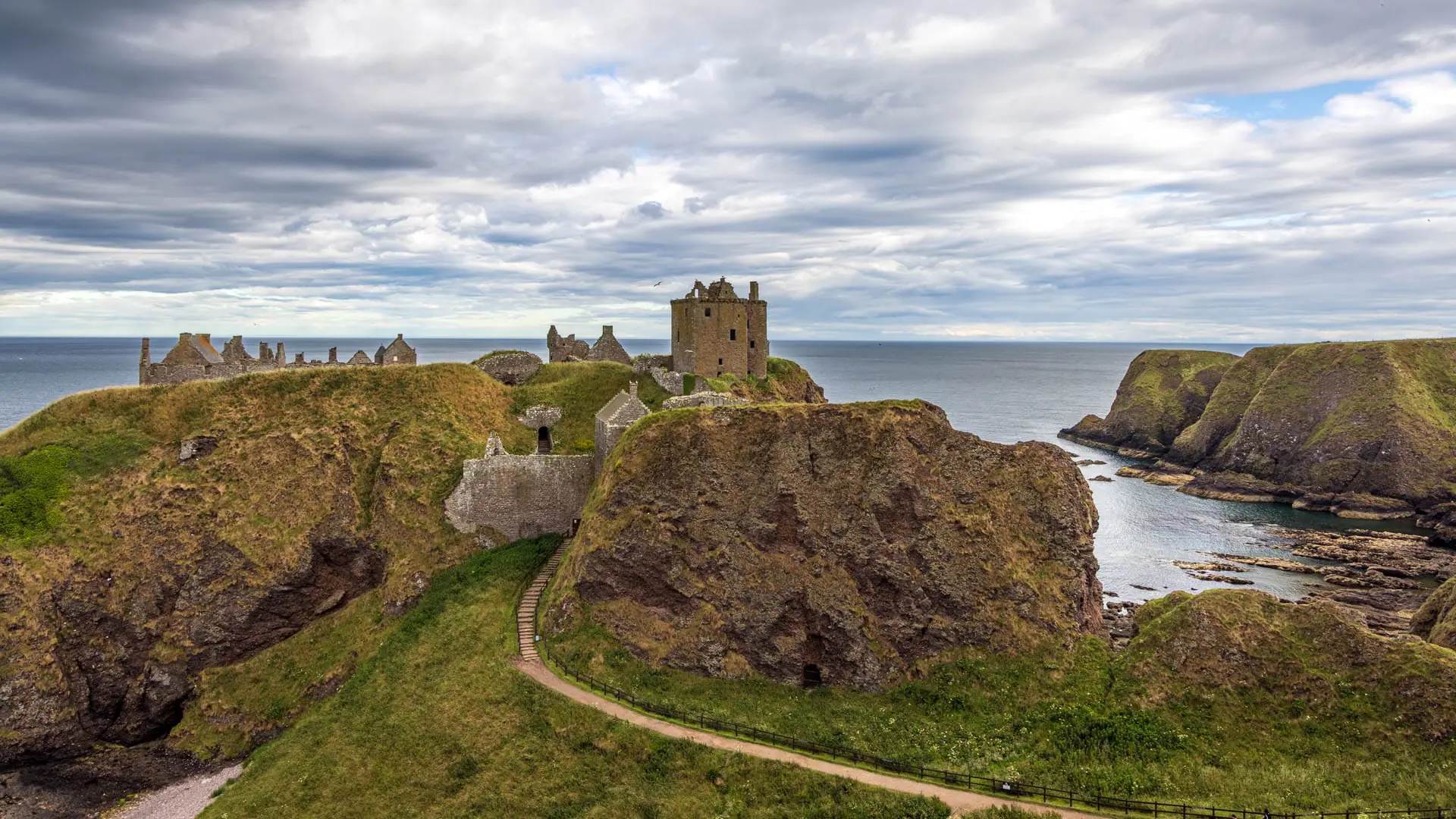
What need is there for walls? Dunnottar Castle sits on cliffs 50 metres high and is nearly impregnable. That didn’t stop people trying, more than once. And so this Scottish castle has a turbulent history.

You’ll need a bit of stamina. Anyone wanting to reach Dunnottar Castle has to climb around 200 steps – and that’s both on the way there and on the way back. What’s a challenge for today’s visitors was, back then, the very best protection against attackers. The castle sits on a plateau whose sides drop 50 metres steeply into the sea. Only a narrow strip of land connects the rock to the mainland, and it first dips down before climbing back up again to the castle gate.
This naturally protected position was ideal for any kind of stronghold. That’s why there was already some sort of fort here as far back as Pictish times. The syllable “Dun” points to this – it means “fort” or “fortress” and crops up in other names all across Scotland too, such as Dunvegan and Dun Telve.
Dunnottar occupied a strategically important position, right at the end of the foothills of the Grampian Mountains, which were difficult for any army to cross. So anyone wanting to head north along the foot of the mountains ended up within Dunnottar’s sphere of influence.
And so the stronghold was fiercely fought over. As early as the 7th century AD, the Annals of Ulster record the entry: “Obesessio duin Foither” – the siege of Dunnottar. And it had many masters since. The Anglo-Saxons under Æthelstan broke their teeth on it. But in 1296 AD, the English king Edward seized Dunnottar by force. Barely a year later, the national hero William Wallace (Braveheart) stormed it and burned the English soldiers inside its chapel. Fewer than 40 years passed before it belonged to the English again, then to the Scots once more a year later …

Calm only returned after the Battle of Bannockburn. Robert the Bruce gave Dunnottar to his commander, Sir Robert de Keith. His grandson set about replacing the wooden fort with a stone keep – the one that still stands today.
Finally, a proper castle!
The Keiths played a significant role: as Earls Marischal, from the 16th century onward they were the guardians of the Honours of Scotland – the crown jewels, so the sword, sceptre and crown of the Scottish king. And they had to defend them with their lives. When civil war broke out across Britain in 1651, the dictator Oliver Cromwell arrived at Dunnottar with his formidable army and laid siege to the castle. The Keiths held out for eight months, the last ten weeks under constant cannon fire. Only then did they surrender.
Even so, Cromwell never got his hands on the Honours of Scotland. A minister’s wife had smuggled them out of the castle and buried them in a nearby church. When the Scottish king reclaimed his throne in 1660, the symbols of his power were restored to him.
But Dunnottar never recovered from the bombardment by Cromwell’s army. The Keiths no longer lived at the castle afterwards; only soldiers were still stationed there. During this period, Dunnottar’s history gained one final, inglorious chapter.

In a long vault, the Whigs’ Vault, unfortunate Covenanters were locked up here in 1685. 45 women and 122 men had to share the space – everyone had just barely enough room to sit. The floor is said to have been covered ankle-deep in filth. They had to buy food and drink from the guards, and there was no toilet. Their crime? They wouldn’t recognise the king as head of their church. They had to spend six weeks here, and many died of hunger during that time. 25 managed to break out, but only eight of them truly escaped – two fell to their deaths from the cliffs. The rest were shipped off as slaves to the colonies, where most of them soon lost their lives too.
After this brutal episode, Dunnottar sank into irrelevance. In the 18th century the Keith family sided with the Jacobites; in 1715 the head of the family was executed for high treason, and the estates were forfeited to the crown.
The castle fell into ruin, until 1925, when the Cowdray family took ownership of Dunnottar Castle and has been restoring it ever since.
Good to know: supplying the castle
At the height of the Keith family’s power, around a hundred servants lived at Dunnottar Castle. What served as a brilliant defence in wartime – the narrow, steep approach to the castle – was a genuine logistical headache in peacetime for feeding its inhabitants. There was a vegetable garden within the walls, but most of the food still had to be brought in from the surrounding area.
This almost impossible transport job fell to specially bred ponies known as “garrons”. They were sturdy and remarkably sure-footed.
Tip: an eye for Merida
A backdrop this dramatic surely has to turn up in a film somewhere. And, in a roundabout way, it does. In the Disney hit “Brave” (Merida in some markets), the heroine lives in a castle that also sits perched on a cliff. And that’s down to Dunnottar Castle. Originally the filmmakers had placed the castle on an island in a loch. But once they saw Dunnottar Castle, they took its scenery on board too.
Personal note: the wrong light for photos
The castle had, of course, also drawn me in because it makes such a unique subject – for my calendar, for instance. The trouble is: if the weather doesn’t cooperate, you can have the best camera in the world and the photos will still come out flat. And on that particular day, the sky was nothing but a milky soup. So neither did the castle’s outline emerge cleanly, nor did any cloud structure show itself.
So I’m a little disappointed with the results. Still, visiting the huge site was great fun regardless.
Getting there:
Coming from the south on the A90, you drive to the “Stonehaven/Banchory” exit; coming from the north, the same exit is signposted “Montrose/Arbroath”. From there you join the A92. But rather than turning left towards Stonehaven, keep going until you see the sign for Dunnottar Castle. Only then turn left, and shortly afterwards turn right again into the car park.
Coming from Stonehaven, first take the A957 until it meets the A92. Turn right there, and the rest is the same as above.