Around 1300, the English attempt to take control of Scotland. But they hadn’t reckoned with the fierce resistance of the Scots under their king, Robert the Bruce. At Bannockburn, it finally comes to the last, decisive battle for the kingdom’s independence.
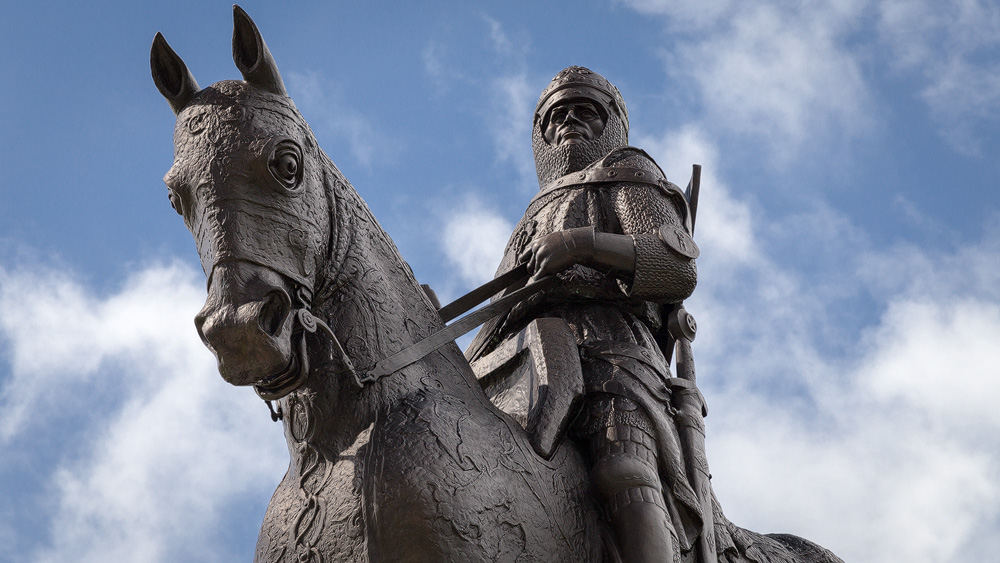
Robert the Bruce, King of Scots, had already, step by step, taken all the country’s important castles that had previously been occupied by the English or their allies. In doing so, he relied consistently on cunning and guerrilla tactics, since he was initially unable to field a large army. In the end, the only thing still missing for the Bruce was the great and strategically vital Stirling Castle. He had it besieged.
The Scottish army had already been camped in front of the castle for over a year when the English king, Edward II, dispatched a large force to relieve it – some sources speak of nearly 14,000 soldiers, others of as many as 25,000. According to the same sources, Bruce’s army numbered just 5,000 to 10,000 men.
On paper, then, England was bringing a clear numerical superiority into the field. But Bruce was well used to dealing with stronger armies. He carefully chose a tactic that pitted mobility and cunning against sheer size. The Scots had only a smaller cavalry force and hardly any archers, but they did have schiltrons at their disposal. Schiltrons were battle formations of men standing in dense ranks, carrying long spears out in front of them.
These schiltrons had the effect of a steamroller, capable of flattening cavalry and infantry alike. Their one vulnerability was fire from archers. It was crucial that the formation never broke apart, since only as a unit could they bring the full force of their long spears to bear.
Incidentally, the terms “English” and “Scots” are something of a simplification when it comes to this battle. The Highland clans of the MacDougalls and the Comyns stood on Edward’s side, and his army also included Welsh archers. What’s more, the entire ruling class on both sides was predominantly Norman in origin – “the Bruce”, for example, was a modified form of “de Brus”, meaning Robert’s ancestors came from France, just as Edward’s did. The preferred language of both leaders would likely have been Anglo-Norman, a variant of French.
Even so, Gaelic would certainly have played a role too, since a number of Highland clans fought among the soldiers on the Scottish side: the MacDonalds and MacRuaris as two of the most powerful among them, along with Campbells, Camerons, Frasers, MacLeans and MacKenzies.
The battlefield: why Bannockburn was so well suited
As terrain for the confrontation, Robert the Bruce chose a field south of Stirling Castle, bordered to the north, east and south by streams: the Pelstream Burn and the Bannock Burn – “burn” being the Scots term for a stream. Only two small bridges led onto this field between the burns. To the west stood a wood, in which Bruce concealed part of his forces. The English advanced from the south.
The first fighting broke out on 23 June 1314. During it, Robert Bruce himself was attacked by an enemy commander, who charged towards the Scottish king in full armour, lance levelled, mounted on a warhorse, intent on running him through. Bruce waited patiently, dodged the lance at the last moment, and split his opponent’s skull with an axe. It turned out that agility and tactics could overcome a heavily armed soldier. And the very next day, that same strategy would prove effective against an entire army.
On 24 June, Edward II duly made the mistake Bruce had been waiting for. The English king ordered his troops to march across the Bannockburn onto the field. No sooner had the soldiers arrived there than the Scottish schiltrons emerged from the woods with their spears, pushing the English into the corner between the two waterways. The English cavalry was broken against the schiltrons. The Welsh archers’ attempt to position themselves to the side of the Scottish army and open fire on it from there was foiled by the small Scottish cavalry force.
Pressed together between the two streams, unable to manoeuvre and eventually gripped by panic, the English had no choice left but a costly retreat. In the end, nearly half the English force was dead, many of them drowned in the Bannockburn.
After the battle: diplomacy takes over
Edward II fled the battlefield; a great many of his nobles had fallen, his army had disbanded. Stirling Castle – the last major stronghold of the English occupation in Scotland – finally fell to Robert the Bruce. Bannockburn was a magnificent victory for the Scots. Even so, the war for Scottish independence would drag on for years to come.
Northern England lay undefended, and in the years that followed there were repeated Scottish incursions into the region. The Bruce won two battles near Yorkshire. But it wasn’t until Edward II had been deposed that Edward III made peace with Scotland, through the Treaty of Northampton on 17 March 1328. Robert’s son David married Edward’s sister, forging a bond between the two royal houses.
Robert the Bruce died on 7 June 1329. To this day, he’s regarded as the great liberator of Scotland, and Bannockburn stands as one of the most important turning points in its history.
