Is it better to exchange money in Germany or in Scotland? What fees apply and what should you know about Scottish currency? Here’s everything you need to know.
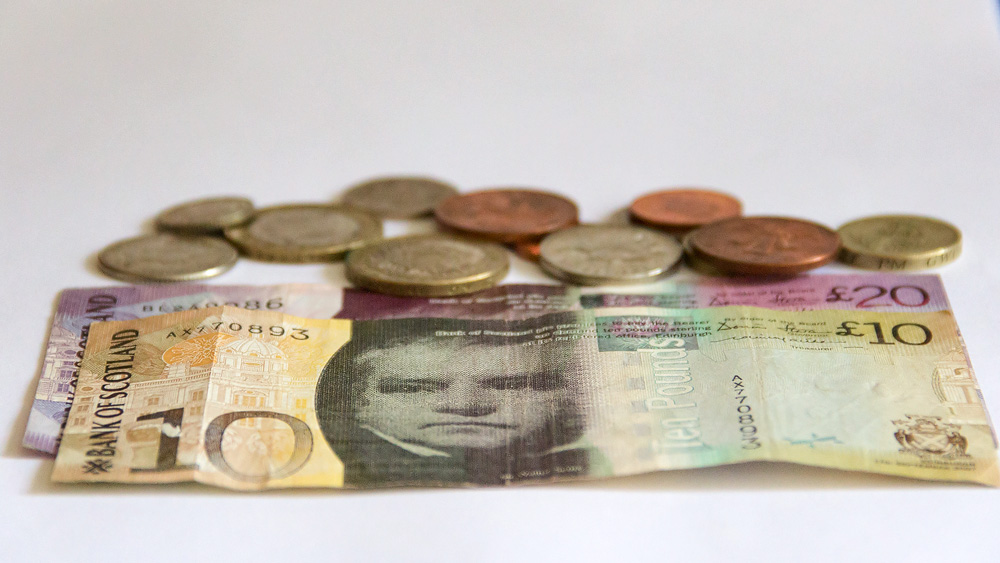
On this page
» Banknotes
» Coins
» Conversion
» Exchanging before the trip
» Exchanging old pound notes
» Debit card or credit card
» Fees
» Postbank SparCard
» Experience reports
As in the whole of the United Kingdom, the currency in Scotland is the pound sterling, whose currency symbol “£” is a stylised “L”. The “L” in turn stands for the Latin word “libra”, meaning “pound”. Its ticker symbol on the markets is GBP, for “Great British Pound”.
The pound is, incidentally, the world’s oldest currency, and the word “sterling” used to describe the uniform silver quality of the coins. The term sterling is still used for silver today.
One more note: since the coronavirus pandemic, cashless payment has become even more widespread. Many shops, restaurants and accommodations accept card payments. This even applies to many parking meters. Even so, you should always carry a little cash, since B&Bs on the islands in particular sometimes prefer cash. Still, it’s no longer necessary to withdraw as much money as before the Covid era.
Banknotes: The Scottish pound notes
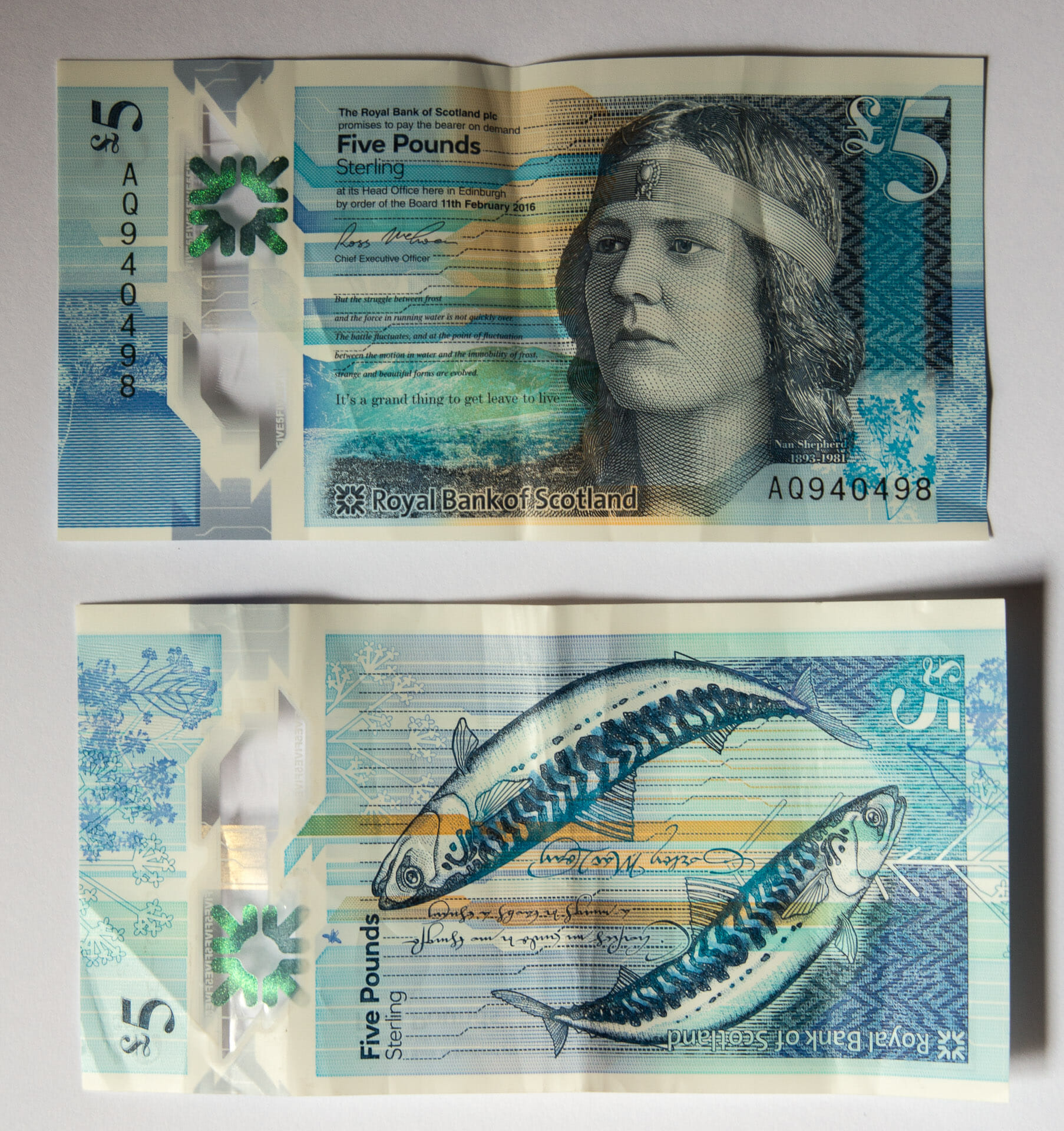
The pound is British and applies equally to England, Scotland, Wales and Northern Ireland, but several Scottish banks print their own banknotes with different designs. These include the Bank of Scotland, the Royal Bank of Scotland (RBS) and the Clydesdale Bank.
So that notes of the same value can be found quickly in your wallet, Scotland’s banks have agreed to use the same colours for the same denominations (this does not apply in England, where the colours differ):
- 5 pounds: blue
- 10 pounds: brown/orange
- 20 pounds: purple
- 50 pounds: green (also red from July 2021)
- 100 pounds: red or green
RBS is the only one of the three banks that also prints 1-pound notes.
The pound notes have also recently been renewed. The new notes now always feature a transparent plastic “window”, as seen here on the Clydesdale Bank note beneath the image of the Forth Rail Bridge.
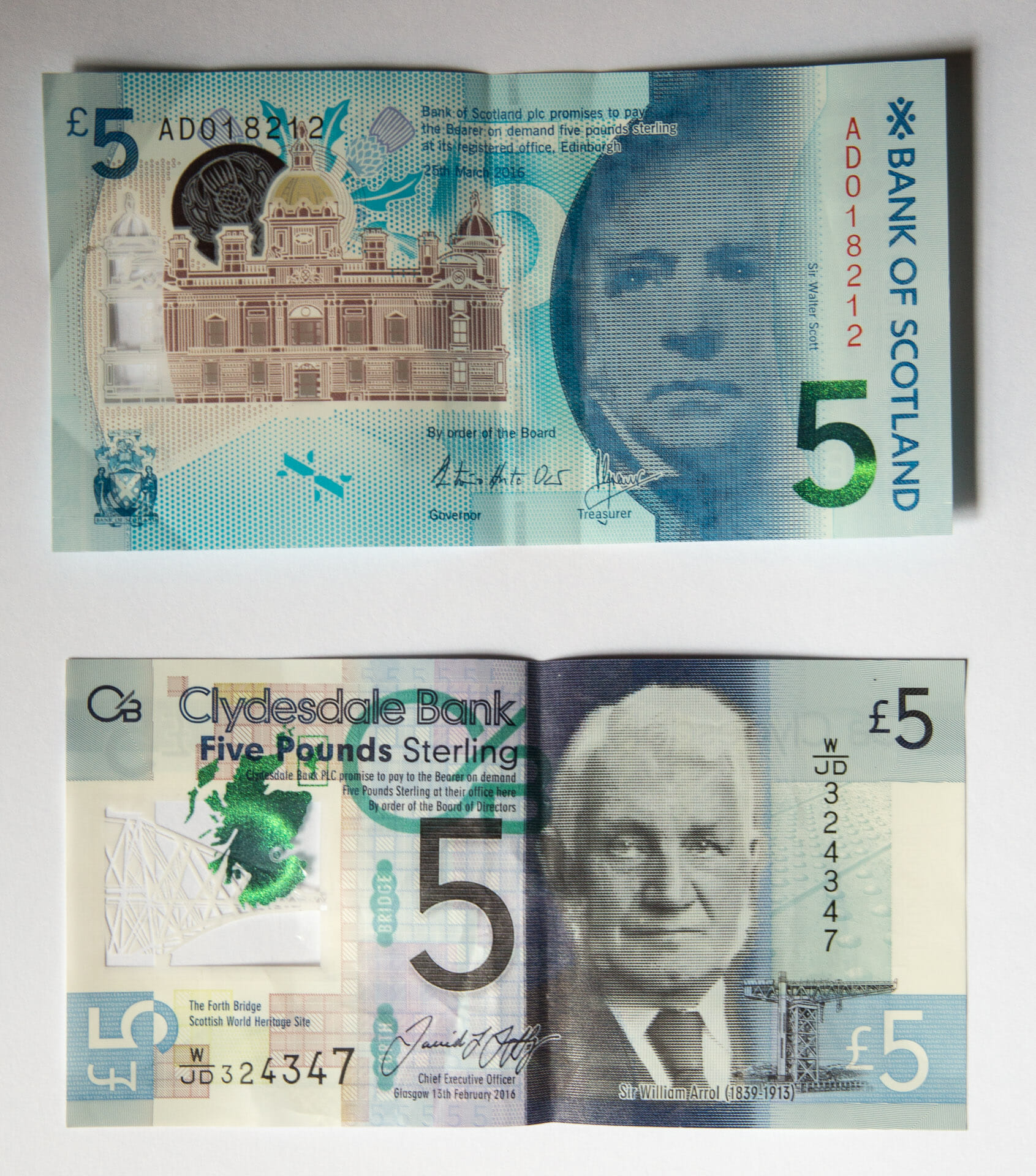
The 10, 20, 50 and 100 pound notes have also been renewed. The old pound notes are no longer valid. Anyone who still has such old notes can usually exchange them at a branch of the bank that issued them.

Coins: From 1 pence to 2 pounds
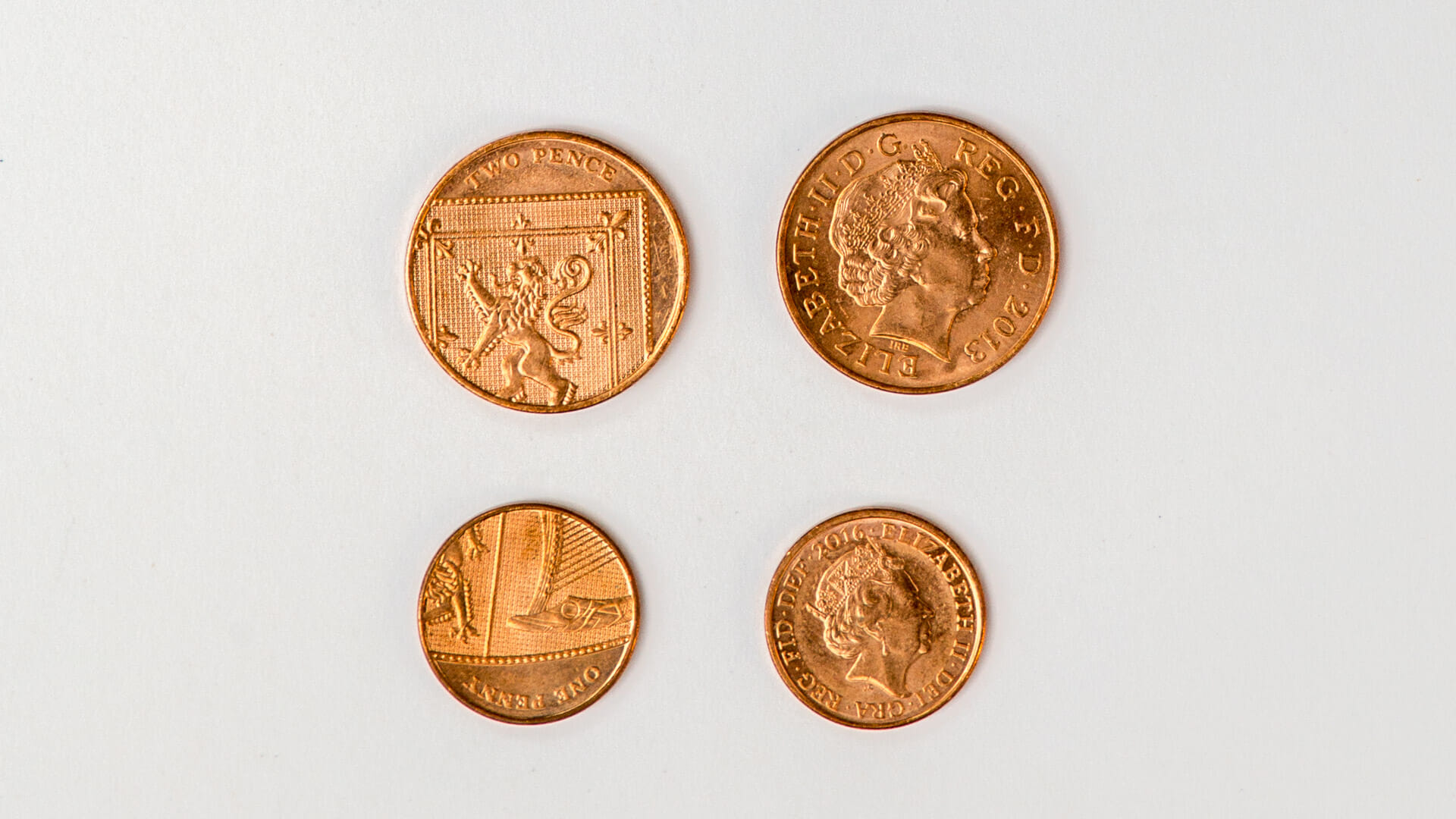
What we call cents in Europe are called pence in Scotland, and they only exist as coins. In addition, 1 and 2 pound coins are also minted.
The coins cause a certain amount of confusion for many visitors to Scotland. For example, the 10 pence coin is larger than the 20 pence coin. In addition, the numbers are often hard to find, or on the pound coins they’re embossed as text rather than as a numeral.
To make rummaging through your wallet easier, here are the colours of the coins:
1 & 2 pence – copper
5 – 10 – 20 – 50 pence – silver
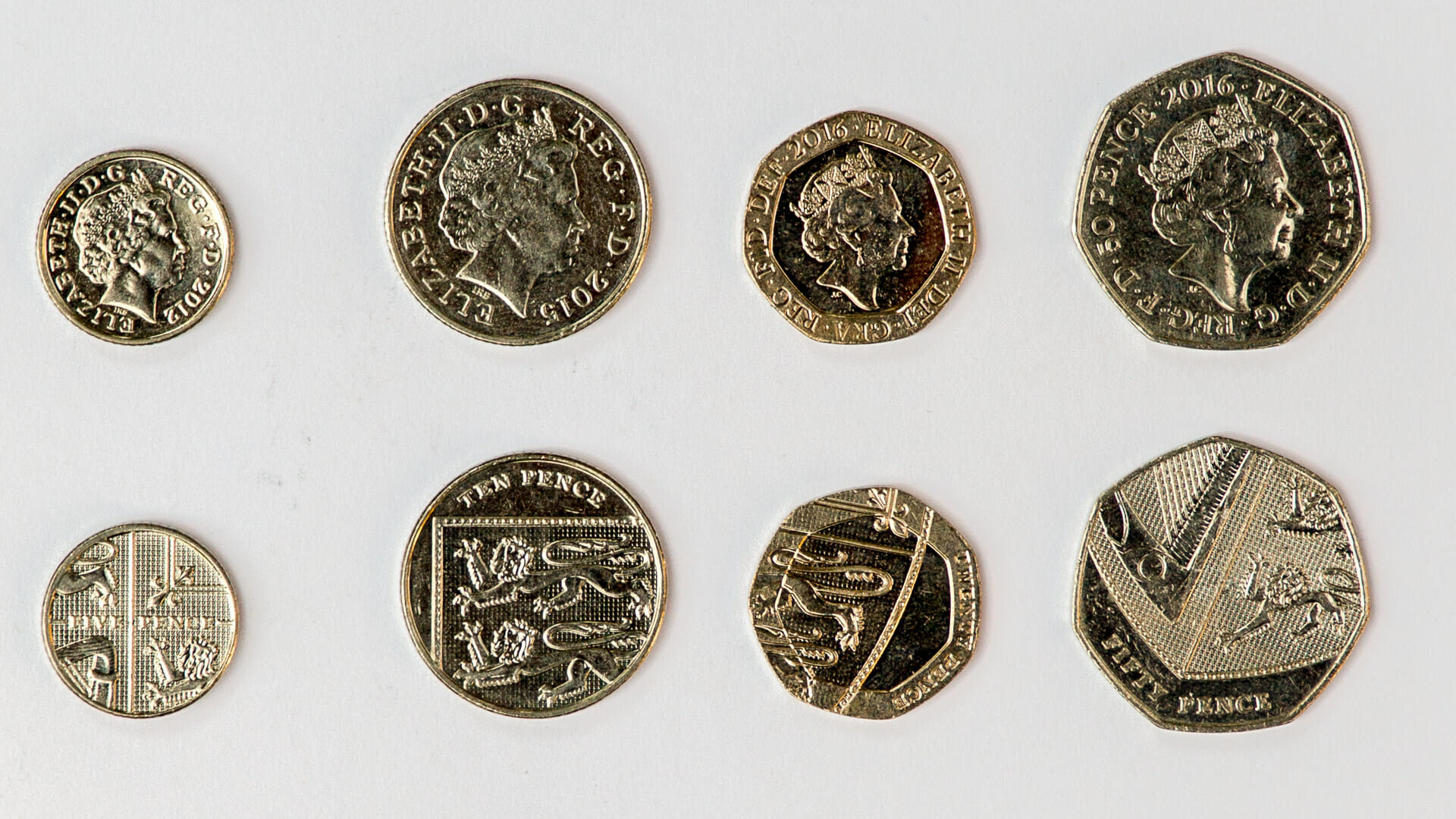
1 & 2 pounds – brass rim, silver centre
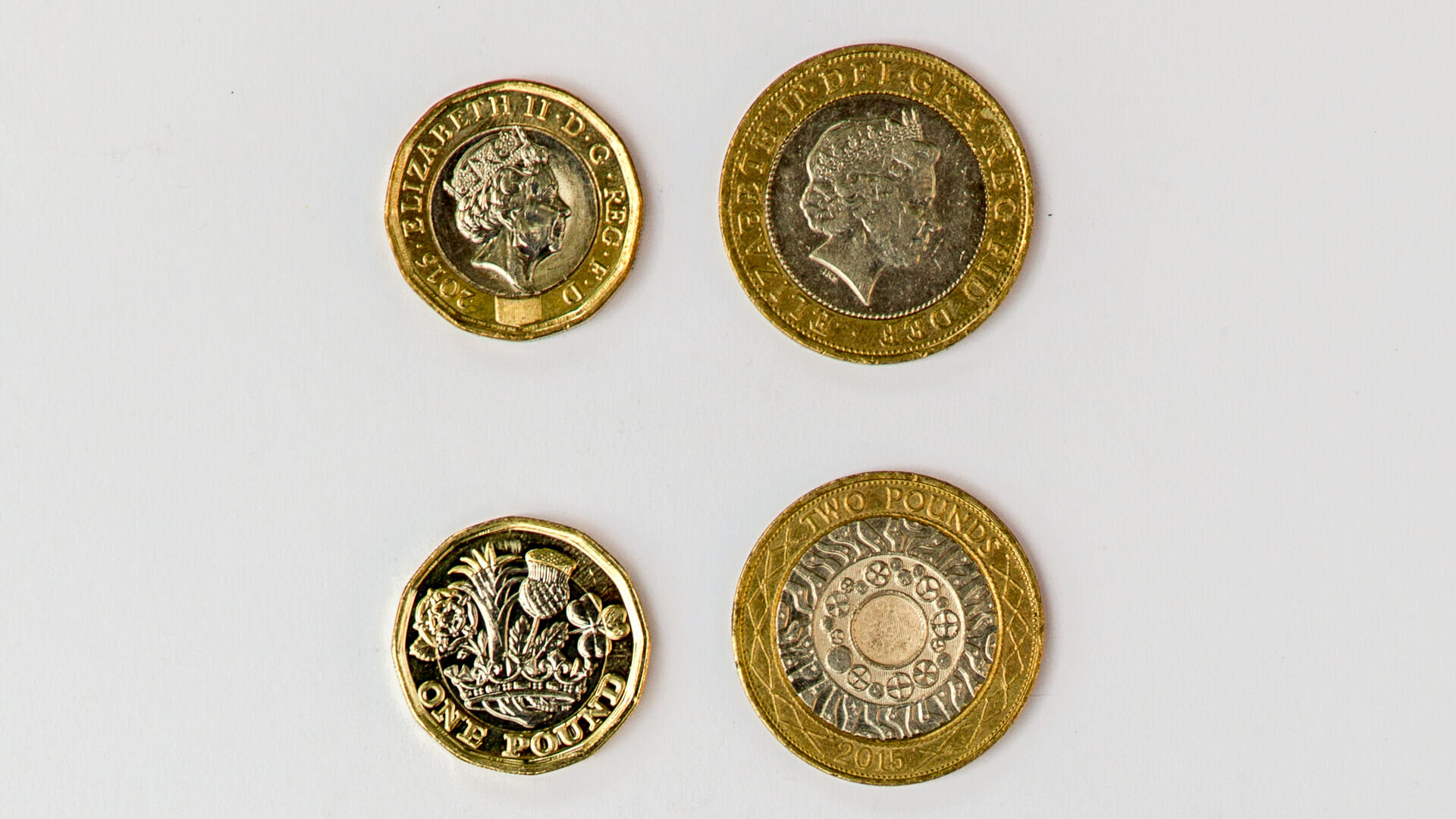
The new one-pound coin was introduced in March 2017. From 15 October 2017, old pound coins could no longer be used.
Tip: With coins, always look at the bottom edge to read the value. Another tip: the 20 and 50 pence coins have corners, the 5 and 10 do not. Likewise, the one-pound coin has corners.
Conversion: What is a pound roughly worth?
The exchange rate between the euro and the pound is currently around 0.84, meaning: for one euro you get 85 pence (1 x 0.89), and one pound is exchanged for €1.19 (1 / 0.84).
Of course, the rate always fluctuates slightly, but it works as a rule of thumb for now (as of July 2024).
Exchanging before the trip: German banks and savings banks
You can already exchange a larger sum before setting off for Scotland at your own bank. In that case, though, you should allow a few days, since many branches don’t keep British currency in stock. Banks usually handle it so that the money is debited directly from your account and paid out in the travel currency. Fees apply for the exchange, and these vary from bank to bank.
Note: One reader pointed out to us that fifty and hundred pound notes are sometimes accepted reluctantly. So when exchanging money, it’s best to ask for twenties. That’s also usually what cash machines pay out.
That said: in principle, cashless payment with a credit card, or also Google Pay, Apple Pay or sometimes even PayPal, works very well.
Old pound notes: How to exchange them
Old pound notes, recognisable by the absence of the plastic “window”, are no longer accepted as a means of payment. However, they can still be exchanged. Surprisingly, this can be done in Scotland at these post offices, but only up to a limit of £300:
- Edinburgh City Post Office, EH1 1BQ – near Waverley Station
- Glasgow Post Office, G1 2RD – near Buchanan Galleries
- Inverness Post Office, IV1 1AX – near the Old High Church
In addition, the notes can usually be exchanged at the respective bank that issued them.
Debit or credit card: Withdrawing at a cash machine in Scotland
Of course, you can also withdraw money on the spot using your debit card, and honestly: for me, that’s the simplest and preferred method.
The prerequisite for this is finding a cash machine that allows withdrawals and currency exchange — and that isn’t always the case. For example, at Edinburgh Airport, the cash machines right next to the currency exchange counters didn’t allow withdrawals, or charged exorbitant fees. It was only when we found a Bank of Scotland machine on the second floor that it worked.
As a rule of thumb: a German debit card usually works via the so-called Maestro debit network, which belongs to MasterCard. You can tell quite easily by the logo on the plastic card.
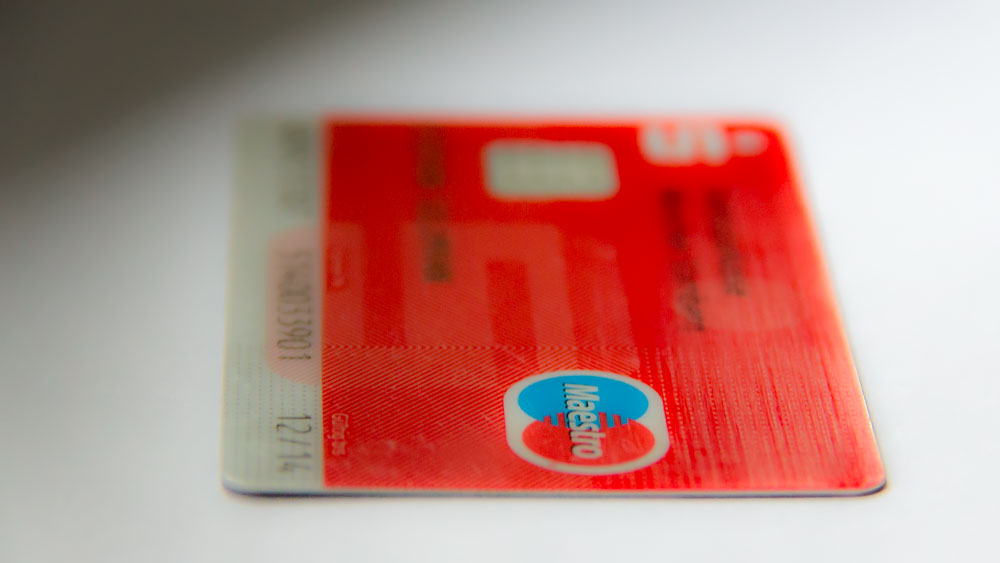
Cash machines display this logo, so if in doubt, look for this symbol. Between partner banks in Germany and Scotland, only very low fees apply.
IMPORTANT, please note: If the machine asks whether you want to be charged in euros, say no. Agreeing to that means accepting Dynamic Currency Conversion (DCC). This “dynamic” currency conversion offers no advantages whatsoever but can cost a lot of money, as the online edition of the German newspaper “Die Zeit” explains. Incidentally, this isn’t only the case at cash machines — you might also be asked this question at a hotel or currency exchange counter. So be careful: always settle in the local currency.
Our experience: We withdraw with our German savings bank debit card at the Royal Bank of Scotland for a fee of €2.50, usually taking out £400 at a time. No further extra costs apply, so it’s cheap and flexible.
We only use the credit card, on the other hand, for paying directly with the card, and never for withdrawing cash, since the fees for that are often significantly higher.
That said, this isn’t always the case, since with some banks withdrawing with a credit card actually works out cheaper. Here it really only helps to ask your bank about fees in advance, or check their website.
One example: reader Sina shared this in the comments below: “With my Mastercard Gold I can withdraw cash abroad at a cash machine free of charge 12 times a year. My bank’s recommendation was to pay for everyday things with the debit card, and withdraw cash with the credit card. Again the reminder: never let the amount be converted into EUR, since that quickly gets expensive. For payments in shops, my bank charges the following fees: debit card – 1% of the transaction, min. 77 cents up to max. €3.70. Credit card – 1.75% of the transaction (so significantly more than with the debit card).” She said everyone should check with their own bank again. Thanks, Sina.
Also a reader tip from Matthias: with some credit cards, such as the ADAC Credit Card Gold, you can top up a balance in advance, which can then be withdrawn in Scotland as pounds without a fee.
Where can you withdraw cash with a debit card in Scotland?
In large towns and urban centres, it’s certainly not hard to find a suitable cash machine. It gets trickier in the Highlands. On the Isle of Skye, for example, there are just four Maestro-compatible cash machines. North Uist and Benbecula each have one, and South Uist has none.
The good news is that you can easily find out online where Maestro-compatible cash machines are located, namely on this page here.
Fees: What does withdrawing money in Scotland cost?
When it comes to fees, keep the following tips in mind:
- Ask your own bank before the trip which banks in Scotland it has fee partnerships with. Note: not all British banks are represented in Scotland, so ask specifically about Scotland.
- If possible, never withdraw cash with a credit card, since fees are usually higher.
- Never use the “direct conversion to euros” service, since it sets an exchange rate determined by the machine operator, which is usually very unfavourable. If you decline this option, the exchange rate is set by your own bank back home instead.
Postbank SparCard: No more fee-free withdrawals abroad!
Back in the nineties, I had a Postbank savings account just so I could withdraw money in Scotland with it. Until last year, four withdrawals abroad were free of charge. Unfortunately, that ended in 2021. Now every withdrawal costs €5.50, and no more than €2,000 per month can be paid out.
For this, however, you need to find a Visa Plus cash machine. These are also fairly widespread in Scotland, though somewhat less common than Maestro ones. Here too, Visa offers a website where you can search for cash machines. Additionally, fees from the other bank may also apply to these withdrawals.
Tesco shop: Money at the supermarket
Tesco, a supermarket chain widespread in Scotland, often offers a currency exchange counter in its stores. You can find the terms and conditions here.
Experience reports: How do other Scotland travellers handle it?
There’s no single best way. But there are people with their own approaches. I asked MyHighlands.de readers to tell me how they handle exchanging money before their Scotland holiday. Here are their answers:
Jule says:
At the RBS cash machine, and then a bit ahead of time so I don’t have to keep getting more money. That’s worked well and saves on fees!
Ellen lives in Scotland and says:
If you need to exchange money in the country, it’s cheaper to go to the post office. We’ve found you pay lower fees there than at the bank.
Iris says:
For everyday needs at home, at the bank; purchases on the spot with the credit card.
Sabine advises:
I have two Postbank SparCards, and I can highly recommend that to anyone. It’s basically a savings account. You get 10 free withdrawals abroad per calendar year per card, so with two cards you can withdraw cash fee-free 20 times, which is plenty — if needed, your partner can also set up one or two cards.
Dominique:
I exchange money in Germany at my bank. If it’s done through the current account, there are no fees. The rest via cash machine in Scotland.
Dirk:
I always get cash at the airport cash machine with my debit card, usually right after arrival.
Klaus:
We take out a bit more from the cash machine in Scotland at once. If you’re there often, it’s worth asking Deutsche Bank — as far as I know they partner with Barclays, and you should be able to withdraw fee-free from a Barclays cash machine with a Deutsche Bank debit card …
Sabine:
At home I get some “starter pocket money” in pounds at my local bank (or, say, Best Western at the station), so I have something in my pocket, and then withdraw cash with the debit card on arrival at the airport …
I’d love to hear it if you share your own experiences with exchanging money for your Scotland trip in the comments here.