The Gaels called their kingdom “Dál Riata”, but the Romans called them “Scoti”. That’s why the country bears their name today: “Scotland”. But who were these original Scots?
Myth (!) has it that the Gaels came from the north-east of Ireland and occupied large stretches of land in the west of Scotland. The Romans called them Scoti. By the early Middle Ages they had grown into a kingdom encompassing the west coast of Scotland, parts of the north coast of Ireland, and the islands in between: Dalriada.
But why is Dalriada so important?
The answer: culture, language, and also the Christian church flourished under the Gaels and would go on to significantly influence the Highlands and all of Scotland for centuries afterwards. The present-day identity of the Scottish Highlands still derives from these original Scots.
Dalriada was not only important for Scotland, though. It is regarded today as one of the significant regions of Europe where early Christian literature was produced.
The founding of Dalriada – myth versus science
There is a founding myth of Dalriada, spread through records in Christian monasteries. According to it, at the beginning of the sixth century Fergus Mór McErc – “Fergus the Great, son of Erc” – crossed the sea from Ireland with his descendants. Around the year 500, he is said to have taken possession of the west coast of Scotland and ruled over the kingdom. But many historians suspect this version was later written into the books as legitimisation for subsequent ruling houses, so that they could claim a common ancestor. Even King James VI of Scotland still did so in the 16th century.
Today’s scholars, however, assume that Dalriada may have developed from an already resident population. This fits with the name “Dál Riata” itself – which translates as “Riata’s share”. A clear indication of a different founding father of this Gaelic kingdom.
The objection to this: the Gaels didn’t speak the same tongue as the Picts and other Celtic Britons. And since the sea separated the Irish part of Dalriada from the Scottish part, surely an invasion must have taken place at some point? Yet there is no archaeological evidence whatsoever of an invasion or displacement.
The matter makes sense once you understand the basis of this Gaelic island kingdom: the sea was not an obstacle but – quite the opposite – a highway that could be travelled by ship. Through trade, the language and culture of the two coasts came into contact with each other, and a shared linguistic area developed. There is now even speculation that people migrated from the British mainland to Ireland – and not only the other way around.
By contrast, the kingdom of the Picts and other Britons was cut off by high mountains such as the Grampians. These represent a much greater language barrier than the sea. This was also demonstrated again some centuries later, when the Lords of the Isles (currently only available in German) built their own island kingdom and once again benefited from the sea routes.
So there’s probably not much substance to the founding myth involving Fergus McErc. But why did the historians of the time spread such disinformation in the first place?
Early Dalriada was called Corcu Réti
When Fergus is said to have crossed the sea in the 6th century, the region was probably ruled by an alliance of two family groups: Cenél nGabráin and Cenél Comgaill. They claimed a common ancestor named Réti and were therefore known as “Corcu Réti”. However, disputes soon weakened this alliance, and a third group grew stronger, seizing power around the 7th century.
For rulers at the time, it was important to be able to claim a common ancestor, and thereby derive their claim to kingship. This third group, the Cenél Loairn, therefore established the Fergus founding myth in order to derive their rights from it. It was, in other words, historical falsification with a power motive.
The extent and size of Dalriada
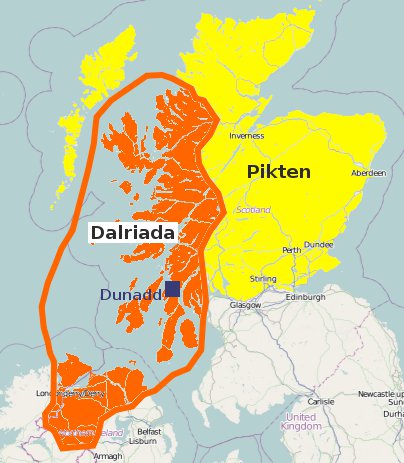
Between roughly 500 and 800, Dalriada stretched mainly across islands and coastal areas. This included part of the north-east coast of Ireland, as well as parts of the west coast of present-day Scotland and the islands of Mull, Islay and later Skye. Iona – the island with the important and famous monastery of St Columba – was also part of Dalriada. The Scoti were, in other words, skilled seafarers who could comfortably and quickly cover most journeys within their kingdom by boat.
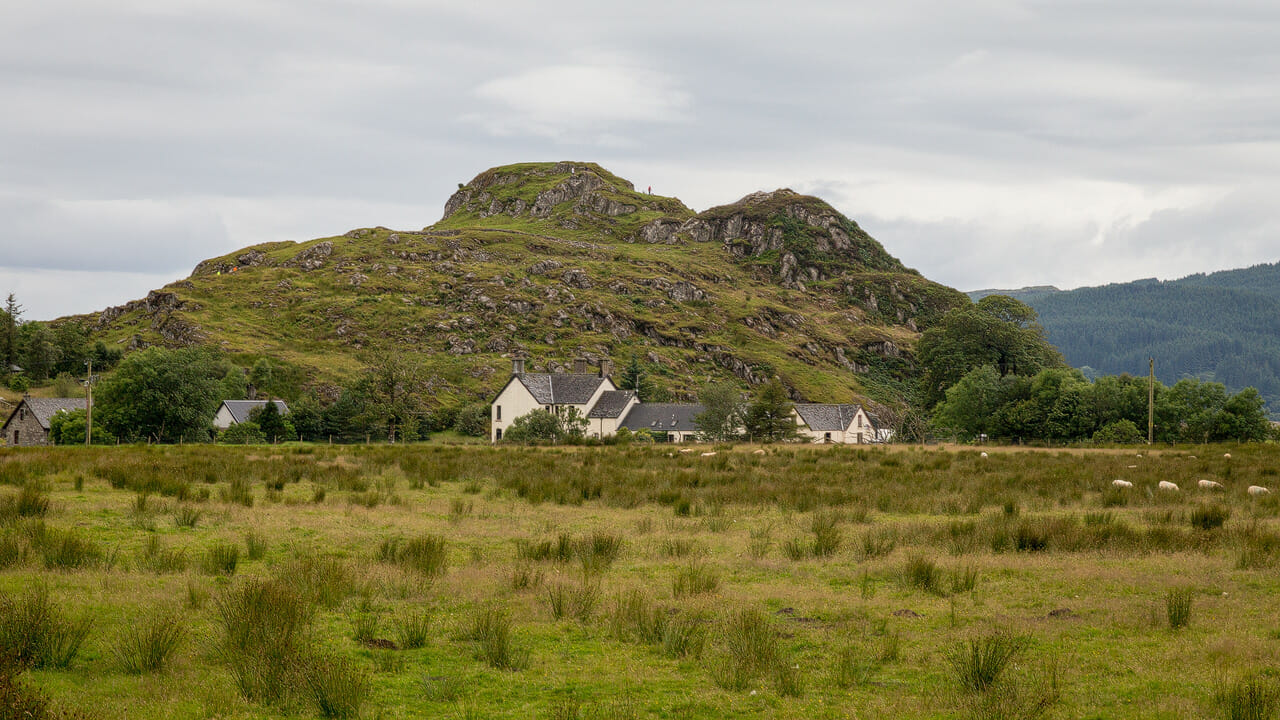
The power centre of Scottish Dalriada was the rock fortress of Dunadd, located in what is now Argyll and Bute.
Unlike Dalriada’s neighbours, the Picts (currently only available in German), there are detailed records of Dalriada’s population and military strength. The Senchus Fer nAlban gives detailed information on the strength of the individual cenéla. The army numbered around 2,000 soldiers and well over a hundred boats. The total population of the kingdom is estimated at around 10,000 people.
Dalriada’s golden age – raids as far as Orkney
In the year 574, St Columba of Iona personally crowned Aedan mac Gabhrann as king. Under this ruler, Dalriada reached its greatest extent around the year 600; Gabhrann wrested land from the Picts. He also built a war fleet, with which he carried out raids as far as Orkney in the north and the Isle of Man in the south.
Dalriada, however, was never to grow larger than this. Aedan mac Gabhrann’s son did still claim parts of Skye, but he already had to cede territory in the south again.
Gabhrann’s grandson eventually lost battle after battle and forfeited territory. By the middle of the seventh century, Dalriada finally came under the rule of the kingdom of Northumbria.
In the year 736, the Picts even succeeded in overrunning the power centre of Dunadd and seizing power. From this point on, historians know little more about Dalriada. But it wouldn’t be long before it made headlines again …
Dalriada’s living legacy
At first, Dalriada no longer played much of a role as a military power. But its ruling line lived on. Around the year 800, King Alpin MacEchdach again tried to take on the Picts by force – with little success; in 834 he was beheaded by them and put on display.
And here we’re back in the realm of legend: his son was to have better luck, thanks to a quirk of Pictish succession. Among the Picts, the claim to rule was inherited through the maternal line. Since Alpin MacEchdach was married to a Pictish princess, her inheritance passed to his son Kenneth Mac Alpin. This claim was supported by both Picts and Gaels, so Kenneth prevailed. Under Kenneth MacAlpin, in 844, the unification of the kingdom of the Picts and the Gaels of Dalriada took place.
But here too, historians now have serious doubts about the story. It is in fact considerably more likely that Kenneth was purely Pictish, and that it was later claimed – once again – that he rightfully held the claim to rule over both kingdoms. After all, later kings also invoked Kenneth as their ancestor.
Either way, by this point there was a common enemy from outside anyway: the Vikings threatened the land from the north and west, seized islands and coastal stretches, and even plundered the holy monastery of Iona. So the Gaels brought the relics of their saint to safety, transporting them into Pictish heartland and settling there.
Facing the Viking threat (currently only available in German) stood a united kingdom of Picts and Gaels: the Kingdom of Alba, the first Scottish kingdom. And although the Picts were long militarily superior to the inhabitants of Dalriada, the language, music and culture of the Gaels ultimately prevailed – and the later clan system (currently only available in German) is also based on the family units of the Gaels from this period. Gaelic language and music are still alive in the Highlands today. Of the Pictish language, by contrast, almost nothing is known today.
By the way: in the west, in the heartland of Dalriada, a new Gaelic kingdom would form again after only a few centuries – the territory of the “Lords of the Isles (currently only available in German)” … but that’s another story.
