Between 80 and 100 Highland Games take place in Scotland every year. But where does this tradition actually come from?
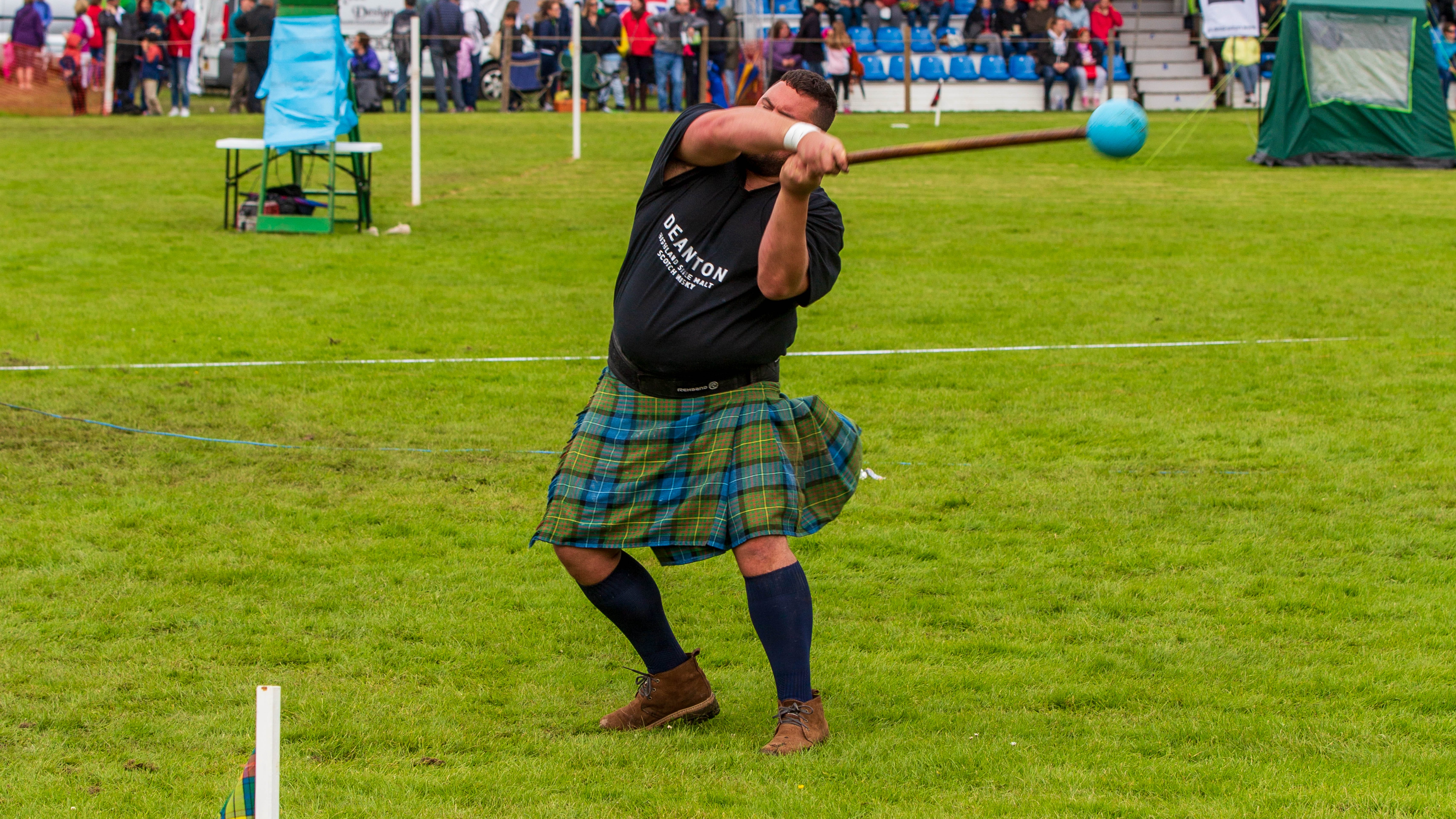
Highland Games fascinate through their typically Scottish disciplines. Tree trunks are flipped end over end in tossing the caber, weights are thrown headlong over a bar (weight over bar), and dancers perform on tiptoe to the bagpipes on stage.
Highland Games really are a unique kind of event. How did they come about? Where do these games and their disciplines come from?
We need to separate myth from documented fact.
Myth: the Irish invented the Highland Games
Competitions are, and always have been, anchored in human societies. That’s why such games can be traced back a long way in the Celtic world too.
One of the oldest accounts is said – depending on the source – to go back to as early as 1800 BC. In Ireland, games were held at that time in honour of the goddess and queen Tailtiu.
The Tailteann Games are said to have been held each year towards the end of July. Some of the disciplines included high and long jump, running, swimming, and throwing for distance. Added to these were martial contests such as javelin throwing, swordfighting, chariot driving, wrestling, boxing, and archery.
Many of these disciplines were typical contests of the kind that also appear and once appeared at the Olympic Games.
But how certain is it that the Tailteann Games really existed? Excavations near the Irish town of Teltown have uncovered Iron Age structures. These could have been used as sporting venues.
However, the games were only part of a festival that was actually intended, overall, as a funerary commemoration. But at such a large gathering, plenty of social business got done too: laws were proclaimed and marriages were contracted. The legitimacy of marriages made at such gatherings was recognised in Brehon law texts and remained permitted up until the 13th century.
From this, it can be assumed that the Tailteann Games really did exist, that they were part of Irish life, and that they were celebrated again and again over several centuries. It was presumably only the Norman invasion of Ireland in the Middle Ages that put an end to them.
What’s not certain, though, is in which century they really first took place, how consistently they were celebrated, and whether they have anything to do with today’s Highland Games in Scotland.
Even though that’s exactly what’s often claimed.
Incidentally, the Tailteann Games were revived in Ireland in the early 20th century. Even today they’re held from time to time, for instance in Kells.
Myth: the origin of the Highland Games in Scotland
One possibility, of course, would be that the tradition of the Tailteann Games came to Scotland with the Scotti. However, even the theory behind this migration is itself disputed. So that claim can’t be stated with certainty either.
Another myth traces the Highland Games back to King Malcolm III of Scotland. He’s said to have started a race up Creag Choinnich hill near Braemar, supposedly to find the best royal courier for himself. But this story, too, isn’t backed up by solid sources. So this is a myth as well.
Facts: What we know for certain
Competitions will have arisen quite naturally in Scotland too. The idea of throwing a hammer as far as possible lies pretty close at hand, quite literally, if people had previously been working with one.
But how might a one-of-a-kind event like tossing the caber have come about? Here scholars point to “raising the couples” – that is, the practice of raising roof rafters. In other words, an activity that grew out of house-building.
Gaelic tradition was, for several centuries, largely oral. There are hardly any written records. That changed in the 18th century.
The “court books of the regality of Grant” from 1703, for instance, shed some light on this. Among other things, they describe the organisation of a series of competitions by Clan Grant. Participants were required to appear in Highland dress and to carry weapons such as a musket, sword, pistol, and dirk.
After the Jacobite defeat at Culloden, there was initially a dry spell, at least in terms of records. But once the Jacobites were no longer seen as a real threat, a revival and romanticisation of the Highlands began – and with it, of the competitions too.
So, at the very least, we know of the following events:
- 1781 Falkirk: bagpipe competition at the cattle market
- 1788 Inverness: the first modern “revival games”
- 1819 St Fillans: St Fillans is considered the first “complete” event in the modern sense.
- 1823 Lonach: the start of a tradition still held every year to this day. (the Games’ website here)
- 1932 Braemar: the first competitions at what is today’s stronghold of the Games.
But the real breakthrough came thanks to Queen Victoria. She travelled through Scotland and developed a genuine admiration for the country. In 1848, she attended the Games at Braemar. That laid the foundation for the royal patronage of the Braemar Highland Games that continues to this day.
Present: the Highland Games today
Victoria set off a kind of chain reaction. Between 1840 and 1900, numerous other places launched their own Highland Games. Between 1900 and the end of the Second World War, hardly any new venues were added. But between 1960 and 2000 came a genuine boom.
Two types of games emerged over time: those run commercially by an organiser, and those organised by the local community – often smaller and more intimate, but unfortunately also vulnerable whenever not enough volunteers could be found.
Myth or fact: today, Highland Games enjoy unbroken popularity. Between May and October, there are plenty of dates for Highland Games in Scotland.
Sources
- Brewster, M., Connell, J., & Page, S. J. (2009). The Scottish Highland Games: evolution, development and role as a community event. Current Issues in Tourism, 12(3), 271–293. https://www.tandfonline.com/doi/abs/10.1080/13683500802389730
- Twenty Long Decades – A Few Glimpses of Braemar Royal Highland Society’s Early Years on the Occasion of its Bicentenary, https://www.braemargathering.org/early-years