A stone, an inn, a view – here at the southern tip of South Uist, history and nature meet quiet and pleasure. This is the Polochar Inn and its Standing Stone.

It’s as if someone wanted to mark a turning point here. From the Polochar Stone onward, the coastline, coming from the east, swings north – and in doing so, it also changes character. Up to this point a rugged, rocky landscape dominates; not far from the stone, the almost endless sandy beach begins, running almost unbroken up the coast of South Uist.

Compared with many other standing stones in Scotland, the Polochar Stone is a dwarf at barely 1.70 metres. An old dwarf, though. It’s thought to have been erected sometime between 2000 BC and the Bronze Age – though not here. Researchers believe it was moved at least once, which sadly ruins the lovely story that the Polochar Stone once served as a waymarker for Stone Age seafarers.
Even so, seafaring does play an important role for the place. Because even if the stone wasn’t meant for sailors, the Polochar Inn right next to it certainly was. Since 1750 the house has sheltered travellers, who in the past waited here for a passage between South Uist and Barra.
These days, no ferry departs from here any more. Only the odd fishing boat anchors in the rock-sheltered waters. That very stillness is what defines Polochar today. Visitors come to unwind, to enjoy the view out to sea towards Barra and Eriskay. The Inn has also built a reputation for its seafood, and as a four-star property with eleven rooms in total.
Good to know: Spelling and origin of the name Polochar

Polochar, Polachar, Pollachar … several spellings of the name are in circulation. Most sources agree that the name comes from “Poll a’ Charra”, with “Poll” said to mean bay and “Charra” stone. A look in the Scottish Gaelic dictionary shows that “Poll” means roughly basin, but claiming that “charra” means stone would be too simple – stone is usually translated as “clach” instead.

Closer to the mark would be “carragh”, meaning standing stone, or “carrachan” for rock and standing stone. Assuming the term stands in the Gaelic genitive, it would likely be “Poll a’Charrachain”. That, however, is based on modern Gaelic – the name is probably considerably older, and so can’t really be translated with today’s vocabulary. In fact, other old place names contain the element “charra”, likewise translated as “standing stone” – for example Auchencar on the Isle of Arran, which comes from the Gaelic Achadh a’ Charra, meaning “field of the standing stone”.
So the translation “basin of the standing stone” does seem to hold up.
Tip: Walking the Machair from Polochar
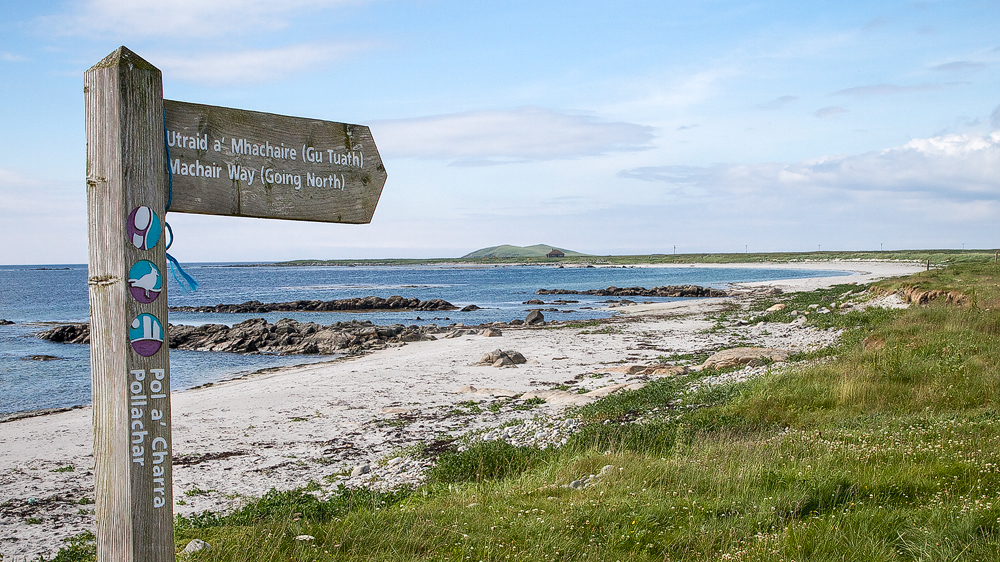
(Photo: Martin Goldmann)
The Polochar Inn makes an excellent start and end point for a long walk into the Machair, the beautifully flowering grassland that fringes South Uist’s sandy beaches. After the walk, the Inn’s staff are happy to look after thirsty throats and hungry stomachs. In good weather you can even sit outside and, with a bit of luck, spot dolphins – or at least enjoy the view towards Barra.
Getting there:
With sat nav: enter “HS8 5TT”, which will get you almost right to the Inn.
Without sat nav: South Uist essentially has one main road, the A865. Follow it, coming from the north or from Lochboisdale in the east, until the road makes a sharp turn right by the Borrodale Hotel. Signs there also point towards Eriskay and the ferry. Take that turn and simply follow the B888 to its end – do NOT turn off again towards Ludag, the ferry, or Eriskay. The road ends at the Polochar Inn, where there’s also a small parking area.


