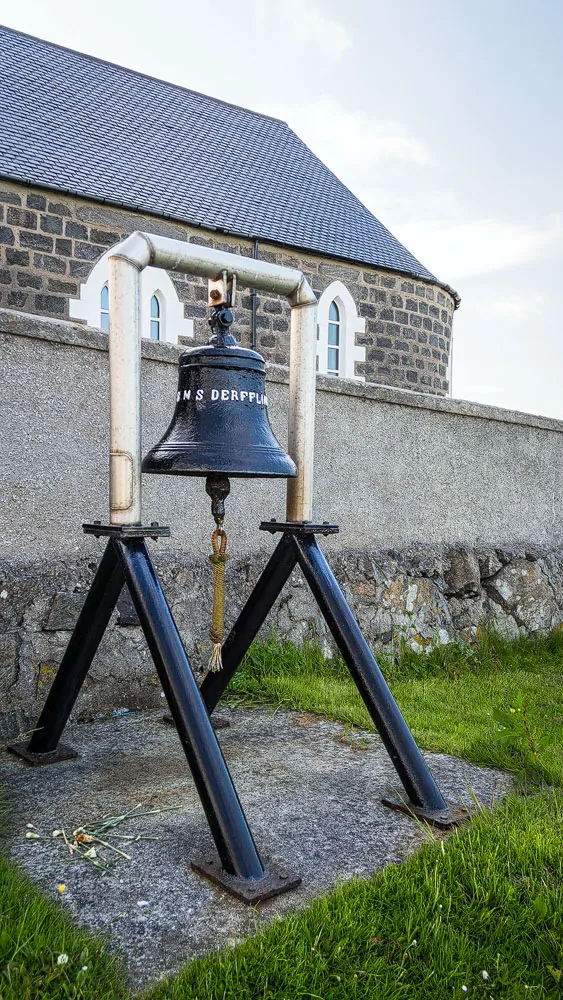
A small island, a small church, a big story: the bell hanging by the door of St Michael’s Church has come a very long way. And the church’s altar is something quite special too.

On a plain iron frame in front of St Michael’s Church on Eriskay hangs a bell. Painted black, not particularly large. Most tourists barely give it a second glance. Only a few might pause for a moment, puzzled by the lettering on it: “SMS Derfflinger” – hardly sounds like a saint’s name.
It’s stories like the one behind this bell that make travelling through the Outer Hebrides so fascinating. Because the bell doesn’t come from Scotland at all, but from Germany – and it’s been on quite a journey. It’s over a hundred years old, and its ring once sounded during naval battles at Dogger Bank and Jutland. It even sank to the bottom of the sea along with an entire fleet, was later raised, and was hauled off to a scrapyard together with its ship. The ship’s name: SMS Derfflinger.
The Derfflinger was the pride of the Imperial German Navy, a modern battlecruiser the British nicknamed the “Iron Dog”, after it once latched onto an opponent like a dog and wouldn’t let go. Once the First World War was over, the German fleet scuttled itself in the natural harbour of Scapa Flow near the Orkney Islands – the Derfflinger among them.
But how did this bell end up at the Catholic church of St Michael’s on Eriskay? And why?
For the British, the ships in Scapa Flow were, on the one hand, a nuisance, since they blocked the harbour; on the other, the metal alone was worth an immense sum. So all but seven of the ships were eventually salvaged and scrapped. Right at the very end – only shortly after the Second World War, in 1946 – the upturned wreck of the Derfflinger was towed from Orkney all the way to Faslane near Glasgow. There she was finally dismantled.

Thirty years later, Father Callum MacNeill was looking for a bell for his church on Eriskay. His search eventually led him to a scrapyard near Faslane, where he found a ship’s bell – emblazoned with the letters “SMS Derfflinger”.
The find suited him perfectly. He had it shipped to Eriskay, where six men and a handcart hauled the bell up the hill to St Michael’s Church. It’s been ringing out here ever since, calling the island’s parishioners to worship.
And there the story could end – if it weren’t for one small snag: the Derfflinger’s ship’s bell was actually handed over to the German Navy as early as 1965, as a symbol of reconciliation between Britain and Germany – officially, and documented with plenty of photographs. Today it sits at the Mürwik Naval Academy, tucked away for lack of space in the storage rooms of the military history training centre there.

So which one is the real one? Even various online forums can’t agree, and the English Wikipedia hedges its bets outright: “The ship’s bell was delivered to the German Federal Navy on 30 August 1965. Her bell is now on display outside the church of St Michael on the Outer Hebrides island of Eriskay.” It can hardly be in two places at once, can it?
In the end, it was the German Naval Museum and the military history training centre at the Mürwik Naval Academy who shed light on the mystery, in response to a direct enquiry (thanks, dear brother Andreas, for your help): “His Majesty’s Ship Derfflinger” actually had two bells – not unusual for ships of that size at the time. One of the two has, after its long journey, now found a safe and peaceful harbour on the island of Eriskay.
Good to know: about St Michael’s Church
The bell by the door is just one item at this church that points to a life at sea. A ship’s lantern hangs by the screen leading to the choir, a clock in the shape of a ship’s wheel sits by the door to the sacristy, and there’s even an anchor at the pulpit. And then there’s the altar: it rests on a ship’s prow.

Why this strong nautical theme throughout?
As is so often the case, the answer lies in one of the darker chapters of Scottish history: the Highland Clearances. Back then, everything belonged to the great landowners. Lady Cathcart, for example, owned the islands of Barra, Vatersay and South Uist. She evicted residents however it suited her – many emigrated to America, others were resettled on Eriskay. The small island soon became overcrowded, with far too many people for any kind of farming. Most residents therefore turned to fishing instead. That tradition endured.

By around 1900, Eriskay’s old church had become too small – it was little more than a run-down thatched blackhouse anyway. The parish priest at the time, Allan McDonald, wanted to fix this and build a new church for his congregation. To help fund it, the local fishermen donated the proceeds of an entire night’s catch to the building project. Father McDonald also chipped in his own money, and finally, in 1903, the new church was complete. It was dedicated to the islands’ patron saint, the Archangel Michael.
Since generations here lived off fishing, and putting out to sea was often dangerous, much inside the church still recalls those seafarers today. Incidentally, the unique altar with its ship’s prow was designed by Father Callum MacNeill – the very same priest who also brought the ship’s bell here.
Eriskay’s old church no longer stands; a statue of Mary today marks the spot where the former place of worship once stood.
Tip: take in the view from above
The church sits atop a hill that you can drive up part of the way by car. From there you get a great view towards South Uist and over parts of Eriskay itself.

You get a lovely overview of the church’s interior from the gallery. Lighting conditions inside can be tricky, though, since the windows are fairly small. So if you want good photos, bring a decent flash along.
Personal note: the ship’s altar appears in a novel
Seeing the ship’s altar mattered to me personally too, since it appears in one instalment of Peter May’s “Blackhouse” trilogy, which I hold in high regard. I had no idea about the story of the Derfflinger’s bell at the time – I only researched that later, back here in Germany.
Getting there:
With sat nav: “HS8 5JJ” will get you roughly in the vicinity.
Without sat nav: Coming from South Uist across the causeway onto Eriskay, turn right towards “Barra Ferry”, then a few metres further turn right again towards “Eaglais Naoimh Mhicheil”. Head up the short climb and look for a parking spot just before the church.