Travellers in Scotland want a good night’s sleep. There are plenty of accommodation options for that, and they differ in more than just price. Here are the different types of accommodation and what makes each one special.

Sleep in a castle? No problem in Scotland. Stay cheaply in a university room? That’s possible too. Accommodation options in Scotland range from luxurious to budget, from traditional to innovative. There are holiday flats in lighthouses, campsites right on the beach, bed and breakfasts in Victorian manor houses, or cottages made from old railway carriages. Whatever you choose, in Scotland you’ll always meet different guests each evening, ready for a bit of a chat. For solo travellers especially, that’s a lovely change of pace.
Travellers really do have a whole range of spectacular options for where and how to lay their head each night. In my Accommodation section, I try to showcase some of these special options.
Below, though, I first want to clear up a few fundamental questions: what types of accommodation exist in Scotland generally? How do they differ, which suits which budget, and how last-minute can you book them?
Book accommodation in advance or spontaneously – which is better?

People often ask whether it’s possible to just find accommodation on the spot in Scotland, or whether it’s better to book from home in advance. I’ve done both several times, and my experiences have varied.
When it comes to youth hostels, hostels and campsites with a tent, I’ve almost always found something on the spot without booking ahead. But especially in high season and in sparsely populated parts of Scotland, even that can get tricky – and yes, there was one occasion when I wasn’t even allowed onto a campsite with my tent anymore. In that case, wild camping was the only option left.
One thing I’ve learned along the way: a good starting point for spontaneous bookers is the local tourist information office. They often have phone numbers and addresses for B&Bs, hotels and campsites, and for a small fee they’ll even call ahead and check directly for you – a service known as “book a bed ahead”.
Personally, though, I now book my accommodation in Scotland well in advance – often more than six months ahead. For me, the place I stay has become an attraction in its own right, so I try to pick out particularly interesting places to stay. Hotels in a castle, for example, or B&Bs with a beautiful view. Naturally, those are also in high demand among other guests.
So, in summary: in theory it’s possible to find something spontaneously on the spot, but during peak summer season it can get stressful, and you’ll always need some patience.
Important abbreviations and terms in Scottish accommodation listings
There are a few standard terms that Scotland travellers will keep coming across in room listings. One of the most important is “ensuite” or “en-suite bathroom“. If a room description includes this, it means the room comes with its own private access to a bathroom and toilet. By contrast, there’s also the option of a private bathroom (“private bathroom”) located, say, at the end of the hallway, or even a bathroom shared with other guests (“shared bathroom”) – though this last option is fairly rare.

You’ll also frequently come across twin and double rooms. A double room means a room with a single bed for two people. A twin room, on the other hand, has two separate single beds. This distinction is common at bed and breakfasts too.
Watch out for the abbreviations used in room prices. You’ll often see something like pppn. That means “per person per night” – as opposed to “per room” or “per night”, where the price is calculated per room. So when comparing prices, be careful whether you’re looking at £35 per night or £35 pppn, which would actually work out to £70 per night for two people.
The word deposit also comes up frequently. This refers to an upfront payment made when reserving a room. Bed and breakfast hosts in particular use this to protect themselves against travellers booking a room and then simply not showing up. Usually it amounts to one night’s payment per person, though some providers charge a percentage instead. This deposit is usually paid by credit card, PayPal or, less often, bank transfer. So it can happen that when booking a two-week trip, you already have to pay for several nights up front.
Hotels, guest houses and inns: staying with the professionals

Travellers to Scotland will find hotels in built-up areas, and often near particularly notable attractions too. Hotels are often part of a chain, professionally run, and offer a larger number of rooms. Dinner is often available there too, which is one thing that sets them apart from bed and breakfasts. Most hotels also have a bar and restaurant for guests.
A notch smaller are guest houses, which in Scotland are often also run as hotels or under the name guest house. In principle, they differ mainly in size and facilities.

Inns are widespread too. These are usually venerable old roadside inns. In earlier centuries they offered not just lodging and food, but also stabling for horses and similar animals. Naturally that’s no longer relevant today. So an inn today is usually a bar that also offers simple meals and guest rooms.
Who’s it for? Hotels, guest houses and inns suit people who prefer a bit more anonymity – though that doesn’t mean you won’t end up having a lovely chat at the hotel bar now and then. Service at hotels tends to be professional. You’ll also often manage to get a room even without a prior booking.
Hotel search on Booking.com
Booking.com (function(d, sc, u) { var s = d.createElement(sc), p = d.getElementsByTagName(sc)[0]; s.type = ‘text/javascript’; s.async = true; s.src = u + ‘?v=’ + (+new Date()); p.parentNode.insertBefore(s,p); })(document, ‘script’, ‘//aff.bstatic.com/static/affiliate_base/js/flexiproduct.js’);Bed and breakfast: staying with lovely people at home

A bed and a breakfast – that’s the concept behind the classic bed and breakfast, or “B&B” for short, in Scotland. In many cases, it’s a room or a floor within a private house. And that private-home setting is the biggest difference from hotels and guest houses. Overall, B&Bs tend to be a notch smaller and more personal.
Staying right in the host’s own house can be especially interesting out in the countryside, since it lets you experience local life up close. B&B hosts often have a lovely little garden, or – as we’ve experienced ourselves – all sorts of animals too, like a flock of chickens.
But don’t worry: you’ll of course have privacy in your own room. Sometimes, though, bed and breakfasts are laid out more like hotels, with plenty of rooms. In that case, the only real difference is that no dinner is offered.
Breakfast at a bed and breakfast is, in most cases, a substantial affair. That means bacon, scrambled eggs, porridge, sometimes even omelette and sausages, right from the morning. Black pudding or haggis often feature in a typical Scottish breakfast too. Alongside that you’ll get “cereals” – all sorts of muesli – and toast. If you tuck in properly, you won’t need anything else until evening.
Things to note: B&Bs are often run by families, but they’re rarely set up with children in mind. Most B&Bs are geared towards older couples or two people travelling together. Rooms are almost exclusively doubles (twin or double), which are sometimes rented out for single occupancy too – though usually at a surcharge.
Who’s it for? Bed and breakfasts are a quintessentially Scottish type of accommodation, with a warm closeness to your host. Prices sit somewhere between hostel and luxury hotel, depending on how they’re furnished. Ideal for couples on a road trip around Scotland.
Cottages and holiday homes: accommodation by the week
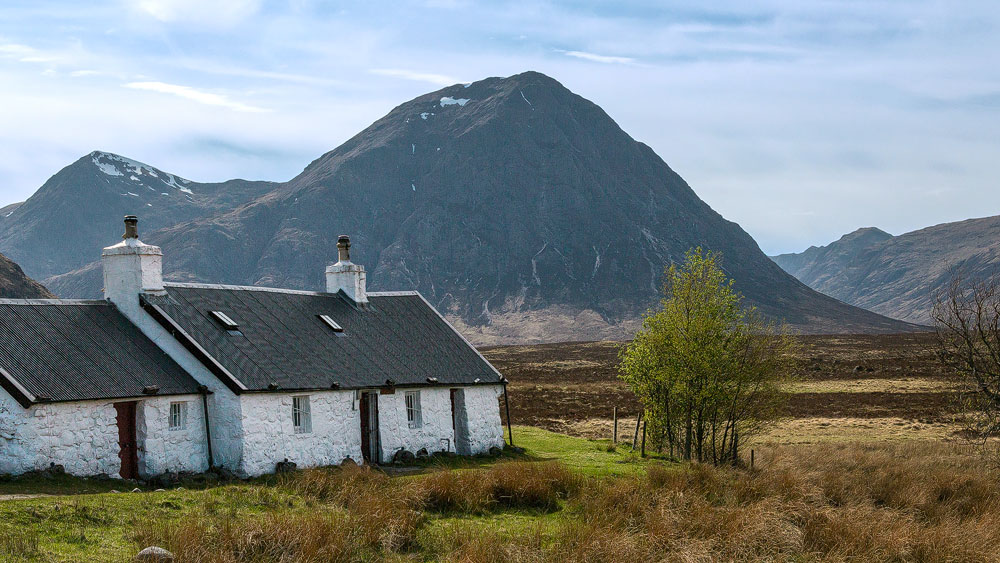
You can rent an entire house, or part of one, as a holiday flat or so-called cottage. This type of accommodation is especially appealing for groups or families. Cottages are generally intended for self-catering, and usually come with a washing machine and dryer. A well-equipped kitchen goes without saying in a holiday home. Bookings usually run for a full week, Saturday to Saturday.

In connection with hillwalking, cottages are also often shared mountain huts, such as the famous Blackrock Cottage shown in the photo above.
Who’s it for? The ideal solution for families. Self-catering helps keep costs down, and everyone can settle into their own space. There’s usually a garden around the cottage too, so children can play outside, or you can sit outdoors together when the weather’s good.
Youth hostels and hostels: booking on a budget

Staying overnight in Scotland can be cheap too. Youth hostels and backpackers’ hostels offer beds in shared accommodation and typically also have a communal kitchen. The name “youth hostel” is a bit misleading, since adults can stay there just as easily. And there are often family rooms or twin rooms available too.
A good place to start for youth hostels in Scotland is the Scottish Youth Hostels Association and its website. Bear in mind, though, that it only lists hostels belonging to the association.
Who’s it for? Budget travellers who can do without the big luxuries. Very sociable.
Campsites: feeling close to nature

Scotland has a dense, good network of campsites for tents, caravans or motorhomes. Even in fairly remote corners of the Highlands, you’ll often still find small campsites. Alongside individual pitches, campsites also offer so-called “facilities” – meaning showers, toilets and often even laundry rooms. In many cases there’s also a small shop, or at least a kiosk, selling a selection of food and camping gear.
Motorhomes can also get a power hookup at campsites and empty their toilets there. However, pitches with hookups are often limited in number.
More and more campsite owners are building small wooden cabins to rent out – known in English as “pods” or “wooden pods”. A nice alternative to a tent. Many sites also offer “static trailers” – fixed caravans on site that travellers can rent.
Scottish campsites – especially in the Highlands – are often set in spectacular surroundings. The famous beachside site at Sango Sands, for instance, or the one at Glenbrittle beneath the Cuillins on the Isle of Skye. Campers really do get close to nature here. The downside: nature, especially in the west of the Highlands, can be demanding. When the rain sets in, for instance, or the midges start swarming in force, the fun on a campsite drops off sharply.
Who’s it for? Independent travellers who don’t plan too far ahead and are travelling with their own motorhome, or even just a tent. Plenty of closeness to nature. Motorhome road trips are certainly suitable for children too.
Airbnb has become established
The platform Airbnb has also firmly established itself in Scotland. Airbnb offers private flat or room rentals. In built-up areas like Edinburgh, Glasgow or Aberdeen, you have good chances of finding a place to stay, but plenty of B&Bs in the Highlands now also handle their bookings through the platform.
Our reader Martin Crome also writes in the comments: “It seems Airbnb had really caught on by summer 2016 – we could find interesting and reasonably priced places to stay online, even fairly spontaneously, once we were already there. Things naturally get tighter in the touristy hotspots, like the Isle of Skye, so it’s worth not waiting too long to book there. There’s a good number of professional providers, like B&Bs, but also plenty of private hosts with some really original places.”
Other accommodation options in Scotland

Beyond the accommodation types listed above, there are a few more options. For anyone travelling with a tent, wild camping out in nature is almost always possible – and on multi-day hikes through the Highland wilderness, it can even be a necessity. This kind of camping is explicitly permitted, covered by the Scottish Outdoor Access Code, as long as you stick to the rules:
- only in small numbers – no large groups
- not on farmed fields or enclosed livestock areas
- at a reasonable distance from buildings or the road
- environmentally friendly, meaning no litter left behind and no significant damage caused
More information can be found in the Scottish Outdoor Access Code.
With a motorhome, wild camping gets a bit trickier. Many beautiful spots now carry a sign reading “No overnight parking” – so keep an eye out for that.
Universities offer a special kind of accommodation too. During term breaks, rooms stand empty there and are rented out to guests. There are offers in Edinburgh and Glasgow, often including breakfast too.