A dream come true: getting married in romantic Scotland. If only it weren’t for the paperwork. Don’t worry, it’s really not that hard.
On this page:
» Choosing a location
» Paperwork
» Same-sex marriage
» Timeline
» Costs
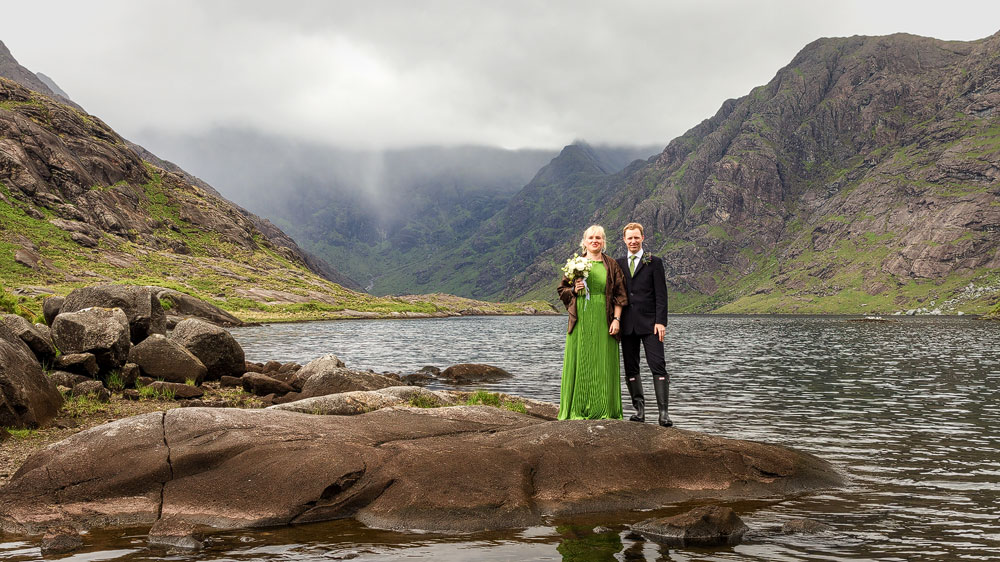
Katrin and I got married in Scotland (you can see wedding photos here), at our beloved Loch Coruisk, right in the middle of the Highland wilderness, accessible only by boat. But before we could fully immerse ourselves in the romantic side of things, we had a fair few bureaucratic hurdles to clear. After all, the marriage also needed to be legally recognised back home. Here are our experiences and tips, in case you’re planning something similar.
The most important thing first: there’s a kind of timeline dictating what needs to be submitted when. If the future married couple keeps this in mind, the organisational effort really isn’t all that stressful. Here, then, are the key facts about getting married in Scotland, based on our own personal experience. And of course, we’ve added further information here as things have developed since our own wedding.
The venue: It depends on who will be marrying you
In Scotland, marriages can be either religious or civil, and this choice can determine the venue:
Registrars can marry you either in their office or, in theory, at any other venue. You can find the current overview of local councils and registrars here. Some of the council links shown there are not always fully up to date, so if in doubt, ask the relevant registrar directly where a wedding is possible.
Religious bodies, primarily the Christian churches. Ministers can, in theory, conduct a wedding anywhere. That said, some clergy will only hold ceremonies in their own church, and some also refuse to marry couples from outside their parish. It’s best to clarify this by phone if you have a particular church in mind.
Humanists (and independent celebrants). Humanist Society Scotland allows couples a great deal of freedom when choosing the wedding location. You can find out more about humanist weddings in Scotland here. A two-year membership of Humanist Society Scotland is included in the booking. Independent celebrants can also create a ceremony around your wishes. However, they can only conduct a legally valid marriage if they are specifically authorised to do so in Scotland. A private or independent celebrant without that authorisation can conduct a symbolic ceremony only. If in doubt, check their status with the local registrar before booking.
Besides the minister, registrar or humanist celebrant, you’ll also need two witnesses aged 16 or over.
The paperwork: Not as many forms as you’d think
Unfortunately, Brexit has complicated things somewhat. European citizens who do not already have an appropriate UK immigration status will generally need a “Marriage Visitor visa” to marry in Scotland. An ETA is not sufficient for getting married or giving notice. The visa currently costs £135 per person. At a minimum, you will therefore need:
- a valid Marriage Visitor visa for each person who requires one
- an original birth or adoption certificate; ask the registrar whether a multilingual version is sufficient or whether a certified English translation is required
- a Certificate of No Impediment or the equivalent issued by your home country, unless the registrar confirms that it is not required in your circumstances
- a valid passport and evidence of your usual residence, such as a utility bill no more than three months old
- for non-UK nationals, the Declaration of Status by Non-UK Nationals
- forms M10 and Celebrant and Witness Details
The Scottish registrar normally asks people who are subject to the marriage law of another country for a Certificate of No Impediment, or their home country’s equivalent. The precise name and issuing authority differ across Europe, so check both with your local civil registration authority and with the Scottish registrar before ordering documents.
If either partner has been married or in a civil partnership before, documented proof of the divorce, dissolution, annulment or the former partner’s death will also be required.
Documents that are not in English must be accompanied by a certified English translation.
Tip: when filling out form M10, try to be as precise as possible when stating the occupations of the parents and of the couple. In our case, a simple “Teacher” wasn’t enough for the registrar, even though my parents were already retired anyway. He wanted to know what kind of teacher, and for which subjects. For others, he wanted to know what kind of company or profession they worked in. For me, “Journalist” alone wasn’t enough either – I had to specify my subject areas too.
Same-sex marriage: Marriage equality in Scotland
With an overwhelming majority, the Scottish Parliament passed a law legalising same-sex marriage in early 2014. Since then, same-sex couples have also been able to marry in Scotland. Everything described here applies equally to them.
The timeline: Countdown to the wedding
As already mentioned, timing is crucial. So here are the key dates to keep in mind.
Around six months beforehand: if you want a religious or humanist wedding, this is the latest point to track down and book your minister or celebrant. You should also start sorting out the venue and, if needed, make a reservation there. Together with a humanist celebrant, you can also work out exactly what should happen during the ceremony. If you’re having a civil wedding, this is also the time to get in touch with the relevant registrar about a date.
Ten to twelve weeks beforehand: now is the time to contact the registration office and submit the “Marriage Notice”. By law, the registrar must receive it at least 29 days before the wedding, but that would be far too tight when planning from abroad. You can find the relevant registrar through the National Records of Scotland overview. After checking the details with the office, send forms M10 and Celebrant and Witness Details together with the requested evidence. Some offices accept scans initially, but the originals must reach the registrar before the ceremony.
In our case, we got in touch with the registrar directly. We sent her scans of our documents in advance by email and asked whether everything was in order. We then agreed with her that we’d send the physical documents. The British authorities also charge processing fees, which we paid over the phone by credit card.
The Marriage Visitor visa can be applied for no earlier than three months before travel. You will need an appointment at a visa application centre, where your fingerprints and photograph are taken. A decision is normally made within three weeks of the appointment. Check the current locations, optional services and charges when applying.
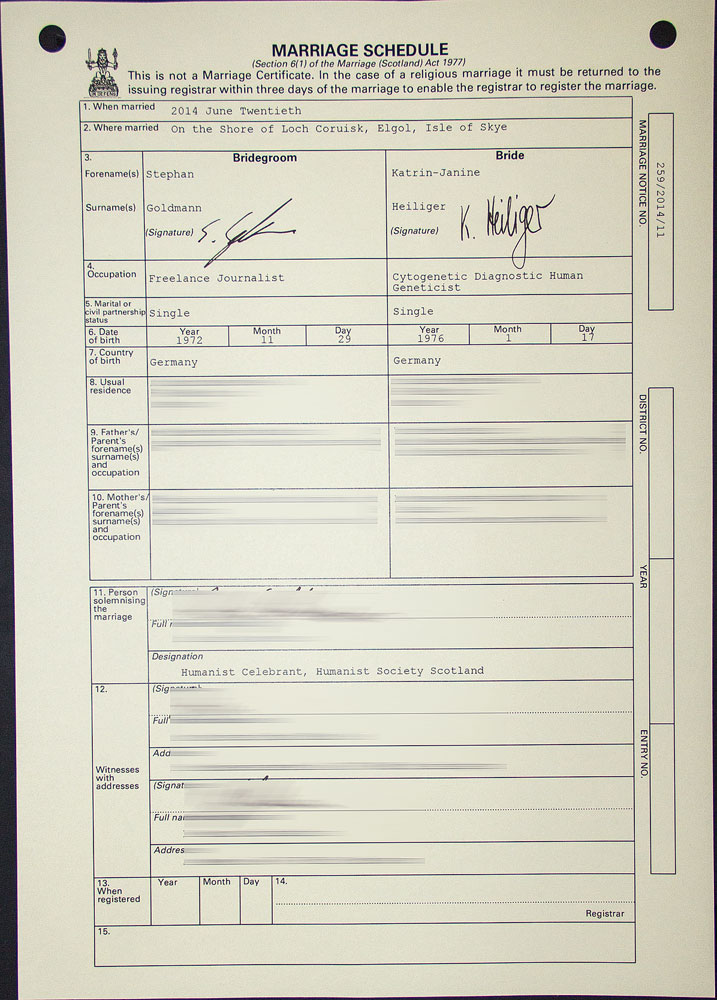
One week beforehand: for a religious or belief ceremony, one of you must collect the “Marriage Schedule” from the registrar during the seven days before the wedding. Make an appointment in good time; a friend or another person cannot collect it for you. For a civil ceremony, the registrar brings the Schedule to the wedding.
The wedding: there is no single legally prescribed wording for the vows. The ceremony must, however, contain the declarations required by Scottish law from both the couple and the celebrant. Immediately after the ceremony, the couple, the two witnesses and the celebrant or registrar sign the Schedule in permanent black fountain-pen ink. The rest of the ceremony can be shaped however you like.
Within three days afterwards, at the latest: after a religious or belief ceremony, the signed Schedule must be returned to the registrar within three days so that the marriage can be registered. After a civil ceremony, the registrar handles this. You can then obtain the Marriage Certificate.
Back home: the rules for recognising or recording a marriage celebrated abroad differ from one European country to another. The Scottish Marriage Certificate is the central proof of the marriage. Your home authority may also ask for an apostille and a certified translation. An apostille can be requested here. Check with the civil registration authority in your country before the wedding to find out whether any additional national formalities apply.
Money and love: The registrar’s fees
In our case, we paid just under £70 in 2014 because we only needed the Schedule from the registrar. The current fixed fees are:
- £45 per person submitting a Marriage Notice, i.e. form M10
- £10 for a copy of the marriage certificate ordered within one month of registration; after that it costs £15
These are the basic statutory fees. If a registrar conducts the ceremony, additional charges apply and can vary considerably by council area, venue, day and time. Ask the relevant registrar for the current local price.
You’ll find all the steps in English on the official National Records of Scotland website.
In short: getting married in Scotland really isn’t difficult, and my wife and I did so successfully in June 2014. Prices have gone up since then, and many European couples now need a Marriage Visitor visa, but in principle the process remains very similar. Don’t be put off by the official hurdles: contact the Scottish registrar and your home-country authorities in good time. Our registrar and celebrant were both extremely helpful, which meant we could simply enjoy the celebration.
