To the Italian prisoners of war, Orkney must have seemed like hell. So they built themselves a piece of heaven: today, the Italian Chapel moves every visitor.
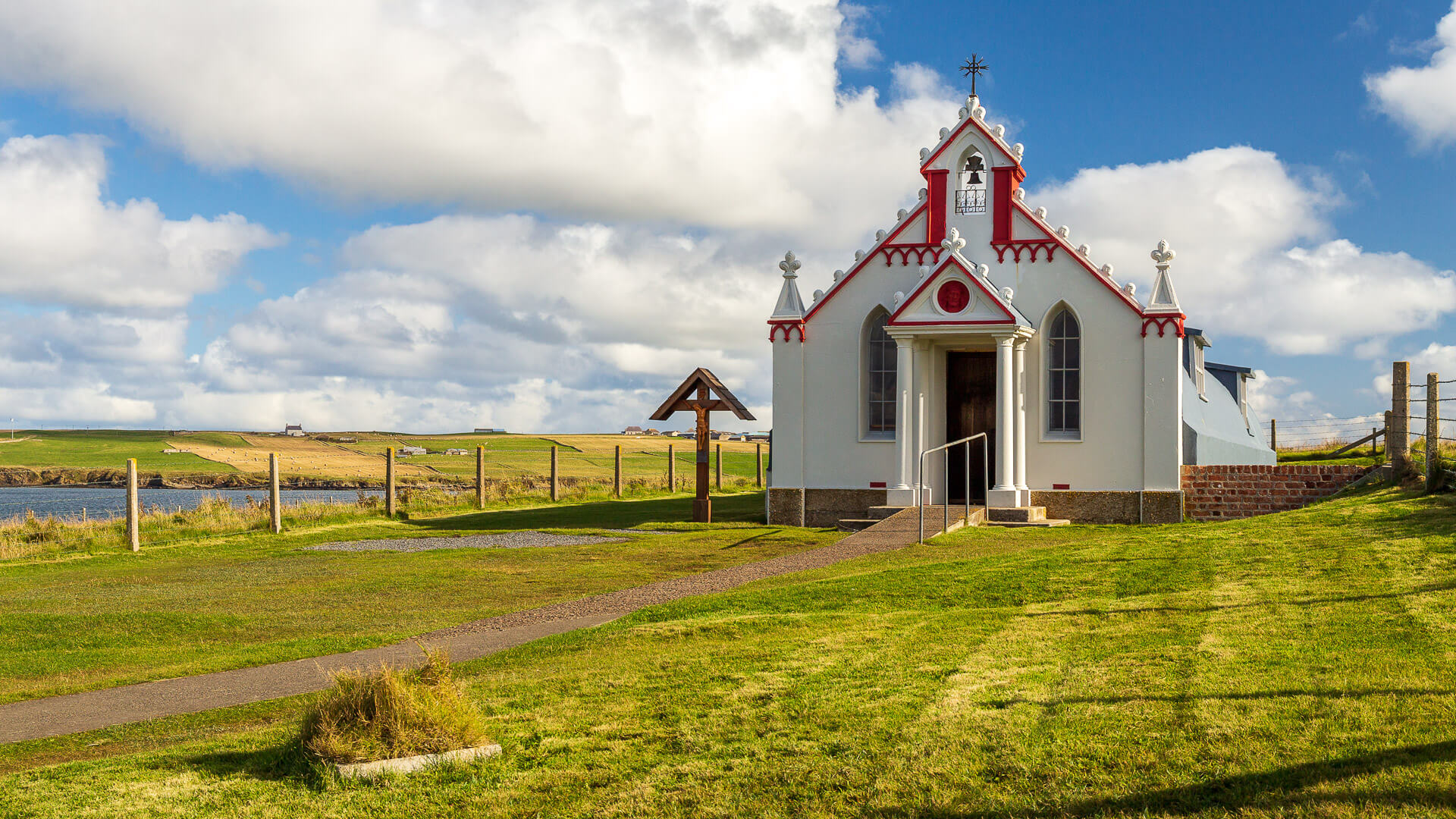
Domenico Chiocchetti’s home was the Dolomites. Towering mountains, lush alpine meadows, blue skies, elaborate architecture – that was what he had grown up with. This place, though, had none of that. Domenico could hardly have imagined anywhere colder, wetter or more desolate than Orkney. These islands, somewhere in the nothingness between the North Sea and the Atlantic.
He would spend the remaining years of the Second World War here and – though he didn’t know it on arrival – he would end up staying longer than anyone else. Voluntarily!
The British had brought him to Lamb Holm, a tiny Orkney island. He and over a thousand other Italian comrades, captured in Africa, were to work here at Camp 60, building huge barriers of rock in the sea. Bulwarks against German U-boats; the British called them the “Churchill Barriers“. For this, they had to break stone, fill enormous wire cages with rubble and haul them to the sea, finally sinking them there.
Domenico was a painter. An artist.
Through all that time, through all the hard labour, the cold, the darkness, only Domenico’s small devotional picture brought him comfort – it showed the Madonna holding an olive branch. His mother had given it to him when he went off to war. In her place, the holy mother was now to watch over her son. And she did – or so Domenico believed.
Again and again he pulled the picture from his pocket and studied it. The Madonna held the olive branch out towards him, almost insistently. As if she wanted to give him a task. Domenico understood: this camp was hell for him. But no one said it had to stay that way.
It began inconspicuously enough. The Italians had laid paths through their Camp 60 so they wouldn’t always have to wade through mud. Bit by bit, Domenico and his comrades planted flowers along these paths. Splashes of colour in the landscape, small shoots of hope. But that wasn’t enough for Domenico. He wanted to create something bigger. Something sacred.
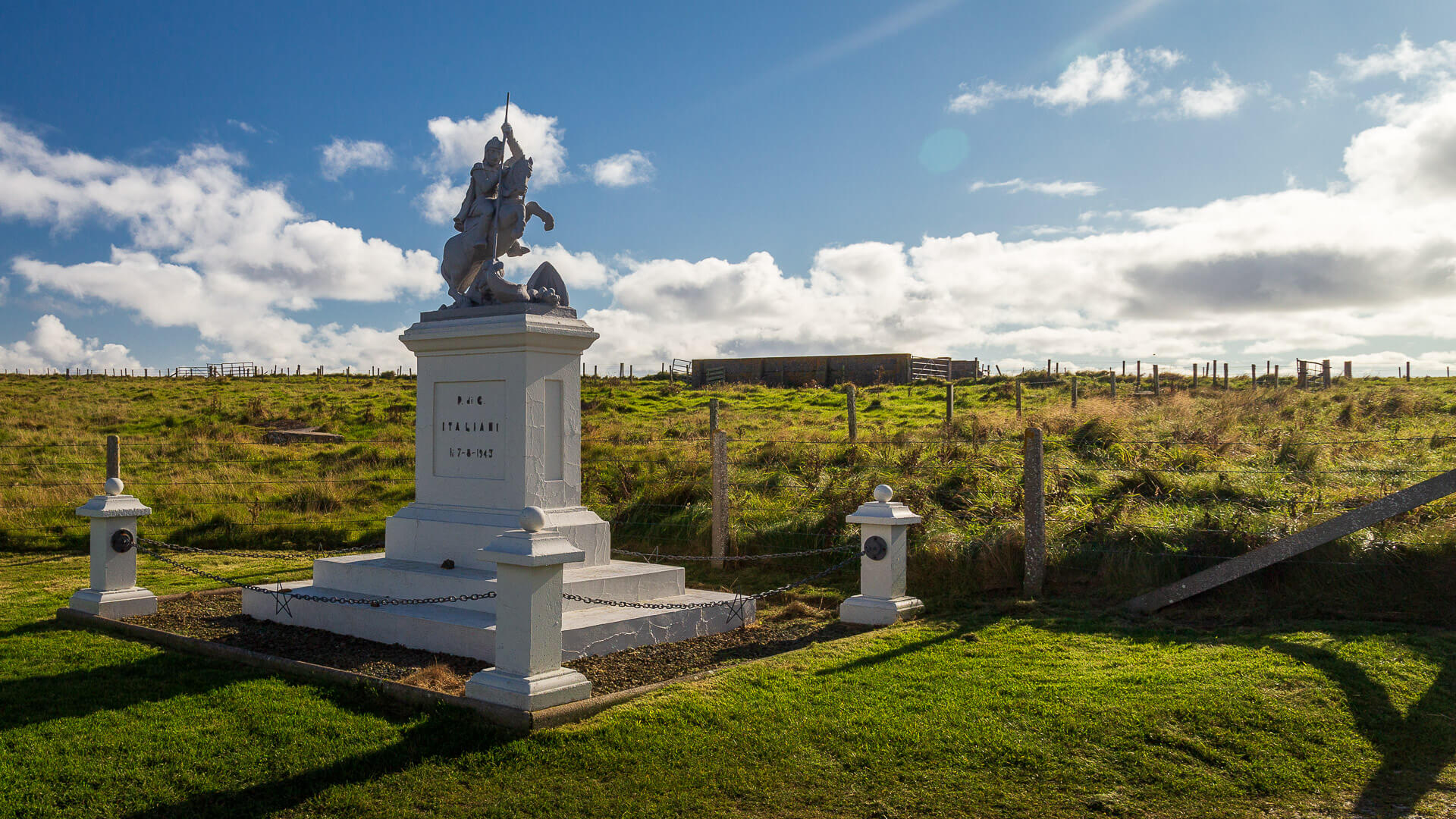
And so, from scavenged barbed wire and cement, he shaped a statue of St George, who now kept watch over the prisoners’ huts. But there was still no church, no place to gather and pray.
When an Italian priest arrived at the camp in September 1943, Domenico knew it wouldn’t be long before they had their own chapel – a genuine “Italian Chapel”. And he would be its master builder.
How the Italian Chapel was built
Domenico was an artist, certainly. He was a visionary, possessed of driving energy. But for his church he needed more: skilled tradesmen. His statue had shown the others what he could achieve alone. What, then, could they all create together?
In Domenico Buttapasta he found someone who could work wonders with cement. Giuseppe Palumbi was a blacksmith who could coax metal into the most beautiful shapes. Giovanni Pennisi was also a painter, lent Domenico Chiocchetti a hand, and would go on to create his own masterpiece for the church. Many other comrades pitched in too – if only by taking on extra shifts on the Churchill Barriers to free up time for Domenico and his church-builders.
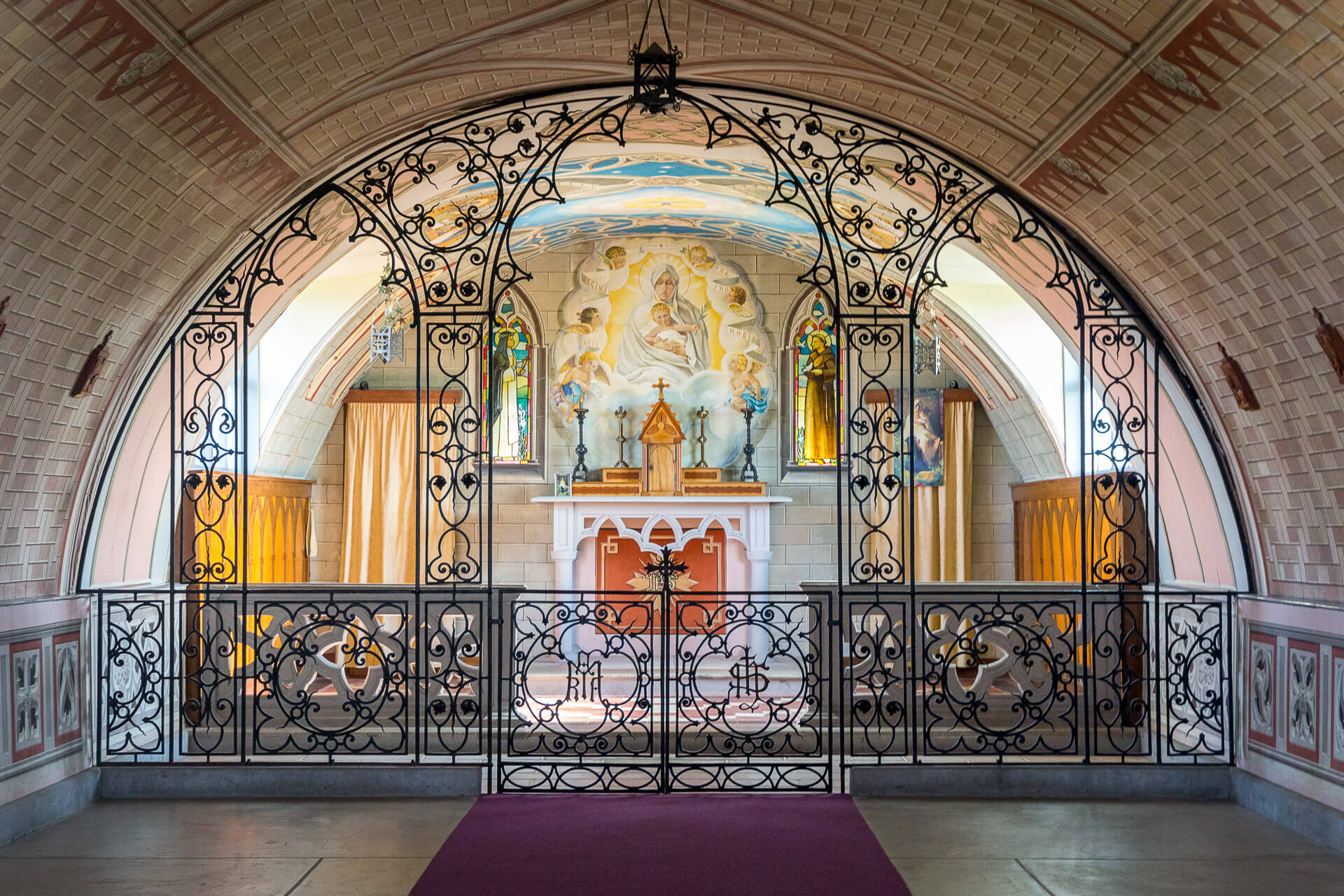
Even the camp command supported Domenico’s project, donating two Nissen huts, which were joined together. The resulting barrel vault formed the nave of the church. But the British material support wasn’t enough for Domenico’s vision of a genuine Italian chapel. So a great deal was “organised”: timber was salvaged from the wrecked ships of the Churchill Barriers. Fabric was ordered from a company, paid for with cigarette money the men had pooled together. Empty tin cans, once eaten from, were turned into lamps for the chapel.
For months, Domenico and his men worked on their Italian Chapel. They clad the huts’ ugly corrugated iron and decorated the walls with images of saints, or gave them the illusion of brickwork. The chancel was separated off by an ornate iron screen, which took the blacksmith four months to make.
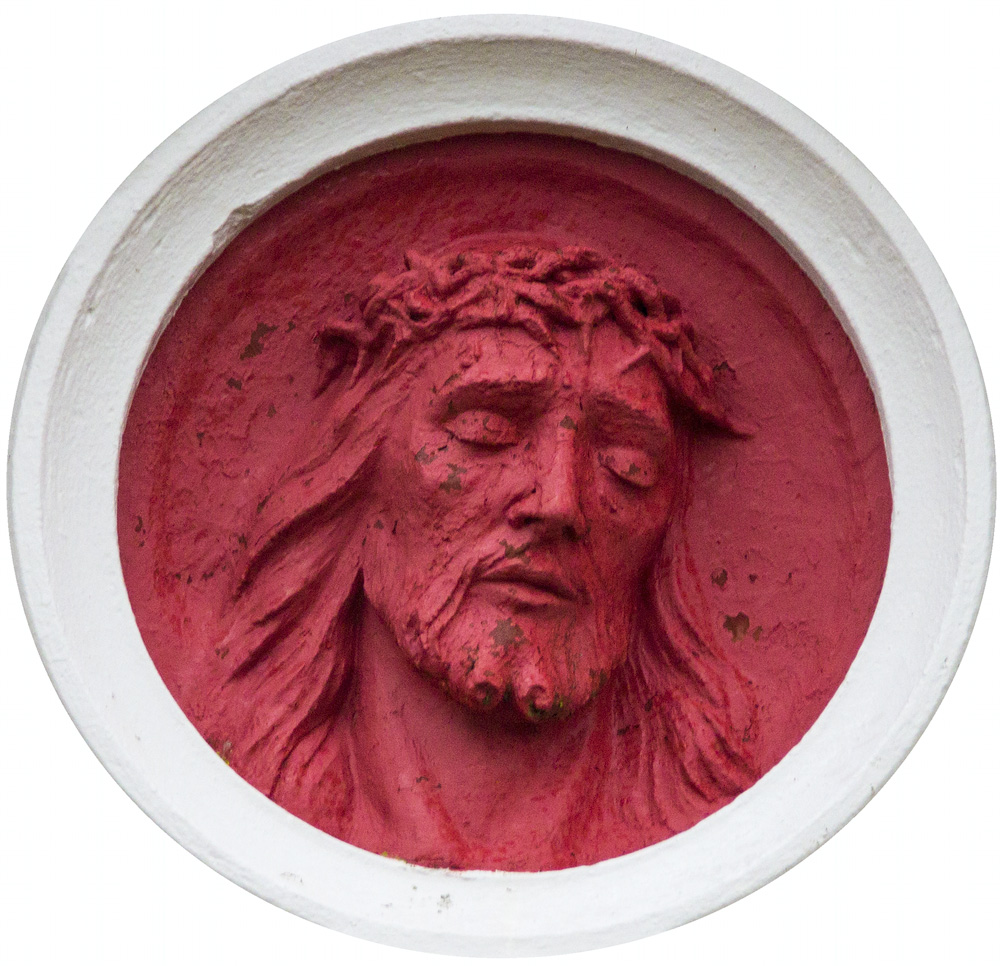
From the outside, though, the hut still looked pitiful. And so Buttapasta took on the façade. Out of cement he created the perfect illusion of a church with a small bell tower. And finally it was Pennisi who carved the relief of Jesus above the entrance.
For the altar, though, Domenico Chiocchetti had something very special in mind: his Madonna with the olive branch, who had comforted him all those months, who had inspired him, was to become the centrepiece of the church. The little picture was already well-worn by the time he finally set about conjuring a Madonna in glowing colours onto the wall, based on that image.
After eight months of building, their Italian Chapel was almost finished. The prisoners consecrated their work with a service, and only a handful of further masses would follow. By now it was summer 1944 – a ceasefire had long since been agreed between the British and the Italians. And so it wasn’t long before the prisoners were moved on – away from Orkney. A relief, one might think.
But not for Domenico. He wasn’t finished here yet, his work not yet done. So he stayed behind alone, voluntarily, as the last man on the island, to complete the Italian Chapel. Only once that was done did Domenico leave Orkney for home. And left his statue, his church, his Madonna behind.
Forever?
How the Italian Chapel survived
This is almost where the story of the Italian Chapel would have ended. The war was over; workers moved in to raze Camp 60 to the ground. Nothing was meant to remain to recall the camp. But before the little chapel, before St George and his dragon, the workers stopped short, in reverence. Against their instructions, they spared the Italians’ work.
Instead, slow decay set in. The church had been built from scraps; it was simply never meant to last forever. But Domenico and his men had poured so much time, love and patience into the work, it was so beautiful, that it captured the hearts of the Orcadians. It became their church. A legacy the Italians had entrusted to them in good faith. And after all: it was a church, a house of God. They themselves were deeply devout people.
In 1958, the people of Orkney founded a committee to preserve the Italian Chapel and restored it as best they could. But they didn’t dare touch Chiocchetti’s own work. And so Domenico Chiocchetti, the former Camp 60 prisoner of war, returned once more to Lamb Holm to refresh his paintings. In the end, he left Orkney with a deep bond to its people. On parting, he wrote:
“The chapel is yours – for you to love and preserve.”
Domenico knew the Orcadians would keep their word. And they do.
Good to know: The Italian Chapel today
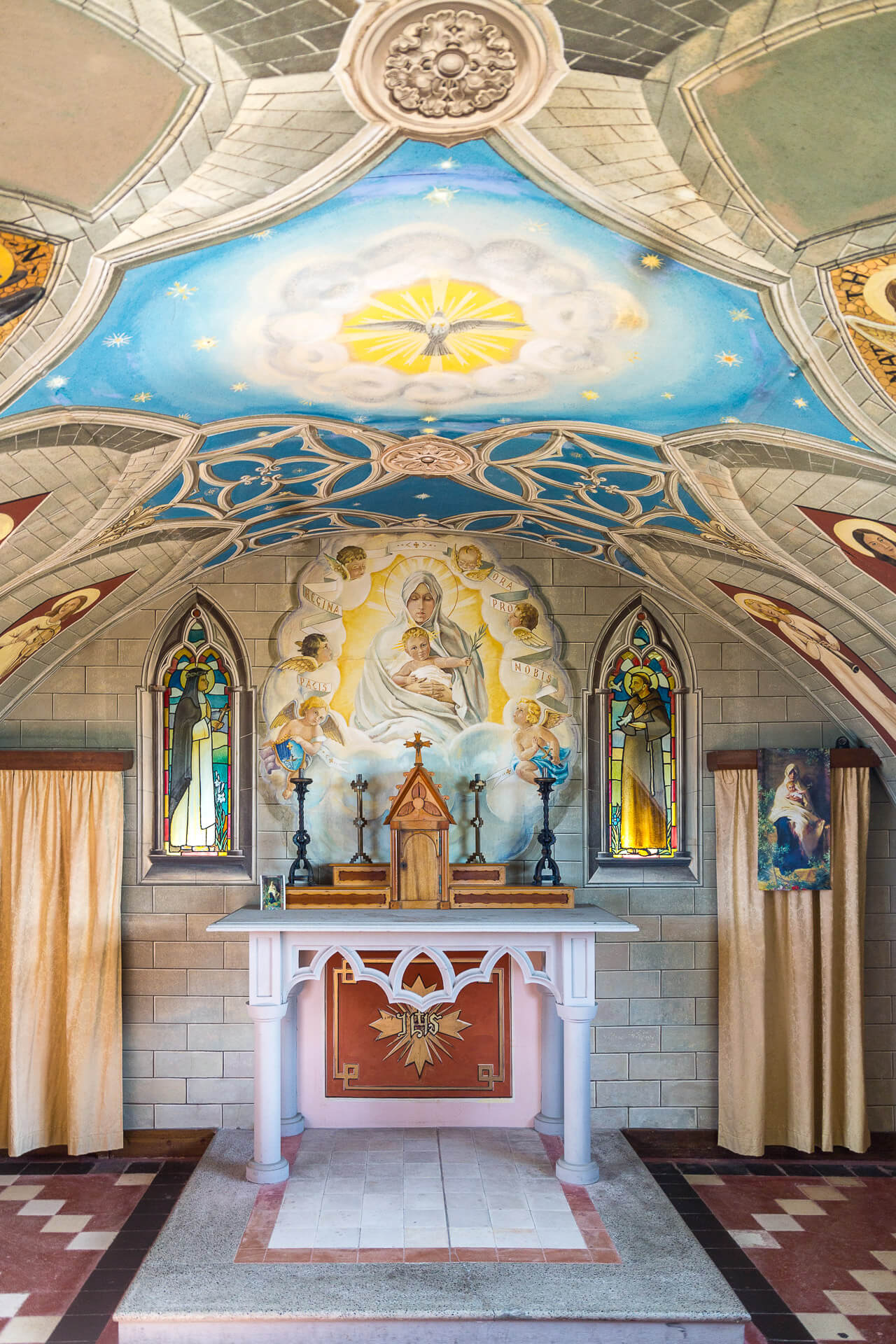
The Italian Chapel connects not only Italians with Orcadians, but also different faith communities. On Orkney, three denominations jointly look after the upkeep of this little gem. A service is also held there on the first Sunday of every month.
The Orkney chapel, incidentally, wasn’t the only one of its kind. Italian prisoners built churches in other camps across Britain too. But most were destroyed along with the camps. One exception is the Henllan Chapel in Wales.
The cross to the left of the church was donated by Moena, Chiocchetti’s home town. Since the war, former camp inmates have visited the church several times. Most recently in 1995.
Domenico Chiocchetti died in 1999 at the age of 89.
The image of the Madonna that served as Domenico Chiocchetti’s model was painted by the artist Nicolò Barabino and can be seen in the cathedral of Genoa.
Tip: The book behind the story
Author Philip Paris tells the story of how this little church on Orkney came to be in his historical novel “The Italian Chapel”.
A gripping and moving read.
Getting there:
With a sat nav: Enter “KW17 2SF” to get you close. From there you may still need to cross a Churchill Barrier and then follow the signpost.
Without a sat nav: From Kirkwall, take the A961 towards St Mary’s. After the “St Mary’s” village sign, the road first bends left, then turns right onto one of the Churchill Barriers. On the other side, the turning to the Italian Chapel car park branches off immediately to the left.
