Where Scotland’s national flag comes from, why a lion represents Scotland just as much as the unicorn does, and what the Scottish thistle is all about – find out here.

On this page
» Scotland’s flag
» royal coat of arms
» Scotland’s motto
» British coat of arms
» national animal, the unicorn
» the Scottish thistle
The Scots are proud of their country, and they’re happy to show it. They don’t just reach for the white-and-blue national flag, either. Other symbols such as the lion, the unicorn, or the thistle are also a common sight. How is it that the Scots have come to have so many symbols? And what do they mean? That’s what I’d like to explain here. The royal Scottish coat of arms plays a central role in this, since it brings all the symbols together at once. But let’s start with the flag.
The flag: what Scotland’s flag means
A white saltire on a blue background – that’s Scotland’s national flag. Locals simply call it “the Saltire”. Saltire refers to a diagonal, X-shaped cross. And indeed, the X-shaped cross refers to the national saint, Andrew, or St Andrews, one of the twelve apostles of Jesus. He was crucified on just such a frame by the Romans in Greece.

But how did St Andrews and his cross come to Scotland? Legend tells of a Christian king of the Picts named Óengus II. On the eve of a battle against pagan Saxons and Angles, he dreamed of St Andrew, who promised him victory. The next morning, a saltire made of clouds appeared in the sky against a blue background. This good omen so encouraged the Pictish army that they won the battle. From then on, St Andrews became the patron saint of Scotland, and the white cross on a blue field became the national flag.

[CC BY-SA 4.0], via Wikimedia Commons
Whether this really happened can’t be proven for certain. What is certain, though, is that the Scottish flag is one of the oldest in the world. The saltire at least already appears on the seal rings of Scotland’s guardians in the 13th century – though in those depictions, the dying apostle himself was also shown. The cross alone came into use from the 14th century onward, when it was decided that Scottish soldiers should wear it front and back as an identifying mark. Around 1542, the flag appears in its present form in the Register of Scottish Arms. However, the blue in the background varied a good deal, sometimes darker, sometimes lighter. In 2003 the Scottish government put an end to that and fixed Pantone 300 as the correct shade.
The royal coat of arms: the “Lion Rampant”
There’s also an unofficial flag of the Scots, often waved for instance by fans at national football team matches: a rearing lion on a yellow or golden field, surrounded by a double red border decorated with fleurs-de-lis. In English it’s called the “Lion Rampant”.

This is the original royal coat of arms of the Scots, traceable back to Alexander II. Alexander II reigned in the 13th century. Some suspect that William I may actually have already borne the arms, since he was often referred to as “William the Lion”. He was King of Scots from 1143 to 1214.
A flag bearing the Lion Rampant, however, may not simply be waved by anyone. It’s only permitted for the British monarch, their High Commissioner (the Lord High Commissioner to the General Assembly of the Church of Scotland), the King of Arms of Scotland (the Lord Lyon King of Arms), and the Royal Regiment of Scotland. Everyone else legally requires permission – which, admittedly, doesn’t bother football fans much.
The Lion Rampant is actually only one part of the full Scottish coat of arms – more precisely, it appears on its shield, the central element. A coat of arms is what “Wappen” means in German, and in the case of the “Lion Rampant” we speak of the “Royal Coat of Arms”. This might sound like an odd term, but it’s actually closely related to the word “arms” in the sense of weapons: it’s just an old form referring to shields and armour elements, which at the time counted as defensive weapons.
The complete coat of arms of King James at Stirling, for example, looks like this:

The following individual elements can be made out from top to bottom:
- Motto: “In defens”
- Crest: a red lion holding a sword and sceptre, wearing Scotland’s crown on its head
- Helm: a helm fitted with a visor and crown
- Shield: the Lion Rampant
- Supporters: two standing unicorns, each holding a standard bearing one of Scotland’s two flags
- Order: St Andrew, holding the saltire as a sign of the Order of the Thistle
- Compartment: the Scottish thistle
The motto: “In defens” and “Nemo me impune lacessit”

“In defens”, or “in defence” in modern English, is a shortened form of the opening of an old Scottish prayer:
“In my defens God me defend
And bring my saulle to ane good end.”
This shortened motto was chosen by the Stewart kings. It was certainly used in the coat of arms by James IV, who reigned from 1488 to 1513. Unfortunately, he had neglected his own defence, and so James IV became the last Scottish king to be killed in battle, falling in defeat at Flodden.
The Stuarts later introduced a second motto, “Nemo me impune lacessit”, meaning “No one provokes me with impunity”. It usually appears on the later coat of arms, which already reflects the union between the Scottish and English crowns under the Stuarts.

This is the motto of the Order of the Thistle, the second-highest order of chivalry in Britain and the highest in Scotland. The motto often appears as a banner at the bottom, or as a border on the plaque hanging from the shield – which itself also represents the Order of the Thistle.
The British version: the royal coat of arms of the united kingdoms
The Royal Coat of Arms of the British Crown bears a strong resemblance to the Scottish one. That’s because, from the 17th century onward, the Scottish royal house provided the monarch for England, Ireland, and Scotland in personal union. In 1707 the United Kingdom was formed under Anne Stuart.
The Scottish national flag was absorbed into the Union Jack, and the royal coat of arms was significantly altered:

Now the unicorn faces a lion, both animals wearing crowns and carrying their own national flags: Scotland on the right, England on the left. The shield bears the “Lion Rampant” twice, along with the three lions from the English royal coat of arms and the harp for Ireland.
There’s also a new motto: “Honi soit qui mal y pense” – “Shame on him who thinks evil of it”. This is the motto of the Order of the Garter, Britain’s highest order of chivalry ahead of the Order of the Thistle.
The fact that the two supporters, unicorn and lion, now stand facing each other for the two kingdoms already gave rise to a satirical rhyme back in the 17th century:
The lion and the unicorn were fighting for the crown
The lion beat the unicorn all around the town.
Some gave them white bread, and some gave them brown;
Some gave them plum cake and drummed them out of town
The motto “Dieu et mon droit”, meaning “God and my right”, is also often found on the coat of arms. It comes from the English king Henry VI, who in the 15th century held the crowns of both England and France.
The national animal: what the unicorn means in Scotland
Proud, wild, freedom-loving, yet pure and beautiful. Wonderful qualities were attributed to the unicorn not just in Scotland – during the Middle Ages, almost the whole world believed in this mythical creature. Trade was even conducted in its horn – though these were usually narwhal tusks, or the tusks of other animals.
The unicorn was also linked to Christianity, for example with chastity and the Virgin Mary. That’s why, according to legend, only a virgin could lure the creature into a trap. Finally, the unicorn was also said to have healing powers. It’s said that with its horn it could purify poisoned water.
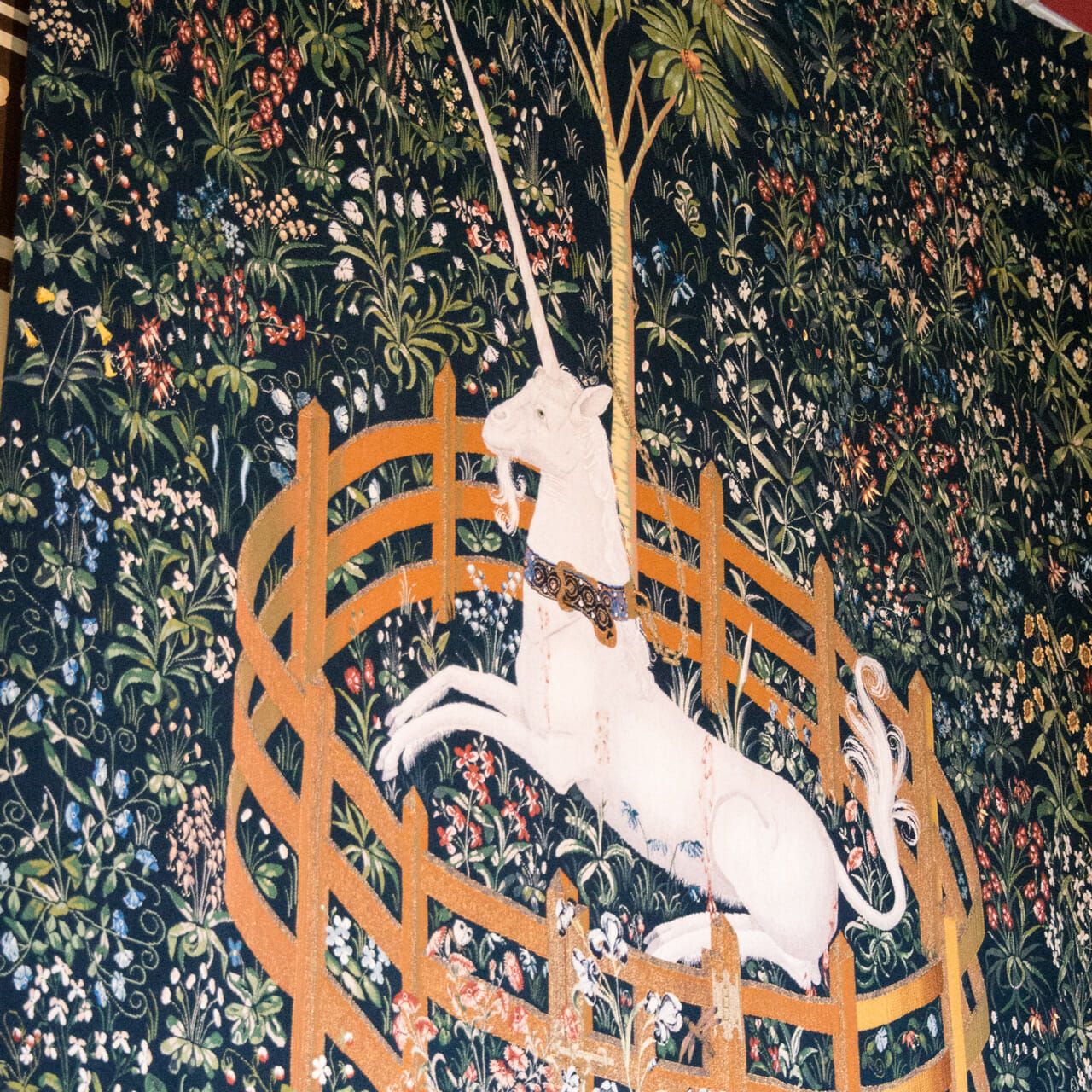
The qualities of the unicorn – whether real or not – lent themselves well to expressing some of Scotland’s ideals, such as preferring death to captivity. One might also read this as a clear statement in the ongoing struggle for freedom against England.
The unicorn first appeared in the Scottish coat of arms under the Stewarts. On the left and right, one unicorn each holds the shield bearing the lion, and also carries a flag. On the left-hand flag the “Lion Rampant” appears again, while on the right is the Saltire, the cross of St Andrew on a blue field.
Exactly when the unicorns came to be added to the Scottish coat of arms isn’t certain. There does, however, appear to be a depiction at Rothesay Castle that may date from before the 15th century.
One important detail: free unicorns are dangerous. That’s why the two creatures on the coat of arms are shown bound with gold chains.
Incidentally, the unicorn is also often seen on its own, for example on the market cross of Glasgow or Stirling.

The thistle: why it’s a symbol of Scotland
You’ll come across the thistle even more often, especially in the Highlands – both as a symbol and as an actual plant.

Naturally, there’s a legend about this too, and it goes something like this: in the 13th century, Norse warriors (descendants of the Vikings) are said to have crept up on sleeping Highlanders. To move more quietly, the attackers had taken off their shoes. The plan would have worked, had one of the Norsemen not stepped on a thistle. He cried out in pain, giving away the covert attack. The Highlanders were able to successfully defend themselves.
This is even supposed to have been the Battle of Largs, in which Alexander III of Scotland drove out King Haakon III of Norway. As a result, the Norwegians eventually withdrew from Scotland entirely.

The thistle later came to be understood again and again as a national symbol, since it also represents some typically Scottish qualities such as defensiveness, resilience, and a deep connection to the land.