For a long time they were seen as painted savages. But today, scholarship knows better: the Picts were not a primitive people. They had a fascinating culture.
Contents:
» Origin and language
» Time of the Picts
» Kingdom of the Picts
» Life in Pictavia
» The great battle
» Cult and church
» End of the Picts
The Picts are an original Scottish people who ruled large parts of what is now Scotland in the first centuries AD. Their name comes from the Latin “picti”, meaning “the painted people”.
The Picts are shrouded in mystery, since very little has survived in writing about them. From this, earlier researchers drew the mistaken conclusion that the Picts had been primitive and had left no writings of their own.
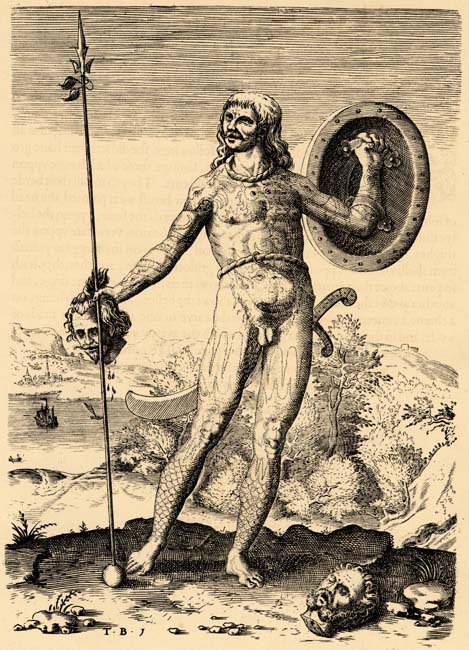
Instead, the image projected onto them was that of a naked, wild tribal warrior. An image that fit beautifully with the romantic ideals of certain writers of the time, who – compared with other indigenous peoples – essentially turned the Picts into a kind of Highland Indian. Wild, romantic, but uneducated.
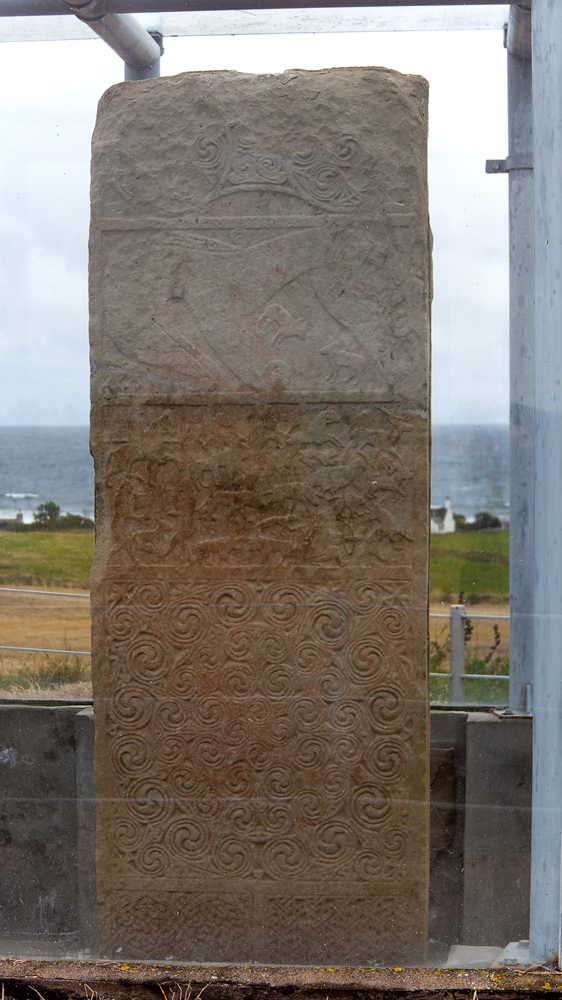
Yet something didn’t add up: could a primitive people really have produced such artfully carved stone stelae as, for example, the one at Shandwick? How does that square with the excavations at Portmahomack, which uncovered a major Pictish monastery comparable to the famous Iona? How could these supposed savages successfully hold their own against well-organised kingdoms like Dalriada? And did the absence of writings really have to mean there had never been any?
Today we know: the old picture was wrong. In fact, the Picts had a culture that stood just as high as that of the other British kingdoms of the time.
Even so, much remains open in Pictish studies.
The origin and language of the Picts
It cannot be said for certain where the Picts originally came from – there simply isn’t enough evidence. All that remains are more and less likely theories.
The one held by most scholars today holds that they were Celts who immigrated to Britain between 1000 and 500 BC and merged with the peoples already living there. These Celts, who may have crossed the English Channel from Gaul, are also the people Julius Caesar encountered when he carried out his first campaigns on the British Isle.
This theory also tells us something about the language of the Picts. It is thought that Pictish was not unlike Welsh, a conclusion drawn from place names and other clues. Of course, this too cannot be proven, since there are simply no surviving documents in the Pictish language.
Small wonder. Writing only arrived with the Christian clergy, and they always wrote in Latin. What’s more, no work from the region and era has survived the ages.
At least this much is known: even though both were Celtic languages, Pictish and Gaelic were different enough that translators were needed between them. Corresponding references to this can be found in the Chronicle of Iona.
When did the Picts live?
This is difficult to pin down exactly. What is certain is that the word “picti” for the Picts was already used by a Roman scholar in the late 3rd century AD. From around 900 AD, the word Picts disappeared again from the record.
The Roman writer spoke of the “Irish and Picts” in the north of England. “Picts” means “the painted ones”, just like the name the Irish gave them: “Cruithini”. It is assumed that the Romans meant tattoos worn by the people of northern Britain – at least, this is the interpretation that has become widely accepted. There is, however, no actual proof that the bodies of the northern peoples were painted.
Professor John Hannavy, in “Scotland Magazine”, issue 101, puts forward the theory that the Romans may also have meant the pictographic script of these peoples, as seen on their stones.
At that time, however, “Picts” was probably more of a collective Roman term for the tribes of northern Scotland, who did not see themselves as a single unit and only banded together against outside enemies.
By the first century AD, the Romans had subjugated half the island and established their culture there. The north of Britain, that is, Scotland, remained unoccupied but not unaffected. At least in the border region north of Hadrian’s Wall, the local inhabitants also traded with the Romans.
Around the year 410 AD, the Western Roman Empire abandoned its provinces on the island. That doesn’t mean there were no troops left in the country at all – the border guards, for instance, presumably stayed on. But the absence of Roman authority made itself felt overall, and over the years the Roman way of life declined, and sadly so did the writing of history.
Other forces now took the reins, for example the Angles and Saxons, who had come across the sea from Germania. And it was during this period that the Pictish kingdom, too, began to emerge as a coherent entity.
Where did the Picts live? Where was the kingdom of the Picts?
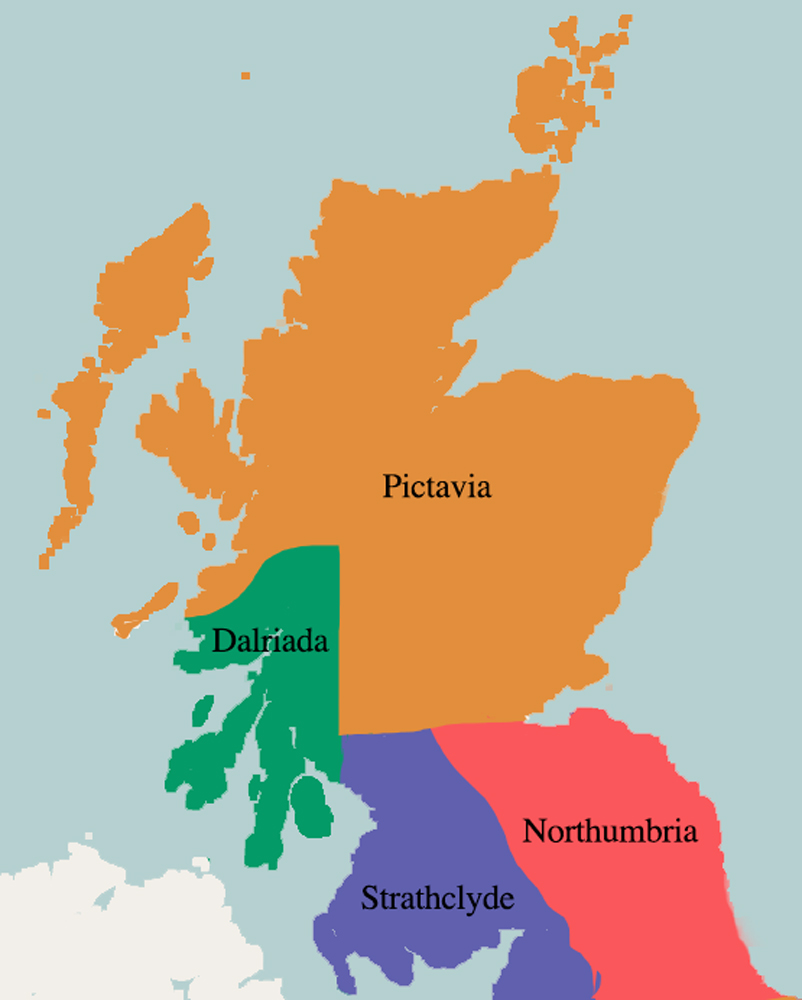
The Picts’ core territory began, in the south, roughly along the line between Glasgow and Edinburgh. To the north it bordered the Great Glen with Loch Ness, that is, the line between Fort William and Inverness. Pictavia, the land of the Picts, was, however, in constant flux. Depending on the outcome of a war, it could grow larger or smaller.
At times, however, Pictish influence extended much further. The Orkney Islands were controlled by them at times, as was the Isle of Skye. That said, areas such as the north of Scotland were probably only sparsely populated.
Pictavia can only be understood in relation to the surrounding kingdoms. First there was Dalriada, the kingdom on the west coast, held by the Scots.
The Picts had frequent dealings with Dalriada … as well as with Northumbria, a kingdom populated by Angles and Saxons who had emigrated to the island from Germania. It lay to the southeast. To the southwest, meanwhile, Pictavia bordered Strathclyde, and until the 7th century there was also Gododdin, though it was soon absorbed by the Angles.
In the end, the two key opponents for the Picts were Dalriada and Northumbria.
Daily life in Pictavia
Most Picts spent their lives as simple farmers. They were presumably liable for tribute and military service, but essentially free. These farmers would mainly have settled in the fertile areas above Inverness and Edinburgh.
The Picts had no towns with markets, nor any minted currency. The population is estimated at around 100,000.
Above the farmers ruled a class of nobles with a retinue of servants and warriors. These warriors formed so-called “warbands” – fighting groups of around a hundred men, flexible and fast, presumably because they travelled on horseback. In battle, the core of the army was formed by these professional soldiers, while the infantry was provided by the peasantry.
Preferred weapons were swords, lances and spears; no armour has so far been found. It is generally assumed that warriors protected themselves with padded tunics – and of course round shields. Helmets, it seems, were rarely worn by the Picts.
The great battle of the Picts
As mentioned, there were two kingdoms the Picts constantly had to deal with: Dalriada and Northumbria. While Dalriada could be kept reasonably in check, Northumbria had, by the mid-7th century AD at the latest, built up a dominant position across the whole of the British Isle. Around the year 670, the Picts suffered a bloody defeat and were subsequently forced to pay tribute to the Anglo-Saxons.
Had this state of affairs continued, an independent Scotland would probably never have come into being later on. That things turned out differently is thanks to Brude (Bridei) III, a Pictish ruler. He seized power in 680 and initially led victorious campaigns against Dalriada and Orkney. He then turned his attention to Northumbria and challenged its king, Ecgfrith. On 20 May the two sides clashed at Nechtansmere, thought to lie near present-day Forfar. Forfar lies around 20 kilometres north of Dundee.
Ecgfrith arrived with an army of a thousand men, a considerable force at the time; the Picts were certainly outnumbered. But they used a ruse. Feigning retreat, they lured their opponents into an ambush. Ecgfrith was killed, the Anglo-Saxons were decisively defeated, and Northumbria’s importance on the island collapsed afterwards. Its influence over Dalriada also waned as a result, sealing the fact that the north of Britain would go on to develop largely independently of the south.
Overall, at the decisive moments, the Picts were mostly victorious. Their high point came under King Óengus (Angus). In 736 he overran Dalriada’s fortress of Dunadd and razed it to the ground, finally forcing the kingdom of the Scots under the Pictish yoke. Twenty years later, fate lent him a hand when Northumbria was decisively defeated by the Britons of Strathclyde. All of Pictavia’s great rivals now lay defeated.
Until a new power appeared on the horizon …
Cult and church of the Picts
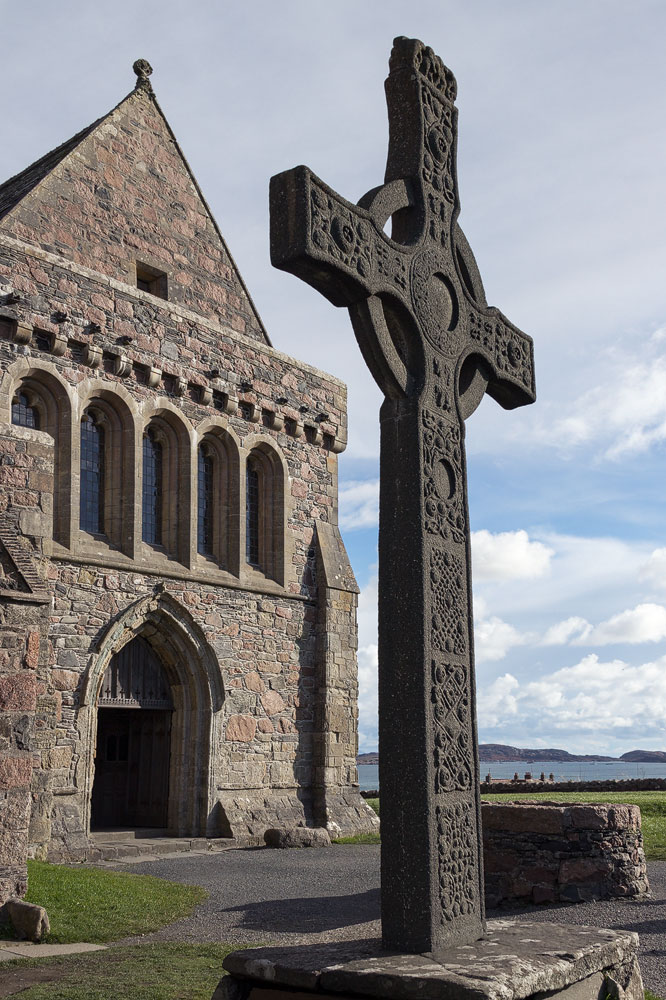
Practically nothing is known about the pagan cults of the Picts. However, the Picts came into contact with Christianity relatively early on. By the end of the 5th century, the southern parts of Pictavia are thought to have been largely Christian.
Initially, the Picts oriented themselves strongly towards the monastery of Iona, whose monks also travelled to Pictavia frequently. There are even documented encounters between St Columba, who founded Iona, and the Pictish king of the time. For a long time they formed the upper echelons of the clergy, though there was also a kind of reformation, during which the king of the Picts turned towards the Roman Catholic Church.
Christianisation is also clearly visible in Pictish art. The stelae, for instance, mostly bear a cross on one side. Then there is also the excavation of the early medieval monastery of Portmahomack in the northeast of Scotland – right in the Pictish heartland.
At this monastery, a building was identified as a parchment workshop. What else would it have been used for, if not writing? And monks, after all, wrote a good deal. Here, then, the myth of a people without writing seems finally disproven. It’s simply that none was ever found.
Was there an end to the Picts?
Around 800 AD, another power entered the scene: the Vikings. It began with small raids targeting the monasteries. But soon the Norsemen also began taking land – for example Caithness and Sutherland, Orkney, and the Hebrides. This eventually led to a battle in Scotland in the year 839 that ended disastrously for the Picts. An entire ruling line was wiped out in the process – that of Óengus, who, a good century earlier, had led Pictavia to its greatest heights. The kingdom was decisively weakened.
A new ruler now entered the scene, one whose name stands at the heart of Scotland’s founding myth: Kenneth MacAlpin. Allegedly(!) a Scot, that is, from Dalriada. And this has always served as evidence that Dalriada ultimately absorbed the Pictish kingdom culturally. Yet this cultural takeover seems more likely to stem from a renewed turn towards the church of Iona, away from Roman Catholicism. At Iona, Gaelic was the preferred language. There was also a stream of refugees fleeing the west coast for the relatively safer interior, and the Gaelic language will have travelled with them.
Around 900 AD, in any case, the word “Picts” disappeared from the few chronicles of the time. The Gaelic term “Alba” came into use, and is still used for Scotland today. But that doesn’t mean the Picts simply vanished with it. Some historians take the view that only the name changed, because Gaelic was now increasingly written instead of Latin, and Alba was simply the Gaelic term for the Picts.
Put quite bluntly: nothing had changed except the label. The term “Scots” too, now used by the English (Angles – that is, Northumbria) – all of these simply referred to the same people, whose language had, under the influence of scholars, that is, the church, slowly shifted towards Gaelic.
The Picts, then, never disappeared. You can still see them today – in Scotland.
Sources:
Most of the information here comes from the well-researched and detailed book by Jürgen Diethe, “Die Pikten: Geschichte und Mythos” (in German). The book presents the current state of scholarship and a plausible, logical interpretation of the sparse historical record and archaeological finds. At the moment, the book is only available as a Kindle edition on Amazon.
An interesting scholarly publication on the excavations at Portmahomack is available from Martin Carver. It can be viewed here.
