A road trip through Scotland is really only worthwhile with a car. How to do it safely and stress-free, and what to watch out for – it’s all here.
On this page:
» Driving on the left
» Minimum age
» Documents
» Speed limits
» Roundabouts
» Passing places
» Animals on the road
» Low emission zones
» Useful helpers
» Taping headlights
» Sat-nav devices
As a driver coming from mainland Europe, you should familiarise yourself with the most important traffic rules on British – and therefore also Scottish – roads before your trip. I’ve gathered the most important driving rules, information and my own accumulated experience here.
First though: I usually travel to Scotland and the Highlands with a rental car, not my own car. Bringing my own vehicle (motorbikes or campervans excepted) to Scotland is simply too expensive and exhausting for me from Munich. Everyone should, however, compare for themselves whether the ferry with their own car might not work out cheaper. That depends on the number of people and the distance to the ferry ports to Scotland.
So far I’ve also only had good experiences with the rental car services at Edinburgh Airport and from Inverness. Arriving, picking up and driving off took more or less a short time (depending on the provider).
Tip: We’ve summarised the most important information on driving in Great Britain in a flyer (currently only available in German), which you can order from us.
Driving on the left: no need to fear driving in Great Britain
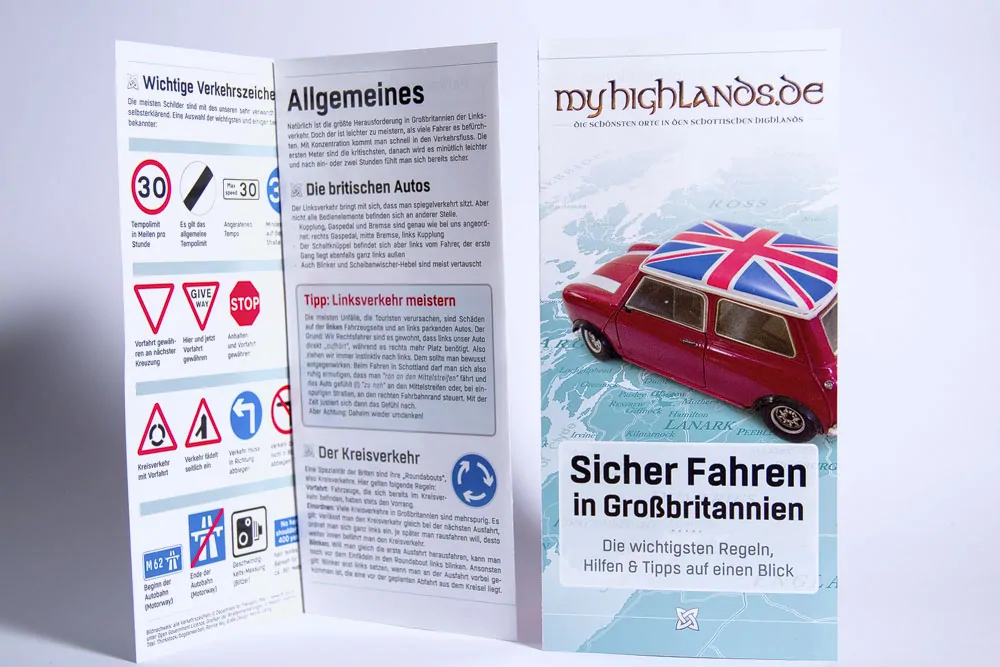
as a printed, high-quality flyer (currently only available in German)
The most common question: do you get used to driving on the left in Scotland quickly? The simple answer: yes, don’t worry. Just get in the rental car and take a look around first:
- Clutch, accelerator and brake are arranged exactly as at home
- The gear stick is to the driver’s left, with first gear on the outer left
- The indicator and wiper stalks are usually swapped too
- The speedometer shows speed in miles per hour (mph);
rule of thumb: mph x 1.6 = km/h
For me it took about 10 minutes to get more or less used to it, and after that it was fine. Still, you should stay focused at all times. It just happens now and then that you switch on the wipers instead of indicating, or grab the wrong gear.
Travelling with an automatic gearbox is even more pleasant – but also more expensive. Gear-shifting mistakes barely occur then, and you only need to move the lever for parking, driving or reverse.
When driving, always remember: unlike at home, there are no left-turn lanes but right-turn lanes.
Another tip from our fans on Facebook (currently only available in German): it helps to stick an arrow with the note “Drive on the left” onto the steering wheel. I sell these in the shop (currently only available in German).
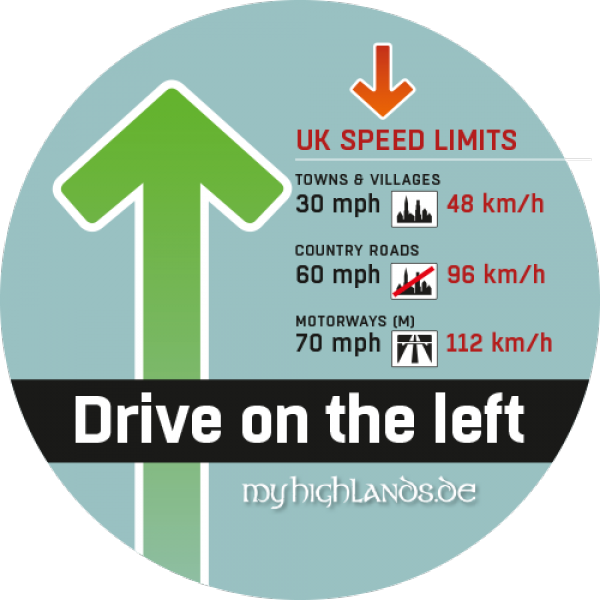
most important speed rules in Great Britain –
the sticker is available here (currently only available in German)
Accident cause no. 1: driving too far to the left
Most accidents caused by tourists involve damage to the left side of the vehicle and to cars parked on the left. We’re used to the car ending on our left, while we need more room on the right. So we instinctively drift to the left. You should counteract this.
When driving in Scotland, I always encourage myself with the words “get up to the centre line” and actually pull the car what feels “too close” to the centre line, or – on single-track roads – to the right edge of the road. Usually that’s then exactly right.
Incidentally, this also spares the nerves of your passenger, who’s the one who suffers if you drive too far to the left – usually by bumping over a pot-holed verge on their side.
Minimum age: when driving is allowed in Great Britain
A common question: how old do you have to be at minimum to drive in Great Britain? Answer: it depends! British road traffic law says you can obtain a provisional licence at 17, but must then always be accompanied by a driver over the age of 21. However, this only applies to residents there.
The good news: the European driving licence remains valid even after Brexit (source here). This means: a licence obtained here is also fully valid over there for vehicles up to 3.5 tonnes, even if the driver is only 18 years old. But careful: this applies to tourists. Anyone planning to settle on the island must obtain a British licence after 12 months.
Renting a vehicle, on the other hand, isn’t quite as simple. Europcar, for example, requires a driver who is at least 19 years old and has held their licence for at least twelve months, for the lowest vehicle class. Usually the driver must be at least 21 years old. For higher vehicle classes, the age requirement rises to as much as 25.
Documents: the papers you need to carry
If you’re only travelling with a rental car, the following are enough:
- ID card or passport
- a valid European driving licence
As long as you took your driving test within the European Union, obtained your licence in the EU, and it hasn’t been declared invalid for any reason, everything’s fine.
If you’re arriving with your own car, you should additionally bring along:
- European accident report form (available as a PDF from ADAC)
- your insurance’s assistance/breakdown cover certificate
- vehicle registration document (but don’t leave it in the car!)
- international motor insurance card (Green Card)
The “Green Card” isn’t mandatory, but can speed up claims handling if problems arise. More information on this is available from the German Green Card Bureau.
Of course, you must have third-party motor insurance. According to the ADAC, the vehicle’s number plate itself serves as proof of insurance in Great Britain too.
Speed limits: different road types and their limits
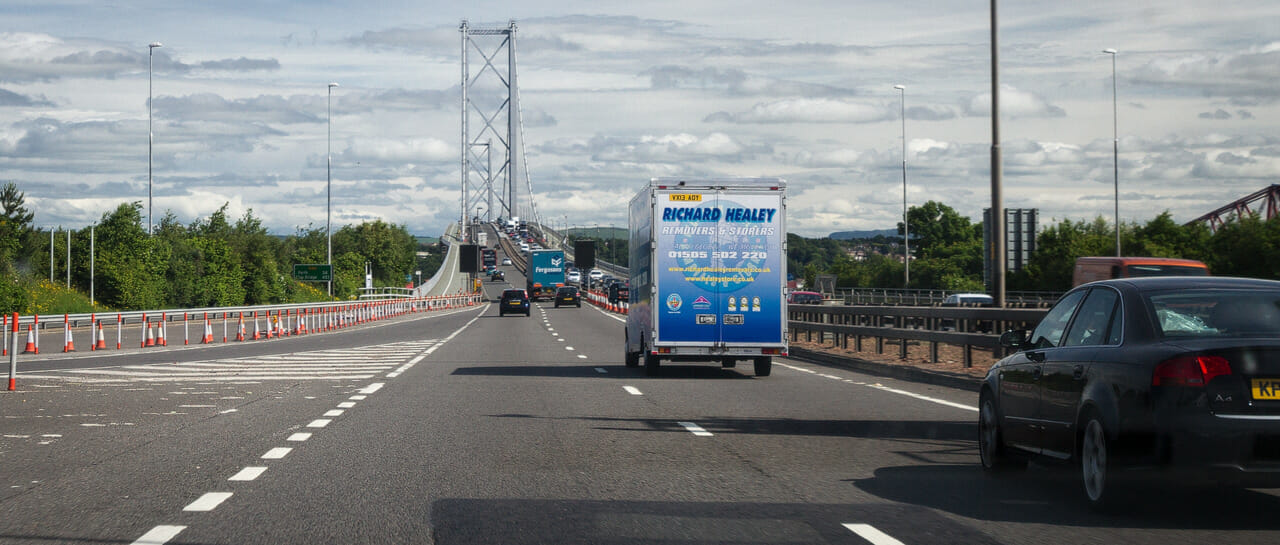
Motorways in Scotland are called – well, motorways. There aren’t many in Scotland, and none at all in the Highlands. But if you want to thunder along the M8 from Edinburgh to Glasgow, you’re allowed to do so at 70 mph.
There are more trunk roads, though, marked with the letter A, for example the A9 to Inverness.
In principle, the British distinguish their roads – and therefore also the speed zones – as follows:
- Built up areas: roads through towns, or roads that have street lighting.
- Single carriageway: any road with no separation between opposing lanes.
- Dual carriageway: roads with two lanes separated in the middle by a barrier, for example a crash barrier. This type of road can still have junctions, though.
- Motorway: equivalent to our motorways at home. A road with a barrier (e.g. a crash barrier) down the middle that cannot be crossed. Acceleration lanes are provided for joining.
The following speed limits apply in these zones:
| Built-up areas | Outside towns | Motorways | ||
|---|---|---|---|---|
| Single carriage way | Dual carriage ways | |||
| Road sign | ||||
 |  | |  | |
| Vehicle type | MPH | MPH | MPH | MPH |
| Cars and motorcycles or vans up to 2t load | 30mph/48kmh | 60mph/96kmh | 70mph/112kmh | 70mph/112kmh |
| Cars with caravan or motorhomes | 30mph/48kmh | 50mph/80kmh | 60mph/96kmh | 60mph/96kmh |
| Buses up to 12m | 30mph/48kmh | 50mph/80kmh | 60mph/96kmh | 70mph/112kmh |
| Lorries <7.5t | 30mph/48kmh | 50mph/80kmh | 60mph/96kmh | 70mph/112kmh (unless stated otherwise) |
| Lorries >7.5t | 30mph/48kmh | 40mph/64kmh | 50mph/80kmh | 60mph/96kmh |
Roundabout: how to behave in a British roundabout
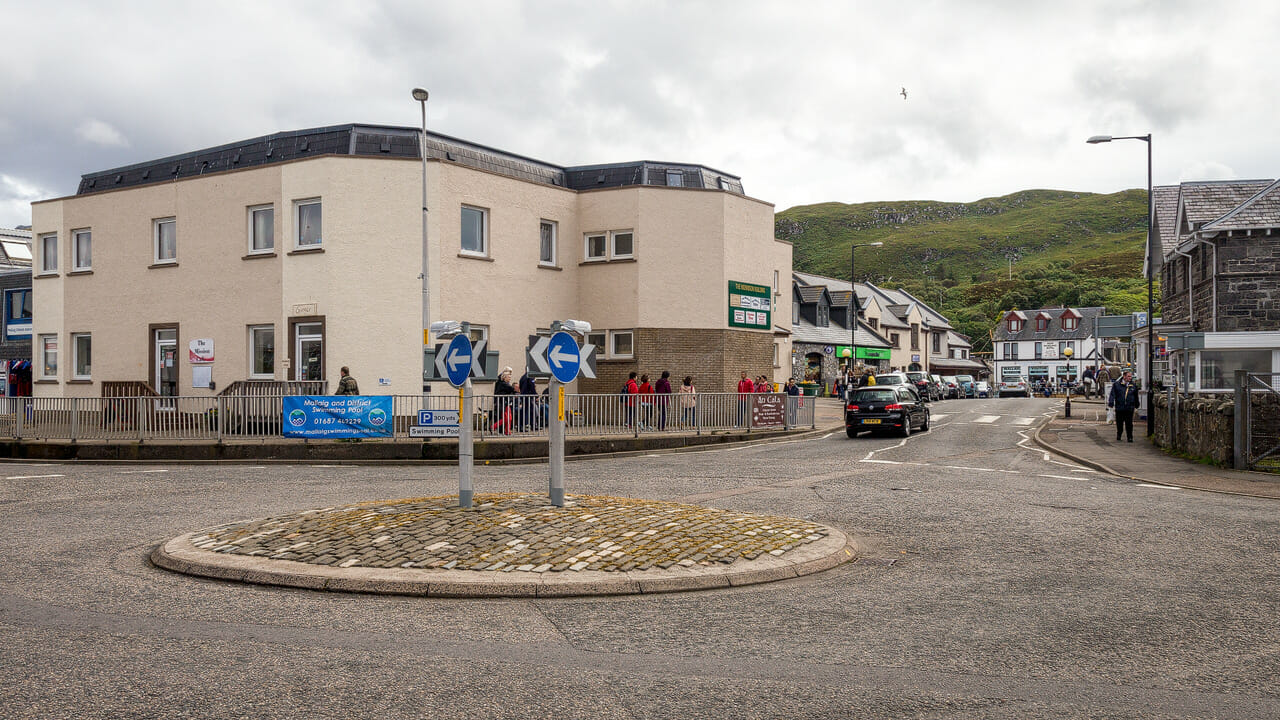
Roundabouts are even more popular in Great Britain than in Germany. Keep the following points in mind:
Direction of travel: In British and Scottish roundabouts, traffic flows clockwise, unlike in Germany. If you want to join, cars in the roundabout come from your right and travel to the left.
Right of way: Cars already in the roundabout always have priority.
Lane positioning: Many roundabouts in Great Britain have multiple lanes. The rule: if you’re leaving at the very next exit, get into the left lane straight away. The further round you want to go, the more you should position yourself to the right before entering. You then drive on the inner lane and (carefully!) move back to the outer lane shortly before your exit. In short: the later you plan to exit, the further inside the roundabout you should stay.
The reasoning behind this rule is that it causes less obstruction for drivers turning directly left.
Indicating: If you want to take the very first exit on the left, you can already indicate left before joining the roundabout. Otherwise, the rule is: only indicate left once you’ve passed the exit before the one you plan to take.
If you already know in advance that you’ll be leaving the roundabout much further round, you can take the right lane (if available), indicate right, position yourself towards the inside of the roundabout, and then indicate left as your desired exit approaches.
There’s an English explanation with nice illustrations here.
Single track roads and passing places: travelling on narrow roads
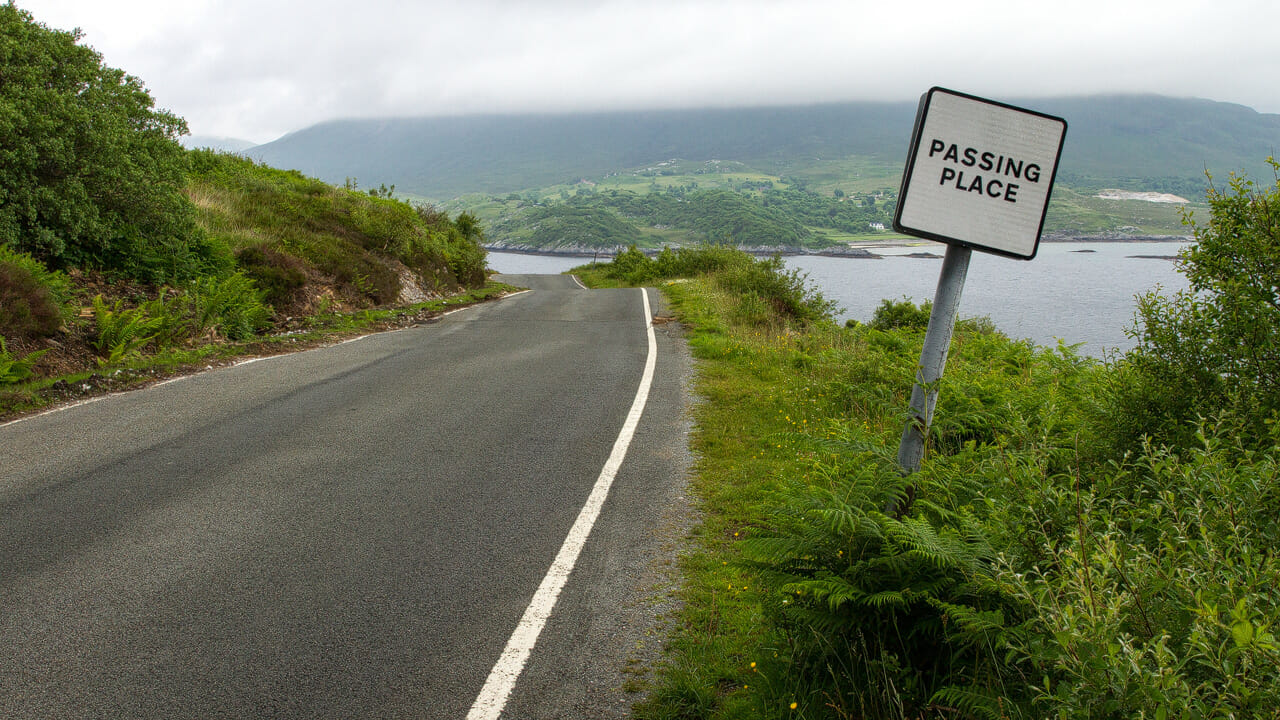
In the Highlands, the most beautiful roads are often so-called “single track roads” – roads that only have room for one car at a time. So that oncoming traffic can still get past, there are passing bays – the “passing places”. These are usually marked from afar by a post.
The rule here: the vehicle on whose left the bay is located pulls into it. If the bay is instead on the right of the car, you drive up to it and let oncoming traffic pull into the bay.
If you see a car in the distance (which is usually the case), you should be fair and wait at the next bay already. A friendly mutual wave of thanks is good manners.
By the way, passing places aren’t just for oncoming traffic. Slower vehicles should let faster ones pass here too. Especially as a tourist ambling comfortably through the landscape, you should let locals who are in a hurry overtake here – you never know, it might be the local doctor on the way to an emergency …
Low emission zones: Low Emission Zones (LEZ)
We’re already familiar with the green stickers for cars from German cities, allowing us to drive into certain low emission zones. These restrictions on certain vehicles are meant to better protect areas from particulate matter and other exhaust emissions.
Low emission zones have also been introduced in Scotland, as “Low Emission Zones” – LEZ for short. They were introduced in 2022 in Aberdeen, Dundee, Edinburgh and Glasgow.
The confirmed minimum criteria for vehicles allowed to enter a low emission zone are:
- Euro 4 for petrol cars and small vans (generally vehicles registered from 2006*)
- Euro 6 for diesel cars and vans (generally vehicles registered from September 2015*)
- Euro VI for buses and lorries (generally vehicles registered from January 2013*)
*These figures are only guidelines – check your vehicle’s manual or ask the manufacturer to be sure
If you’re arriving with your own car, you should also bear in mind the area around London and other major British cities.
Ignoring the rules leads to drastic fines.
Living obstacles: sheep and Highland cattle
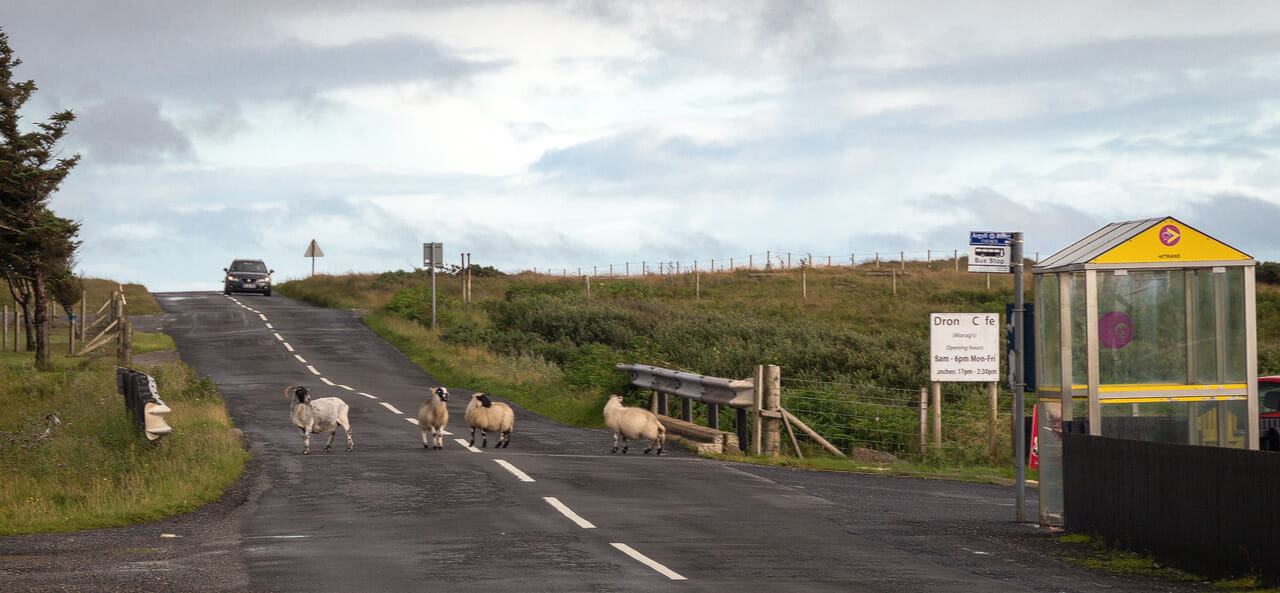
Almost everywhere along the roads, we encounter sheep and sometimes also the massive Highland cattle.
Sheep usually notice a car coming and jump aside quickly. They tend to be quite timid. So no problem, as long as you drive slowly when you see the sheep warning sign and generally stay a bit alert.
It gets trickier with the cattle. With their long horns, they even look threatening to drivers. And they’re aware of the effect, often standing stoically on the road, chewing away. Honking doesn’t help here.
Best to try to pass carefully and slowly – or simply wait. (If anyone knows a better solution, let me know at stephan@myhighlands.de)
Other important rules: right of way, seatbelts and more in Great Britain
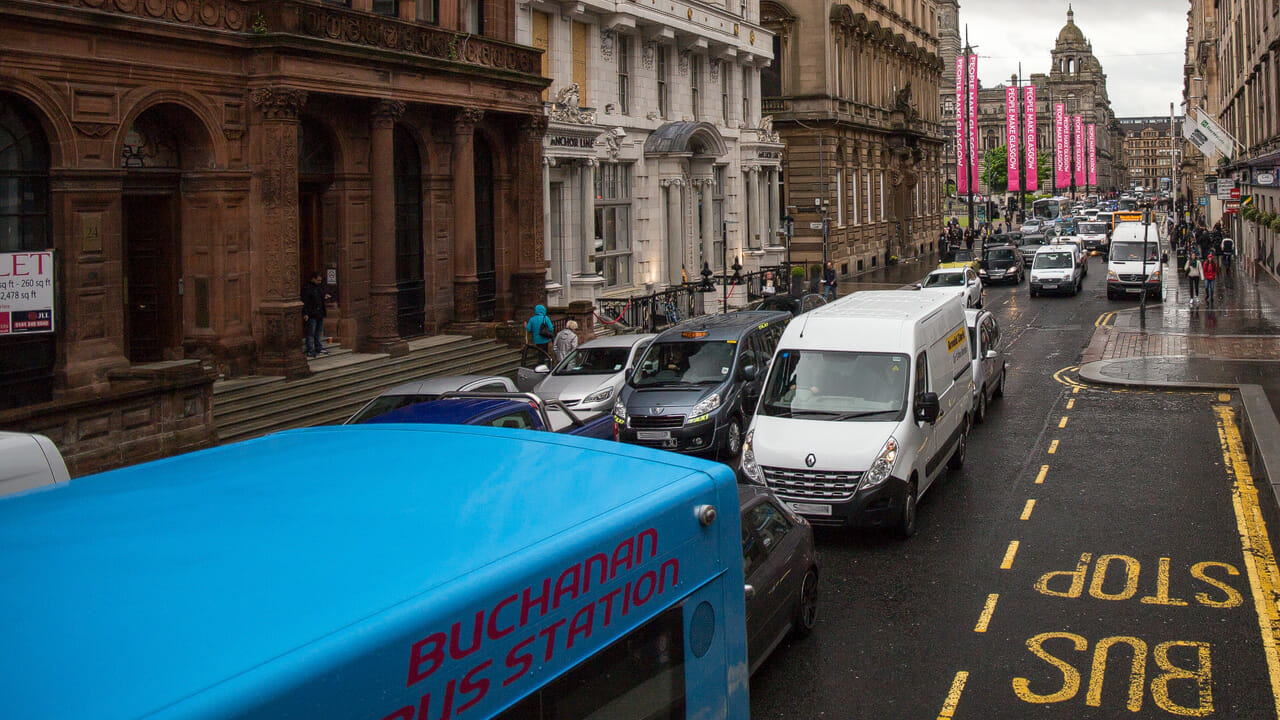
Right of way: There’s no dedicated “priority to the right” rule as we have at home. Priority is mostly regulated by white lines and give-way triangles painted on the road.
Seatbelts: Every occupant must be belted in. Getting caught without one costs 60 pounds. For classic cars that were originally (!) built without seatbelts, the rule doesn’t apply. Children must then sit in the back seat, though. Children under three years of age aren’t allowed to travel in such cars at all.
Alcohol: Since the end of 2014, Scotland has had a limit of 0.5 per mille blood alcohol (as in Germany). Before that, the limit was 0.8 per mille. Anyone caught over the limit at a checkpoint can face a fine of up to 5,175 pounds, lose their licence, or even go to prison.
Other parts of Great Britain have higher limits: there, 0.8 per mille is allowed.
Phone calls and texting: In principle, no driver may make phone calls while driving unless using a hands-free system. So if you want to use your phone normally, or even type a text message, pull over at a suitable spot to do so.
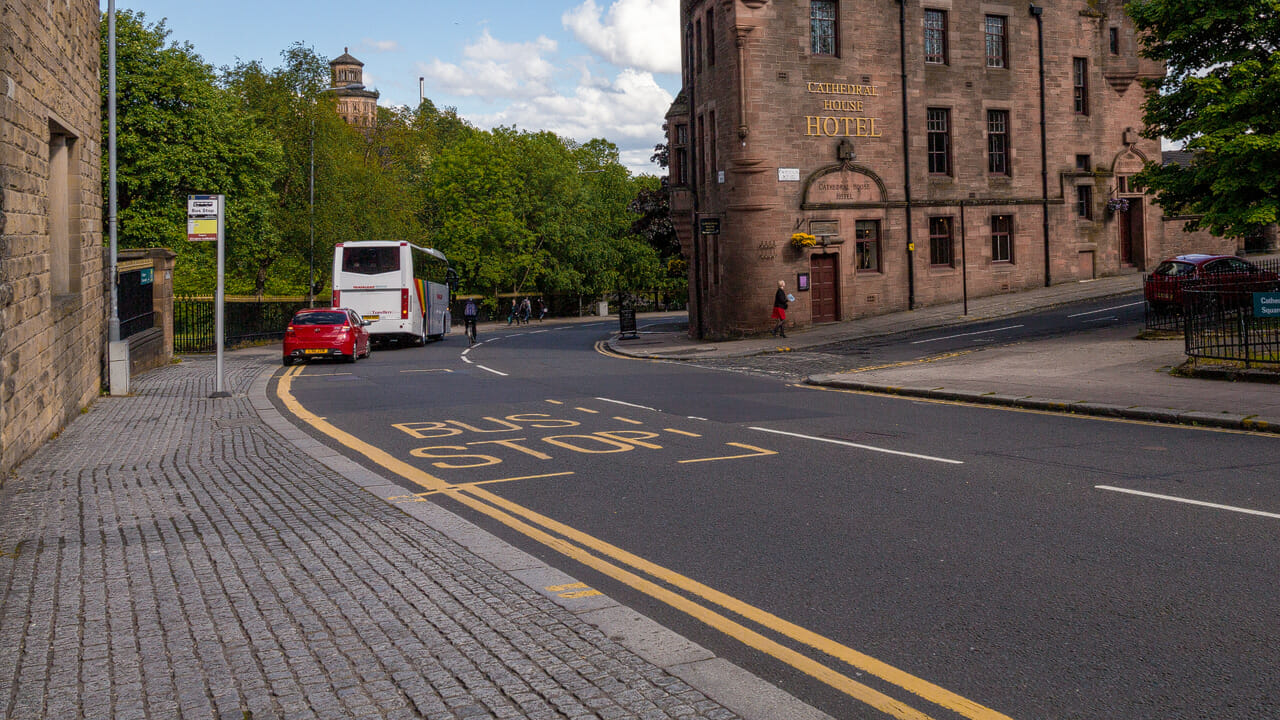
Road markings: A whole topic in itself, as they are very elaborate in Scotland and England. This PDF explains it in detail, in English. In short:
- yellow lines indicate a parking ban
- red lines mark a stopping ban
- white lines are stop, give-way or boundary lines
One last thing: we Germans are unfortunately often opinionated and aggressive drivers. In the Highlands, the clock ticks differently. Stay friendly, drive calmly and attentively – then you can really enjoy your journey through the Highlands.
Taping headlights for Great Britain: worthwhile for your own car
A clear answer to the question of whether the headlights of your own car, brought from the continent, need to be taped over with film for a trip to Great Britain, is genuinely hard to find.
Background: many cars’ dipped beam is asymmetrical. In Germany, for example, the right side of the road is lit up more, while the light is dimmed more towards the centre. This is meant to avoid dazzling oncoming traffic. In Great Britain it would then be exactly the other way round, dazzling drivers on the other side.
I found the following information on the topic:
- English Wikipedia says here that it’s necessary to do so; German Wikipedia says so here
- Some modern cars have a travel mode that lets you switch from LHD (Left Hand Drive) to RHD (Right Hand Drive)
You can also buy the stickers on the ferries to Great Britain. However, applying them isn’t entirely easy depending on the model, and the stickers on the ferry are also a bit more expensive. So it’s worth buying the stickers at home beforehand and familiarising yourself with how to apply them to your own car’s headlights in advance – the actual application then happens only on the ferry, or shortly after.
The company Eurolite has posted an extensive tutorial on YouTube about their headlight stickers – in English, aimed at drivers from England travelling to the continent. It should still be applicable to German cars, though.
Sat-nav devices: entering addresses correctly in the Highlands
Sat-nav devices are a real help when travelling through Great Britain, and Scotland in particular: the driver can concentrate on driving while the passenger enjoys the scenery.
Most car rental companies offer sat-navs for a daily surcharge. But honestly: given the extra charges, buying your own device is worthwhile.
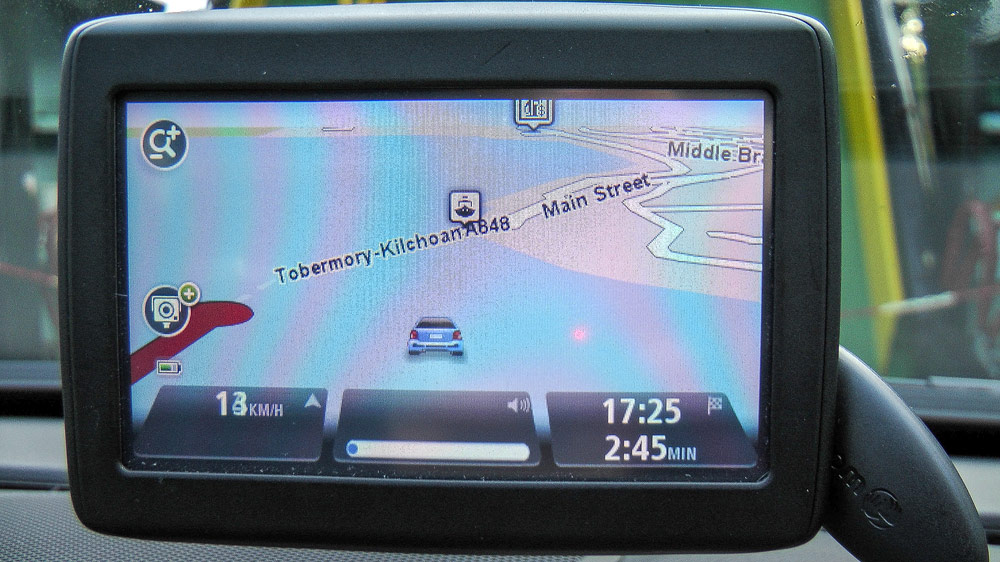
Of course, you can also bring a sat-nav from home. That’s fine in itself, as long as you keep two small things in mind:
1. Some sat-navs send you into a roundabout the wrong way on the map. Don’t worry, it’s almost impossible to enter incorrectly. And if it does happen, you notice very quickly.
2. Watch out for ferries. The sat-nav suggests the shortest route and also asks whether it may include ferries in the calculation. I ran into this trap when driving to Islay. Of course I took a ferry for that. What I didn’t think about: the sat-nav calculated the shortest route, which in turn involved two further ferry connections between Edinburgh and Islay. The crux of the matter: the sat-nav naturally doesn’t know their departure times and acts as if you had an immediate connection there. And so this route got us into trouble, as we nearly missed the third, crucial ferry to Islay. So always double-check the suggested route!
Entering the address is often confusing for us, though. The trick: for most sat-nav devices, the postcode is enough, since it already defines the address quite precisely. For example, IV7 8LS stands for the “Inverness” area (almost the entire Highlands area uses IV), district seven. The second part then refers to the corresponding post office and a street area. (This also works in Google Maps, by the way.)
Owners of a TomTom device may run into difficulties here, as they can’t enter the full address. This is a recurring issue.
My tip: Bring your own sat-nav and enter the most important places as favourites already at home. Then, on holiday, you just call them up. Because not every small place can be found immediately by address. That can be a bit tricky. So: it’s best to look up remote bed & breakfasts or route points beforehand from the comfort of your sofa – that already builds my anticipation for the trip.
