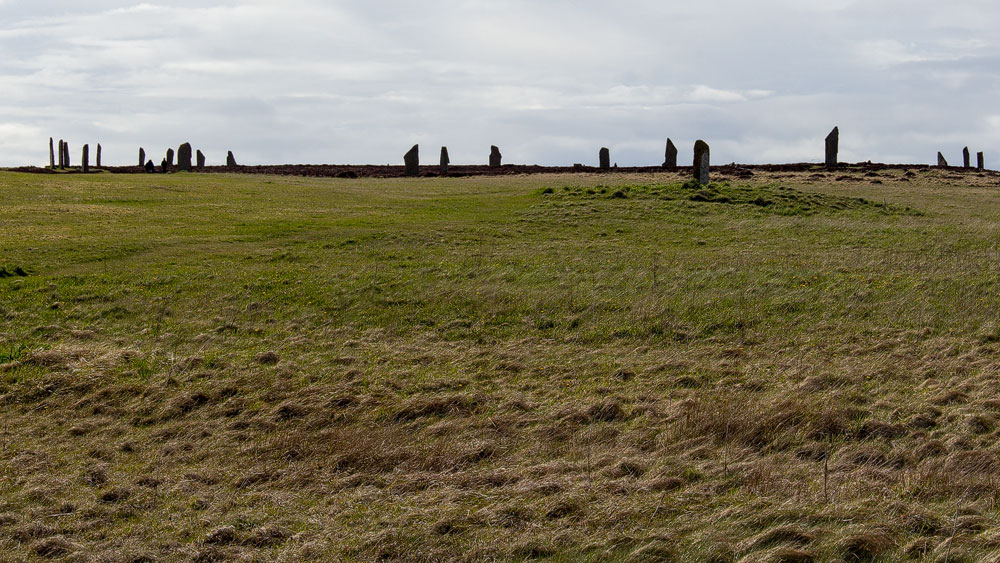
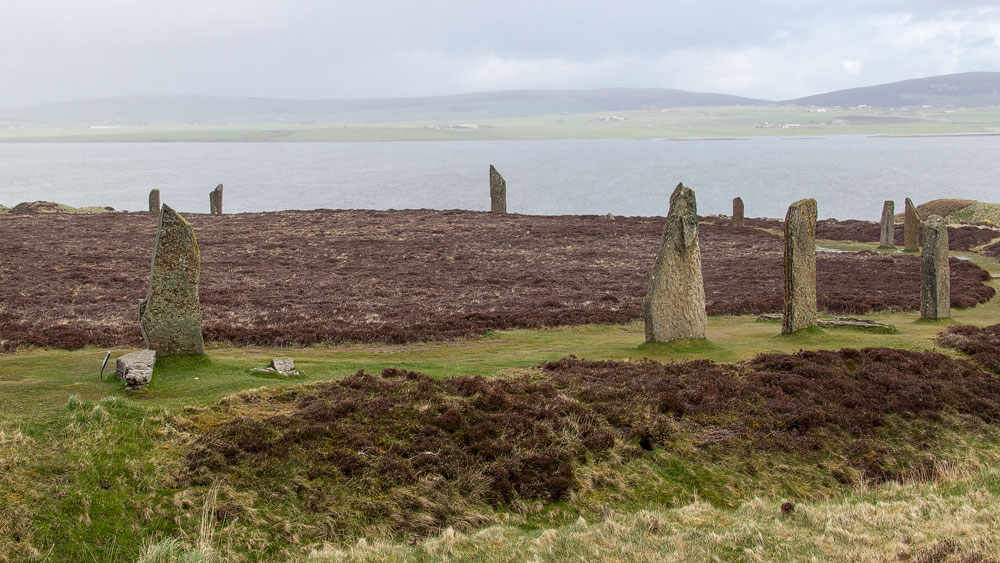
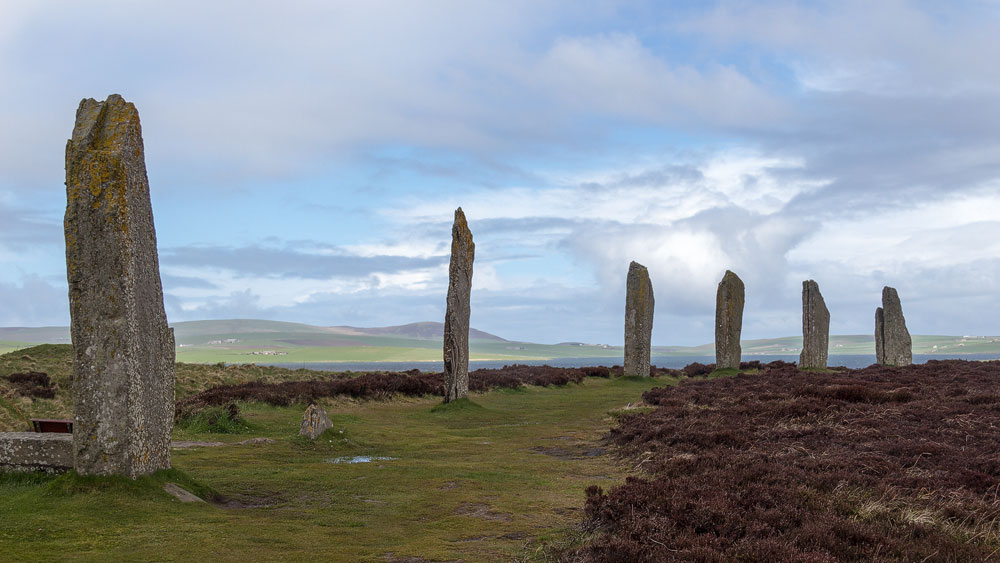
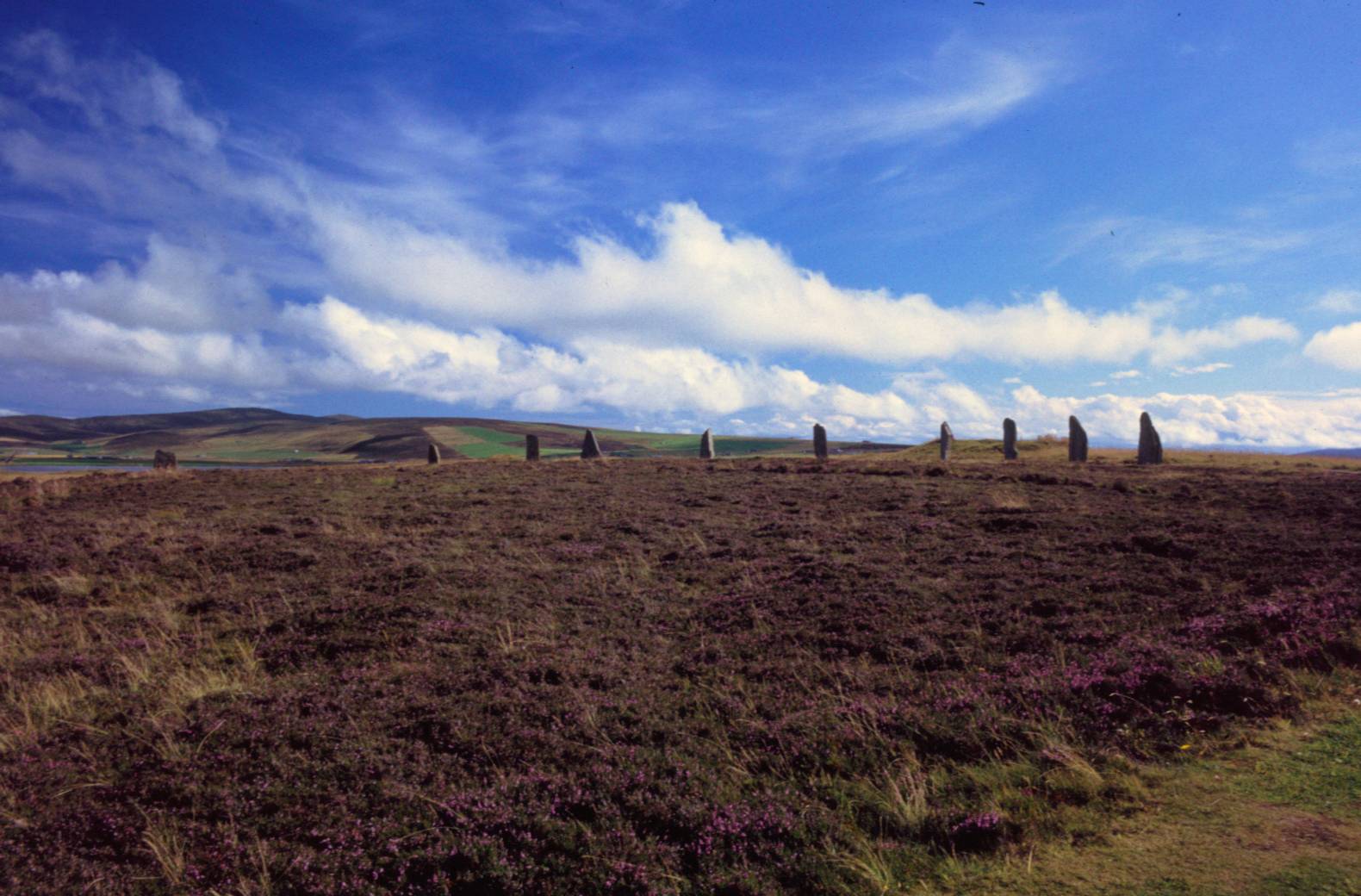
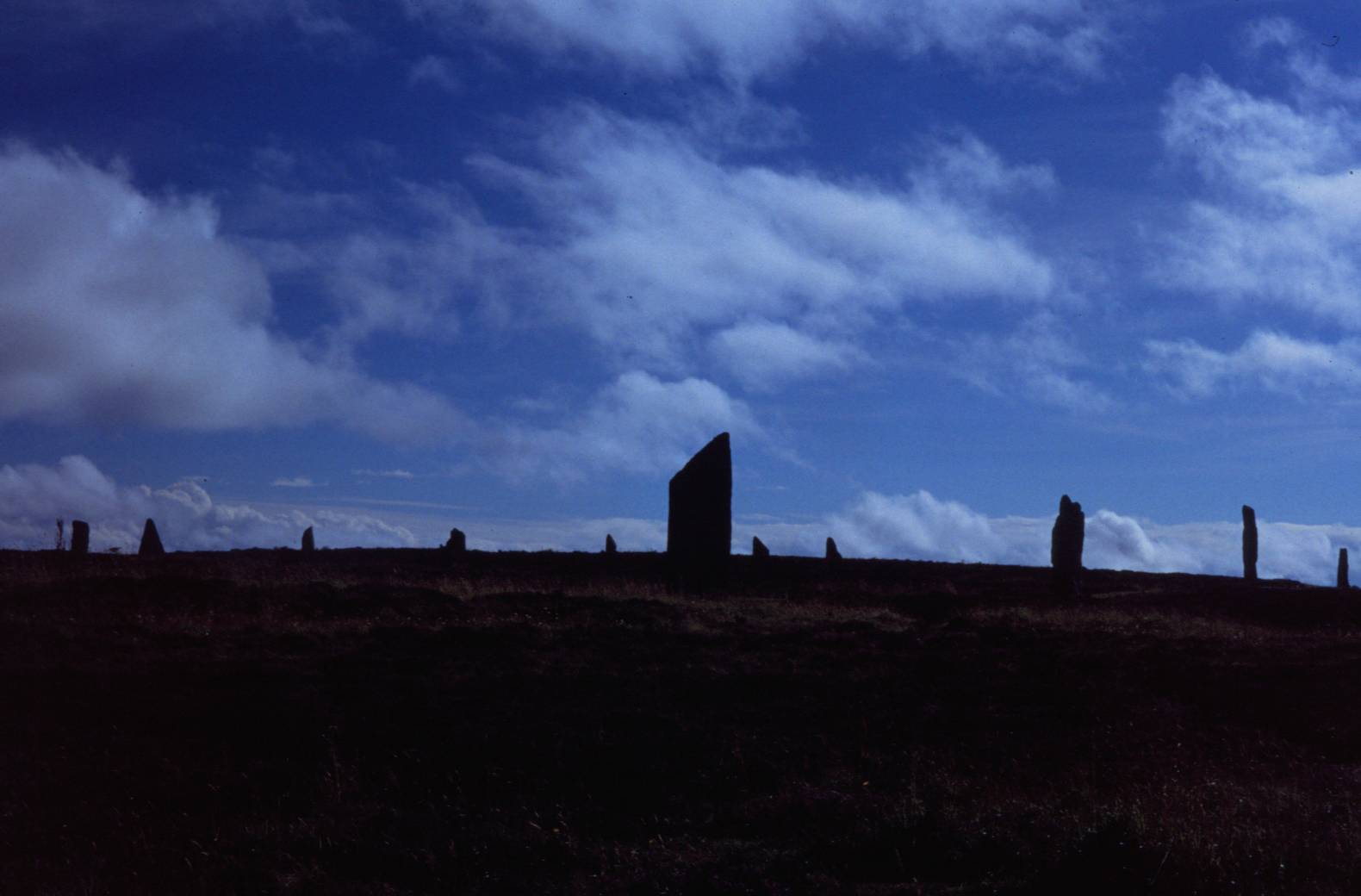
Brooding clouds, heather and enormous stones – when the weather cooperates, the mysterious Highland atmosphere of the Ring of Brodgar draws visitors right in.
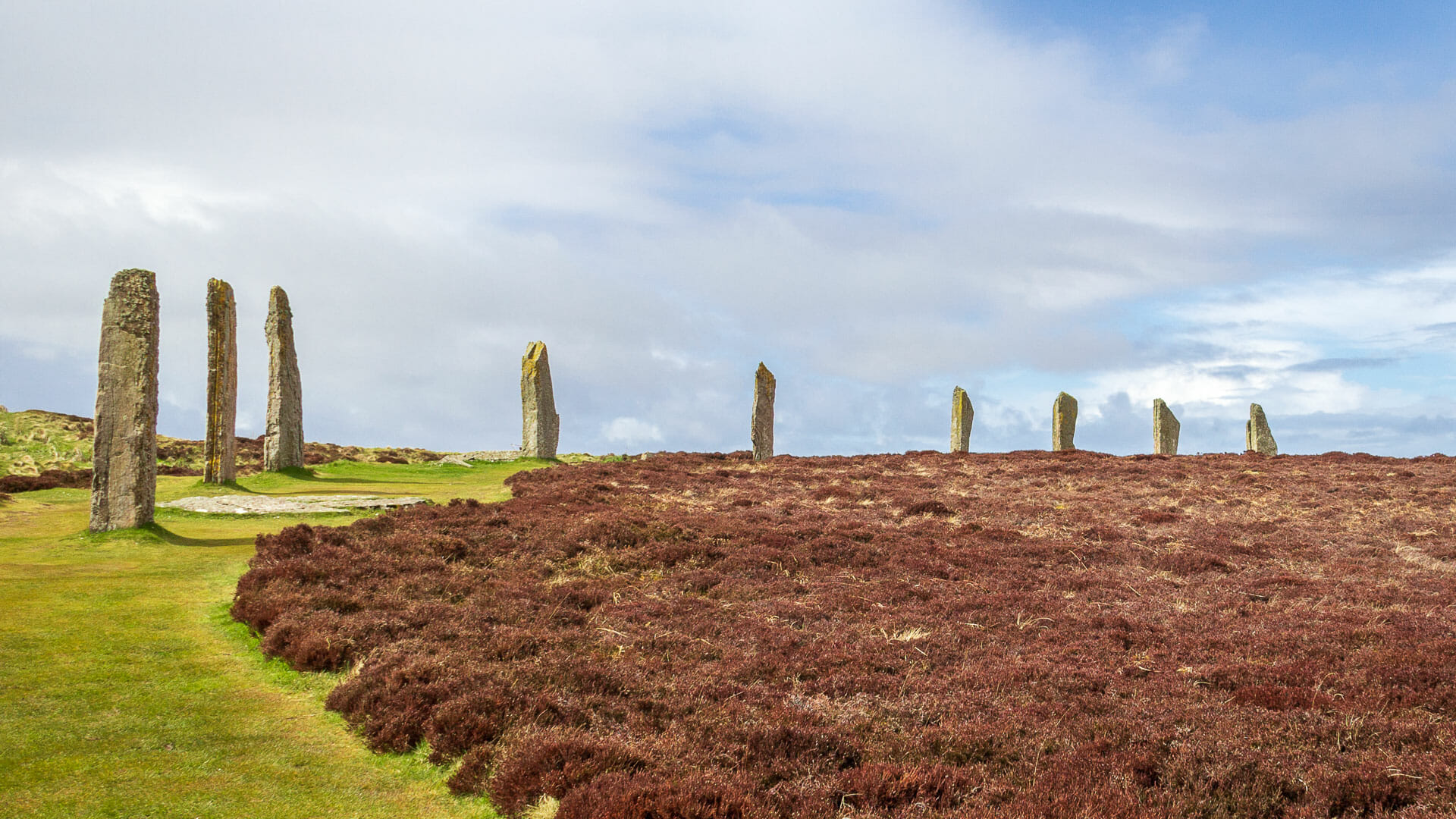
Nothing shelters you here: no shade softens the sun, no canopy of leaves catches the rain, no mountain slows the wind. Here there is only the raw elements. Utterly exposed like this, the stones of the Ring of Brodgar have stood for thousands of years, defying the forces of nature.
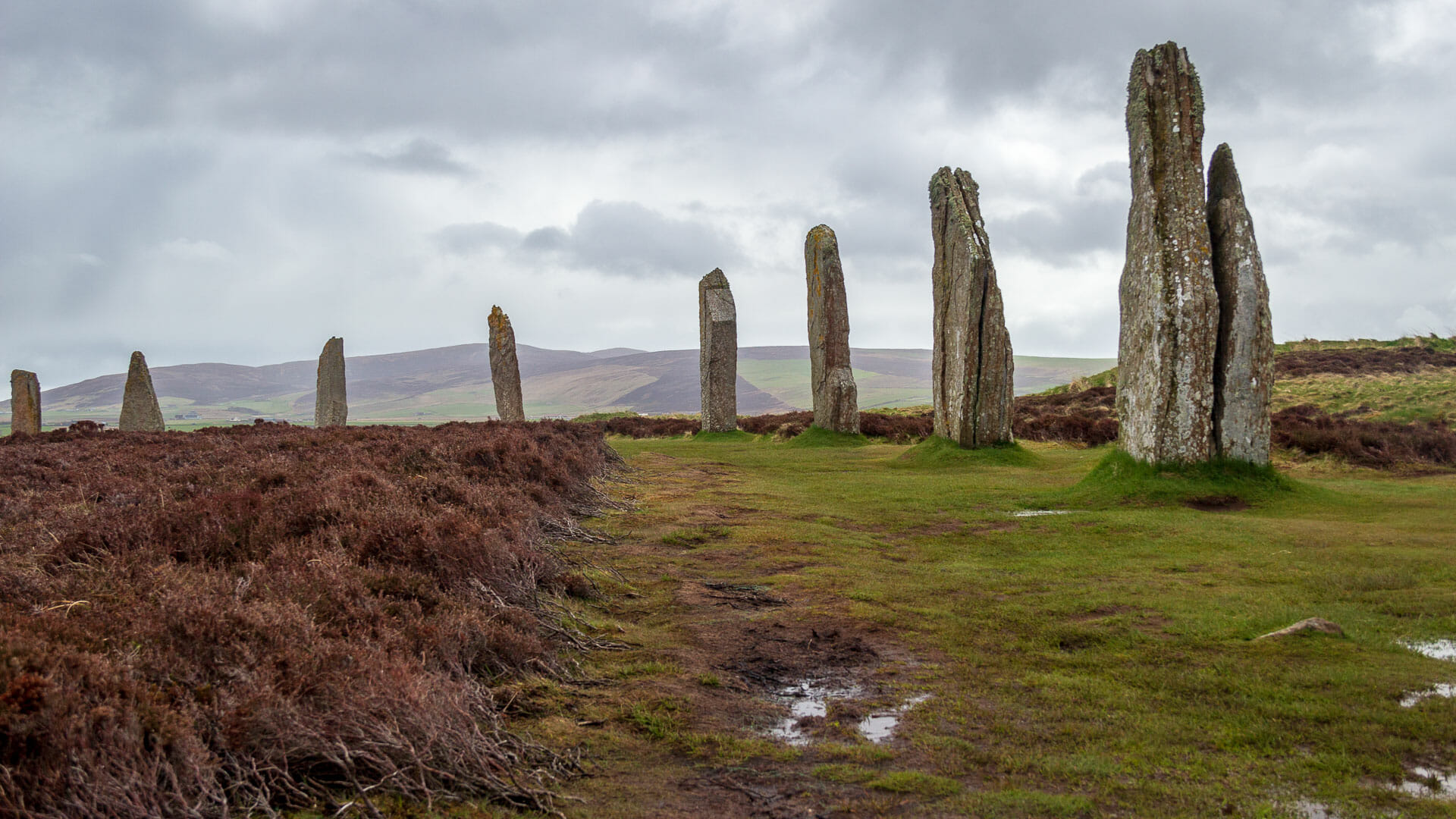
Of course, time has left its mark. Moss grows on the flanks of the monoliths, the surface is weathered, and lightning has split one of the stones. Yet they still stand upright, forming a gigantic circle. The centre of the site is carpeted in heather – when it’s in bloom, it lends the Ring of Brodgar an almost elfin magic.
Look around and you take in large stretches of Orkney’s Mainland, with its gentle hills and the glittering Loch of Stenness and Loch of Harray framing the headland on which the stone circle stands.
If you’re granted a quiet moment here, and let yourself sink into it, you can feel the venerable beauty and mysterious atmosphere of the Ring of Brodgar.
Did you know: the age, layout and purpose of the Ring of Brodgar
At a maximum age of 4,700 years, the Ring of Brodgar is a comparatively young stone circle – at least compared to its neighbour, the Standing Stones of Stenness, which are around 300 years older still. Since no extensive excavations have taken place, scientists can only estimate its age: it’s thought to have been built somewhere between 3000 and 2500 BC.
Its scale, however, is impressive: there were once more than 60, perhaps even more than 70 stones in total, and the circle’s diameter of 104 metres is considerable (there are only two larger stone circles in Britain: Avebury at 420 metres and Stanton Drew at 113 metres). Today, 27 stones remain standing, most of them around two metres tall – though one reaches almost five metres in height.
Scientists have also calculated that construction required around 80,000 hours of labour, moving a combined weight of some 12,000 tonnes – all without machinery, of course.
Equally remarkable: the stones differ from one another in colour, texture and shape. Since almost nothing about the stone circle was left to chance, this too appears to have been deliberate on the part of its builders. That also implies there were probably seven different quarries the stones were gathered from – though this may well have continued over several centuries.
It’s now even considered likely that several different groups were involved in the construction over generations – and that they were competing with one another. So it was arguably less about building something for eternity, and more about the social standing of the builders at the time.
The circle itself, incidentally, is considered one of the most precisely constructed stone circles anywhere. Despite its size, it’s not only almost perfectly circular, but the stones were also set at nearly equal intervals.
Amid all the talk of stones, the ditch surrounding the monument deserves a mention too. Ten metres wide and four metres deep, it offered access into the sanctuary’s interior at only a few points. The sheer volume of earth and rock moved to create it was enormous!
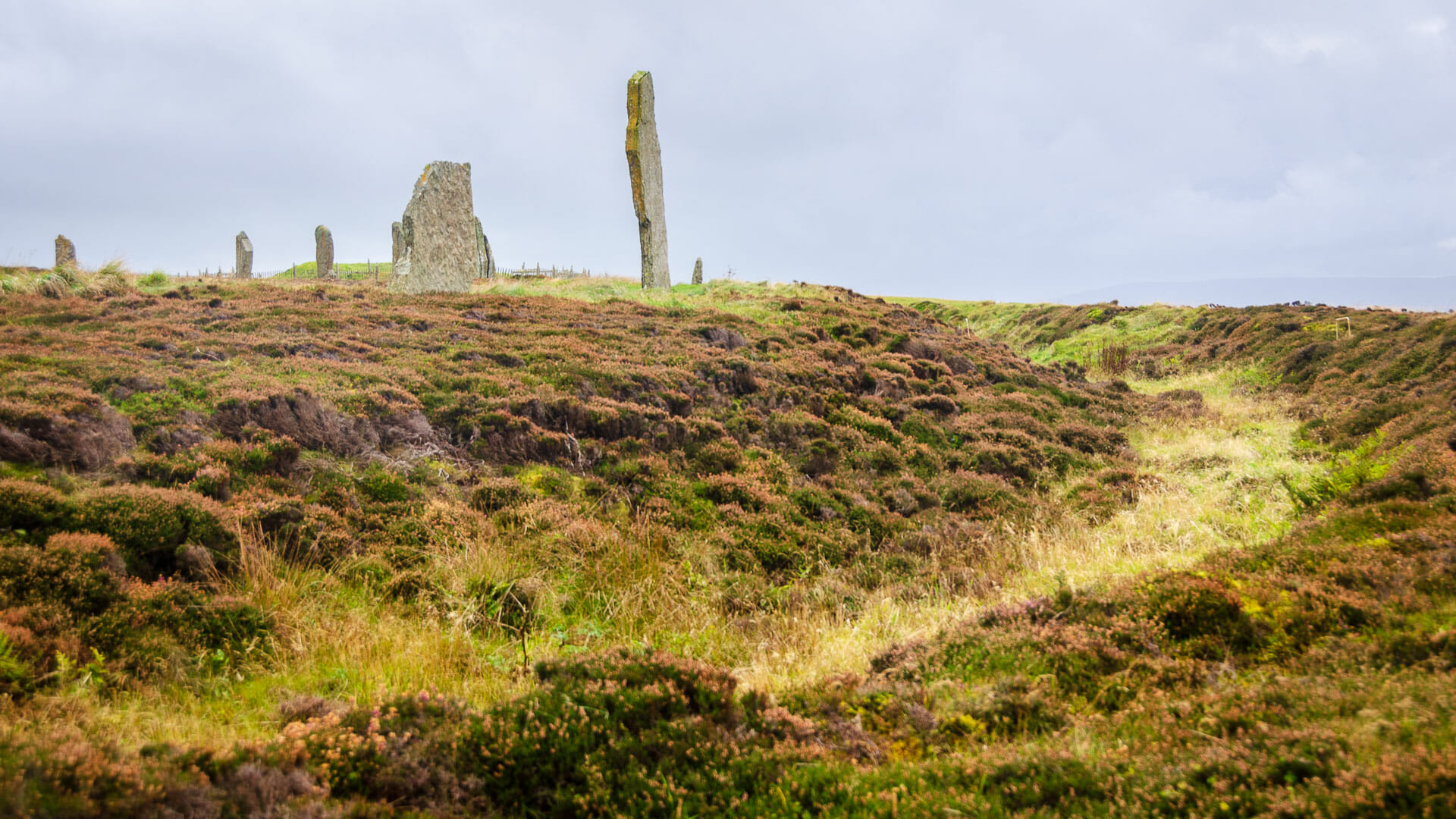
During the Neolithic period, the Ring of Brodgar is thought to have held space for up to 3,000 people or more, gathering to take part in rites we know nothing about today.
The Ring of Brodgar naturally belongs within the wider context of the so-called “isthmus” of the Ness of Brodgar – a true Eldorado for archaeologists, who continue to uncover further wonders and knowledge about Neolithic life here, piece by piece.
Tip: more Neolithic sites on Orkney
The Ring of Brodgar is part of Orkney’s Neolithic heritage – and the youngest of the group. Three further witnesses to this era stand nearby. Just a few hundred metres away lie the Standing Stones of Stenness; a few kilometres further on stands the chambered cairn Maes Howe; and finally, on the west coast, the Stone Age village of Skara Brae. All of this can easily be combined into a lovely day trip.
Personal note: a wonderful atmosphere
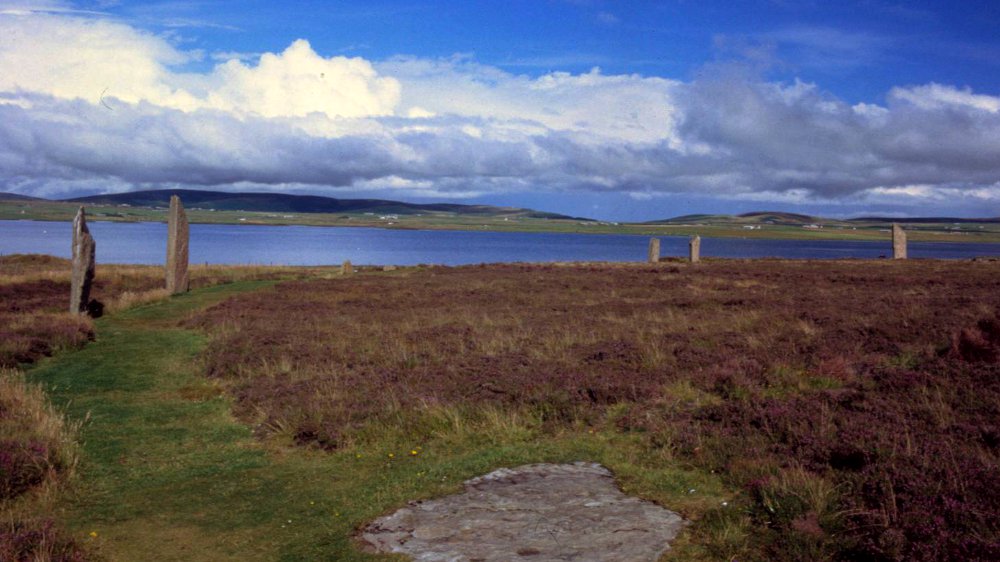
Back in the 1990s, tourism in Scotland wasn’t as developed as it is today. Back then, I could genuinely let the atmosphere of the Ring of Brodgar sink in for a while. Unfortunately, that was then abruptly interrupted by a tour group pouring out of a coach. These days, that quiet moment isn’t possible any more – the stone circle is now fenced off and can only be viewed from designated paths.
Getting there:
By sat nav: “KW16 3JY” will bring you close to Sutherland’s Garage. From there it’s just a short way – simply follow the B9055 and the signposts.
Without sat nav: From Stromness, head towards Kirkwall, then turn left at Stenness towards the Bay of Skaill. You’ll then see the Ring of Brodgar on your left from the road, with a sign pointing to the car park. Driving time is around 15 minutes.
Bus: There’s a scheduled bus service to Stenness, as well as a number of tourist coach tours, which you can ask about at the tourist information office.