Scotland is said to have had up to 3,000 castles – many now just ruins. No two were alike, and over time the castles kept evolving. A look at the history of the castle.
Shock: of all Scotland’s showpiece castles, Eilean Donan Castle is a reconstruction. It was completely rebuilt in the early 20th century.
Many other castles, meanwhile, look today like stately palaces. And others that we think of as typically medieval actually date from the Renaissance. Still others have vanished completely.
So what actually is a typical Scottish castle? Is there an original? And how did castles develop over the centuries?
Here are the answers.
The term “castle”
When we in Germany talk about a “Burg”, we usually mean a stone fortification used during the Middle Ages. The twist: people at the time didn’t call it a Burg at all, but “hûs”, “turn” or “stein” – sometimes also “Veste”.
When we say “Schloss” today, on the other hand, we picture a rather elegantly dressed-up noble residence – something Neuschwanstein-like. But even the word “Schloss” actually carries the idea of being enclosed and defensible. Something was shut in here.
And finally we also know the manor house or estate house. There we picture a large farmstead or a small mansion.
We find all of these buildings in Scotland too. So what are they called in English?
“Castle”.
The common English term simply doesn’t distinguish between all the forms the way we do in German. And so we come across Glengorm Castle – a Baronial-style manor house –, Dunrobin Castle – a veritable fairy-tale palace – and Dunstaffnage Castle – a medieval castle.
Incidentally, it’s similar in Gaelic. There the term is “Caisteal”.
Both terms are rooted in Latin: a Castrum was a large, fortified military camp. The smaller sibling of the Castrum was the Castellum. And “castle” derives from that.
Of course English has further terms too: “fort”, for instance, for later military fortifications. And in Gaelic there’s also the term “Dùn”. Originally used for early forms of fortification, it turns up in an astonishing number of Scottish castle names:
Dunvegan, Dunstaffnage, Duntulm, Dunnottar, Dunollie, Dunrobin …
So, now we know what we call castles – but what actually IS a castle?
Defining a castle
Let’s try a test: if you close your eyes and picture a castle, what does it look like? Stone walls? Battlements? A pointed tower? A drawbridge? None of that is wrong. But it’s not exactly a uniform definition either.
Because the period we call the Middle Ages lasted, roughly speaking, a thousand years – from around 500 to about 1500 AD.
Over that fairly long stretch of time, warfare technology changed and improved constantly. And that means castles kept changing constantly too.
So what, then, is a castle? According to Wikipedia, an “enclosed, habitable defensive structure.” In other words: someone lived there, and you could defend yourself against enemies.
With that in mind, we can look at what in Scottish history fits that definition.
Before the Middle Ages
Let’s start briefly in the Iron Age – roughly the period from 800 BC to 100 AD. Because even then, fortified structures already existed in Scotland.
And we can still see them today: for instance the impressive brochs and the remains of the large, walled forts.
If you want to visit some: great brochs include Dun Carloway on the Isle of Lewis, Dun Troddan and Dun Telve near Glenelg, or Broch of Gurness on Orkney. As for Iron Age forts, you can admire the Caterthuns near Edzell in Angus.
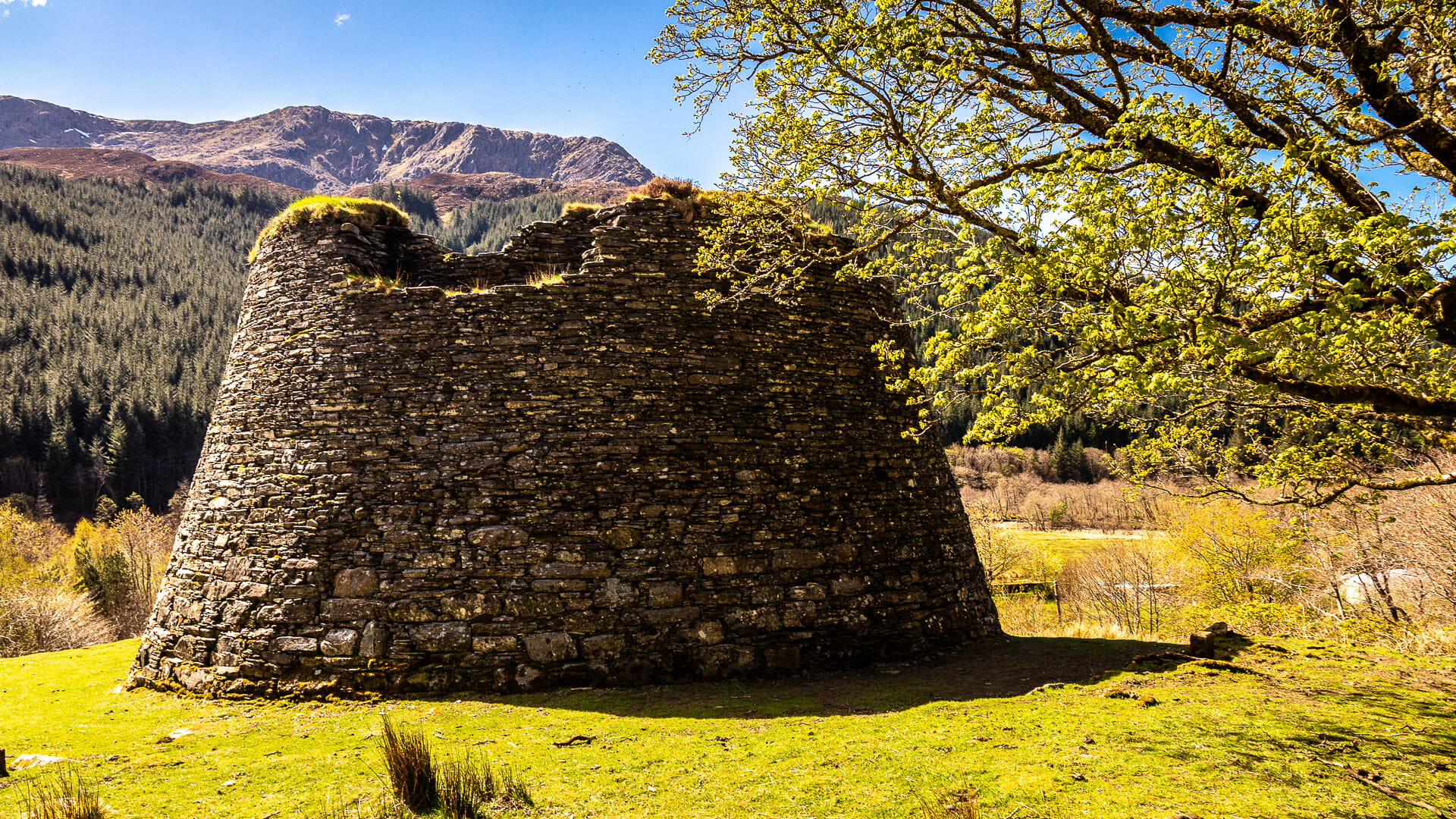
These fortifications were at least partly built in stone, which is why they’ve survived the ages.
I mention these sites because they often cast a long shadow into the Middle Ages too. Some brochs, for instance, continued to be used well into the early Middle Ages. It’s similar with the forts: since the fortifications were usually built in strategically favourable spots, people in the early Middle Ages simply kept using them. They rebuilt and extended them. Researchers call these “multi-phase forts”.
The early Middle Ages
We arrive at the early Middle Ages – roughly around 600 AD. In Scotland, small kingdoms are just forming: in the east and north the Picts, in the south the Britons of Alt Clut, and in the west the Gaelic kingdom of Dalriada.
These small Scottish kingdoms were controlled from fortified centres of power. And these centres could already fit the definition of a castle, because they were defensible and permanently inhabited.
Dalriada’s centre of power is Dunadd. Let’s take a quick look at it:
Dunadd sits on a large cone-shaped rock, a volcanic plug. At the time it was presumably surrounded by marshland, making it hard to reach on foot.
But even once you’d made it to the foot of the rock, you still had to walk up a sunken path toward a gate set between two tall rocks. Already here, defenders above could hurl stones or spears down at anyone they spotted as an enemy.
The area at the foot of the hill was already protected by a thick stone wall, three metres thick and four metres high. Wooden palisades were probably added on top of that.
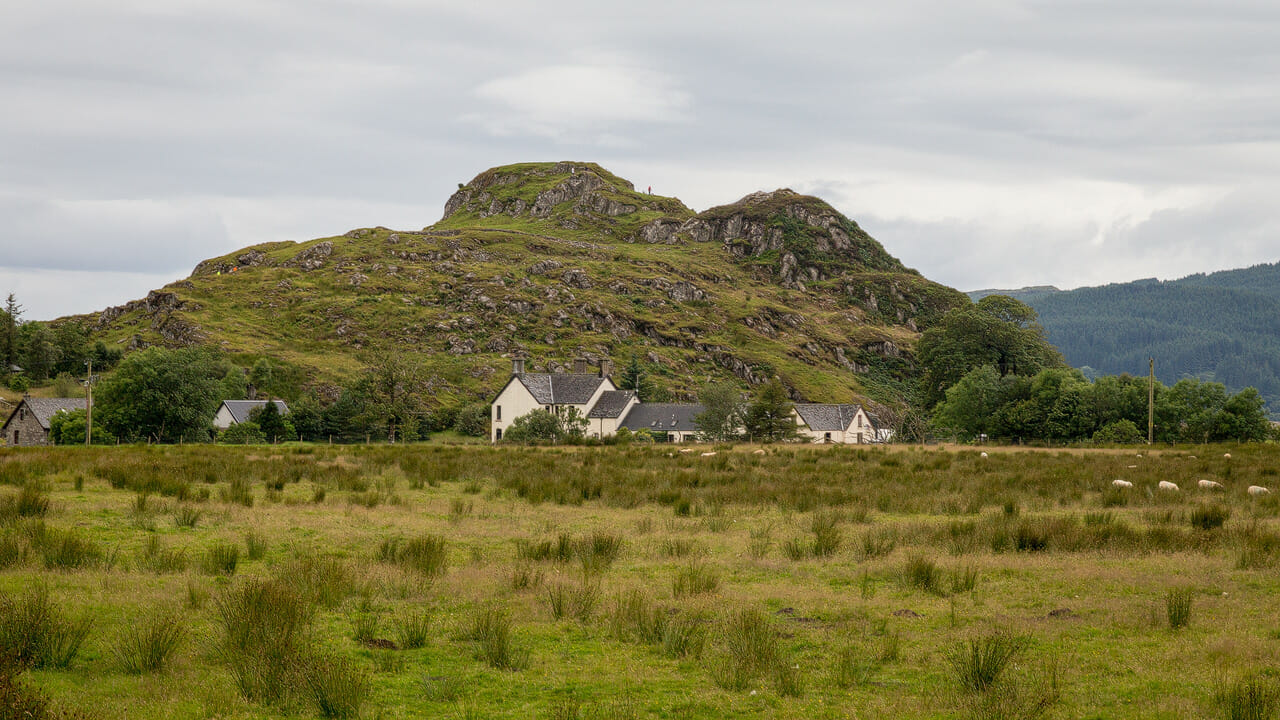
Entering the fortification, you’d find yourself in a first courtyard, which also contained dwellings and workshops. A little further up the slope lies another courtyard – again surrounded by a wall.
One level further up still lies another walled enclosure. Inside it, for example, sits the ceremonial inauguration stone. Finally, at the very top of the summit, stands the citadel – a final stone bastion. From here the rulers governed Dalriada.
So Dunadd really was a well-secured centre of power.
And the great thing is: you can still visit it today, even if the fortifications themselves can now only be glimpsed.
Let’s briefly look at the other kingdoms too, the Picts and the Britons. Their fortifications are built in a very similar way.
Alt Clut, for instance – later Strathclyde – had its seat on Dumbarton Rock, which juts into the mouth of the River Clyde, not far from present-day Glasgow.

The Picts had yet another type of fortification in the north and east: the so-called promontory fort. “Promontory” describes a rocky headland jutting out into the sea.
The advantage: on a headland like that, only one side needs to be defended. Here too there were houses, workshops and dividing walls. One such huge Pictish site lies at Burghead on the Moray Firth.
To sum up: in the early Middle Ages, the peoples living on Scottish soil exploited the defensive advantage offered by large rocks and headlands. They built fortifications there with several thick walls and often a citadel too. They lived in houses within these complexes and worked in workshops there.
In principle, these were already something like castles.
So how does this era end – why did these great structures disappear?
The answer: wars among themselves, and the Scandinavian invasions from around 800 onward, brought a violent end to many of these forts.
Even so, many of them continued to be used right up to around the year 1100.
The High Middle Ages
We reach the time around 1100 AD. Back home, the emperors of the Holy Roman Empire are in power. On the island, the Picts and the Gaels of Dalriada have already merged into the kingdom of Alba, and feudalism is already taking hold in the Lowlands. The islands in the west and north still belong to the Norwegian realm. There, mixed peoples have formed in places, the Gall-Gaidheal. In the south, the English are becoming a powerful rival. And Norman families are immigrating from France, such as the de Brus, Comyns and Balliols.
They bring their own type of castle with them: the motte with an outer bailey – in English, “motte and bailey”. A motte is essentially an artificial earthen mound with a kind of tower on top. That tower is usually made of wood, as are the palisades surrounding it. But the motte is only the core of the castle. There are further palisades forming a bailey, where people lived.
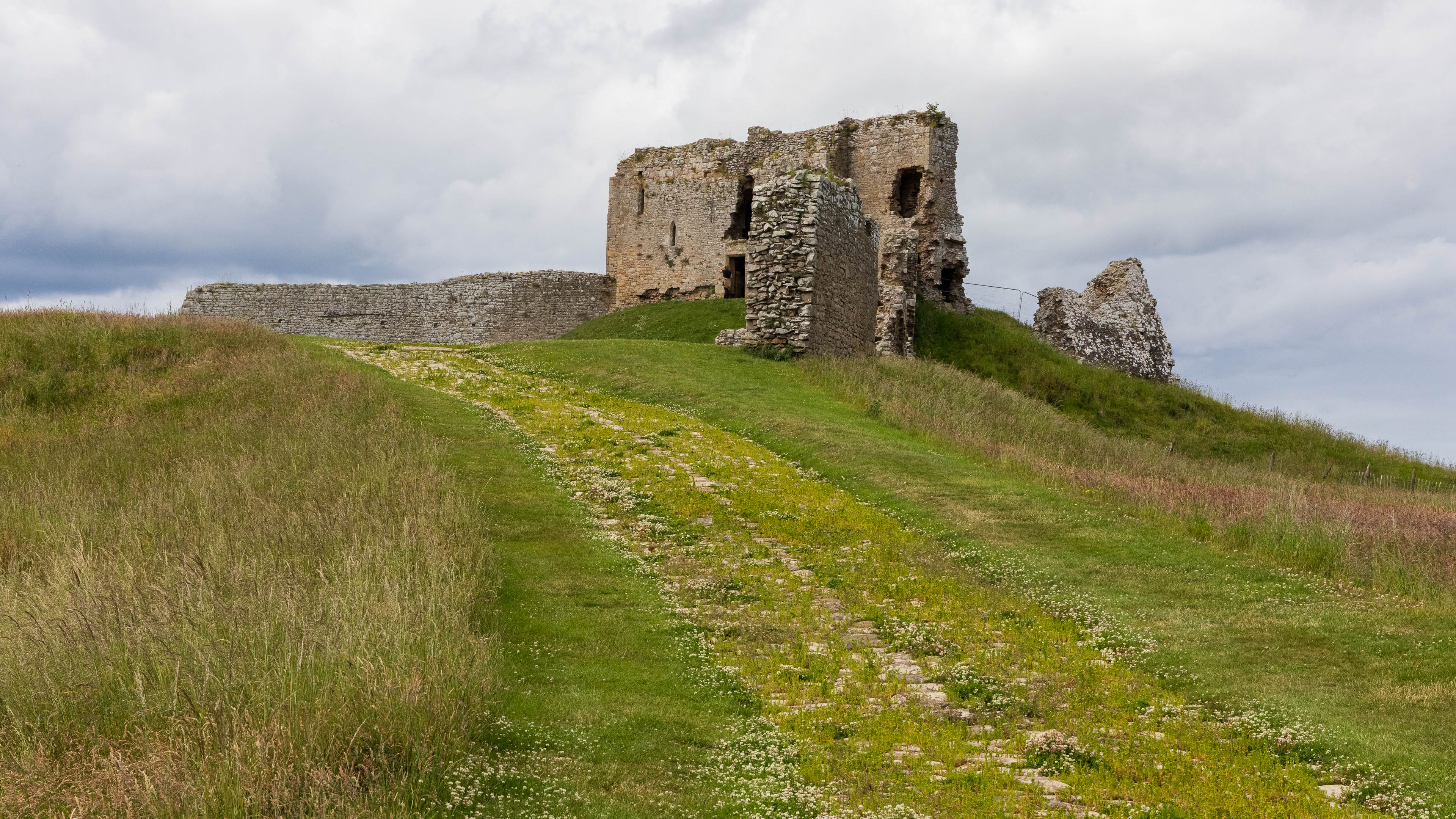
Mottes with outer baileys were built up until around 1250. But this type of fortification has one decisive drawback for us today: it was made of wood. That means it hasn’t survived the ages, and we can no longer see it today.
Still, we do know of one place where a motte once stood: Duffus Castle near Elgin. There you can still at least make out the artificial mound.
A quick stop on our journey through time: we’re already in the High Middle Ages! And we still don’t have anything that really matches our idea of a classic castle.
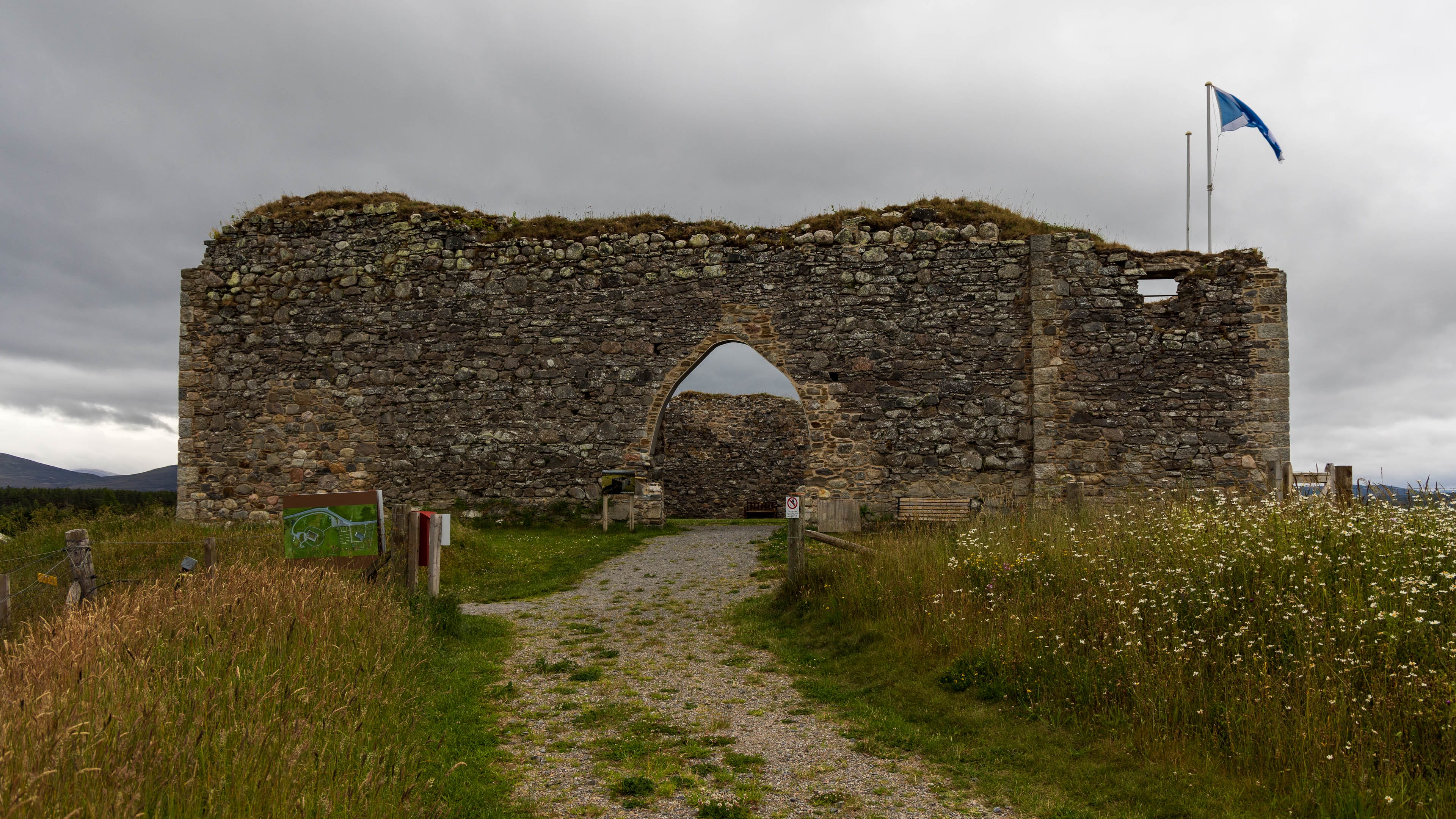
But now they arrive, starting around the 12th century. Because while mottes still existed, hybrid forms emerged that already incorporated stone. And soon the first purely stone castles appear – some built very simply: a wall around a courtyard, perhaps with a tower attached. Inside there were buildings, but these were made of wood and, so to speak, leaned against the stone wall.
One example of such a castle is Castle Roy in Speyside. Dismissed by many as boring, it’s precisely for that reason so valuable – because it was barely altered over the following centuries. Castle Roy is one of the truly original castles. It just happens to look rather simple.
But from the 13th century onward, more complex structures start appearing. Castles increasingly feature a keep, also known as a donjon. This multi-storey building was meant to serve as a residence while also taking on defensive duties in times of war.
They’re surrounded by tall walls, the curtain walls. In German, we’d probably come closest with “Ringmauer”. Dunstaffnage Castle belongs to this type of castle, built from 1220 onward.
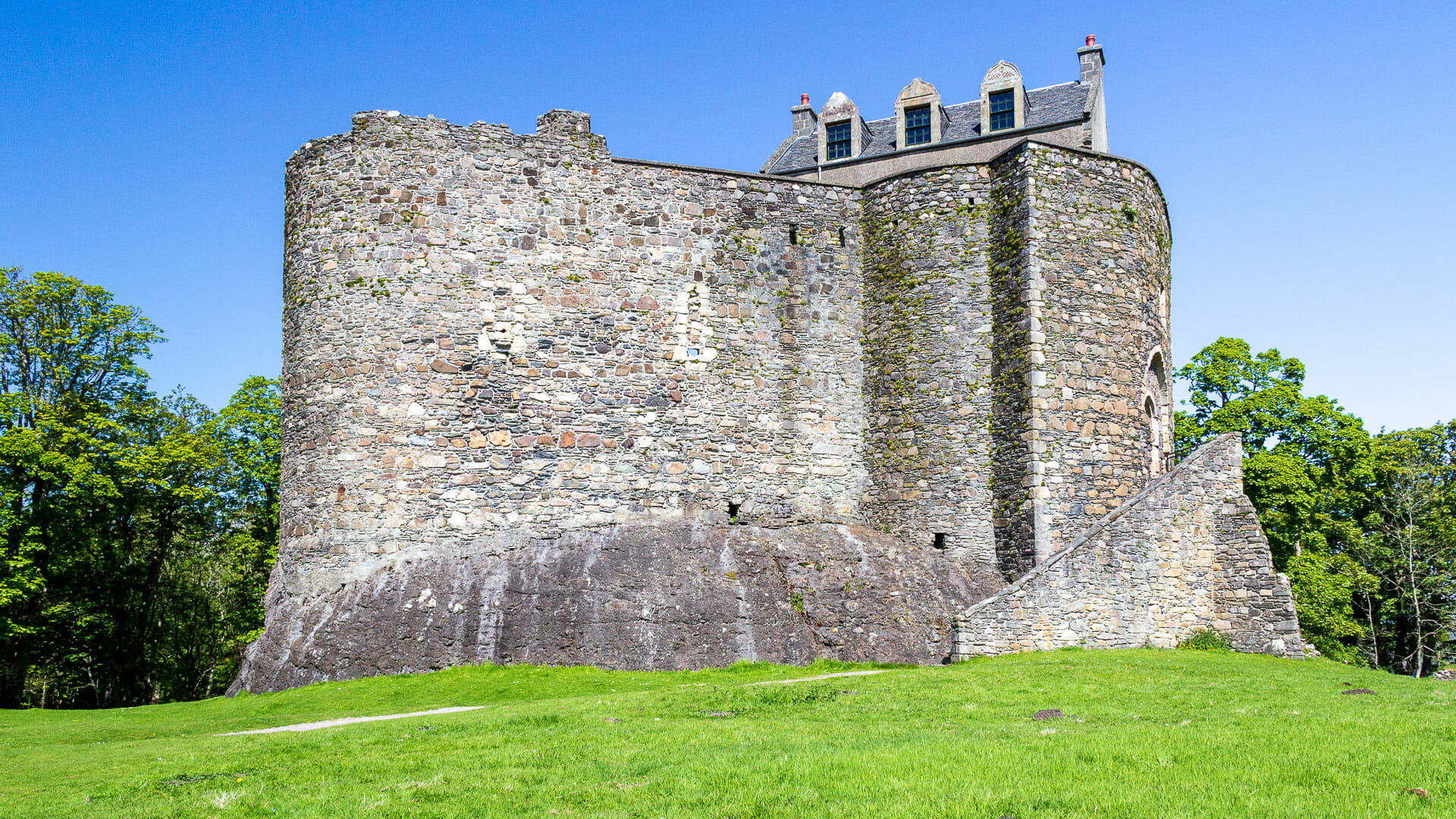
Caerlaverock is another very famous example: while the old castle there was still built rather like Castle Roy, the new version just 50 years later already looks like a typical “curtain wall with keep” castle. And if you’re wondering about the name: the Celtic word “Caer” also means castle. It crops up quite often in Welsh.
I think this is roughly where – around 1300 – the castles we picture as classic really emerge. Almost already by the end of the Middle Ages. Most of them, though, were extended more and more over the centuries that followed.
Castles in the late Middle Ages
Towards the end of the Middle Ages, a new style of building appears once again – one that’s very typical of Scotland and Ireland: the tower house. A very compact castle, essentially a budget version even for lesser nobles.
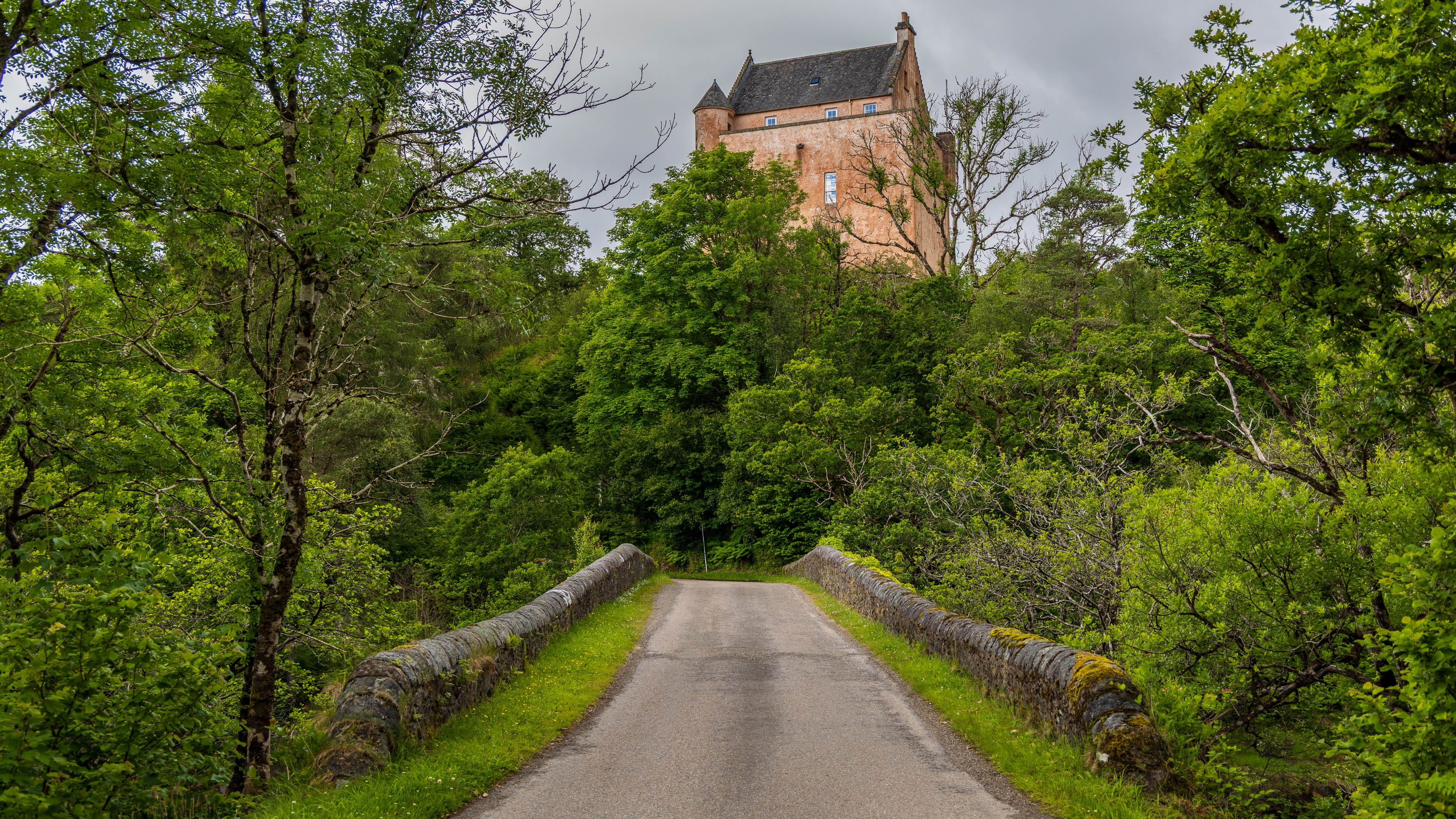
From the outside, these castles look rectangular and simple. Inside, however, they were considerably more complex.
Let’s work our way up through a typical tower house, from bottom to top. On the ground floor there was a storeroom, possibly also a kitchen. To get up, we take the spiral staircase set into the thick masonry, invisible from the outside.
We reach the hall on the upper floor. This is where the big business was done, and where people dined. The room is warm, thanks to the large fireplace. You could retreat into the window bays leading to small windows.
The next storey isn’t enclosed. We find ourselves on a gallery, able to look down onto the hall below. Small private chambers lead off from the gallery.
Finally we reach the attic storey. From here we can step out onto the wall-walk, looking out over the land. If enemies approached, they’d be targeted from here.
Tower houses stay in fashion for quite a while. One scenically beautiful example is Castle Stalker above Oban on the west coast.
By now, though, we’ve reached the end of the Middle Ages, around the year 1500.
Back in Germany at that time, the land is a patchwork of small realms under the rule of an emperor.
The modern era
Let’s briefly recall the definition of a castle: inhabited and defensible.
But in an increasingly strong state, things become safer. Having a defensible house becomes less important. Instead, it becomes more about prestige.
From the Renaissance onward, castles are expanded into palaces – like Stirling Castle, for instance. At the same time, entirely new palaces appear, such as Linlithgow Palace. Or the palace at Falkland. Tower houses continue to be built during this period, but become considerably more elaborate: further wings are added. Towers and battlements often become more of a nod to the past than a functional necessity.
A fine example of this is Crathes Castle in Aberdeenshire.

With the union of the kingdoms in 1707, more forts in the modern sense appear: the Ruthven Barracks, the Bernera Barracks, and later the huge Fort George. The wealthy and the nobility now tend to build mansions or country houses instead – the House of Dun near Montrose, for example, in 1730.
Castles, by this point, had only one real chance: either they were converted into palaces – as happened with Dunrobin Castle – or they fell into ruin. Adapt, or disappear.
Summary
So there’s no single typical or original Scottish castle. And even many castles from the Middle Ages stand on the sites of former Iron Age forts.
One thing is clear: if castles did NOT keep up with the times, their fate was sealed. Seen that way, change is a vital part of the story.