Absolute freedom, and the chance to reach the most remote corners of the country. Touring Scotland by car has definite advantages. Here’s what you should keep in mind.

On this page:
» Your own car or a rental car
» Safety
» Clockwise or counter-clockwise?
» Suggested routes
Unlike a bus tour, where every passenger follows a fixed rhythm, drivers move completely freely. If someone wants to linger somewhere longer, they simply do – the car isn’t going anywhere without you. Spontaneous detours are also possible, for example if the owner of your accommodation gives you a special tip.
In short: in Scotland, your own car or a rental car is the best way to explore the country at your own pace. You can of course just wing it, but most people want to tick off at least a few attractions. And many want to drive right through the country – in other words, do a round trip by car.
Below are some tips on the subject of touring Scotland by car. They’re based on my own experience on my road trips. Other travellers may well have a different opinion – if so, feel free to leave a comment below.
By the way: the article Driving Safely in Scotland has plenty of information on what to watch out for on UK roads, which documents you need to carry, and more.
Road trip: Your own car or a rental car?
Unless you can borrow a car from a friend in Scotland, you really only have two options. Both have pros and cons. Either you make the long journey to Scotland in your own vehicle, or you rent a car from Avis, Sixt, Europcar, Hertz and the like.
The case for a rental car
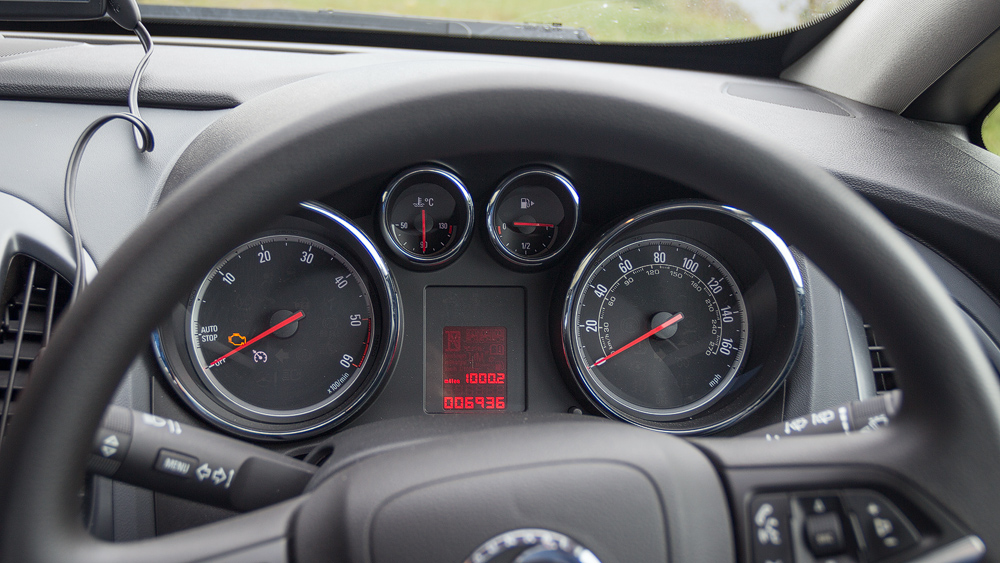
For one thing, the steering wheel is on the “right” side given the traffic layout. That means you get a better view of the traffic from the driver’s seat when overtaking or turning right. For another, with a rental car you can start your road trip from almost any point in Scotland. You can fly into Aberdeen, Edinburgh, Glasgow, or even up to Orkney with a connection, and continue from there by rental car (see flights to Scotland).
Downside: You don’t know the rented car as well, and the dashboard and gearstick are arranged differently in British cars. Booking a rental car also adds a few hundred euros to the cost – for two weeks without an excess and with an automatic gearbox, it can even run to around 2,000 euros. You may also run into frustrating moments with the rental companies’ hotlines, as happened in my case with Europcar.
The case for your own car
First, of course, there’s familiarity: everyone knows their own car well and gets on better with it than with an unfamiliar rental. Your own vehicle is also usually bigger than a rental car, since renting a larger estate or van for two weeks can already cost around 2,000 euros.
And crucially: there’s no weight limit on luggage like on a plane. Everyone can pack their car to the roof. What’s more, the Scots are a bit more forgiving when they spot a foreign number plate – they know the steering wheel is on the “wrong” side and that things might take a little longer.
Downside: If you live in southern Germany, just getting to the ferry can take a long time. And there’s only a single ferry crossing that gets you (almost) all the way to Scotland. It runs overnight from Amsterdam to Newcastle (ferry information). You’ll also have less overview of the traffic. A co-driver you can rely on is worth its weight in gold.
Motorhomes: The king of the road, of course, is whoever tours Scotland in their own motorhome or caravan. However, quite a bit has changed for motorhome drivers since the Covid pandemic. Scottish authorities now look more closely at whether a motorhome is only briefly parked, or whether a public car park is being misused as a campsite.
Spontaneous ferry crossings without a prior booking are no longer possible on certain routes to some islands. On top of that, wild parking is increasingly being penalised – in fact, the Scottish Outdoor Access Code doesn’t cover motorised vehicles at all. More on the rules for motorhomes in Scotland can be found on the page “Is wild camping with a motorhome allowed in Scotland?”
Since a great many motorhomes are on the road especially during high season, it can happen that campsites are fully booked. That’s why booking ahead is often necessary, particularly in touristy hotspots.
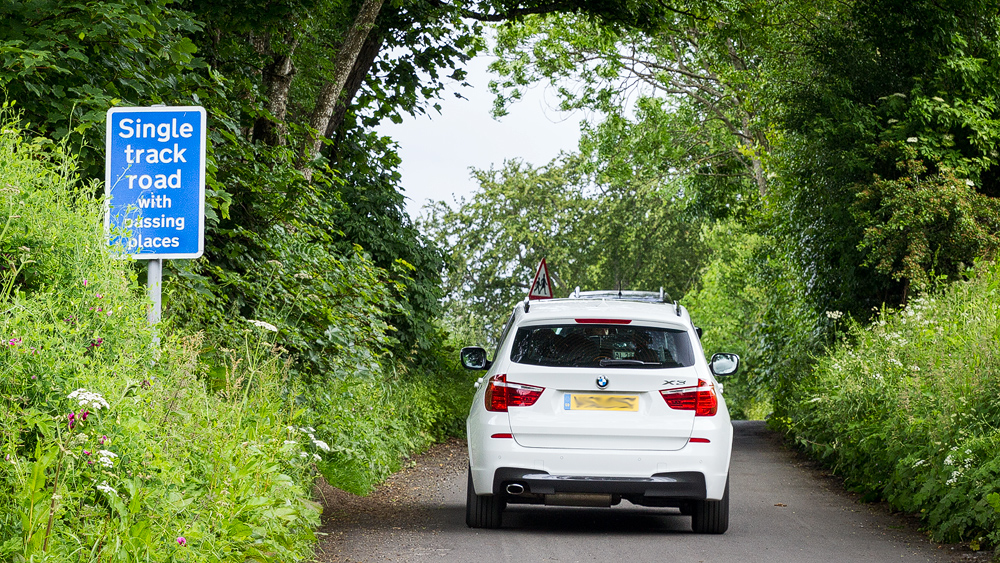
There are also single-track roads, especially in the north and on the islands, which demand a good deal of nerve and driving skill. All of them are passable, though, unless a sign explicitly warns otherwise. One such warning can be found, for example, at the mountain pass Bealach na Bà.
None of this should put you off travelling to Scotland with a motorhome. But I do recommend that camping enthusiasts prepare well.
Important if driving your own car: watch out for LEZs
Across the whole of the UK, many areas are introducing “Low Emission Zones” (LEZs). This means that on the way to, and within, Scotland there are many emission zones where certain cars aren’t allowed to drive unless they meet the relevant emission standards.
Despite Brexit, the United Kingdom still relies on the Euro emission standards. Only vehicles meeting these standards may enter LEZs:
| Vehicle | Emission standard |
|---|---|
| Petrol cars | Euro 4 |
| Diesel cars and small vans | Euro 6 |
| Buses, coaches and lorries | Euro VI |
| Motorcycles | no restrictions |
| Electric cars | Euro 7 |
LEZs are already in place in Scotland in: Aberdeen, Dundee, Edinburgh and Glasgow.
If you’re travelling with your own car, you should also bear in mind the area around London and other major British cities.
Breaking the rules leads to drastic fines.
More information in English on Scotland’s LEZs is available on this official page.
In the shop: Handy helpers for the road
Safety: What you need for a road trip
If you’re touring Scotland by car in your own vehicle, there are a few things you should sort out in advance:
- International insurance card (“Green Card”): It allows your home country’s liability insurance to apply abroad as well. This card is technically no longer required, since a valid number plate is now sufficient proof even within the EU. However, the card does help when it comes to processing a claim. You can request the green card from your insurer.
- Adjust your headlights: On our cars, the headlights are angled more to the right, so the edge of the road and road signs are better lit. In the UK, though, that means oncoming traffic gets dazzled. This needs to be avoided. Sometimes it can be adjusted via the onboard computer in travel mode. It may also be enough to turn both lights down using the dial – you’ll often still see well enough. If none of that works, there are stickers you can put over the headlights. More on covering headlights for the UK.
- D sticker: An EU number plate with the appropriate D marking is sufficient in Scotland. Otherwise you’ll need the good old oval D sticker.
- Thorough check-up: The garage network in the north of Scotland is thin. If your car breaks down somewhere in the northern Highlands on a Sunday, it’s very hard to find help. So it’s worth having your own car checked over beforehand.
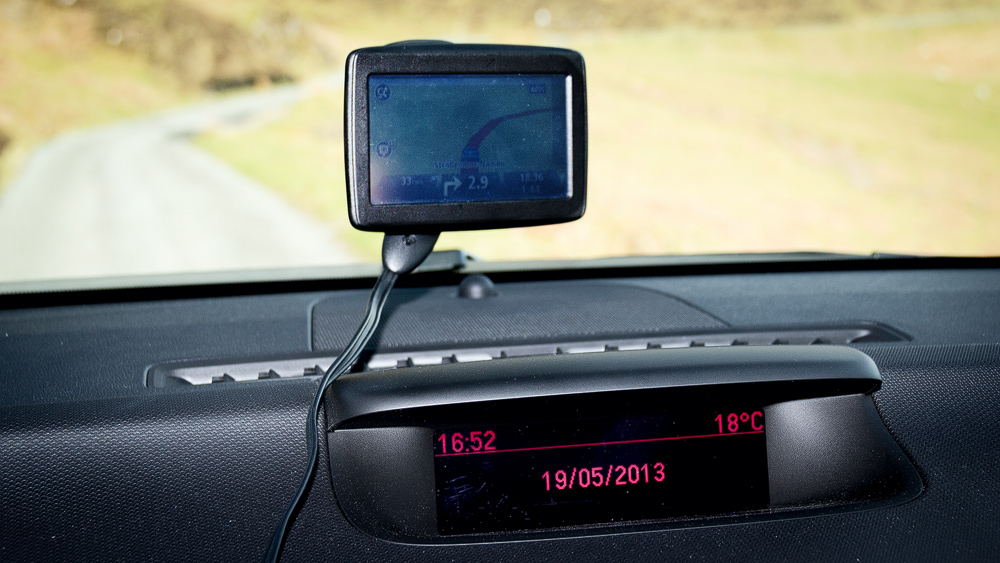
- Sat nav: I never travel without one anymore. It’s so relaxing to just be guided along.
And if you decide on a rental car? Then above all you need a valid driving licence. Remember to also book an additional driver who likewise has their documents with them. Taking turns driving is simply more pleasant on longer stretches.
Listen carefully when insurance is offered at the rental car desk. Above all, find out how much excess remains in the event of a claim.
And here’s another tip: bring your own sat nav from home if you have one. Booking one there gets expensive.
Direction: Clockwise or counter-clockwise?
Most car tours essentially run along the coasts, like the new North Coast 500, for example. And that makes sense, since most settlements and attractions are located there too. The further north you go, the less there is inland. The only question is: which direction do you drive the coast in? Up the west and down the east, i.e. clockwise? Or the other way round?
There are basically two things to consider: first, the Scottish weather. On average it rains about twice as often in the west as in the east of the country. If you’d rather leave Scotland in good weather, doing the round trip clockwise improves your odds. The second factor is the landscape and settlement pattern: the east isn’t as wild scenically as the west, and it’s also somewhat more densely populated.
My recommendation: I like driving up the coast in the east and down in the west. The weather may be a little worse in the second half of the trip, but scenically, driving counter-clockwise builds to an appealing climax, in my view – especially if you work in the Isle of Skye.
Suggested routes: How can I plan the tour?
Finally, you need to keep an eye on your time budget. A ten-day road trip from Edinburgh works fine if you stay on the mainland. But then you’ll miss out on the Highlands’ most captivating landscapes – for example the Isle of Skye, surely one of Scotland’s most beautiful settings. And the Outer Hebrides are well worth experiencing too.
But for a big tour covering Scotland and the islands, you should really allow around three weeks.
I’ve sketched out a few route ideas here. If you have further suggestions, feel free to share them in the comments below.
Suggested route “Highlands Coast”
A beautiful round trip through the heart of the Highlands out to the coasts and back, including the Isle of Skye.
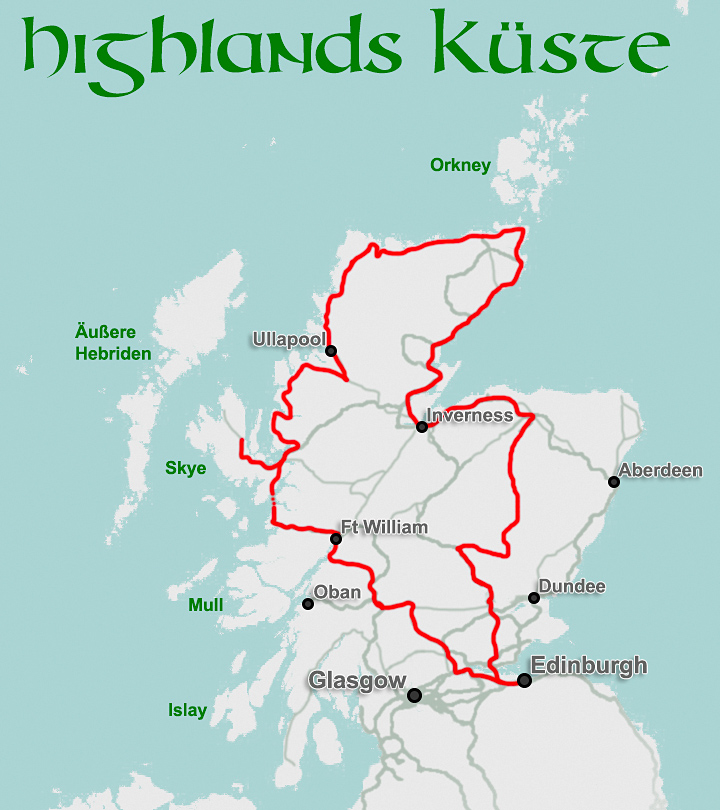
Key sights: From Edinburgh, through the Cairngorms and Speyside, to Elgin, Culloden, Inverness, the east coast with Dunrobin Castle, the north coast with Smoo Cave, the west coast as far as Ullapool and via Applecross to Skye, on to Fort William, through Glen Coe and back to Edinburgh
Areas: Speyside, Inverness-shire, Sutherland, Isle of Skye, Argyll & Bute
Downside: No Loch Ness, no Outer Hebrides, no Islay
Time: 14 days, including arrival and departure days, two days in Edinburgh, three nights on Skye, otherwise day-by-day stages.
Can be extended with three days on Orkney.
Suggested route “Highlands Total”
A car tour taking in all of Scotland’s most interesting stops, with enough time for excursions and hikes.
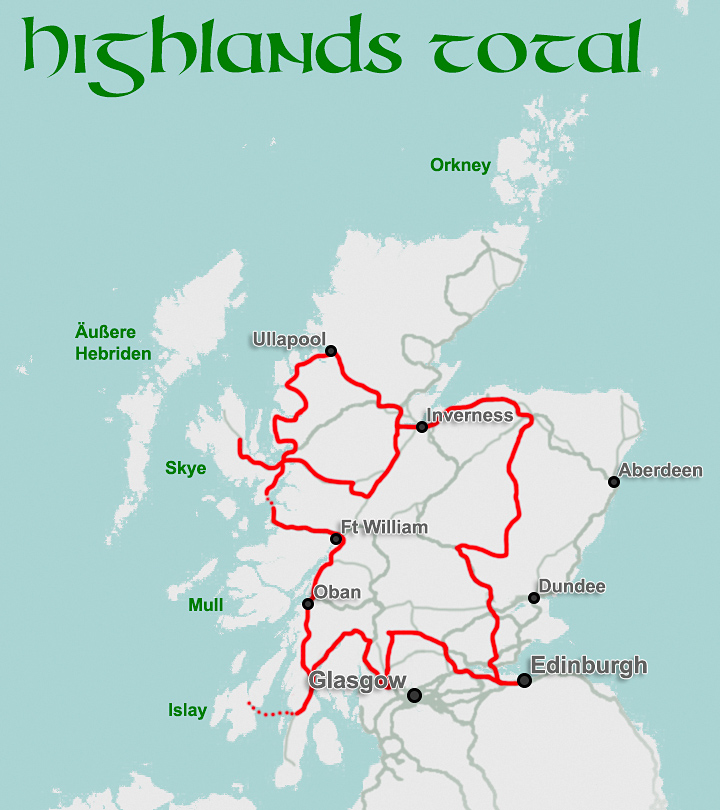
Key sights: Edinburgh, Loch Lomond, Islay, Oban, Isle of Skye, Ullapool, Inverness/Loch Ness, Dufftown, Pitlochry, Edinburgh
Areas: Speyside, Inverness-shire, Isle of Skye, Islay, Argyll & Bute
Downside: No Outer Hebrides, missing the north of the Highlands
Time: 21 days, including arrival and departure days and two days each on Islay, on Skye, in Speyside and in Edinburgh, otherwise day-by-day stages.
More details on this tour, with a detailed description and the option to book it, are available here.
Suggested route “Hebrides Tour”
A car tour through the heart of the Highlands and out to the Outer Hebrides with their Atlantic beaches. Then on to the whisky island of Islay.
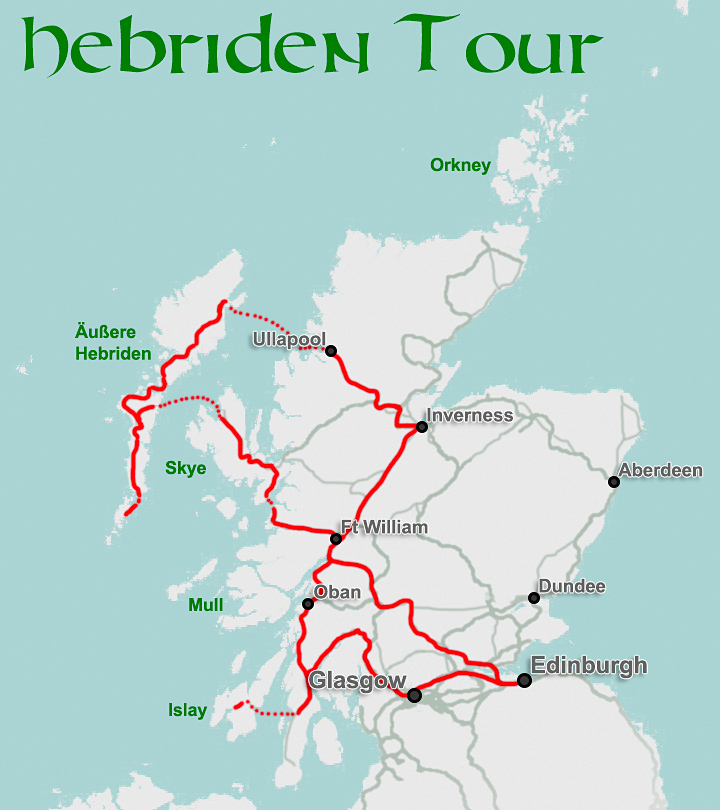
Key sights: Edinburgh, Glen Coe, the Great Glen with Loch Ness, Inverness, Ullapool, the Outer Hebrides, Isle of Skye, the Road to the Isles from Mallaig with Glenfinnan and the “Harry Potter” train, the Jacobite Steam Train, Oban, Islay, the “Rest and be thankful” pass, possibly Glasgow, Edinburgh
Areas: Inverness-shire, Outer Hebrides, Isle of Skye, Argyll & Bute
Time: 21 days minimum, to spend enough time on each of the islands.
Can be extended with the Isle of Mull.
Suggested route “Quick & Dirty”
Some people simply don’t have much time. Eight days in Scotland is very little, but even then you can still do an interesting loop.
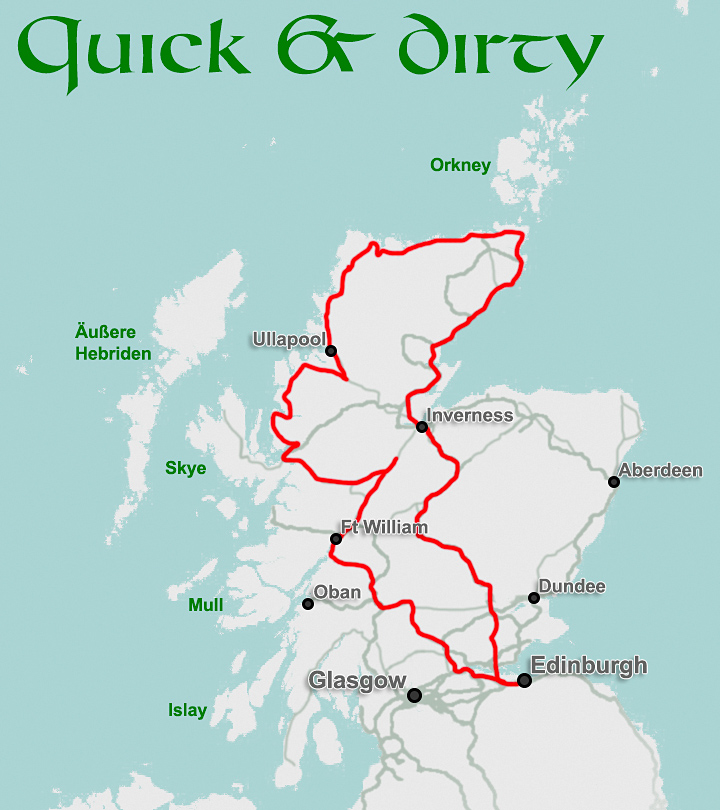
Key sights: Edinburgh, Inverness, the east coast with Dunrobin Castle, the north coast with John o’Groats, Smoo Cave, the west coast as far as Ullapool and via Applecross, past Loch Ness to Fort William, through Glen Coe and back to Edinburgh
Areas: Inverness-shire, Sutherland, Argyll & Bute
Time: Eight days, with one day in Edinburgh, the rest are day-by-day stages as you like.
Can be extended with Orkney or the Isle of Skye.
You’ll find more inspiration in our “Book a Trip” section, where we also showcase various tours available to book.
Next article: Driving Safely in Scotland